
Lagoon builds for volume and social living. Fountaine Pajot builds for sailing feel and a more finished interior. If you are chartering in the Caribbean with family or friends, either brand will serve you well, and the right pick comes down to how much living space you want against how much you care about performance and finish. This guide compares the two on the points that matter on a week-long trip, then looks at the power catamarans each builder makes, which is where most BVI charter guests end up.
TL;DR
- Lagoon leans toward interior volume, big flybridges and residential layouts, which is why it is so common in charter fleets.
- Fountaine Pajot leans toward sailing performance, efficiency and a more refined interior finish.
- For a BVI week where you will mostly motor between close anchorages, the layout and deck space matter more than upwind angle.
- Power catamarans from both builders, such as the Fountaine Pajot MY6, suit guests who want speed, stability and short passage times.
- We can match a boat to your group size and itinerary. Start with our bareboat pricing or crewed charter pricing.
Table of Contents
- The core difference: volume versus balance
- Fountaine Pajot vs Lagoon at a glance
- Space and layout: where Lagoon usually wins
- Sailing feel and finish: where Fountaine Pajot earns its following
- Does the difference matter in the BVI?
- Power catamarans: Fountaine Pajot MY6 and Lagoon Seventy 8
- Power or sail for a week in the BVI?
- What a BVI charter costs with us
- Perspective
- Find your boat with Virgin Charter Yachts
- How to choose: a short checklist
- FAQ
- Sources
The core difference: volume versus balance
One comparison of the two brands puts it this way: Lagoon maximizes volume, comfort and flybridge living, which makes it a natural fit for charter fleets and social cruising. Fountaine Pajot emphasizes sailing performance and efficiency, and appeals to owners who want a more responsive, traditional sailing feel.
That matches what the sailors on owner forums and review sites keep saying. Lagoon tends to give you more accommodation per foot. Fountaine Pajot gives up a little of that volume for a boat that moves better.
Neither is better in the abstract. The useful question is what a week on board looks like for you.
Fountaine Pajot vs Lagoon at a glance
| Criteria | Lagoon | Fountaine Pajot |
|---|---|---|
| Design priority | Interior volume, comfort, flybridge living | Sailing performance, efficiency, refinement |
| Interior feel | Residential, roomy, production-grade finish | Frequently described as higher-grade finish and lighting |
| Upwind and light air | Solid cruiser | Often points higher and does better in light air |
| Typical use | Charter fleets, family and social cruising | Owners who value sailing feel |
| Parts and service | Very large dealer network, strong in Caribbean charter hubs | Smaller footprint, strong sailing following |
| Yearly ownership cost | Roughly 6 to 9% of value | Roughly 6 to 9%, often cited at the lower end |
The finish and upwind claims come from a 2026 brand comparison, which says Fountaine Pajot boats often point 3 to 5 degrees higher than comparable Lagoons. The ownership-cost range and the point about Lagoon’s dealer network come from another brand breakdown. Treat these as general tendencies, not guarantees for any single boat.
Space and layout: where Lagoon usually wins
If your priority is a big social cockpit, a flybridge you can actually live on and cabins that do not feel tight, Lagoon is hard to beat. The builder’s own numbers show the scale. The Lagoon 46 is 14.5 meters (47’7") long, carries 127 m² (1,367 sq ft) of upwind sail area, and offers berths for 6 to 12 people in 4 to 6 cabins. The Lagoon 51 stretches to 15.6 meters (51’2"), with 149 m² (1,603 sq ft) upwind and berths for 8 to 14.
For a family of six or a group of friends who want separate cabins and plenty of room to spread out, that volume is the point. Independent charter commentary on the Caribbean says to prioritize usable space, stability and shallow draft. Multiple cabins help families and groups, level indoor-outdoor living reduces fatigue, and shallow draft opens up more beaches and anchorages than a deeper monohull.
Sailing feel and finish: where Fountaine Pajot earns its following
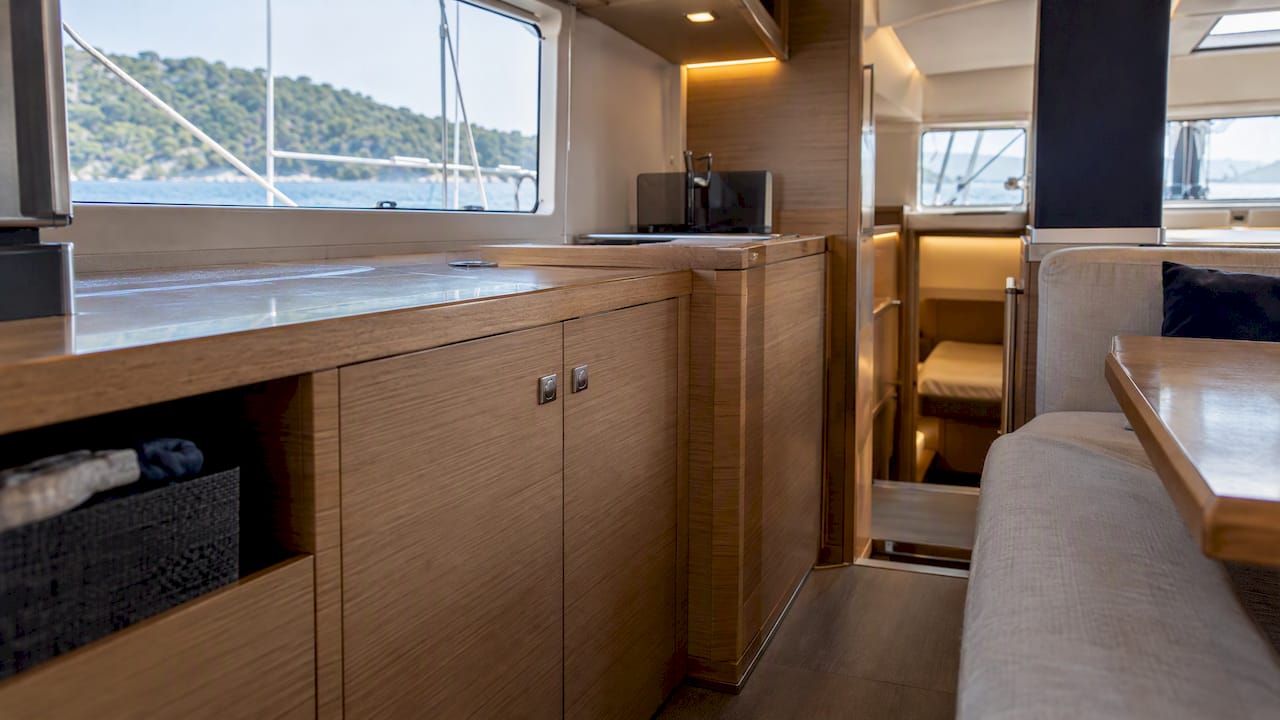
Fountaine Pajot owners talk about how the boats feel under way and about the interior. Cabin lighting, matched wood veneer and joinery are the usual points of praise. If you are a keen sailor, or you plan to buy and want a boat that rewards good trim, that matters.
The builder is also pushing hard on electric propulsion. Fountaine Pajot says the Aura 51, Elba 45 and Astréa 42 carry Smart Electric technology, with other models to follow. In a head-to-head review of the Lagoon 51 and Aura 51, the Lagoon stood out for its large flybridge and voluminous living space, while the Aura offered the Smart Electric option and solar panels.
One caution on the head-to-head: a Fountaine Pajot and a Lagoon of the same length are not the same size inside. Compare cabin count, berths and deck space for the actual boats you are considering, not just the overall length.
Does the difference matter in the BVI?
Less than the forums suggest. The British Virgin Islands are a short-hop cruising ground: most anchorages are a few miles apart, trade winds are steady, and many guests spend more time at anchor or on a mooring ball than under sail. Cruising World’s advice is to match the boat to your cruising ground, budget and the kind of sailor you want to be. In the BVI that usually means weighing deck space and cabin privacy above upwind angle.
So a simple rule of thumb:
- Large group or multi-family trip: favor the roomier layout, which is usually a Lagoon.
- Couple or small family who like sailing: a Fountaine Pajot’s balance and finish is worth a look.
- Short island hops on a tight schedule: consider a power catamaran, covered below.
Power catamarans: Fountaine Pajot MY6 and Lagoon Seventy 8
Both builders also make motor catamarans, and this is where the brand comparison becomes very practical for a charter guest.
Fountaine Pajot MY6 and Power 67
The MY6 has a full-length owner’s cabin, two cabins in the starboard hull and a social flybridge. In the builder’s own account of a test it climbed easily to 25 knots and was described as stable and manoeuvrable. An Asia Pacific Boating review calls it spacious and stable, with generous deck space, separated hull accommodations and easy joystick maneuvering.
For a fair picture, YachtBrokerReviews notes that there is no main-deck dining table, so the flybridge and saloon become the main gathering areas, and that the owner’s stateroom is limited by hull width. It also lists ownership points to inspect, such as yellowing synthetic-teak decking on the flybridge and an integrated control system that can be tricky. These are things an owner checks on a purchase. As a charter guest you simply choose a boat that is professionally maintained, which is what we focus on. You can read more about the boat on our MY6 charter page or see the 2024 Fountaine Pajot MY 6 and 2024 Fountaine Pajot Power 67 listings.
Lagoon Seventy 8 versus Fountaine Pajot Power 80
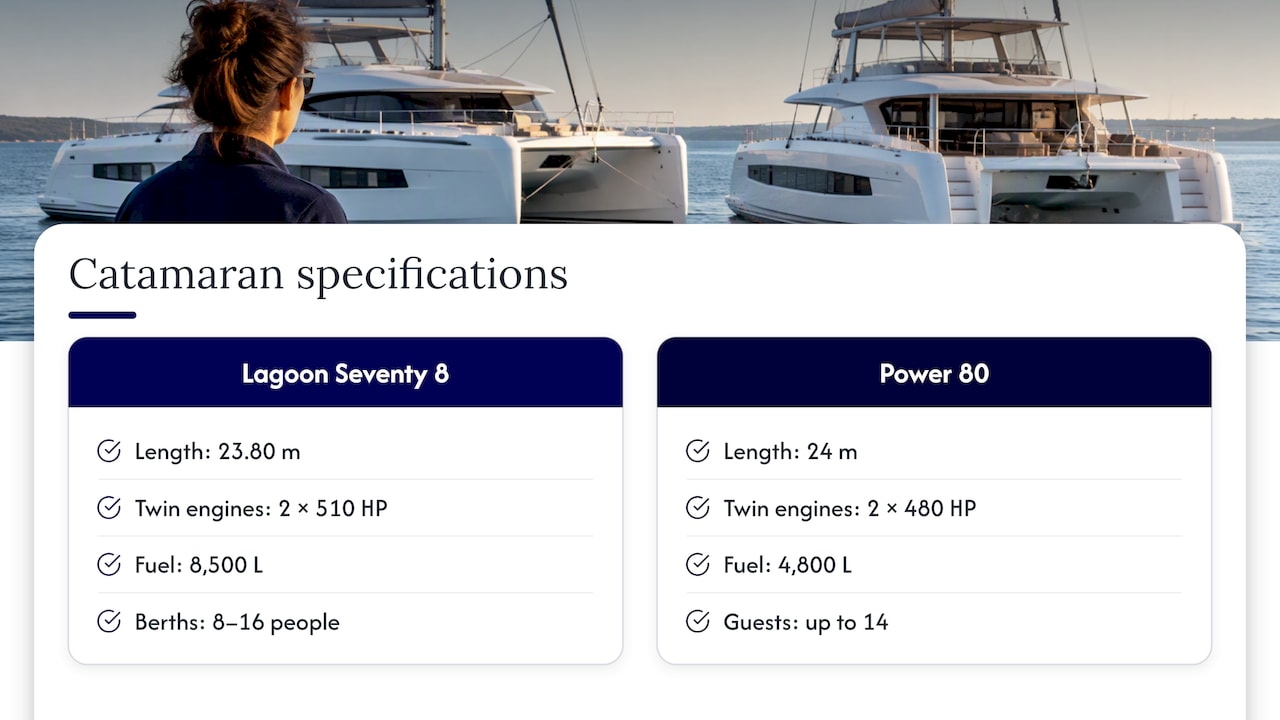
At the top end, the Lagoon Seventy 8 is 23.80 meters (78’1") with 2 x 510 HP, 8,500 liters (2,246 US gal) of fuel and berths for 8 to 16 people. The Fountaine Pajot Power 80 is a 24-meter motor yacht with an 11.09-meter beam, 2 x 480 HP, 4,800 liters (1,268 US gal) of fuel and room for up to 14 guests. These are large crewed-charter boats, so for most guests the comparison is about layout and crew service more than specification.
Power or sail for a week in the BVI?
If the brand debate leaves you stuck, step back and decide between power and sail first. Power catamarans give you speed, a steady platform and air conditioning and generator comfort on many boats. Sailing catamarans give you the quiet and the sailing. We lay out the trade-offs in our guide to power versus sailing catamarans for a BVI charter.
It also helps to know how charter costs are built. For a look at how another market structures its charter pricing, see this yacht charter price guide. In the BVI, the main variables are boat size, season, whether you hire a captain or crew, and extras such as water toys.
What a BVI charter costs with us
These are the prices published on our site, so check the linked pages for the current rates and seasons.
| Charter type | Published weekly price |
|---|---|
| 3-cabin power catamaran, bareboat | £6,000 to £10,000 |
| 4-cabin power catamaran, bareboat | £8,000 to £14,000 |
| 5+ cabin luxury power catamaran, bareboat | £12,000 to £20,000 |
| Premium catamaran, crewed (4 to 6 guests) | $25,000 to $35,000 |
| Luxury catamaran, crewed (6 to 10 guests) | $35,000 to $70,000 |
| High-end luxury catamaran or motor yacht, crewed | $70,000 to $120,000 |
If you want a captain on a bareboat, a standard captain is $250 per day and a training captain is $300 per day, as listed on our charter costs page. Wi-Fi is a one-off $250 per charter, per our what’s included page. If you are unsure whether you need a captain, read our guide to bareboat charter with a skipper.
Perspective
Brand loyalty is strong among catamaran owners, but a charter week is a different job from owning a boat. Our family has run charters out of Tortola for 30 years, and the thing guests remember is rarely the upwind angle. It is the sunset on the flybridge, the kids jumping off the back step, and whether the boat was spotless and working when they stepped aboard.
That is why we curate our fleet around maintenance and luxury, with modern catamarans from Fountaine Pajot, Leopard, Aquila, Aventura, Lagoon, Horizon and Two Oceans. We would rather talk to you about your group, your dates and how you like to spend a day than push one brand. Tell us how many of you are coming and what a perfect day looks like, and we will tell you which boat fits.
For most BVI itineraries, we think a power catamaran is the easiest way to see more islands in comfort: stable at anchor, quick between stops and generous with deck space.
alexia
Find your boat with Virgin Charter Yachts
We are a family-owned charter company based on Tortola, offering bareboat and crewed catamarans and motor yachts in the British Virgin Islands and the Caribbean since 1996. Tell us your group size, dates and the kind of week you want, and we will shortlist boats with you.

Browse luxury crewed charters, look at motor yacht charters in the BVI, or request our e-brochure.
How to choose: a short checklist
- Count your cabins honestly. Couples sharing a double is easy. Two couples and kids need separate cabins and heads.
- Decide on a crew or not. A crewed charter handles navigation, cooking and docking. Bareboat gives you the helm. Our crewed charter guide and bareboat guide explain both.
- Ask about the equipment. Generator and water maker make a real difference to comfort. See our bareboats with a water maker and bareboats with a generator.
- Match the boat to the water. Shallow draft and stable platforms open up anchorages in the islands.
- Think about ownership last. If you are considering buying, a charter week on each brand tells you more than any review.
FAQ
Is Lagoon or Fountaine Pajot better for charter?
Neither wins outright. Lagoon is very common in charter fleets because of its volume and flybridge living space. Fountaine Pajot appeals to guests who like a more refined interior and a livelier boat under sail. Choose by group size and how you plan to spend your days.
Does Fountaine Pajot sail better than Lagoon?
Generally, yes. One 2026 comparison says Fountaine Pajot boats often point 3 to 5 degrees higher and do better in light air. On a BVI trip, with short hops and steady trade winds, most guests will not feel that gap as much as the difference in living space.
What is the Fountaine Pajot MY6 like?
It is a power catamaran with a full-length owner’s cabin, two cabins in the starboard hull and a social flybridge. It reached 25 knots in a builder test, and reviewers describe it as stable with easy joystick handling. One independent review notes there is no main-deck dining table, so guests gather on the flybridge and in the saloon.
Which brand is cheaper to own?
Ownership costs for both are estimated at roughly 6 to 9% of the boat’s value per year, with Fountaine Pajot often cited at the lower end. Lagoon’s large dealer network can make parts and service easier to find in Caribbean charter hubs.
Sources
- Lagoon vs Fountaine Pajot: Build, Performance, Resale
- Lagoon vs Fountaine Pajot 2026: The Honest Comparison
- Lagoon 46 | Lagoon
- Lagoon 51 | Lagoon
- SEVENTY 8 | Lagoon
- FPY 80 | Fountaine Pajot
- Fountaine Pajot decarbonization plan
- Fountaine Pajot MY6 at the Palma Boat Show
- Fountaine Pajot MY6 Specifications, YachtBrokerReviews
- Spotlight: Fountaine Pajot MY6, Asia Pacific Boating
- Caribbean Chartering: Why Catamarans Are So Popular
- The Best Entry-Level Cruising Cats to Buy in 2026, Cruising World
- Yacht charter price guide
Recommended
- Fountaine Pajot MY6 vs Leopard 53 | BVI Charter
- Monohull vs Catamaran: Which Should You Choose?
- Power Catamaran Layouts: Choosing the Best BVI Charter Yacht
Did You Know?
The BVI are only accessible by boat. Check out our charter yachts that can get you there. View Our Fleet