
Good yacht charter etiquette comes down to a few habits. Take your shoes off, treat the crew as professionals, tell them what you want instead of expecting them to guess, keep out of crew-only spaces, and tip at the end of a crewed charter. Pack soft bags and smart-casual clothes. Follow the captain on safety and weather. Do those things and you will fit in on any yacht, from a bareboat catamaran in the British Virgin Islands to a fully crewed motor yacht.
This guide covers the rules guests actually need, what to wear, how crew and guests share the space, and how to work out a gratuity. It draws on published guidance from yachting media and on what we see on Tortola every week.
TL;DR
- Remove street shoes before you step aboard. Go barefoot or wear clean, light-soled boat shoes that have not been worn ashore.
- Dress smart-casual and pack light in soft luggage. Swimwear, a hat, sunscreen and a few relaxed evening outfits cover most of a week.
- Stay out of crew areas and the galley unless invited. Ask the cook before taking food, and tell the crew your preferences early.
- Tipping is discretionary. The MYBA guideline is 5% to 15% of the base charter fee, and 20% is not unusual for American guests.
- Hand the tip to the captain privately on the last morning, for sharing among the whole crew.
Table of Contents
- The shoe rule and what to wear
- Respect the captain and crew
- Shared spaces and crew areas
- Safety, water and noise
- How much to tip yacht crew
- Our perspective
- Planning a crewed or bareboat charter with us
- FAQ
- Sources
The shoe rule and what to wear
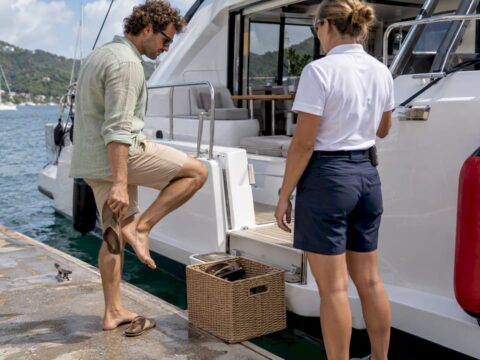
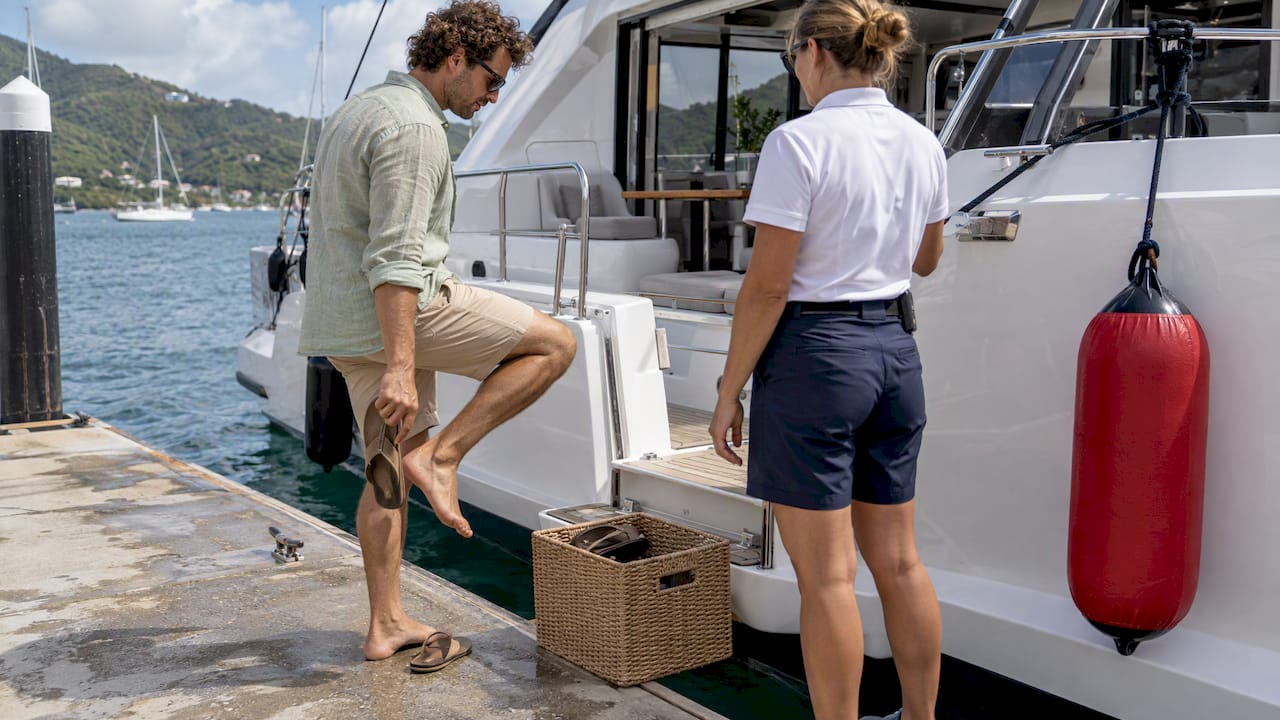
The first thing every charter guest learns is the shoe rule. BOAT International’s first-timer guide boils basic etiquette down to removing your shoes, respecting the crew and enjoying the trip the way you would a luxury hotel. Cruising World adds the detail that matters: take off street shoes when boarding, then go barefoot or wear clean, light-soled boat shoes that have not been worn ashore.
The reason is practical. Decks, teak and white cushions mark easily, and a dock carries grit, oil and dirt. Carry a pair of sandals for shore stops and leave them in a basket by the stern or the gangway, not in the saloon. Never wear heels on board.
Dress code for daytime and evenings
There is no black tie on a Caribbean charter. BOAT International’s etiquette guide recommends smart-casual dress: linen, linen-jersey or silk-cotton by day, and lightweight knitwear with linen trousers on cooler evenings. It also suggests thinking about the activities you have planned and any themed evenings, so ask your crew or charter specialist in advance whether anything is planned.
A realistic packing list for a week:
| Item | How much | Why |
|---|---|---|
| Swimwear | 3 to 4 sets | Things rarely dry fully overnight |
| Cover-ups and light shirts | 4 to 5 | Sun protection at lunch and on deck |
| Hat and sunglasses | 1 each | Strong sun on open water |
| Evening outfits | 3 to 4 relaxed pieces | Dinner ashore or on the aft deck |
| Light layer | 1 | Evenings under way can feel cool |
| Boat shoes or sandals | 1 pair each | Clean and light-soled for the yacht |
Pack in a soft duffel, not a hard suitcase. Soft bags fold away into cabin lockers, and hard cases are awkward to store. This matters even more on a catamaran, where cabin storage is tidy but not unlimited.
Respect the captain and crew
On a crewed charter, the captain is responsible for the vessel and everyone on it. The practical rule is simple: follow the captain’s word on safety and weather. If the captain suggests moving anchorages, skipping a sail, or changing the plan because of conditions, that is not negotiable, and a good captain will explain the reasons.
Crew are hospitality professionals, so treat them as you would the staff of a very good hotel. Learn names on the first day. Say thank you. Raise any dissatisfaction early and calmly, because a problem mentioned on day one can usually be fixed, while one mentioned at the end cannot.
Tell them what you want
BOAT International says guests should disclose their preferences clearly, including how fast they like meals to run and whether an activity should go ahead, instead of expecting crew to guess. The same guide recommends declaring dietary requirements well before boarding. Allergies, vegetarian or kosher needs, and strong dislikes belong on the preference sheet, not in a conversation at dinner.
Crew are not babysitters
If you are chartering with children, Cruising World notes that professional crew are not babysitters and parents should not expect full-time childcare. Crew will happily help with a snorkel session, a paddleboard or a kid-friendly menu. Supervision stays with you. Our family guide to chartering with kids covers safety and planning in more depth.
Shared spaces and crew areas
The yacht is your home for the week, but it is also the crew’s workplace and living space. A few boundaries keep everyone comfortable.
- Crew areas. Stay out of crew-only spaces unless you are invited. The galley is typically the chef’s territory.
- Food. Do not help yourself from the chef’s pantry. Cruising World advises asking the cook before taking anything from the main galley refrigerator or lockers. If you want a midnight snack, ask at dinner and it will be waiting.
- Cleaning. When crew need to clean a cabin or saloon, vacate the space for a short while.
- Tidiness. Keep shared areas tidy, and rinse sand and salt off before heading inside.
- Guest numbers. Do not bring extra people or pets without approval. BOAT International points out that yachts have legal maximum capacities and the captain is responsible for observing them. If your group is large, check the limits first: see our note on whether 12 people can bareboat a catamaran in the BVI.
Safety, water and noise
Listen to the safety briefing, even if you have chartered before. Cruising World says guests should follow the instructions for heads, water, lights and electrical outlets, and conserve fresh water. A boat makes its own water and holds a limited supply, so short showers matter.
Some specifics from BOAT International’s guide:
- Report any toilet problem immediately. Marine toilets block easily, and a small issue ignored becomes a big one.
- Shower after swimming in salt water.
- Avoid coloured tanning oils, which can stain upholstery and decks.
- Smoke only where permitted, and with consideration for others.
Sound carries over water at anchor. Cruising World recommends keeping noise low in harbors before 8 a.m. and after 11 p.m. A speaker on the flybridge at midnight in a crowded bay will not make you popular with the neighboring boats.
One more modern habit: connectivity. If you need to stay online, ask in advance. On our charters, Wi-Fi is an optional $250 one-off fee per charter, listed on our what’s included page. Agreeing screen time with your group early means conversation at dinner is not competing with phones.
How much to tip yacht crew
Tipping is the part of yacht charter etiquette that confuses American guests most, because the quoted figures vary widely. Here is what the published guidance says.
- The MYBA guideline is 5% to 15% of the charter fee, with more than 15% possible for exceptional service. Gratuity is discretionary, not mandatory.
- BOAT International says the tip should not be related to the APA (the advance provisioning allowance) and notes that 20% is not unusual for Americans.
- The tip is calculated from the advertised weekly base rate, not the total including provisions, taxes or other fees, according to Yachting.
Some tip pages online quote 15% to 20%. Treat those as the high end of what Americans commonly give, not as a rule. Your own budget and the level of service decide.
A worked example
Our crewed Luxury Catamaran category (6 to 10 guests) is priced at $35,000 to $70,000 per week. Take a base rate of $35,000 for illustration:
| Tip level | Amount on a $35,000 base rate |
|---|---|
| 5% | $1,750 |
| 10% | $3,500 |
| 15% | $5,250 |
| 20% | $7,000 |
The figures are simple arithmetic on the base fee only, not an estimate of what you should pay. For a Caribbean-specific budgeting view, see our guide to tipping yacht crew in the Caribbean. If you want to compare gratuity norms on other types of trips, this budget guide to why gratuities vary shows how tipping customs shift by travel style.
When and how to hand it over
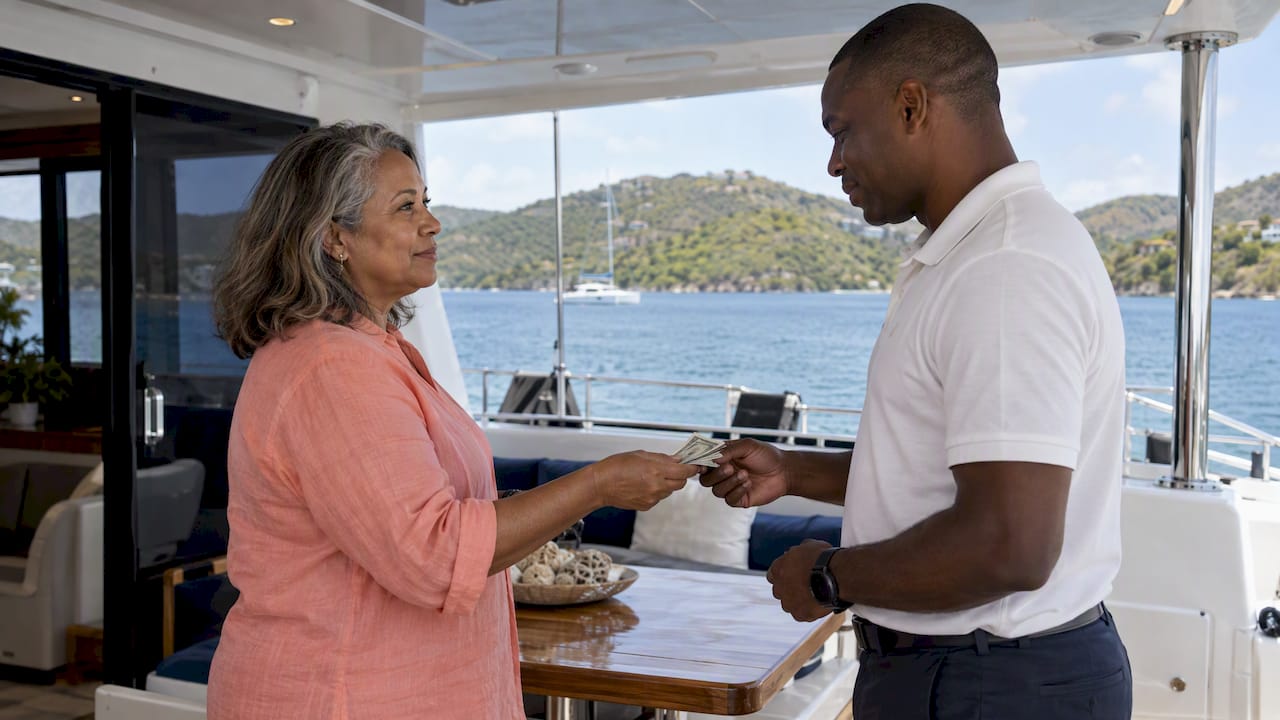
BOAT International recommends that the principal guest discuss the amount privately with the captain on the final morning, and that the captain then distributes it among the whole crew. Cash is the usual form. Bring it with you, because there is no ATM at anchor. If service fell short, speak up during the trip, not with a smaller tip as the first signal.
What about a bareboat charter?
On a bareboat charter you sail the boat yourselves, so there is no standing crew to tip. If you hire a skipper, the standard captain is $250 per day and a training captain is $300 per day, as set out on our charter costs page. Whether to add a thank-you is your choice.
Our perspective
We have run charters from Tortola since 1996 as a family-owned business, and one pattern is clear: the best trips are the ones where guests and crew understand each other from the first hour. Etiquette is mostly communication. Tell us who is coming, what everyone eats, how active or lazy you want the days to be, and we can match the yacht and the plan to you.
Some of our advice is simple. Choose the right boat for the group, because a crowded yacht makes good manners harder. Brief everyone, children included, on the shoe rule and the water rule before you land. Treat the captain’s weather call as final. And treat tipping as thanks for a week of service, not a transaction.
Our team plans every itinerary personally and is reachable before and during the trip, so questions like “what should we wear for dinner?” or “how do we handle the tip?” are never awkward. We would rather you ask than worry.
— alexia
Planning a crewed or bareboat charter with us
If you are ready to turn etiquette into an actual trip, we offer bareboat catamarans and fully crewed yachts in the British Virgin Islands and the Caribbean. Bareboat power catamarans run from £6,000 to £10,000 per week for a 3-cabin, £8,000 to £14,000 for a 4-cabin, and £12,000 to £20,000 for a 5+ cabin luxury model. See the bareboat pricing page for details.

Crewed charters run from $25,000 to $35,000 per week for a Premium Catamaran (4 to 6 guests), $35,000 to $70,000 for a Luxury Catamaran (6 to 10 guests), and $70,000 to $120,000 for a High-End Luxury Catamaran or Motor Yacht. Our luxury crewed charter pricing lays it out, and our crewed charter guide explains how a week works. You can also read what is included in a crewed charter.
FAQ
Is there a dress code on a yacht charter?
There is no formal dress code. Smart-casual works: linen or light cotton by day, and lightweight knitwear with linen trousers on cooler evenings. Check ahead if a themed evening is planned. Shoes come off when you board.
Can I wear shoes on a yacht?
Not street shoes. Go barefoot or wear clean, light-soled boat shoes that have not been worn ashore. Keep a separate pair of sandals for going ashore and leave them at the gangway.
How much should I tip the crew?
The MYBA guideline is 5% to 15% of the base charter fee, and 20% is not unusual for Americans. Tipping is discretionary. Calculate it from the advertised weekly base rate, not provisions or taxes.
Who do I give the tip to?
Discuss it privately with the captain on the last morning. The captain shares it among the whole crew, so you do not need to hand out separate envelopes unless the captain suggests it.
Can I go into the galley or help myself to food?
Not without asking. The galley and the chef’s pantry are crew territory. Ask the cook before taking food from the main refrigerator or lockers, and share snack requests at mealtimes so they can be planned.
Sources
- Charter yacht etiquette: 24 tips every luxury guest should know, BOAT International
- Superyacht charter tips: a first timer’s guide, BOAT International
- Etiquette Tips For Crewed Charters, Cruising World
- How Much to Tip on a Yacht Charter, Yachting
Recommended
- Tipping Yacht Crew in the Caribbean: What to Budget
- BVI Packing List for Yacht Charters: What to Bring
- A Definitive Guide to Luxury Crewed Yacht Charters
- What’s Included in a Crewed Charter
Did You Know?
The BVI are only accessible by boat. Check out our charter yachts that can get you there. View Our Fleet