
A cruising power catamaran typically burns somewhere between 9 and 25 US gallons per hour, depending on its size, engines and above all your speed. Published tests put a 40-foot class boat at roughly 24 gallons an hour at 18 knots, and a lighter, slower-cruising design at under 9. This guide gives you tested numbers, a formula you can run yourself, and a worked cost example using diesel prices posted in the British Virgin Islands.
TL;DR
- Fuel burn is driven mostly by speed. Slowing down by a few knots can cut gallons per hour dramatically, and the cost per nautical mile falls with it.
- Tested cruising figures range from 8.5 gph (a light 42-foot cat at 15 knots) to about 24 gph (a Leopard 40 PC and a 47-foot Archipelago at 18 knots).
- Trip fuel equals running hours times gallons per hour, plus maneuvering time and a reserve.
- Scrub Island Marina lists diesel at $8.50 a gallon for 2026, far above the US retail average, so BVI fuel budgets need their own math.
- On a charter, ask exactly how fuel is handled before you book, then plan your days around a realistic cruising speed.
Table of Contents
- What the tested numbers say
- Why your burn will differ from the brochure
- The speed trade-off in numbers
- How to estimate fuel for your trip
- What power catamaran fuel costs
- How fuel is handled on a BVI charter
- Budgeting the whole week
- Ways to keep fuel cost down
- Our perspective on power cat fuel
- Plan a power catamaran charter in the BVI
- FAQ
- Sources
What the tested numbers say
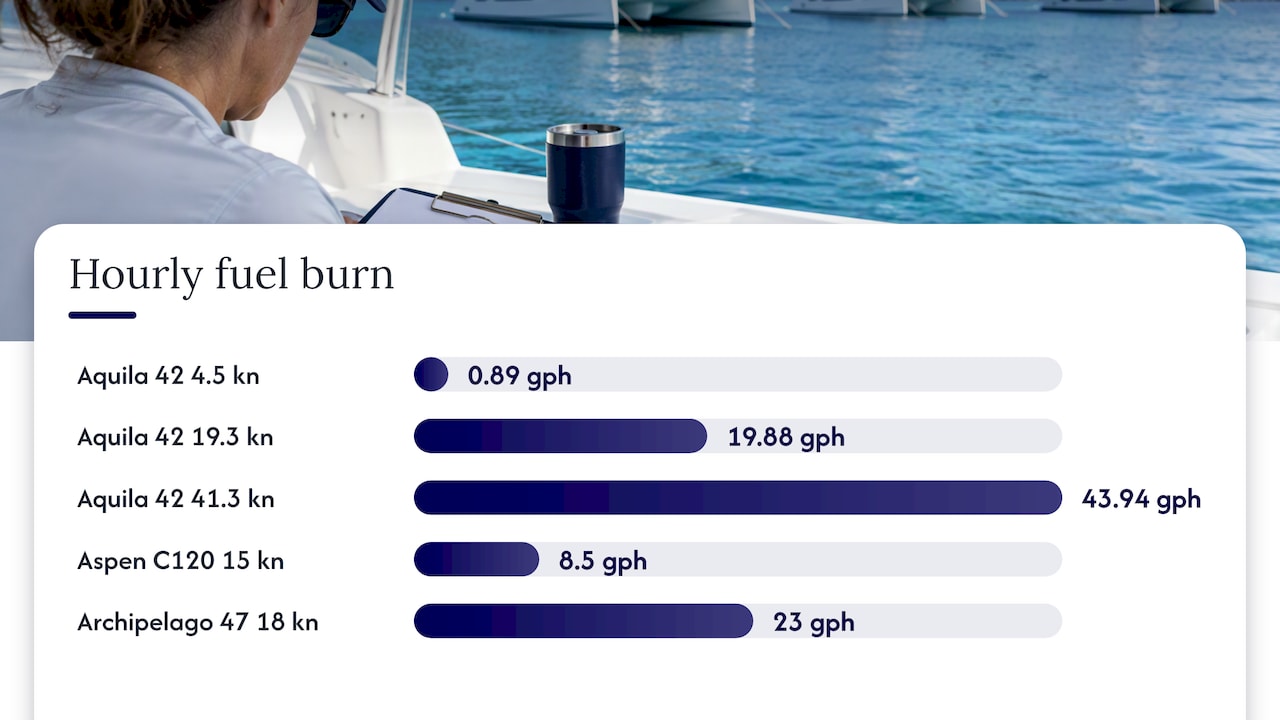
No single figure describes “a power catamaran.” Hull length, weight, engine size and cruising speed all differ, and magazines test under different loads. Still, the published sea trials give a useful range. Here they are side by side, with the per-mile figure worked out from each source’s own numbers (gallons per hour divided by knots).
| Boat | Speed | Burn | Approx. gallons per nautical mile |
|---|---|---|---|
| Aspen C120, 42 ft 6 in | 15 knots | 8.5 gph | 0.57 |
| Aquila 42 Coupe | 4.5 knots | 0.89 gph | 0.20 |
| Aquila 42 Coupe | 19.3 knots | 19.88 gph | 1.03 |
| Aquila 42 Coupe | 41.3 knots | 43.94 gph | 1.06 |
| Leopard 40 PC | about 18 knots | 23.77 gph (90 L/h) | 1.32 |
| Archipelago 47 | 18 knots | 23 gph | 1.28 |
| Prestige M8 Evo | 10.3 knots | 49 L/h (about 12.9 gph) | about 1.41 |
Three lessons stand out.
Speed matters more than length. The Aquila 42 is the same boat in every row, yet it goes from under one gallon an hour at 4.5 knots to nearly 20 at 19.3 knots. The Aspen C120 sips fuel at 15 knots, but that is a specialized, lightweight design, not a typical charter hull.
Test conditions flatter the boat. The Prestige figure was recorded with nine people aboard in nearly calm water, which is closer to charter reality than an empty boat, and it is still a best case. Real days in the islands add wind, chop and current.
Efficiency per mile is not the same as efficiency per hour. Going faster burns more per hour but you cover more distance, so on some hulls the per-mile gap is smaller than you would guess. At planing speeds, the PassageMaker analysis of the fuel equation notes, extra speed matters less than it does at slow displacement speeds.
If you read a brochure claim for fuel economy, check which speed it refers to. A number without a knot figure beside it tells you almost nothing.
Why your burn will differ from the brochure
Builders test with a clean hull, fresh props and light loads. You will charter with a full crew, water tanks, provisions, toys and a dinghy. Several things push the number up:
- Load. One fuel-planning guide estimates that a full crew, water tanks and gear can add 10 to 15 percent to consumption.
- Speed and RPM. The same source recommends checking the flow meter at your actual cruise RPM rather than trusting a single published figure.
- Wind, waves and current. Heading into a trade-wind chop costs more than running downwind.
- Trim and engine setup. AeroMarine Research lists hull resistance, loading, wind, waves, engine rating and trim among the variables, and treats fuel burn as an interaction of them, not a fixed number tied to length.
- Fouling. Growth on hulls and propellers raises resistance. Warm tropical water grows it fast, which is why keeping the hull clean matters, and guidance on keeping the hull clean is worth reading if you own a boat. PassageMaker reports that a fouled hull or propeller can materially cut efficiency.
On a charter you do not control fouling, but you control speed, and speed is the biggest lever.
The speed trade-off in numbers
PassageMaker gives a vivid example: over a 75-mile trip, raising speed from 7.5 to 9 knots pushed consumption from 30 gallons to 90. That is a 20 percent speed increase for triple the fuel. Your boat will not match that exactly, because it depends on the hull, but the shape of the curve is the same for displacement-type running.
The Aquila 42 data shows the other end. Between 19.3 and 41.3 knots, burn per hour more than doubles, but burn per mile is nearly flat at about one gallon. So the expensive zone is the transition, not the top end. For a charter, that means:
- Find the speed where the boat feels comfortable and settled, usually a modest cruise, and stay there.
- Avoid hovering in the awkward middle where the bows rise and consumption climbs without much gain in speed.
- Remember that on a vacation, a slower passage is part of the point. Short hops between BVI anchorages rarely demand top speed.
How to estimate fuel for your trip
The math is simple, and a fuel calculator guide lays it out the same way:
- Running hours = distance in nautical miles ÷ speed in knots
- Fuel used = running hours × gallons per hour
- Nautical miles per gallon = speed ÷ gallons per hour
- Then add time for idling and maneuvering, plus a reserve
A rough engine-side check also exists. Boating Magazine explains that diesel consumption can be estimated from horsepower and specific fuel consumption, with an example of 16.6 gallons per hour for a 300-horsepower diesel at peak output, and cruise consumption lower than that.
A worked example
Take a boat that behaves like the Leopard 40 PC test: 23.77 gph at about 18 knots. Say your itinerary has four moving days of three hours at cruise, 12 hours in total.
- Fuel: 12 × 23.77 = about 285 gallons
- Distance covered: 12 × 18 = about 216 nautical miles
- Add a margin for idling at moorings and maneuvering, say 10 percent, and you are near 314 gallons
Those are illustrative assumptions, not a quote for any specific yacht. Your actual boat, load and speed will change the result, so treat it as a template and replace the gallons-per-hour with your yacht’s figure.
What power catamaran fuel costs
Fuel price is where the Caribbean surprises people. The U.S. Energy Information Administration reported a national retail diesel average of $3.711 per gallon for the week of October 6, 2025. That is the number most Americans carry in their heads.
In the British Virgin Islands the dock price is much higher. Scrub Island Marina’s 2026 rate table lists diesel at $8.50 per gallon and gasoline at $7.50, and says the rates are subject to change. That is one marina’s posted price, not a territory-wide average, and prices differ by dock and by date, so confirm before you rely on it.
Here is the 314-gallon example priced both ways:
| Diesel price | Cost for about 314 gallons |
|---|---|
| $3.711 (US retail average, Oct 2025) | about $1,165 |
| $8.50 (Scrub Island Marina, 2026) | about $2,669 |
Same boat, same itinerary, more than twice the bill. Slow the cruise from 18 knots to a gentler pace and you can pull that figure down noticeably, while still reaching the same anchorage before lunch.
How fuel is handled on a BVI charter
This is the part that varies by operator and by contract, so ask before you book rather than assuming. Questions worth putting in writing:
- Is fuel included in the charter price, or billed afterward based on actual use?
- If billed, is it at a flat rate or at the price paid at the dock, and how is consumption measured?
- Is there a deposit or a refundable amount against fuel?
- Are generator hours, air conditioning and water-maker use counted in the same bill?
- Is a captain’s fuel and food covered, and what is the daily captain rate?
On our own pages, we list the standard captain at $250 per day and a training captain at $300 per day, with details on charter costs, and Wi-Fi at a one-off $250 per charter on the what’s included page. Ask your charter planner how fuel is treated for the specific yacht you are considering, so the number in your budget is the number on your final invoice.
Budgeting the whole week
Fuel is one line in a larger budget. Our published weekly rates for bareboat power catamarans are £6,000 to £10,000 for a 3-cabin boat, £8,000 to £14,000 for a 4-cabin and £12,000 to £20,000 for a 5+ cabin luxury power catamaran, as listed on the bareboat pricing page. Crewed rates start at $25,000 to $35,000 per week for a premium catamaran for 4 to 6 guests, $35,000 to $70,000 for a luxury catamaran for 6 to 10 guests and $70,000 to $120,000 for a high-end catamaran or motor yacht, per the crewed pricing page.
Against those figures, a fuel bill of a couple of thousand dollars is meaningful but not decisive. It is large enough to plan for, and small enough that a relaxed cruising speed keeps it a minor part of the trip.
Ways to keep fuel cost down
- Plan shorter legs. The BVI is built for island hopping, with anchorages close together. Fewer hours underway is the surest saving.
- Cruise, don’t sprint. Pick a comfortable speed and stay at it.
- Travel light. Extra water, gear and toys add to the load. Bring what you will use.
- Use the generator sensibly. If your contract counts generator fuel, run it with intent, such as cooling the cabins before bed.
- Choose the weather window. A downwind day is cheaper than a beat into the trades. Your captain or charter planner knows which legs flip with the wind.
Our perspective on power cat fuel
We have run charters out of Tortola for 30 years, and the most common fuel mistake we see is guests planning by the day instead of by the hour. They picture a long itinerary and then discover the engines were running far more than they expected. A power catamaran gives you speed, space and a flat ride, and it deserves to be used for all three, but it pays to think of the throttle as part of your holiday budget.
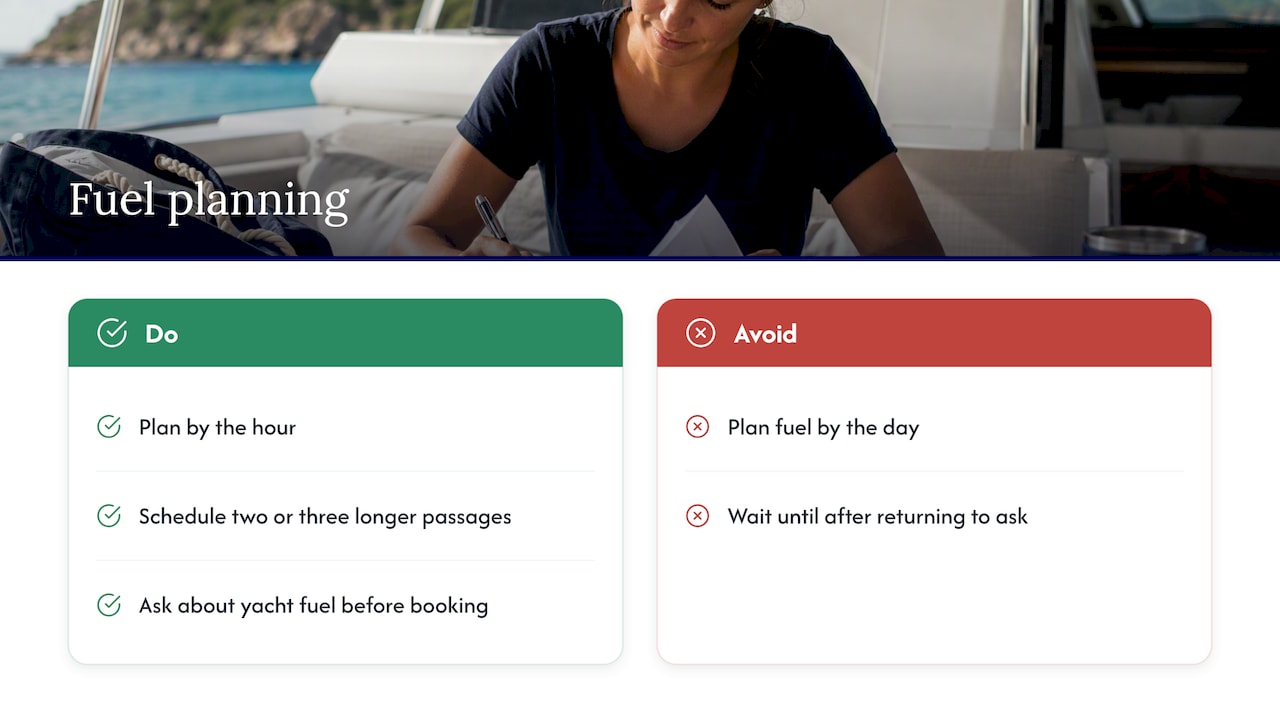
Our advice: decide early which days are for getting somewhere and which are for staying put. Plan two or three longer passages and let the rest of the week be short hops, snorkeling stops and long lunches on the hook. If you are weighing power against sail for your group, our comparison of power versus sailing catamarans walks through the trade-offs honestly, and the power catamaran charter guide covers the boats themselves.
And always ask your planner about fuel handling for the specific yacht you are looking at. We would rather you know the answer before booking than after returning.
— alexia
Plan a power catamaran charter in the BVI
We are a family-owned operation based on Tortola, with a fleet of modern power catamarans from builders including Fountaine Pajot, Leopard, Aquila, Aventura, Lagoon, Horizon and Two Oceans. Whether you want to skipper yourself or have a crew handle the throttle, we can match a yacht to your group size, itinerary and budget.

See current weekly rates on our bareboat pricing page, or look at luxury crewed charters if you would rather leave the navigation and the fuel planning to a professional captain.
FAQ
How many gallons per hour does a power catamaran burn?
Tested cruising figures run from about 8.5 gph for a light 42-foot cat at 15 knots to about 24 gph for 40 to 47-foot boats at 18 knots. Your yacht’s number depends on engines, load and speed, so ask for its figure at cruise RPM.
How much does fuel cost on a BVI charter?
That depends on your boat, your hours underway and how the charter contract handles fuel. Scrub Island Marina lists diesel at $8.50 per gallon for 2026, so a few hundred gallons can mean a bill in the low thousands of dollars. Confirm the current price and the billing method before you book.
Are power catamarans more fuel efficient than monohull motor yachts?
Catamaran hulls generally have lower drag at speed, which is why builders promote their efficiency, but results vary by model. Compare gallons per nautical mile at the same speed, not just the marketing claim.
Does speed really change fuel use that much?
Yes. In the Aquila 42 test, burn rose from 0.89 gph at 4.5 knots to 19.88 gph at 19.3 knots. A modest reduction in cruising speed is the biggest saving you can make on a charter.
Sources
- Sweet Simplicity, Soundings Online
- Aquila 42 Coupe video test, Boat Review
- Leopard 40 PC, BoatNews
- Archipelago 47 test, PassageMaker
- Prestige M8 Evo sea trial, Yachting News
- Feel The Burn: The Fuel Consumption Equation, PassageMaker
- Marine Fuel Planning, CalcFuel
- Fuel consumption analysis, AeroMarine Research
- Free Boat Fuel Calculator, FloatPlanWizard
- Calculating Boat Fuel Consumption, Boating Mag
- U.S. Energy Information Administration, This Week in Petroleum
- Scrub Island Marina rates
- Hull cleaning steps and timing
Recommended
- Power Catamaran Charter BVI: Your Complete 2026 Guide
- Power Catamaran vs Sailing Catamaran for a BVI Charter
- BVI Power Catamaran vs Motor Yacht: What’s the Difference?
- 30+ Years’ Tortola Expertise: Best Power Catamarans for BVI Charters
Did You Know?
The BVI are only accessible by boat. Check out our charter yachts that can get you there. View Our Fleet