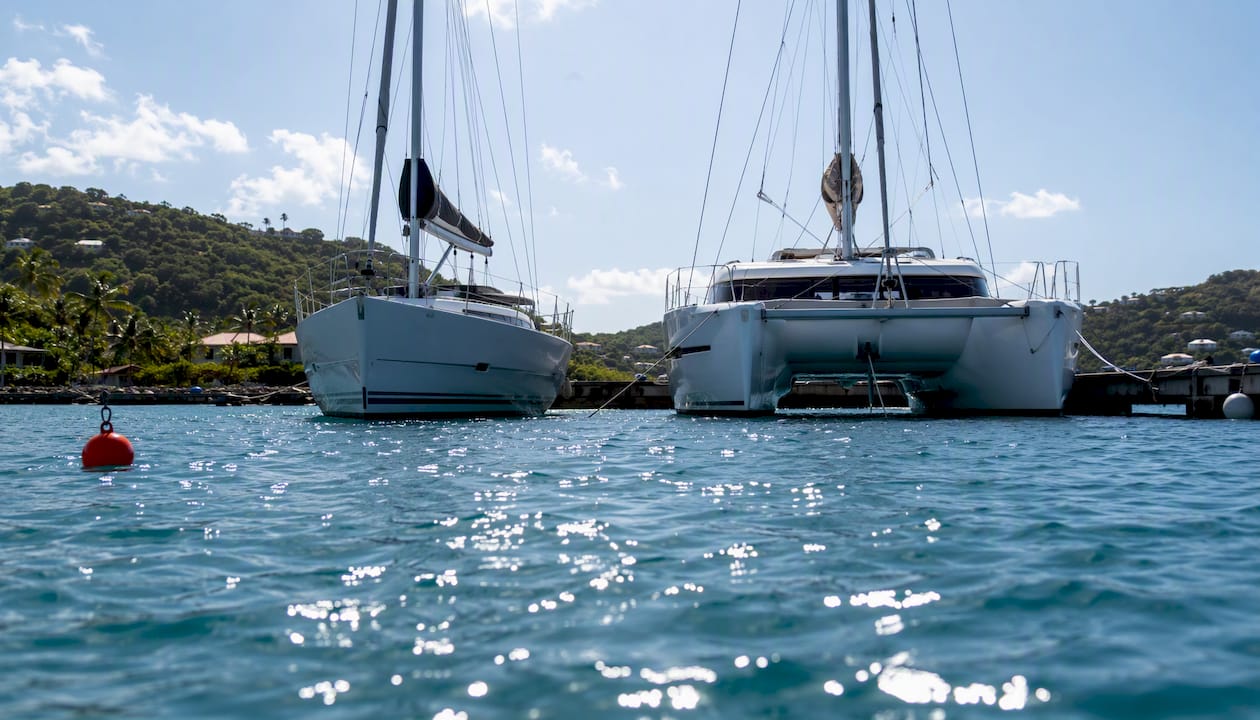

Choose a catamaran if your top priorities are living space, shallow-water access, and keeping guests comfortable at anchor. Choose a monohull if you want lower purchase cost, sharper upwind performance, and the self-righting safety margin that deep-keel designs carry in heavy weather. That is the short answer. The longer one depends on what you actually plan to do with the boat.
Quick verdict:
- Catamaran: More cabin volume, flatter motion at anchor, twin-engine redundancy, and access to anchorages that deeper-draft boats simply cannot reach.
- Monohull: Better upwind pointing, lower purchase and berth costs, simpler single-engine maintenance, and a self-righting keel that recovers from knockdowns.
Before you sign anything, charter the hull type you think you want for at least a week. Sail it loaded the way you intend to live aboard, anchor in a chop, and dock it in a tight slip. That one week will tell you more than any comparison article can.
Key Takeaways
Catamarans win on livability and shallow-water access; monohulls win on upwind performance, purchase cost, and self-righting safety, and chartering before buying is the most reliable way to validate which trade-offs you can actually live with.
| Point | Details |
|---|---|
| Cost premium is real | Catamarans typically cost 20–40% more to buy and up to 50% more annually in berth fees at beam-priced marinas. |
| Draft shapes your itinerary | Cats drawing 3–4 ft open anchorages that monohulls drawing 6–7 ft cannot safely enter, especially in the BVI and Caribbean. |
| Safety is about seamanship | Catamarans do not self-right; prevention through early reefing and conservative routing is the primary safety strategy. |
| Comfort wins the household vote | Hull-separated cabins, flat motion at anchor, and wider saloons make catamarans the preferred platform for families and charter groups. |
| Virgin Charter Yachts | Offers bareboat and crewed charters in the BVI with Fountaine Pajot, Lagoon, and Leopard cats to test the platform before buying. |
Table of Contents
- How do monohulls and catamarans compare across the decisions that matter?
- What catamarans do better for buyers and charterers
- Trade-offs and practical downsides of catamarans
- What monohulls do better for buyers and traditional sailors
- Practical downsides and buyer trade-offs for monohulls
- How do speed, pointing, and handling actually differ under sail?
- Stability, capsize risk, and what safety really means offshore
- Living aboard: motion, privacy, ventilation, and daily comfort
- What does ownership actually cost? Purchase, berths, maintenance, and resale
- Everyday handling: docking, engines, and maintenance realities
- Which hull type fits your situation?
- How to use a charter to validate your preference before buying
- Charter both hull types with Virgin Charter Yachts before you decide
- Sources
How do monohulls and catamarans compare across the decisions that matter?
The table below covers the dimensions that actually drive purchase decisions. Manufacturer examples appear as reference points, not ranked endorsements.
| Dimension | Monohull | Catamaran |
|---|---|---|
| Best for / typical use | Offshore passagemaking, racing, coastal cruising, budget-conscious buyers | Family cruising, charter, liveaboard, shallow-water destinations |
| Speed: light air & reaching | Moderate; displacement hull limits top speed | Higher average speeds off the wind; lighter displacement accelerates faster |
| Speed: upwind | Better pointing angle; deeper keel reduces leeway | Wider tacking angle; more leeway upwind |
| Stability & motion | Heels under sail; rolls at anchor; self-righting | Flat platform under sail and at anchor; does not self-right if capsized |
| Safety / capsize behavior | Keel provides self-righting moment; knockdown recovery is possible | Capsize is rare but catastrophic; prevention is the primary safety strategy |
| Draft & anchoring | Deeper draft (typically 5–7 ft on a 40 ft boat); limits anchorage options | Shallow draft (typically 3–4 ft); opens coves and reef anchorages |
| Interior volume | Narrow beam limits cabin count and saloon width | Wide beam yields more cabins, larger saloon, and separate heads |
| Purchase price | Lower; often 20–40% less than a comparable-length cat | Higher purchase price; premium reflects beam, dual hulls, and systems |
| Marina / berth costs | Lower; narrow beam fits standard slips | Up to 50% higher annual berth fees in some ports due to beam-based pricing |
| Maneuvering & docking | Single engine; tighter turning radius under sail | Twin engines give excellent low-speed control; wide beam needs more space |
| Resale demand | Strong in traditional sailing markets | Strong in charter-heavy markets; high demand for spacious platforms |
| Charter friendliness | Adequate for small crews; less cabin separation | Preferred by charter fleets; hull-separated cabins and larger social areas |
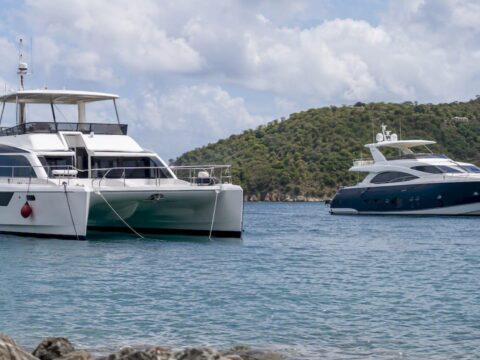
Brand reference points: Lagoon 42 and Fountaine Pajot Elba 45 are common catamaran benchmarks in the 40–45 ft range. Leopard 45 is a popular charter cat. Beneteau Oceanis 46.1 represents a well-regarded monohull in the same size class.
A few rows deserve a direct note. Draft is the one that most changes a Caribbean or BVI itinerary. A monohull drawing 6.5 ft cannot anchor in Anegada at low tide without risk; a catamaran drawing 3.5 ft can. That single difference shapes entire passage plans.
What catamarans do better for buyers and charterers
Practical Boat Owner’s comparison puts it plainly: multihulls typically achieve higher top and average speeds in light air and offer noticeably more living space. Those two advantages drive most catamaran purchases.
Living space and usable volume. A 45 ft catamaran carries roughly twice the beam of a 45 ft monohull. That beam translates directly into a wider saloon, a galley you can actually work in while the boat is moving, and four private cabins with separate heads rather than two cabins sharing one. For a family of four or a group of six on a charter, the difference is not subtle.
Stability at anchor. Catamarans sit flat. A monohull in a 15-knot anchorage rolls enough to send a coffee mug sliding; a cat in the same conditions barely moves. That matters for sleep, for cooking, and for guests who are not experienced sailors. Seasickness risk drops significantly when the boat is not rocking through the night.
Shallow draft and anchorage access. Most modern cruising cats draw 3–4 ft. That opens up reef anchorages, mangrove creeks, and shallow coves that a monohull drawing 6 ft cannot safely enter. In the BVI, that means spots like Anegada’s Loblolly Bay or the shallower corners of the Bight become part of your itinerary instead of a view from a distance.
Speed off the wind. Lighter displacement and twin hulls let catamarans accelerate quickly in light air and carry speed on a broad reach that a displacement monohull cannot match. On a downwind passage from Tortola to Anegada, a 40 ft cat will typically arrive noticeably ahead of a 40 ft monohull in the same breeze.
Twin-engine redundancy. If one engine fails on a catamaran, you still have steerage and propulsion. That operational margin matters in tight anchorages and when entering a marina with a cross-wind. Brands like Lagoon, Leopard, and Fountaine Pajot all build their cruising cats around this twin-engine architecture as a standard feature.
Pro Tip: When evaluating a specific catamaran model, ask the broker for the bridgedeck clearance measurement. Models from Fountaine Pajot and Lagoon vary meaningfully on this spec, and higher clearance directly reduces slamming noise in short, steep seas.
Trade-offs and practical downsides of catamarans
The advantages above come with real costs. Buyers who skip this section tend to be surprised six months into ownership.
Purchase price premium. A catamaran typically costs 20–40% more to buy than an equivalent-length monohull, and annual marina fees can run up to 50% higher in some Mediterranean and Caribbean ports where berth pricing is based on beam. That premium compounds over time.
Marina access and berth costs. Wide-beam cats need T-head berths or end-ties, which are limited in many historic harbors and crowded marinas. When they are available, they often carry a surcharge. In popular BVI and Eastern Caribbean anchorages this is less of a problem, but in a busy European port it can mean waiting for a berth or paying significantly more.
Windage and anchoring behavior. Catamarans present a large windage profile. At anchor, they tend to sail around on their rode rather than lying quietly head-to-wind the way a monohull does. They can also lie athwart the tide, which increases chain-wrap risk. A bridle is not optional on a cat; it is standard practice. Anchoring technique requires adjustment, and in a crowded anchorage a cat swings a wider arc.
Bridgedeck slamming. In short, steep seas, the underside of the bridgedeck can slam hard. Boating Magazine’s sea-trial data confirms that bridgedeck clearance and load distribution are critical design factors: low clearance and heavy loading increase slamming frequency and noise significantly. Overloaded cats in a chop can be genuinely uncomfortable. Weight discipline is not optional.
Non-self-righting behavior. A capsized catamaran stays inverted. This is the failure mode that experienced offshore sailors take most seriously. Prevention is the entire safety strategy: reef early, route conservatively, and never let the boat get overpowered. That discipline is manageable, but buyers need to understand it before committing to offshore passages.
A catamaran typically costs 20–40% more to purchase than a comparable monohull, and berth fees can run up to 50% higher in beam-priced ports.
What monohulls do better for buyers and traditional sailors
Monohulls have been the default offshore platform for a century, and for good reasons that still hold.
Upwind pointing and keel efficiency. A deep, weighted keel generates lateral resistance that lets a monohull point closer to the wind with less leeway than a catamaran. Boating Magazine’s comparison notes that monohulls generally point higher and tack more crisply because of this keel design. On a windward passage, that difference translates into fewer miles sailed and less time beating.
Self-righting recovery. The keel that limits leeway also provides a righting moment. A monohull knocked down by a breaking wave will, in most cases, come back up. That recovery behavior is a meaningful safety margin for offshore passages in heavy weather. It does not make a monohull indestructible, but it gives the crew time to recover and respond.
Marina access and berth costs. A 45 ft monohull fits in a standard 45 ft slip. A 45 ft catamaran needs a berth wide enough for its 25 ft beam. In crowded marinas, that distinction determines whether you get a berth at all. Monohulls also pay lower beam-based fees where those apply.
Helm feel and sail feedback. Many experienced sailors describe sailing a monohull as more connected. The boat heels, the helm loads up, and you feel the sail trim in your hands. That feedback loop is part of what makes sailing rewarding for performance-minded sailors. A catamaran’s flat, stable platform is comfortable, but it mutes some of that tactile communication.
Lower purchase price and simpler systems. A Beneteau Oceanis 46.1 costs meaningfully less than a Lagoon 42 of similar vintage. One engine, one propeller, one set of standing rigging. Maintenance is simpler and spare-parts sourcing is more straightforward. For buyers on a tighter budget or those who prefer to do their own work, that simplicity has real value.
Pro Tip: If you are buying a monohull for offshore use, prioritize keel-to-hull joint inspection above almost everything else in the survey. That connection point takes the most stress in a knockdown and is the most expensive to repair if compromised.
Practical downsides and buyer trade-offs for monohulls
No hull type is without compromise. Here is where monohulls fall short.
Heeling and onboard motion. A monohull heels under sail. On a close reach in 20 knots, that means cooking at a 20-degree angle, sleeping braced against a leeboard, and guests who are not sailors feeling genuinely uncomfortable. Motion at anchor in a rolly swell is a real quality-of-life issue for anyone spending more than a night aboard.
Draft restrictions in shallow water. A monohull drawing 6–7 ft is excluded from a significant portion of the best anchorages in the Caribbean and BVI. Anegada, the shallower cuts around the Tobago Cays, and many mangrove anchorages are simply off the table. That limits itinerary flexibility in exactly the regions where shallow-draft access matters most.
Interior volume constraints. The same narrow beam that makes a monohull marina-friendly makes it cramped below. A 45 ft monohull typically offers two or three cabins with a shared head arrangement. Four couples on a charter week will feel that constraint. Privacy is limited, and the saloon doubles as a corridor.
Single-engine redundancy. One engine means one point of failure. In a tight marina entrance with a cross-wind, losing power has no backup. Experienced monohull sailors manage this with good seamanship and anchor readiness, but it is a genuine operational difference from a twin-engine cat.
Perception vs. reality on offshore safety. Monohulls are not automatically safer offshore than catamarans. A well-found cat sailed conservatively is a capable bluewater boat. The self-righting advantage is real, but it is one factor among many. Construction quality, crew skill, and weather routing matter more than hull type for most offshore passages.
How do speed, pointing, and handling actually differ under sail?
Performance differences between hull types are real, but they depend heavily on point of sail and conditions. Buyers often overweight speed in their decision and underweight the daily-use implications.
Light-air acceleration and top speed. Catamarans benefit from lighter displacement and shallower draft. In 8–12 knots of breeze on a broad reach, a 40 ft cat will typically sail 1–2 knots faster than a 40 ft monohull. Practical Boat Owner confirms that multihulls typically show higher top and average speeds because lighter displacement lets them accelerate in light winds. That speed advantage widens weather windows on passages and reduces motoring hours.
Upwind pointing angles. A monohull with a deep keel can typically point to within 35–40 degrees of the true wind with minimal leeway. A catamaran, with its shallower daggerboards or fixed keels, often sails at 45–50 degrees effectively. On a 100-mile windward passage, that difference adds miles and time. It is not the whole story, but it is a real one.
Tacking behavior. Monohulls tack crisply. The weighted keel carries momentum through the eye of the wind, and the boat comes around predictably. Catamarans take longer to tack, require more helm input, and can get stuck “in stays” if the boat loses speed mid-tack. Experienced multihull sailors learn to carry more speed into a tack and sometimes bear away slightly to build speed before attempting it.
Apparent wind and leeway. Catamarans generate apparent wind quickly on a reach because of their speed. That lets them carry a tighter sail trim than their true wind angle suggests. On a broad reach, a cat sailing at 9 knots in 15 knots of true wind is experiencing apparent wind from well forward of the beam. Sail trim on a fast cat is a different skill than on a displacement monohull.
Practical cruising speeds. A 40 ft monohull on a broad reach in 15 knots will typically average 6–7 knots. A 40 ft cat in the same conditions will average 8–10 knots. Upwind in 15 knots, the monohull may point higher and make better VMG despite the cat’s raw speed advantage.
Pro Tip: When test-sailing a catamaran, deliberately try a few tacks in light air. If the boat stalls mid-tack with an experienced helm, that is a design or rig-tuning issue worth investigating before purchase.
Stability, capsize risk, and what safety really means offshore
This is the section most buyers read twice, and they should.
Initial vs. ultimate stability. A catamaran has high initial stability: it resists heeling strongly up to a point. A monohull has lower initial stability but recovers through a much wider range of heel angles. The critical difference is what happens at the extreme. A monohull’s keel provides a righting moment that brings the boat back from a knockdown. A catamaran’s righting moment disappears once it reaches a certain heel angle, and as Outer Passage’s lived-experience account explains, catamarans do not self-right if capsized. Prevention is the entire safety strategy.
Capsize vs. sinking. A capsized catamaran typically floats inverted. That is survivable if the crew is prepared with a life raft, EPIRB, and the ability to get on top of the upturned hull. A monohull that sinks gives the crew less time but a more familiar emergency sequence. Neither scenario is desirable; both are rare in well-maintained boats sailed by competent crews.
What prevention looks like on a cat:
- Reef earlier than you think you need to. The standard advice is: if you are thinking about reefing, you are already late.
- Manage load discipline. An overloaded cat sits lower, reduces bridgedeck clearance, and slams harder in chop.
- Route conservatively. Avoid exposed anchorages in forecast fronts. Use weather windows, not weather guesses.
- Check cross-beam and bulkhead connections annually. These are the structural elements that take the most stress in heavy conditions.
- Verify daggerboard condition if the boat has them. A damaged daggerboard changes leeway and handling in ways that are not always obvious at the dock.
Ocean-crossing suitability. Both hull types cross oceans regularly. The ARC (Atlantic Rally for Cruisers) fleet includes substantial numbers of both. What makes a boat passage-capable is construction quality, rig integrity, bridgedeck clearance (for cats), and crew seamanship, not hull type alone. Kyriakoulis Yachts’ comparison notes that monohulls’ deeper keels aid self-righting and give different failure and recovery dynamics, but a well-found cat sailed conservatively is a legitimate bluewater platform.
Living aboard: motion, privacy, ventilation, and daily comfort
For anyone spending more than a weekend aboard, daily-life quality often outweighs performance specs.
Saloon and galley ergonomics. A catamaran’s wide beam gives the galley room to breathe. Two people can work in the galley simultaneously. The saloon table seats six without anyone sitting sideways. On a monohull, the galley is typically a narrow corridor, and the saloon table requires the settee to double as seating on both sides. Neither is unusable, but the difference is felt every meal.
Motion at anchor. This is where catamarans win most household votes. Practical Boat Owner’s owner accounts confirm that catamarans significantly improve onboard comfort for groups and families because cabins are hull-separated and social spaces are larger. A flat platform at anchor means better sleep, less seasickness, and guests who want to come back next year.
Bridgedeck slamming. The flip side of that flat platform is bridgedeck noise in a chop. Boating Magazine’s sea-trial findings show that low bridgedeck clearance and heavy loading increase slamming frequency. A well-designed cat with adequate clearance and a disciplined load plan is quiet. An overloaded cat in short seas is not. This is a design-specific issue, not a categorical one. For more on how hull geometry affects this, the engineering detail behind eliminating hull slap at anchor is worth reading before you commit to a specific model.
Privacy and cabin layout. On a catamaran, the owner’s cabin occupies one hull and guest cabins occupy the other. Sound transmission between cabins is minimal. On a monohull, all cabins share the same hull structure, and a snoring crewmate in the forward cabin is audible aft. For charter groups or families with teenagers, that separation is not a luxury.
Ventilation and light. Catamarans typically have larger windows and hatches relative to their interior volume. The elevated saloon position on most modern cats gives a panoramic view and better airflow. Monohulls tend to be darker below and rely more on opening ports for ventilation.
Liveaboard checklist before you commit:
- Berth length and width in each cabin (test it with your actual body)
- Number of heads and whether they are ensuite or shared
- Refrigeration capacity and whether it runs off solar or requires engine hours
- Storage volume for a 2-week passage (lockers, under-berth, cockpit)
- Companionway ergonomics: can you move between cockpit and saloon quickly in rough conditions?
Pro Tip: Spend a night at anchor aboard any boat you are seriously considering buying. One night in a rolly anchorage tells you more about motion comfort than a week of daysailing.
What does ownership actually cost? Purchase, berths, maintenance, and resale
Budget planning for either hull type requires looking past the purchase price.
Purchase price. A catamaran typically costs 20–40% more than a comparable-length monohull. A used Lagoon 42 or Leopard 45 in good condition commands a significant premium over a Beneteau Oceanis 46.1 of similar age and condition. That premium reflects the beam, the dual-hull construction, and the systems complexity.
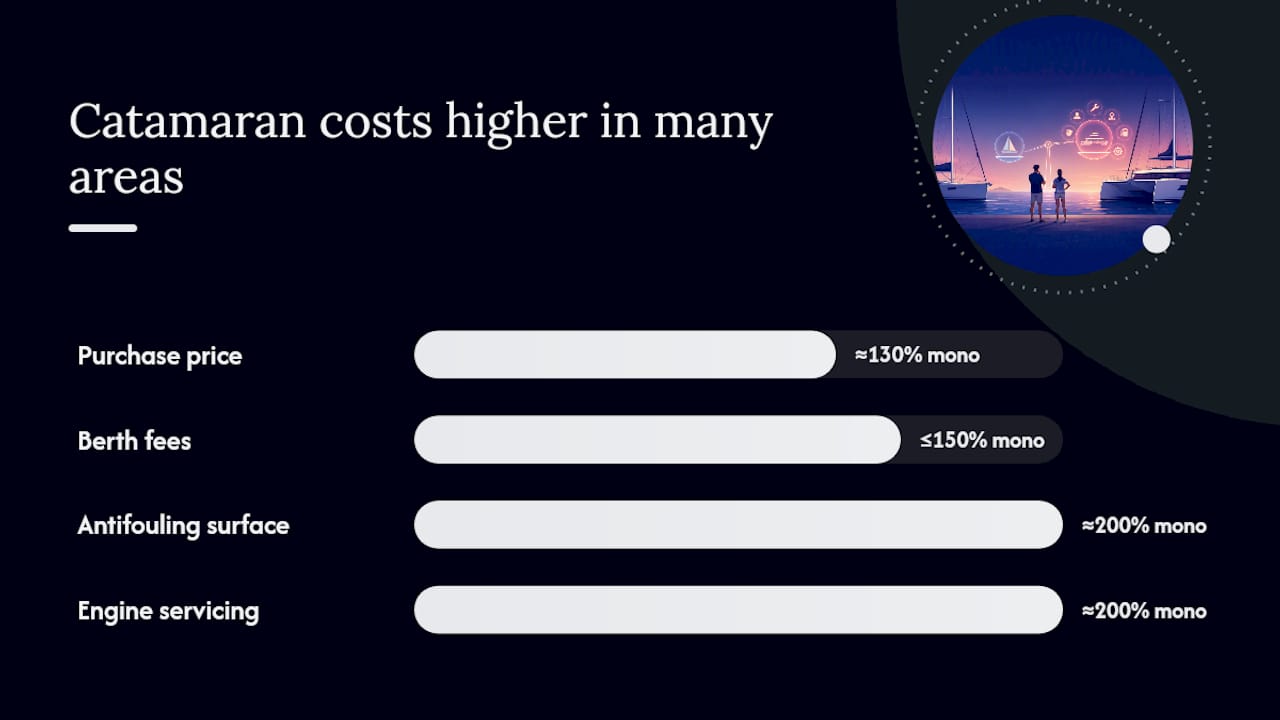
Berthing and marina fees. Beam-based pricing is standard in many Mediterranean and Caribbean marinas. A catamaran drawing 25 ft of beam pays for 25 ft of berth width, not just its length. Monohulls often get better access to narrow marinas and lower berth rates in historic harbors and crowded ports.
Maintenance. Two hulls mean twice the antifouling surface. Two engines mean two service schedules, two sets of impellers, two prop systems. Folding props on cats require specific checks and lubrication that fixed props do not. The per-item cost of each service is similar; the frequency doubles. Budget accordingly.
Fuel and motoring costs. Catamarans are faster under sail, which can reduce motoring hours on passages. But twin engines burn more fuel per hour than a single engine when motoring. The net effect depends on your sailing style and route. In the trade winds, a cat may motor less. In light-air coastal cruising, the twin-engine fuel cost adds up.
Insurance. Catamarans typically carry higher insurance premiums than monohulls of similar length, reflecting replacement cost and the non-self-righting risk profile. Charter use adds another layer of premium. Get quotes for both hull types before finalizing a budget.
Resale value. In charter-heavy markets like the BVI and Eastern Caribbean, catamarans often retain value better due to demand for spacious charter platforms. In traditional sailing markets where marina constraints matter, monohulls can be easier to sell. If you are buying with a charter program in mind, the cat’s resale trajectory in that market is generally stronger.
| Cost category | Monohull | Catamaran |
|---|---|---|
| Purchase price (relative) | Lower baseline | 20–40% premium over comparable monohull |
| Annual berth fees | Standard slip rates | Up to 50% higher in beam-priced ports |
| Antifouling | One hull | Two hulls; roughly double the surface area |
| Engine servicing | One engine, one schedule | Two engines, two schedules |
| Insurance | Lower premium | Higher premium; reflects replacement cost |
| Resale demand | Strong in traditional markets | Strong in charter-heavy markets |
Everyday handling: docking, engines, and maintenance realities
Ownership workload differs between hull types in ways that are easy to underestimate.
Docking a catamaran. Wide beam is the defining challenge. Most cats need a T-head berth or an end-tie, and those are not always available. When they are, the approach requires more planning: the boat does not fit in a standard slip, and wind on the beam affects a wide-profile boat more than a narrow monohull. Twin engines compensate significantly. With practice, most cat owners become confident dockers using differential throttle.
Here is a practical docking sequence for a catamaran in a cross-wind:
- Approach the berth at a shallow angle with the wind on the bow quarter.
- Use the leeward engine to pivot the bow toward the dock while the windward engine holds position.
- Get a bow line on first; the stern will follow with differential throttle.
- Never rely on a single spring line to stop a wide-beam boat in a cross-wind.
- In tight marinas, a bow thruster adds meaningful control, even on a twin-engine cat.
Twin-engine maintenance. Boat Tomorrow’s technical overview notes that twin-engine setups reduce single-point failure risk but create two routine service schedules and two prop systems. Folding props are common on cats and require different checks than fixed props: the blades must open and close freely, and the hub mechanism needs periodic lubrication. Add this to your pre-season checklist.
Routine maintenance tasks unique to each platform:
- Catamaran: Bridgedeck inspection for stress cracks, daggerboard condition and seal checks, bridle and snubber gear, antifouling on two full hulls, twin-engine impellers and zincs.
- Monohull: Keel-to-hull joint inspection, single-engine service, rudder bearing check, standing rigging tension (often higher loads on a stiffer rig).
Transitioning between hull types. Sailors moving from a monohull to a catamaran consistently report that tacking feels sluggish at first and docking feels wider than expected. The reverse transition, from cat to mono, brings back heel and helm feedback that can feel dramatic after a flat platform. A short charter in the new hull type before purchase is the most efficient way to recalibrate.
Which hull type fits your situation?
The right answer depends on your priorities, not on which hull type wins a generic comparison.
Buyer profiles:
- Family with kids (coastal cruising and charter): Catamaran. The flat motion, separate cabins, and large cockpit make the experience manageable for non-sailors and children. A Lagoon 42 or Fountaine Pajot Elba 45 fits this profile well.
- Couple doing long offshore passages: Monohull, with a strong case for a well-found cat if comfort is the priority. A Beneteau Oceanis 46.1 or similar offers the self-righting margin and upwind efficiency that bluewater passages reward.
- Charter business owner in the BVI or Caribbean: Catamaran. Charter guests want space, stability, and privacy. A Leopard 45 or Lagoon 42 commands higher charter rates and fills more weeks per year than a comparable monohull.
- Weekend coastal cruiser on a budget: Monohull. Lower purchase price, standard slip access, and simpler maintenance make a monohull the practical choice for sailors who are not living aboard.
- Liveaboard cruiser prioritizing comfort over performance: Catamaran, provided the budget covers the purchase premium and higher berth costs.
Decision checklist:
- What is your realistic purchase budget, including a 10–15% survey and refit reserve?
- What is your primary sailing region, and what draft do the anchorages require?
- How many people will be aboard regularly, and do they need private cabins?
- Are you planning offshore passages where self-righting behavior matters?
- What marina or mooring situation will you use most, and does it accommodate wide-beam boats?
- Do you intend to put the boat into a charter program?
Score each question against the hull type it favors. If four of six answers point to a catamaran, that is your hull. If the budget question alone rules out the cat premium, the monohull is the answer regardless of other preferences.
Crew skill and training. Catamarans require different seamanship: earlier reefing, different tacking technique, and anchoring with a bridle. Neither hull type is harder to sail in absolute terms, but the learning curve is real when switching. Budget for a day or two of instruction when transitioning.
How to use a charter to validate your preference before buying
Chartering before buying is not just a nice idea. It is the most cost-effective due diligence available to a boat buyer.
A week-long charter in the intended sailing region, loaded the way you plan to live aboard, will surface issues that no sea trial or boat show visit reveals. You will find out whether the galley works at a 15-degree heel, whether the anchor windlass is fast enough for your style, and whether the cockpit layout actually fits your crew.
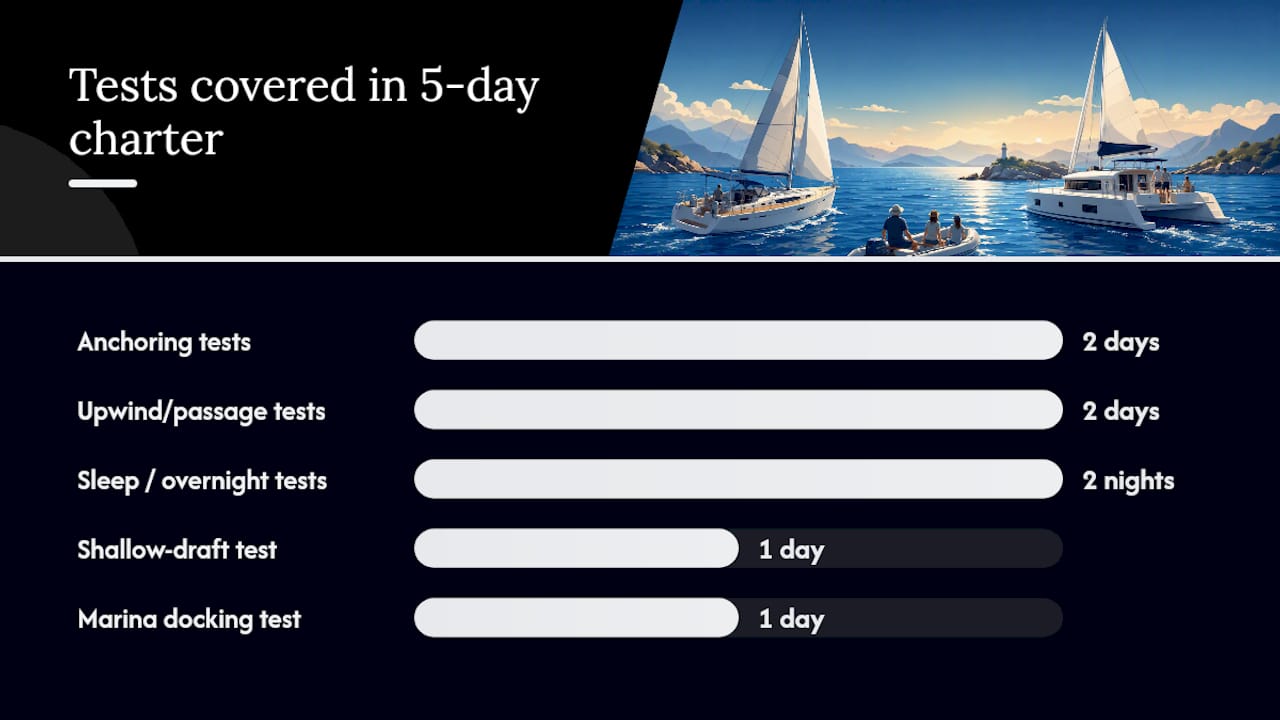
Sample test-sail itinerary for the BVI (5 days):
- Day 1: Tortola to Norman Island. Passage leg in open water to test motion under sail and upwind performance. Anchor in the Bight and spend the night to evaluate motion comfort.
- Day 2: Norman Island to Anegada. Shallow-draft test. A catamaran can anchor close to the beach; a monohull cannot. This day reveals draft limitations concretely.
- Day 3: Anegada layover. Test anchoring behavior in a cross-wind. Set a bridle on a cat; observe how the boat lies. Evaluate sleep quality and galley use at anchor.
- Day 4: Anegada to Virgin Gorda (North Sound). Marina docking test. North Sound has a range of berth types; practice docking in a cross-wind.
- Day 5: Virgin Gorda to Tortola. Upwind return leg. This is where monohull pointing advantage becomes tangible. Note how many tacks you need and how the boat handles in short chop.
Charter checklist: what to test and verify:
- Anchor in at least two different conditions (calm and cross-wind) to evaluate rode behavior and bridle setup.
- Reef the mainsail in a gust above 20 knots and time the process.
- Dock into a tight slip or T-head at least once without assistance.
- Cook a full meal underway on a close reach.
- Sleep aboard for at least two nights in different anchorage conditions.
- Check bilge access, engine compartment ergonomics, and battery state after 24 hours at anchor.
For a detailed approach to planning a test-charter itinerary, the step-by-step luxury yacht tour planning guide covers the logistics of structuring a charter around specific validation goals.
Virgin Charter Yachts operates a fleet of modern catamarans from Fountaine Pajot, Lagoon, Leopard, and other leading builders in the BVI, which makes side-by-side charter comparisons practical. Ask the charter operator specifically about hull-type differences when booking, and request an itinerary that includes both a passage leg and a shallow-water anchorage.
What the data and the sea actually tell you
The monohull vs. catamaran debate has been running in sailing forums for decades, and most of it misses the point. The real question is not which hull type is better in the abstract. It is which one fits the life you actually intend to live aboard.
What the evidence consistently shows is that comfort wins the household vote. Families and charter guests who spend a week on a catamaran rarely want to go back to a monohull. The flat motion, the space, the private cabins, and the shallow-draft access to places a monohull cannot reach add up to a qualitatively different experience. That is not a performance argument; it is a livability argument, and for most buyers, livability is what they are actually buying.
The counterargument is real, though. Experienced offshore sailors who have spent years reading a monohull’s helm, who value the self-righting margin in heavy weather, and who find the catamaran’s flat platform disconnected from the sea, are not wrong. They are describing a different relationship with sailing. A catamaran is a platform for living on the water. A monohull is a tool for sailing through it. Both are legitimate.
What I would push back on is the idea that one hull type is categorically safer than the other. A well-found catamaran sailed conservatively by a competent crew is a capable bluewater boat. A poorly maintained monohull sailed aggressively in bad weather is not safe because it has a keel. The variables that actually determine offshore safety, including construction quality, crew skill, load management, and weather routing, dwarf the hull-type variable for most passages most sailors will ever make.
Charter first. Charter loaded. Charter in conditions that approximate your intended use. That one week will give you a verdict no article can.
Charter both hull types with Virgin Charter Yachts before you decide
The most practical next step after reading a comparison like this is getting on the water. Virgin Charter Yachts has operated out of Tortola, BVI since 1996, with a fleet of modern catamarans from Fountaine Pajot, Lagoon, Leopard, and Aquila, specifically maintained for charter use in the British Virgin Islands and Caribbean.
A bareboat or crewed charter with Virgin Charter Yachts gives you a real-world test of the catamaran platform in the exact sailing region where shallow draft, twin engines, and cabin separation matter most. The BVI itinerary naturally stress-tests the differences: shallow anchorages at Anegada, passage legs in the trades, and marina docking at Tortola. The team’s 30 years of local knowledge means your itinerary can be structured specifically around the validation questions you need answered before buying.
This is not a purchase commitment. It is a week of due diligence that happens to be a genuinely good vacation. Book a charter or request an itinerary with Virgin Charter Yachts to get started.
Sources
- Monohulls vs Multihulls: which is best? - Practical Boat Owner
- Catamaran Versus Deep-V Monohull
- Catamaran Versus Monohull: A Comprehensive Comparison for Informed Yacht Selection - Kyriakoulis Yachts
- Monohull vs Catamaran: What Really Changes at Sea (After Living Aboard All Three) — Outer Passage
Did You Know?
The BVI are only accessible by boat. Check out our charter yachts that can get you there. View Our Fleet