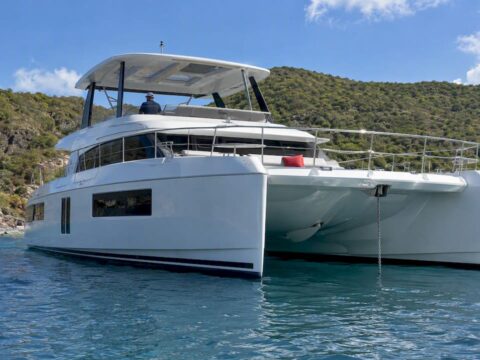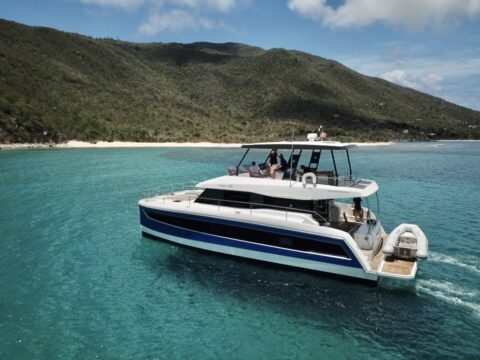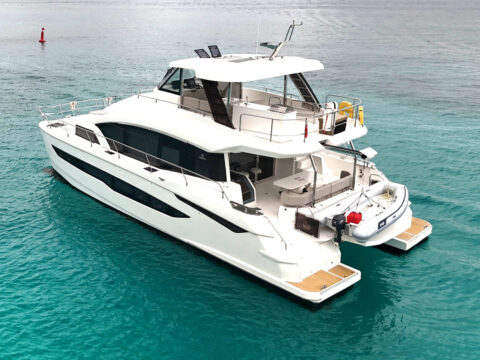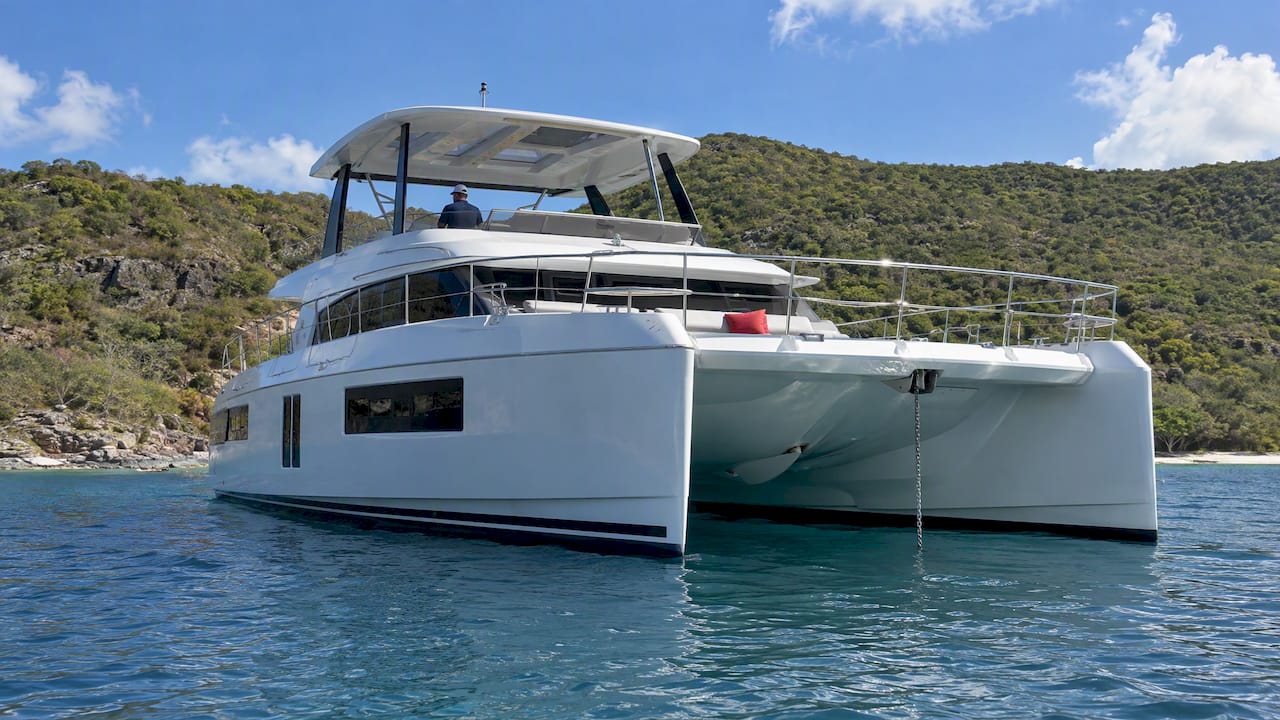

For eight guests, we recommend a 4-cabin power catamaran as the starting point, moving up to a 5+ cabin luxury power catamaran when budget allows. Four private cabins mean no one shares a bed with a stranger, and the generous flybridge and aft deck space keep a full group comfortable at anchor. You can check current pricing and availability in the booking section below.
TL;DR:
- A 3 cabin boat sleeps six in private cabins, leaving two guests on a convertible saloon berth; choose it only if that arrangement suits your group.
- Before booking, confirm exact bed sizes, ensuite access, air conditioning coverage, galley capacity, and tender size; these details affect privacy and daily comfort for eight.
- Bareboat four cabin charters cost £8,000 to £14,000 weekly, while 5+ cabin models cost £12,000 to £20,000; fuel, mooring, and provisioning cost extra.
- A standard captain costs $250 per day, while a training captain costs $300 and also teaches boat handling for guests pursuing future bareboat certification.
- Peak winter dates can book out months in advance, so reserve once travel dates are set and consider charter insurance given the investment.
Table of Contents
- Which Virgin Charter Yachts power-cat classes fit a group of eight
- How cabin layout shapes privacy and comfort for 8 guests
- What power-catamaran ride comfort really feels like in the BVI
- How to choose the right power catamaran for your group
- Sample itineraries for an eight-guest power-cat charter
- What an 8-guest charter costs and when to book
- Why our fleet and local base matter for your charter
- What matters most when planning for eight guests
- Ready to book your power catamaran for 8
- FAQ
- Sources
Which Virgin Charter Yachts power-cat classes fit a group of eight
We curate three power-cat classes that work for eight guests, and the right one depends on how your group pairs up and how much privacy everyone wants. Each class is built around a different balance of private cabins, shared living space, and crew support.
The 3-Cabin Power Catamaran suits eight guests only when some are comfortable on a convertible saloon berth or when a couple of guests are children who can share a cabin. It typically has two or three heads, a single saloon, and a flybridge for lounging. This class works best for close friends or extended family who do not mind flexible sleeping arrangements, and it is our entry point for groups watching cost. It is offered on a bareboat basis, meaning you or a licensed member of your group handles the helm, though a standard captain can be added.
The 4-Cabin Power Catamaran is our default recommendation for eight guests. Four private cabins, usually each with its own ensuite head, let four couples or four pairs of friends each have a door that closes. The flybridge, aft cockpit, and saloon give the group enough separate zones that eight people are not stacked on top of each other during the day. This class is available bareboat or with a standard captain, and it is large enough that a crewed option with a chef becomes practical too.
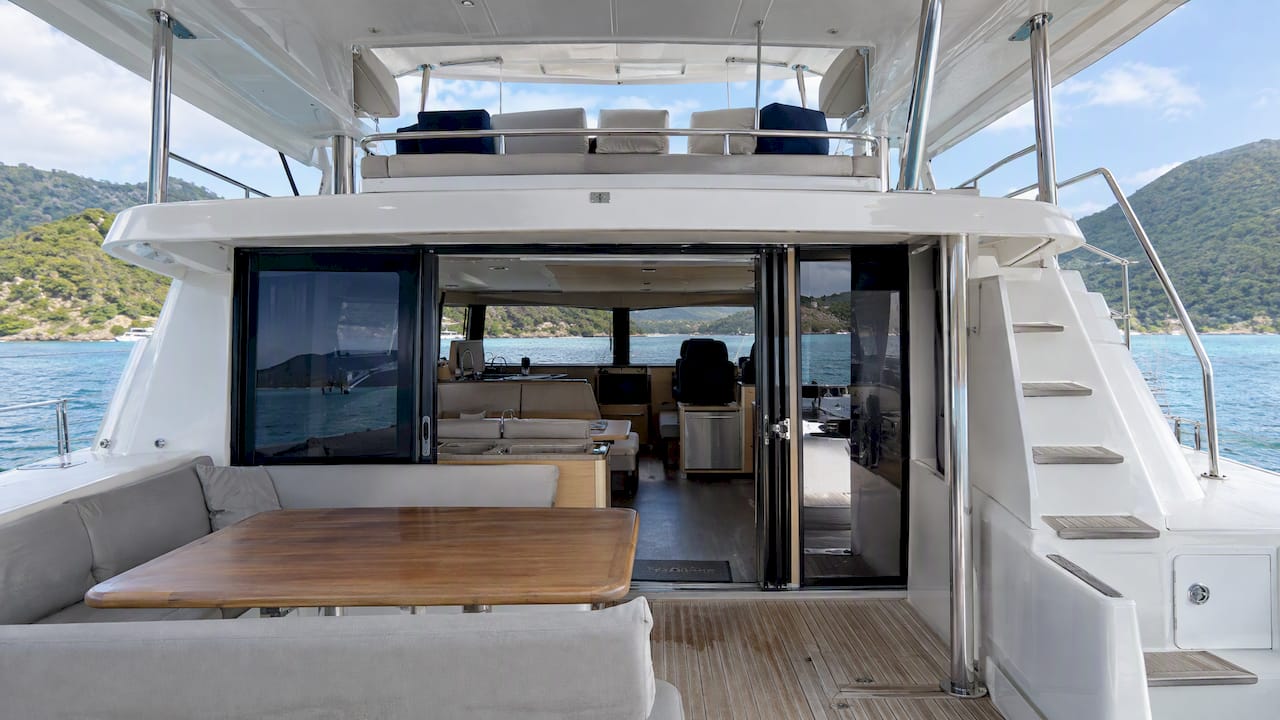
The 5+ Cabin Luxury Power Catamaran is the upgrade for groups that want extra social space, a larger galley, or crew quarters separate from guest cabins. With a fifth cabin often used for crew or as a bunk room for kids, this class gives the most breathing room on board and suits milestone trips, multi-generational families, or groups who want a full-service crewed experience.
Across all three classes, you have two captain options:
- A standard captain runs the boat and handles navigation, anchoring, and local knowledge for day-to-day cruising.
- A ‘training captain’ does the same work while also teaching guests boat handling, useful if your group wants to build toward bareboat certification on a future trip.
Wi-Fi is available as an add-on across the fleet, and galley capacity scales with cabin count, so the 4-cabin and 5+ cabin classes carry larger fridge and freezer space suited to provisioning for eight people over a full week.
How cabin layout shapes privacy and comfort for 8 guests
The number of cabins on a power catamaran determines how much privacy your group actually gets, and it is worth mapping your guest list against the layout before you book. A 3-cabin boat typically sleeps six in private cabins and adds two more on a convertible saloon berth, which works for close friends but creates an obvious hierarchy of comfort. A 4-cabin layout gives four couples or four pairs their own door and, in most cases, their own ensuite head, which removes that hierarchy entirely. A 5+ cabin luxury layout adds a buffer cabin, often used for a fifth couple, solo travelers, or kids, while keeping crew quarters separate from guest space.
- Count your actual sleeping pairs first: four couples need four cabins, not four berths.
- Ask whether each cabin has a private ensuite head or shares one down the hall.
- Confirm mattress size in each cabin, since some layouts mix queen and twin configurations.
- Check air conditioning coverage, since older or lower-tier cabins sometimes run on a shared zone.
- Review in-cabin storage, since a week’s worth of luggage for eight adds up fast.
Convertible berths are fine for kids, close siblings, or a group that genuinely does not mind flexible sleeping, but we would steer any group of four couples toward a 4-cabin or 5+ cabin layout with private ensuites.
Pro Tip: Ask for the cabin diagram before booking, not just the brochure photos, so you know exactly which cabin has the smaller berth or the shared head.
What power-catamaran ride comfort really feels like in the BVI
Power catamarans ride on twin hulls, which gives them a wide stance and high initial stability compared to a monohull of similar length, so guests feel less rocking at anchor and less heel underway. That stability comes with a tradeoff: the bridge deck connecting the two hulls can slam into waves in rougher conditions, a factor tied to tunnel clearance, boat speed, loading, and sea state, according to Boating Magazine’s breakdown of power catamarans.
In practice, BVI waters are largely protected by the island chain, so most passages stay calm. On the occasional choppier crossing, captains manage comfort through a few standard adjustments:
- Reducing speed to soften the ride over wave sets.
- Altering course slightly to take waves at a better angle.
- Choosing sheltered anchorages on the lee side of an island for overnight stops.
A captain’s operating choices on speed and course matter as much as the hull design itself once sea state picks up, a point Boating Magazine makes explicit when comparing powercat ride quality to monohulls. For a deeper technical comparison of how power and sailing catamarans handle BVI conditions, our power catamaran versus sailing catamaran guide walks through the differences in more detail.
How to choose the right power catamaran for your group
Booking for eight guests comes down to a short list of specifics you should confirm before you commit, rather than relying on marketing photos alone.
- Confirm cabin count and head count match your actual sleeping pairs.
- Ask about galley size, fridge and freezer capacity, since provisioning for eight for a week is substantial.
- Check air conditioning zones and whether every cabin is covered, not just the saloon.
- Ask about tender size, since a dinghy that fits four means two trips for every shore excursion.
- Measure deck and social space against your group’s daytime habits: lounging on the flybridge, dining on the aft deck, or both at once.
- Clarify crew quarters if you are booking crewed, so guest cabins are not shared with staff.
When you reach out, ask pointed questions: what are the exact bed configurations in each cabin, are linens and towels included, is washroom access private or shared, what captain certifications does the crew hold, what provisioning is included versus billed separately, and what is the fuel policy at the end of the charter. For bareboat charters specifically, our BVI bareboat charter requirements page outlines what qualifies a group to skipper without a captain aboard.
Finally, verify trust signals: how long has the operator been based in the BVI, what does the maintenance schedule look like, and what do past guests say about their experience on that specific yacht.
Sample itineraries for an eight-guest power-cat charter
How you use the boat day to day should shape which class you book, so here are three routes scaled to a group of eight.
Relaxed 5-day route: Short hops of 1 to 2 hours keep sea time low and beach time high.
- Day 1: Norman Island for snorkeling and a sunset at a beach bar.
- Day 2: The Baths at Virgin Gorda, anchoring near Virgin Gorda Yacht Harbour for provisioning.
- Day 3: Cane Garden Bay for a slow beach day.
- Day 4: Jost Van Dyke for its well-known beach bars.
- Day 5: Return cruise with a final snorkel stop.
Active 5-day route: Longer hops of 2 to 4 hours suit a group that wants more ground covered.
- Day 1: Depart early for Anegada, a longer crossing rewarded with flat white-sand beaches.
- Day 2: Explore Anegada’s reefs before heading back toward Virgin Gorda.
- Day 3: The Baths and North Sound.
- Day 4: Sandy Cay and Jost Van Dyke.
- Day 5: Return leg with a final snorkel stop near Norman Island.
7-day premium route: With more range on a larger powercat, add a private beach barbecue day, a full day at Anegada, and two island-hopping days between Virgin Gorda and Jost Van Dyke, with provisioning scaled up front for eight guests across the full week. Our island guide breaks down anchorages and shore stops in more detail.
What an 8-guest charter costs and when to book
Price depends on several factors that stack together, so it helps to know what drives the range before you request a quote.
- Season: peak winter months command higher rates than summer or shoulder season.
- Yacht class: a 3-cabin bareboat costs less than a 5+ cabin luxury crewed catamaran.
- Crewed versus bareboat: crewed charters include staff and provisioning handled for you, which adds cost but removes planning work.
- Fuel, mooring fees, and provisioning: these are typically billed on top of the base charter rate.
- Extras: Wi-Fi, a training captain instead of a standard captain, and premium provisioning all add to the total.
On the bareboat side, our 3-Cabin Power Catamaran runs $6,000 to $10,000 GBP per week, our 4-Cabin Power Catamaran runs £8,000 to £14,000 per week, and our 5+ Cabin Luxury Power Catamaran runs £12,000 to £20,000 per week. On the crewed side, our Premium Catamaran for 4 to 6 guests runs $25,000 to $35,000 per week, our Luxury Catamaran for 6 to 10 guests runs $35,000 to $70,000 per week, and our High-End Luxury Catamaran or Motor Yacht runs $70,000 to $120,000 per week. A standard captain runs $250 per day, and a training captain runs $300 per day, while Wi-Fi is a $250 one-time fee per charter.
Peak-season dates for an eight-guest group can book out months in advance, so we recommend reserving as early as possible once your travel window is set, a pattern consistent across BVI charter cost planning. Expect a deposit at booking, with charter insurance worth adding given the size of the investment.
Why our fleet and local base matter for your charter
We have operated as a family-owned charter company based on Tortola in the BVI since 1996, which means three decades of local knowledge behind every itinerary we help plan. Our fleet draws from established builders including Fountaine Pajot, Leopard, Aquila, Aventura, Lagoon, Horizon, and Two Oceans, each curated for maintenance standards and comfort rather than picked for the lowest acquisition cost.
Being based on Tortola for 30 years means we know which anchorages work in which wind direction, which provisioning partners deliver on time, and which cabin layout actually suits a group of eight before anyone steps aboard.
That local footing shapes every recommendation in this guide, from cabin counts to itinerary pacing.
What matters most when planning for eight guests
Three things decide whether an eight-guest charter feels effortless or cramped: privacy, provisioning, and captain experience. Privacy means matching cabin count to your actual sleeping pairs, not just total berths. Provisioning means ordering enough food and drink for eight people across a full week, not estimating on the fly. Captain experience means a crew that knows BVI anchorages well enough to adjust the plan when wind or swell changes. Reach out to our team directly if you want help matching these three priorities to a specific yacht.
— alexia
Ready to book your power catamaran for 8
We handle the planning details, from cabin matching to provisioning to captain selection, so you can focus on who’s coming and what beaches you want to see. Our team can walk you through current availability for eight-guest groups across bareboat and crewed options.

- Check bareboat pricing for the 3-Cabin, 4-Cabin, and 5+ Cabin Power Catamaran classes.
- Browse our 52’ Luxury Powercat for a flagship example of social space suited to eight guests.
FAQ
What is the best catamaran charter setup for 8 guests in the BVI?
A 4-cabin power catamaran is the most reliable match for eight guests, since it gives four couples or pairs their own private cabin and ensuite head. Groups wanting extra social space or a crewed experience often step up to a 5+ cabin luxury layout.
Which layout is considered the best power catamaran for privacy?
A 4-cabin layout with ensuite heads in every cabin gives the most privacy for four couples, since no one shares a bed or bathroom with another pair. A 3-cabin boat with a convertible berth works for close friends or family but creates uneven comfort across the group.
How many people can comfortably fit on a power catamaran?
Capacity depends on cabin count: a 3-cabin layout typically sleeps six in private cabins plus two more on a convertible berth, while a 4-cabin layout sleeps eight in private cabins. A 5+ cabin luxury layout can sleep ten or more, with extra cabins used for crew or additional guests.
Are power catamarans good in rough water?
Power catamarans offer high initial stability from their twin-hull design, which keeps the ride steadier than many monohulls in moderate conditions, according to Boating Magazine. In larger waves, the bridge deck can experience slamming, so captains typically reduce speed or adjust course to keep the ride comfortable.
Should I book bareboat or crewed for a group of eight?
Bareboat works for groups with a licensed skipper aboard or those adding a standard or training captain, and it offers more flexibility on itinerary and budget. Crewed charters include a dedicated captain and often a chef, which removes planning and cooking duties but runs at a higher weekly rate, as shown in our crewed charter pricing.
Recommended
- Best BVI Power Catamaran for 6, 8, 10 or 12 Guests
- Power Catamaran Layouts: Choosing the Best BVI Charter Yacht
- Convert Guest Lists Into Exact LOA Targets for BVI Power Cat Charters
Did You Know?
The BVI are only accessible by boat. Check out our charter yachts that can get you there. View Our Fleet