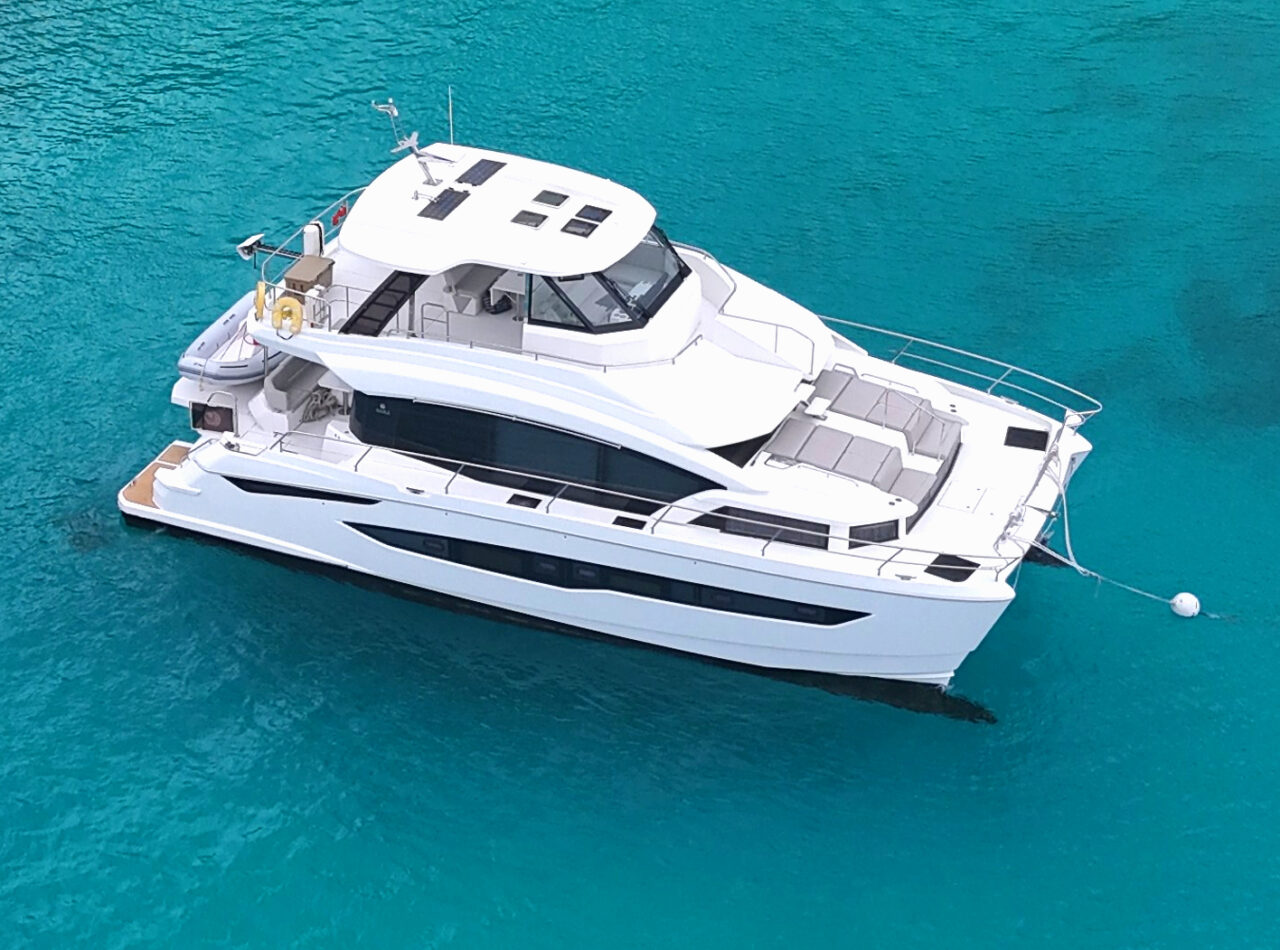

If you're researching larger power catamarans for a BVI bareboat charter, there's a good chance you've come across the Aquila 545.
At Virgin Charter Yachts, we actually operate an Aquila 545 in our BVI bareboat fleet—Southern Cross—so rather than reviewing the model from a manufacturer's brochure or a boat-show walkthrough, we can tell you how we think the layout works for real charter groups.
The short version?
The Aquila 545 offers an exceptional amount of living space, a huge flybridge, a main-deck primary cabin and accommodations for up to 10 guests. We particularly like the layout for families and mixed groups.
But there is one important thing to understand before booking one:
While the Aquila 545 has five guest cabins, the fifth cabin is a bunk cabin rather than another traditional queen cabin.
For a family with children or teenagers, that can be an excellent layout.
For five adult couples, we'd probably also show you some of our Aventura powercats with five true double cabins.
That's one of the advantages of chartering with a company that operates several different brands of power catamarans—we don't need to tell you that one particular model is right for everyone.
Here's what we think you should know about the Aquila 545 before choosing one for your BVI charter.
How Big Is the Aquila 545?
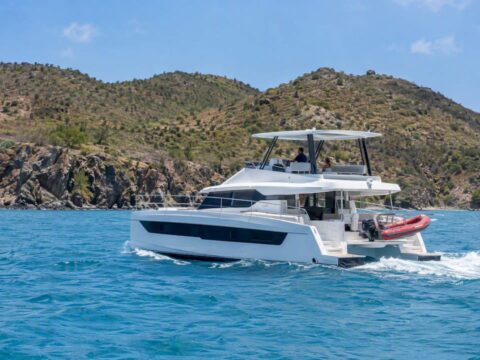
At approximately 54 feet long with a 25-foot beam, the Aquila 545 is a substantial power catamaran.
But length alone doesn't really explain how large the boat feels.
The wide beam, large salon, expansive flybridge and multiple outdoor living areas create a tremendous amount of usable space.
For a group of eight to ten people, that's important.
There are places where everyone can comfortably spend time together, but there's also enough space that the entire group doesn't have to sit in the same area all day.
That's one of the biggest differences you'll notice when comparing the Aquila 545 with smaller powercats.
What Is the Aquila 545 Cabin Layout?
This is where we think it's important to look beyond the simple description “5 cabins / 5 heads / sleeps 10.”
Not all five-cabin layouts are the same.
Our Aquila 545, Southern Cross, accommodates up to 10 guests in:
- One main-deck primary cabin
- Three queen guest cabins
- One guest cabin with bunk beds
- Five guest heads
That makes the yacht very versatile, but it also means who is traveling matters.
Ten guests consisting of parents, grandparents and children may love this layout.
Five adult couples may have different priorities.
That's why we always ask about the makeup of your group rather than simply asking how many people are coming.
The Main-Deck Primary Cabin Is a Standout Feature
One of our favorite features of the Aquila 545 is the primary cabin located forward on the main deck.
On many catamarans, all of the guest cabins are located down in the hulls.
The Aquila does something different.
The primary suite is accessed directly from the main living level, which gives it a very different feel from a traditional hull cabin.
For parents, grandparents or the couple taking the primary suite, it can be a significant selling point.
It also helps explain why simply comparing the number of cabins between two powercats doesn't tell you which yacht has the better layout for your group.
Is the Aquila 545 Good for 10 Guests?
Yes—but it depends on who those 10 guests are.
This is probably the most important thing we would tell someone considering this yacht.
For a family or mixed group of 10, the Aquila 545 can be an excellent choice.
For example, imagine:
- Parents in the main-deck primary cabin
- Grandparents in one queen cabin
- Another adult couple in a queen
- Two additional adults in the third queen
- Two children or teenagers in the bunk cabin
That layout can work extremely well.
The bunk room gives younger guests their own space without using one of the traditional double cabins.
But if your group is five adult couples, we would probably recommend comparing the Aquila 545 with some of our other powercats before making a decision.
Is the Aquila 545 a Good Choice for Five Couples?
It can accommodate five couples, but it wouldn't necessarily be our first recommendation.
The reason is simple:
The fifth cabin has bunk beds.
If five couples are splitting the charter equally, there's an obvious question:
Who gets the bunk room?
For groups of five couples, we generally prefer to show you layouts with five true double cabins so everyone has a more comparable sleeping arrangement.
For example, some of our Aventura powercats are particularly well suited to groups of five couples because they provide five double guest cabins.
This doesn't make the Aventura universally “better” than the Aquila.
It simply makes the layout better suited to that particular group.
That's an important distinction.
Where the Aquila 545 Really Shines: Families
If we were choosing the type of group that gets the most benefit from the Aquila 545 layout, larger families would be near the top of the list.
The bunk cabin that may be less desirable for an adult couple can be exactly what a family wants for children or teenagers.
At the same time, the adults still have proper queen cabins and the beautiful main-deck primary suite.
The yacht also has plenty of communal living space, which matters when eight or ten people are spending a week together.
Everyone can gather for meals or drinks, but there are also enough separate areas for people to spread out.
For a multigenerational family or two families traveling together, that combination can work extremely well.
The Flybridge Is One of the Best Features of the Aquila 545
One of the reasons guests are drawn to larger powercats is the amount of outdoor living space, and the Aquila 545 delivers particularly well here.
The flybridge is enormous.
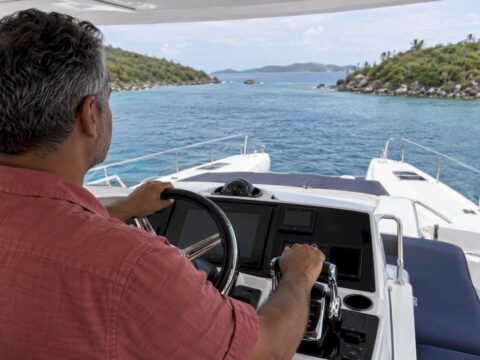
Rather than simply being a helm station with a couple of seats, it's another major social area aboard the yacht.
That means part of the group can be upstairs enjoying the view while others are in the cockpit, salon or forward area.
In the BVI, where so much of your vacation is spent outside, we think this matters considerably more than some of the technical specifications people focus on when comparing boats online.
You're not buying the yacht.
You're living on it for a week.
The question isn't only how the boat performs.
It's whether ten people can comfortably enjoy spending seven days aboard.
Why Powercats Work So Well in the BVI
The Aquila 545 is a purpose-built power catamaran rather than a sailing catamaran with the mast removed.
For BVI chartering, powercats offer some practical advantages.
You're not dependent on the wind to determine your route, and you don't need to tack back and forth to reach a destination.
You generally point the yacht where you want to go and head there.
VCY guests typically operate our powercats in approximately the 10–18 knot range, depending on the yacht and conditions.
Because BVI destinations are relatively close together, that means you can spend more of the day enjoying the islands and less of it getting from one destination to another.
Is the Aquila 545 Difficult to Operate?
It's important to put this in perspective.
The Aquila 545 is a 54-foot powercat with a 25-foot beam.
This isn't the yacht we'd recommend to someone whose boating experience consists primarily of operating a 22-foot runabout.
But for an appropriately experienced powerboat operator, twin-engine powercats can be very intuitive to maneuver because the engines can be operated independently.
We review the proposed skipper's boating experience before approving any bareboat charter and will let you know whether we think a particular yacht is appropriate for your experience.
After your detailed onboard yacht briefing at Nanny Cay, one of our checkout captains travels aboard with you, as an on-water check out is required and included in your charter.
You'll demonstrate close-quarter maneuvering and then continue to Norman Island, where your group demonstrates picking up and properly securing a mooring ball.
The checkout captain then makes their own way back to Nanny Cay.
So the checkout doesn't mean sacrificing your first charter day.
Learn more about experience requirements, checkout captains and preparing for your charter in our BVI Bareboat Charter Guide.
What About the Aquila 545's Fuel Consumption?
This is a large power catamaran, so it will naturally use more fuel than a smaller powercat.
We don't think that needs to be turned into a reason not to charter one.
It's simply something to understand when comparing yacht sizes.
If your highest priority is minimizing fuel consumption, a smaller powercat will generally make more sense.
If your priorities are space, a large flybridge, five guest cabins and the comfort of a 54-foot powercat, then higher fuel consumption is part of choosing a larger yacht.
We would make the same point when comparing a large SUV with a small car: more size and power generally come with greater fuel use.
The question is which features matter most to your group.
Aquila 545 vs. Aventura 50: Which Is Better?
Neither is universally better.
They work particularly well for different groups.
For a family or mixed group that can make good use of the Aquila's bunk cabin, the Aquila 545 can be a fantastic option. You get the main-deck primary suite, tremendous living space and a very large flybridge.
For five adult couples, we would generally give the Aventura 50 serious consideration because its layout can provide five true double cabins.
This is why we don't recommend choosing a powercat based solely on length or maximum guest capacity.
The Aquila is longer.
But for five couples, the Aventura's cabin configuration may matter more than those additional feet.
Aquila 545 vs. Aventura 56: Which Should You Choose?
The Aventura 56 is another large powercat worth comparing if your group wants substantial space.
Again, we'd start with the people traveling, not the manufacturer's specifications.
How many couples?
Are children coming?
Does everyone need a double bed?
How important is the primary cabin?
Which outdoor spaces does your group prefer?
What yacht features matter most?
Once we know those answers, it's much easier to determine which layout makes sense.
Aquila 545 vs. Leopard 53: What's the Difference for Charter Guests?
The Leopard 53 is another excellent large BVI bareboat powercat, but its layout is different.
The important thing when comparing the two isn't simply 54 feet versus 53 feet.
Look at:
- Where everyone will sleep
- How the guest cabins compare
- Outdoor living areas
- Flybridge layout
- Water access
- The number and configuration of heads
- Which features matter to your particular group
We'd rather have you choose a slightly smaller yacht with the perfect layout than a larger yacht that doesn't work as well for the people traveling.
Should You Choose a Smaller Powercat Instead?
Possibly.
Bigger isn't automatically better.
If you have six guests, you may not need five cabins and 54 feet of yacht.
A smaller powercat may cost less to charter, use less fuel and still provide plenty of room for your group.
On the other hand, some guests simply enjoy having additional space.
A group of six can absolutely charter an Aquila 545 if they love the yacht and want the additional living areas.
There's no rule saying every cabin needs to be occupied.
The question is whether the additional space and features are worth the additional cost to you.
Who Is the Aquila 545 Best For?
We think the Aquila 545 is particularly worth considering if:
- You're traveling with a larger family or mixed group.
- You need accommodations for up to 10 guests.
- Children or teenagers can use the bunk cabin.
- A main-deck primary suite appeals to your group.
- You want a very large flybridge and substantial outdoor living space.
- You value space more than minimizing fuel consumption.
- Your skipper has appropriate experience for a large powercat.
We would probably steer you toward comparing other layouts if:
- You're five couples and everyone wants a traditional double cabin.
- Your skipper's experience isn't appropriate for a yacht of this size.
- You're a small group primarily concerned with keeping the charter and fuel costs as low as possible.
That's not a criticism of the Aquila.
The best charter yacht isn't the biggest or most expensive yacht. It's the yacht whose layout and features best match your group.
Frequently Asked Questions About the Aquila 545
How many guests can the Aquila 545 accommodate?
VCY's Aquila 545, Southern Cross, accommodates up to 10 bareboat guests in five guest cabins with five heads.
Does the Aquila 545 have five queen cabins?
No. Southern Cross has a main-deck primary cabin, three queen guest cabins and one bunk cabin.
This distinction is particularly important for groups of five couples.
Is the Aquila 545 good for families?
Yes. In fact, we think families and multigenerational groups are where this particular five-cabin layout can work especially well. Children or teenagers can use the bunk cabin while the adults occupy the primary and queen cabins.
Is the Aquila 545 good for five couples?
It can accommodate five couples, but we would also show you powercats with five true double cabins, particularly the Aventura models, before you make a decision.
Is the Aquila 545 good for eight guests?
Yes. Eight guests have considerable space aboard and may not need to use every guest cabin, depending on the makeup of the group.
Is the Aquila 545 too big for six guests?
Not if you want the extra space. Six guests certainly don't need a 54-foot, five-cabin powercat, but some groups specifically choose larger yachts for the additional living space and amenities.
Does the Aquila 545 have a main-deck master?
Yes. One of the standout features of the Aquila 545 layout is the primary cabin located forward on the main deck rather than down in one of the hulls.
Is the Aquila 545 difficult to maneuver?
It's a large yacht and requires appropriate boating experience. However, experienced powerboat operators often find twin-engine powercats intuitive because each engine can be controlled independently. VCY reviews the skipper's boating resume before approving the charter.
Is an on-water checkout required?
Yes. Southern Cross is one of VCY's Platinum yachts and requires an included on-water checkout. Your checkout captain travels with you from Nanny Cay toward Norman Island, so the checkout becomes part of your first day's journey rather than keeping you at the dock.
Does the Aquila 545 use a lot of fuel?
A 54-foot powercat will naturally consume more fuel than a smaller powercat. If fuel economy is a primary concern, we'd recommend comparing smaller models. If space and amenities matter more, the additional fuel consumption is part of choosing a larger yacht.
Is an Aquila 545 or Aventura better for 10 guests?
It depends on the group.
For a family or mixed group, the Aquila 545's main-deck primary cabin and bunk cabin can work extremely well.
For five couples, we'd generally compare it closely with an Aventura offering five traditional double cabins.
Comparing an Aquila Charter with Virgin Charter Yachts vs. MarineMax
If you're specifically looking for an Aquila powercat in the BVI, you may also be comparing Virgin Charter Yachts with MarineMax Vacations.
One of the biggest differences is yacht selection. MarineMax specializes in Aquila powercats, while Virgin Charter Yachts operates a multi-brand powercat fleet including Aquila, Aventura, Leopard and Fountaine Pajot.
That means if the Aquila 545 is the best fit for your group, we're happy to recommend it. But if another brand offers a cabin layout, size or features that better suit your group, we can show you those options too.
Read our full comparison: Virgin Charter Yachts vs. MarineMax Vacations
Can We Help You Decide If the Aquila 545 Is Right for Your Group?
Absolutely.
One of the advantages of booking through Virgin Charter Yachts is that we aren't limited to one brand of powercat.
Our BVI bareboat fleet includes powercats from Aquila, Aventura, Leopard and Fountaine Pajot.
That allows us to start with your group and recommend the yacht that actually fits rather than trying to fit every group onto the same brand.
Tell us:
- How many guests are traveling?
- How many couples?
- Are children or teenagers coming?
- How many true double cabins do you need?
- What is your skipper's boating experience?
- Which yacht features matter most?
- What is your approximate budget?
If the Aquila 545 is the best fit, we'll tell you why.
If an Aventura, Leopard or Fountaine Pajot makes more sense for your group, we'll show you that instead.
Because choosing the right BVI powercat isn't about finding the biggest boat. It's about finding the right boat for the people you're bringing with you.
Did You Know?
The BVI are only accessible by boat. Check out our charter yachts that can get you there. View Our Fleet