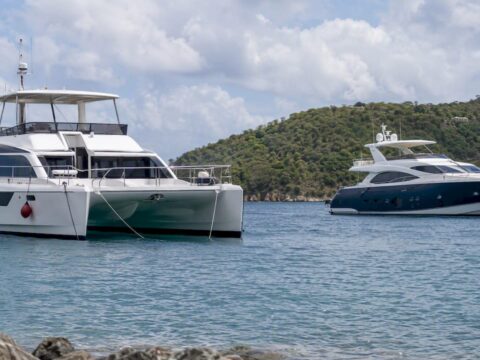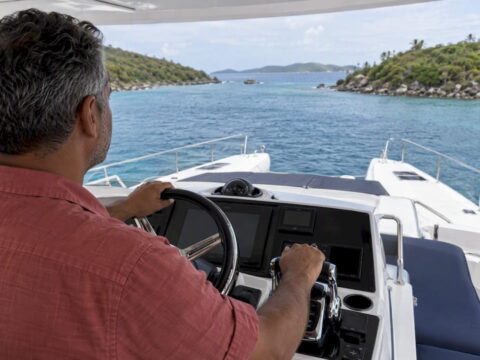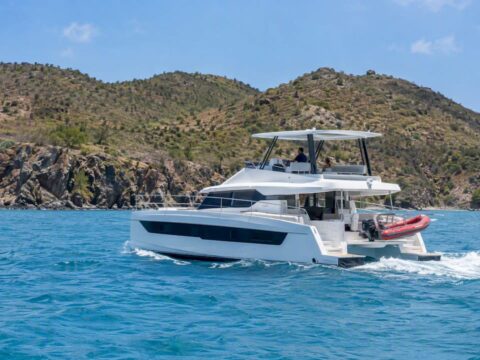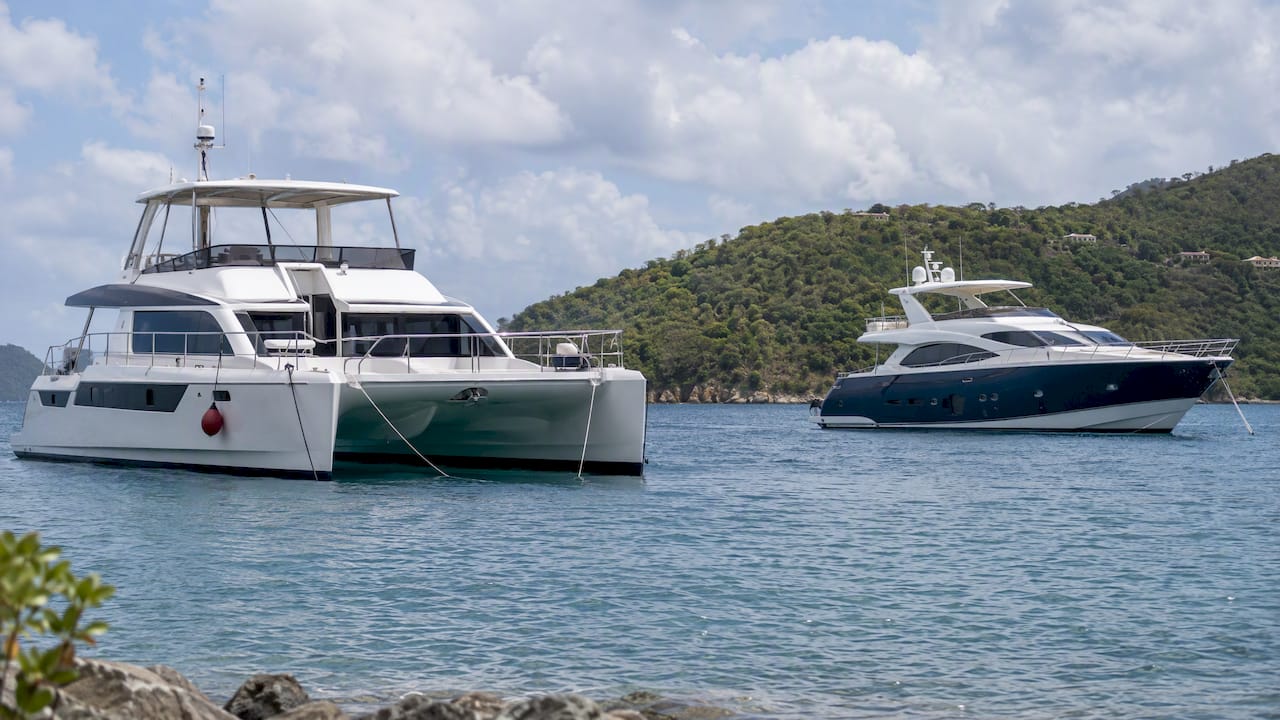

A power catamaran has two hulls and twin engines. A motor yacht has one hull and is built around its engines and its decks. For a British Virgin Islands charter, that single difference decides how much space you get, how the boat feels at anchor, how it handles in a tight harbor and what the week costs. Most families and groups heading to the BVI are better served by a power cat. Guests who want a full crew and a multi-deck yacht often prefer a motor yacht. Below we explain why, with numbers where they exist.
TL;DR
- A power catamaran has two hulls, no mast and no sails. A motor yacht is a single-hull vessel powered by engines, usually with more decks and a crew.
- Power cats give you a wide, flat platform: more living space per foot of length, a steadier ride at anchor and easy maneuvering with engines set far apart.
- Motor yachts suit guests who want multiple decks, separate lounges and a professional crew looking after everything.
- Our published bareboat power cat rates run from £6,000 to £20,000 per week. Crewed catamarans and motor yachts run from $25,000 to $120,000 per week.
- Choose by guest count, cabin needs and how much service you want, not by the word “yacht” alone.
Table of Contents
- What a power catamaran actually is
- What a motor yacht is, and how the hull changes everything
- Side-by-side: power catamaran vs motor yacht
- Space and cabins
- Stability and comfort at anchor
- Speed, handling and fuel
- Bareboat or crewed: the real dividing line
- What a BVI charter costs: how to compare rates
- Which one fits your trip
- Our perspective
- Plan your BVI charter with us
- FAQ
- Sources
What a power catamaran actually is
A catamaran is a boat with two hulls. A power catamaran, also called a multihull powerboat, drops the mast and sails and carries larger engines than a sailing cat. Those engines give it a higher top speed, and the hulls are reinforced to handle the extra weight and power.
In practice, you get a boat that looks like a floating apartment. The two hulls are joined by a bridge deck that carries the main salon, galley and a large cockpit. Cabins sit in the hulls, usually with their own heads. The helm is up on the flybridge or inside the salon, depending on the model.
The fleet we charter in the BVI is built around this layout. It includes modern power cats from Fountaine Pajot, Leopard, Aquila, Aventura, Lagoon, Horizon and Two Oceans. If you want to see how the choice looks against a sailboat, our guide to power catamaran vs sailing catamaran covers that comparison.
What a motor yacht is, and how the hull changes everything
A motor yacht is a single-hull vessel powered mainly by engines. The hull shape is the key difference. According to Discover Boating, multihulls have separate, distinct hulls, while larger cruising motor yachts lean toward semi-displacement hulls.
A single hull is deep and narrow compared with a catamaran. That gives a motor yacht a classic profile and often a more traditional layout. Larger motor yachts tend to spread across several decks, with a master suite, separate dining and lounge areas, and room for crew quarters.
In the BVI, the term “motor yacht” covers a wide range. It can mean a compact single-hull cruiser or a large, fully crewed luxury vessel. Our motor yacht charter in the BVI page shows what we offer at the top of that range.
Side-by-side: power catamaran vs motor yacht
| Factor | Power catamaran | Motor yacht |
|---|---|---|
| Hulls | Two, widely spaced | One |
| Layout | Wide single-level living, cabins in the hulls | Often multiple decks, separate lounges |
| Stability at anchor | Very steady, wide beam | More roll in a swell, depends on size and stabilizers |
| Maneuvering | Twin engines set far apart | Depends on the vessel and its thrusters |
| Typical charter style | Bareboat or crewed | Usually crewed |
| Best for | Families, friends, multi-island trips | Guests wanting a full-service, multi-deck yacht |
The table is a guide, not a rule. Individual boats vary, so use it to decide what to ask about, then look at the specific yacht.
Space and cabins
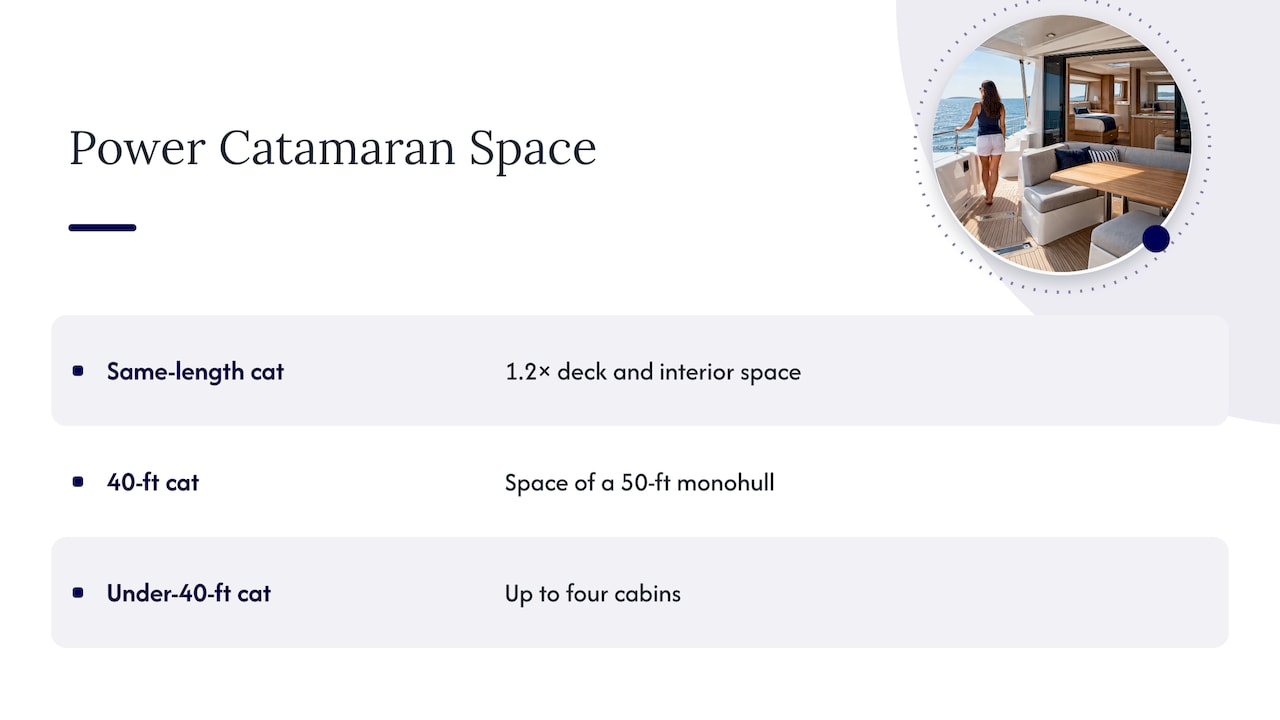
Space is where power cats win most clearly. Discover Boating reports that catamarans provide about 1.2 times the deck and interior space of a same-length monohull. Its example is a 40-foot cat with roughly the space of a 50-foot monohull. It also notes a cat can offer up to four cabins under 40 feet.
That matters for a group. On a single hull of the same length, cabins are usually smaller and the salon is tighter. On a cat, the salon and cockpit are broad and open, and each hull holds its own cabins, so guests are not on top of one another.
If you are traveling with eight people, cabin count becomes the deciding factor. We cover that in detail in why four cabins come first for eight guests. For sizing a boat from your guest list, converting guests into exact length targets helps.
Where a motor yacht pulls ahead is in how its space is organized. Larger motor yachts often offer multiple decks, separate living and dining areas, entertainment systems and professional crews. If you want a formal dining room or an upper sun deck apart from the main lounge, a motor yacht gives you more ways to split the day.
A direct comparison of the two options on a charter is on our page about motor yacht vs power cat space.
Stability and comfort at anchor
Most BVI charter days end in a quiet bay, so stability at anchor matters more than top speed. Catamarans are flat. Discover Boating says the wide-set twin hulls give power cats greater stability underway and at rest. BGS Marin adds that the wider beam gives a higher righting moment, which helps prevent rolling at anchor and keeps the boat level underway without trim tabs.
For you, that means a few practical things:
- Cooking in the galley is easier because things stay put.
- Sleeping is better in an overnight swell.
- Children and less confident guests move around the boat more safely.
- The cockpit stays a usable dining table rather than a tilting platform.
A single-hull motor yacht can be very comfortable, especially a larger one. But a narrower hull rolls more at anchor than a wide cat does, so it relies on its size and equipment to compensate.
Speed, handling and fuel
A power cat is not a racing boat, but it is efficient for its size. Discover Boating reports average fuel efficiency 20 to 30 percent better than comparable boats, despite having two engines. It also notes that twin engines set far apart improve maneuverability, which helps when you are picking up a mooring ball or backing into a marina slip.
There are trade-offs, and an honest comparison names them. The same source lists:
- It can be harder and more expensive to find dock space for a wide boat.
- The bridge deck can slam in head seas.
- Performance drops when the boat is overloaded or unevenly loaded.
In practice, this means packing sensibly. Spread heavy provisions and gear evenly, and keep the load within what the boat is built for. If you are chartering a bareboat, we walk you through that in your briefing.
Motor yachts vary far more. A large crewed yacht may have impressive range and a smooth, deep-hull ride, but it will usually burn more fuel per hour than a cat of similar size. Your crew handles that, and fuel is one of the line items to check in a crewed quote.
Bareboat or crewed: the real dividing line
In the BVI, the choice between a power cat and a motor yacht often follows another choice: do you want to run the boat yourself, or have someone run it for you?
Power cats are available both ways. A bareboat charter means you rent the boat without a professional crew. If you want help, you can add a captain. Our published rates are $250 per day for a standard captain and $300 per day for a training captain, listed on our charter costs page. Our bareboat charter requirements and captain guide explains who needs one.
Motor yachts, especially larger ones, are most often chartered with a full crew. That removes the navigation and docking from your plate, along with the meals and cleanup. If you are weighing that level of service, it helps to understand how luxury travel differs from mainstream options in general: the value is in personal service as much as in the vessel.
A second dividing line is the crew-to-guest relationship. On a crewed power cat, the crew is small and the atmosphere is intimate. On a larger motor yacht, you may have a bigger team with specialist roles. Neither is better. It depends on whether you want a private-home feel or hotel-style service.
What a BVI charter costs: how to compare rates
Price comparisons go wrong when the quotes cover different things. Before you compare two boats, make sure you are comparing the same package.
Here are our published weekly rates, as listed on our site.
Bareboat power catamarans (see bareboat pricing):
| Boat | Weekly rate |
|---|---|
| 3-Cabin Power Catamaran | £6,000 to £10,000 |
| 4-Cabin Power Catamaran | £8,000 to £14,000 |
| 5+ Cabin Luxury Power Catamaran | £12,000 to £20,000 |
Crewed catamarans and motor yachts (see crewed pricing):
| Boat | Weekly rate |
|---|---|
| Premium Catamaran (4 to 6 guests) | $25,000 to $35,000 |
| Luxury Catamaran (6 to 10 guests) | $35,000 to $70,000 |
| High-End Luxury Catamaran / Motor Yacht | $70,000 to $120,000 |
The range within each band reflects the yacht, its age and size, and the season. The bareboat rates are in pounds and the crewed rates are in dollars, so convert at the current rate when you compare.
When you set quotes side by side, check these items:
- Crew. Is a captain, chef or deckhand included, or priced separately? A captain is $250 per day on our standard rate.
- Fuel. Is it included, or billed at the end of the week?
- Provisions. Bareboat guests usually stock the boat. Crewed charters have food and drink arrangements that differ by package.
- Extras. Wi-Fi on our charters is $250 one-off per charter, as noted on our what’s included page.
- Taxes and fees. Ask what is added on top of the base rate.
- Season. Rates move within the published ranges depending on when you go.
A bareboat power cat is generally the lower-cost way into the BVI. A fully crewed motor yacht sits at the top of the range because the price carries crew, service and a larger vessel. Our full charter cost breakdown shows what each line covers.
Which one fits your trip
Families with children
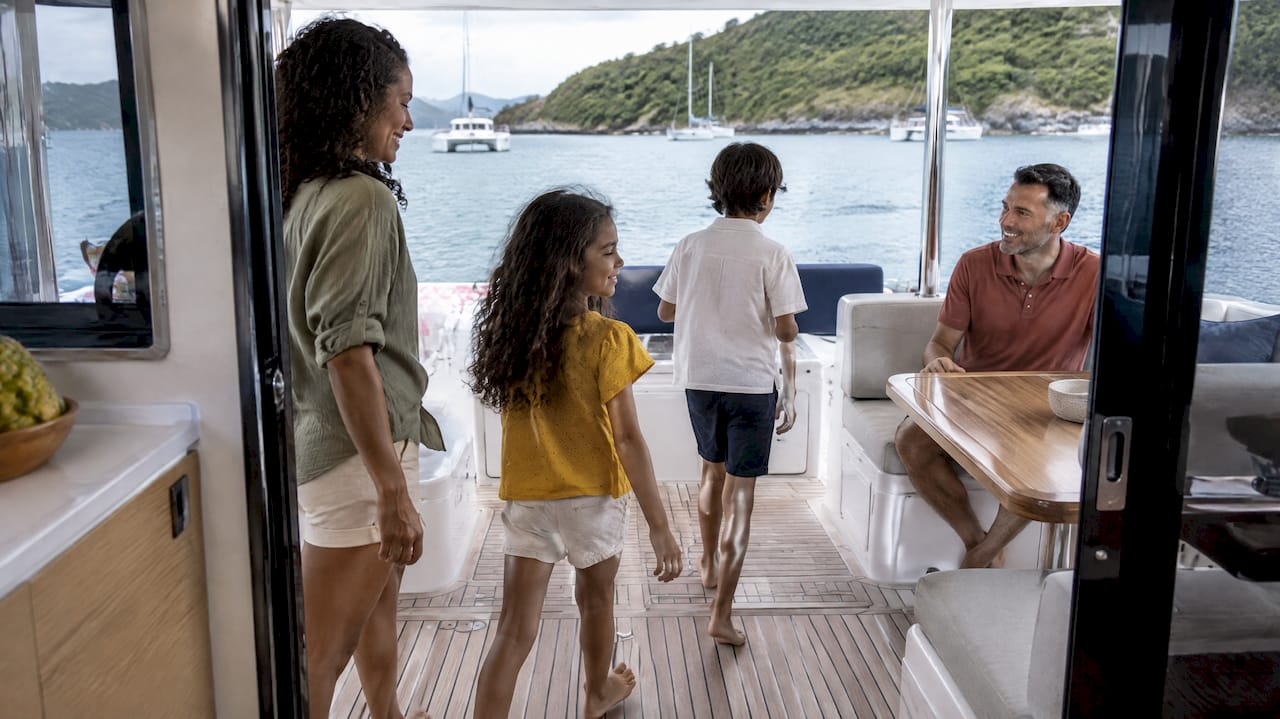
A power cat is usually the right call. The flat ride, wide decks and separate hulls give children room to move and parents a place to retreat. You can see what we offer in our family yacht charter in the BVI page. A writer in Cruising World described an Aquila 54 power cat in the BVI as exceptionally comfortable for a family, while noting it lacked the serenity of sailing. That is a fair trade-off to keep in mind.
Couples
Couples can go either way. A smaller crewed catamaran gives privacy and a romantic setting, while a motor yacht gives a more formal, hotel-like stay. If you want a private cabin and a quiet cockpit for sunset, a power cat has plenty of room for two.
Groups of friends
Four to eight adults sharing a boat need cabins with their own heads and a large social space. Power cats are built for this, and four-cabin layouts are common. Check the cabin count before the boat length.
Guests who want full service
If you do not want to think about navigation, meals or mooring, a crewed charter makes sense. Both a luxury catamaran and a motor yacht can deliver that. Our luxury crewed charters page shows the options.
Island-hoppers
If you want to cover many anchorages in a week, handling matters. Twin engines set wide apart make a power cat nimble in harbor, and efficient fuel use helps when you move each day. Our island guide and guide to navigating the BVI help you plan the route.
Our perspective
We have been based on Tortola since 1996, and we are a family-owned operation. Over that time, we have watched guests step aboard expecting one thing and discover they wanted another.
Here is what we tell people. Do not start with the boat type. Start with the people. How many of you are there, how many cabins do you need, and who wants to be on holiday rather than at the helm?
For most groups of friends and families, a power cat is the answer. It gives you the space, the steady ride at anchor and the easy handling in the harbors you will visit. That is why our fleet is built around modern power catamarans, and why we keep them carefully maintained.
For guests who want a larger, multi-deck vessel and a professional crew, a motor yacht is a good choice, and we can arrange it. The key is to be honest about what you want from the week. If you want to cook, swim and run the boat with your family, choose a bareboat or captained cat. If you want to be looked after, choose crewed.
We would rather match you to the right boat than sell you the most expensive one. Tell us your guest list and your dream week, and we will tell you plainly which type fits.
— alexia
Plan your BVI charter with us
If you are ready to compare boats, we can help you choose between a power catamaran and a motor yacht based on your group, your budget and your itinerary. Start with our bareboat charter pricing if you want to run the boat yourself, or our crewed charter pricing for a full-service week. You can also request our e-brochure to see the yachts in detail, or contact us through Virgin Charter Yachts to talk it through with our team.
FAQ
What is the difference between a catamaran and a regular boat?
A catamaran has two hulls joined by a deck, while a regular single-hull boat has one. The twin hulls give a catamaran a wider, flatter platform. Discover Boating reports that this gives about 1.2 times the deck and interior space of a same-length monohull.
Do catamarans have bathrooms?
Yes. Charter catamarans and motor yachts have marine heads, and larger boats usually give each cabin its own. The exact setup depends on the yacht, so check the cabin and bathroom layout of the specific boat before you book.
Is a power catamaran cheaper than a motor yacht in the BVI?
Usually, yes at the entry level, because bareboat power cats are chartered without a full crew. Our bareboat power cat rates run from £6,000 to £20,000 per week, while our top crewed catamaran and motor yacht band runs from $70,000 to $120,000 per week. A crewed power cat falls between the two, so compare what each quote includes.
Do I need a captain to charter a power catamaran?
Not always. Requirements depend on your experience and the yacht, and our bareboat requirements page explains them. If you want a captain, our standard rate is $250 per day, and a training captain is $300 per day.
Sources
- Catamaran Boats | Discover Boating
- Boat Hull Types | Discover Boating
- Power Catamaran vs Motor Yacht | BGS Marin
- The Multihull Mystique | Cruising World
- Why Luxury Cruises Differ From Mainstream | Hidden Door Travel
Recommended
- Power Catamaran vs Sailing Catamaran for a BVI Charter
- Monohull vs Catamaran: Which Should You Choose?
- 15–25% More Space: Motor Yacht or Power Cat for Your Charter
- Motor Yacht Charter BVI | Luxury Yachts in the British Virgin Islands
Did You Know?
The BVI are only accessible by boat. Check out our charter yachts that can get you there. View Our Fleet