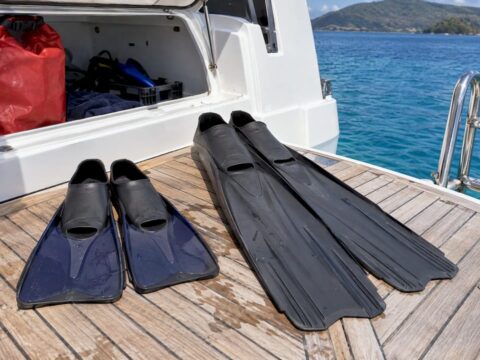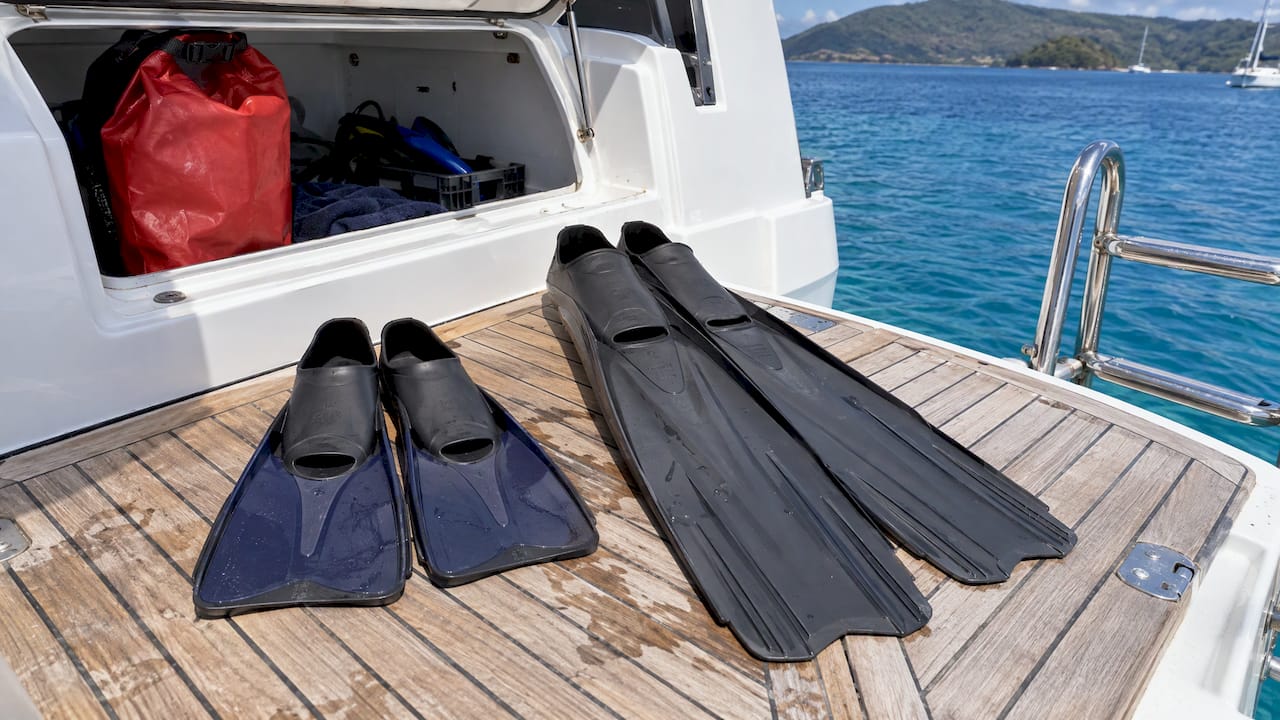

For most people snorkeling from a yacht in the Caribbean, the best choice is a short or mid-length blade that still pushes real water, not an extra-long freediving fin. Long fins give more thrust per kick but need strong legs, take up suitcase space and sit closer to coral. Short fins pack easily and turn quickly, but the cheapest ones lack power if a current picks up. The sweet spot is a compact travel fin with a proper blade, and the rest of this guide shows how to decide.
The question comes up in two settings. Swimmers in a pool ask it for training reasons, and snorkelers ask it before a trip. We answer both briefly, then focus on the second, because a week on a charter yacht is where most of our guests will wear fins.
TL;DR
- Long fins (roughly 20 to 24 inches for swim fins, over 25 inches for scuba) give more thrust per kick. They suit strong swimmers, open water and currents.
- Short fins (roughly 12 to 16 inches) are lighter, easier to pack and quicker to maneuver. They suit calm bays, reef flats and casual snorkeling.
- Travel fins are a short-blade category. The better ones, such as the Scubapro Go Travel, keep good propulsion. The cheapest fitness or bodyboarding fins can fall short in a current.
- Fit matters more than length. Fins that are too tight or too loose cause blisters, so try them on with the socks or booties you will wear.
- For a yacht charter, pack a compact, well-reviewed short or mid-length fin, and bring a longer pair only if you are a confident swimmer planning long swims.
Table of Contents
- Short fins vs long fins at a glance
- How blade length changes your kick
- When long fins are the right call
- When short fins are the right call
- Travel fins vs regular fins
- How to choose for a charter week
- Getting the fit right
- Our view on fins for a BVI week
- Put the right fins on a boat that fits your trip
- FAQ
- Sources
Short fins vs long fins at a glance
| Short fins | Long fins | |
|---|---|---|
| Typical length | About 12 to 16 inches (SwimOutlet) | About 20 to 24 inches for swim fins; over 25 inches for scuba (Divinglore) |
| Power per kick | Lower | Higher |
| Effort | Faster, higher-tempo kick | Slower kick, but strong legs are needed |
| Maneuverability | Quick turns, good in tight spots | Wider turning, more care needed near reef |
| Packing | Often fits a carry-on | Often strapped to the outside of a bag |
| Best for | Calm bays, pool technique, casual snorkeling | Currents, long swims, freediving, scuba |
How blade length changes your kick
A fin is a lever. A longer blade has more surface to push water, so each kick moves you further. Divein’s tested guide, written by PADI-certified instructors, says longer blades use energy more efficiently because of their larger surface area, while shorter blades are easier to transport and better for travel. It adds that rounder, curved blades take less energy, and flat rectangular blades give more propulsion at higher energy cost.
The best hard evidence comes from lifeguards. A 2024 study in the Journal of Functional Morphology and Kinesiology had rescuers swim with long fins, short fins and no fins. Long fins gave significantly better rescue times: short fins were about 55 seconds slower than long fins and swimming with no fins was about 90 seconds slower. Rescuers in long fins also reported lower arm exertion. The authors note that shorter fins favor a higher kick frequency and lower energy expenditure per kick, so long fins win on speed over distance rather than on ease.
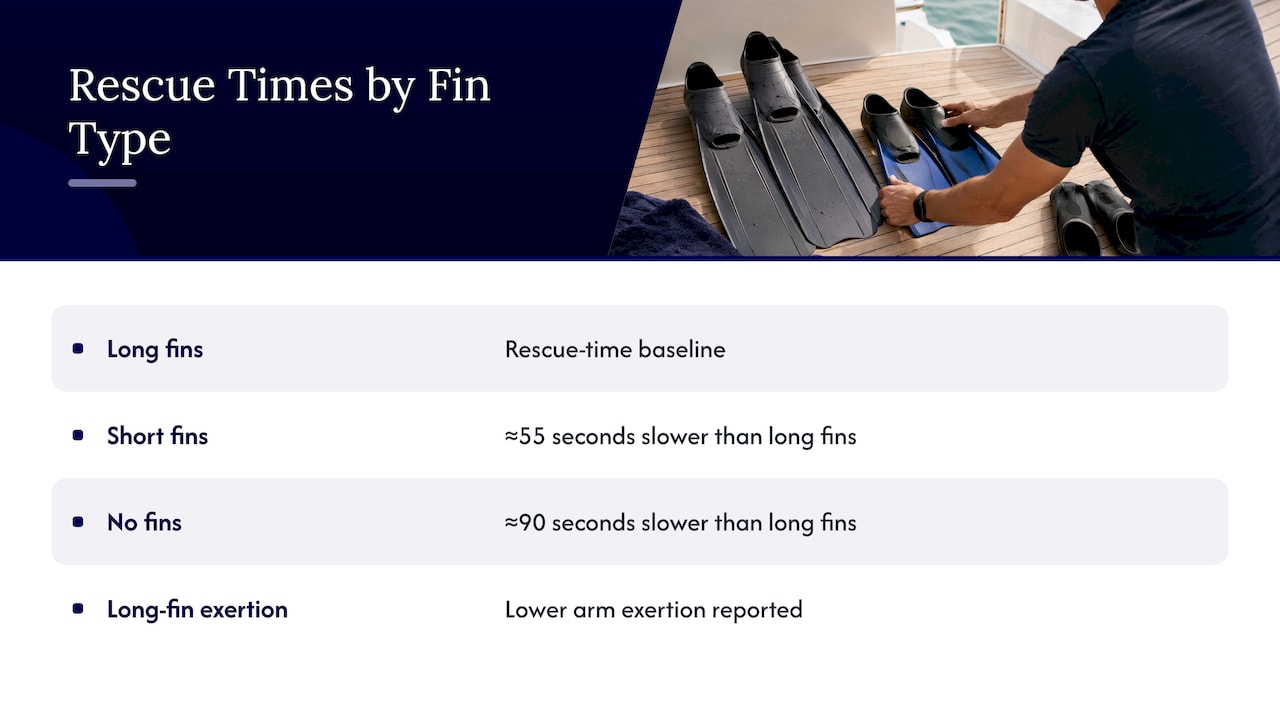
That is useful context for a vacationer. If you ever need to swim back against wind or tide to a dinghy or boat, a longer blade is the safer tool. If you are floating over a reef flat taking photos, you do not need that thrust.
Which muscles each length works
If you also swim laps at home, length changes the workout. An electromyography study summarized on ResearchGate found that with short fins the thighs and buttocks are activated more than the shanks, and that fin length influenced muscle activity significantly while stiffness did not.
U.S. Masters Swimming, in an article by TYR professionals, explains the training split. Long blades suit smooth drill work and help swimmers learn to kick from the hip. Short blades are ideal for speed work, keep your body position higher and feel closest to normal swimming. Kiefer Aquatics reaches a similar view: it recommends beginners start on long blades because the added resistance slows tempo and loads the legs, while short blades promote a faster kick tempo for experienced swimmers.
For a holiday, the takeaway is simple. Short fins make you work your hips and thighs at a quicker tempo. Long fins let each kick do more, if your legs can drive them.
When long fins are the right call
Long fins earn their space in three situations:
- A long swim out to a reef line. More thrust per kick means fewer kicks to get there.
- Current or surge. Bestsnorkelspots describes longer blades as trading maneuverability for thrust, a better pick for a coast with surge or a current on the way back.
- Freediving and scuba. Long fins are mainly recommended there, where they provide thrust and control.
The trade-offs are real. Divinglore points out that swimmers without the strength or technique will struggle, and that maneuvering takes skills like the helicopter turn and reverse kick. Yucca Fins warns that an overly long blade increases drag and stress on knees and hips during sustained kicking. CAPAS adds that long blades demand more muscular exertion, and that tiring in water cooler than your body can cut a trip short.
There is also a reef-care point. Snorkel Around the World advises against extra-long freediving fins for snorkeling because a longer fin can break coral easily in shallow reefs. It recommends medium-length blades instead. That matters in the British Virgin Islands, where much of the snorkeling is over shallow, living reef.
When short fins are the right call
Short fins are the better match when:
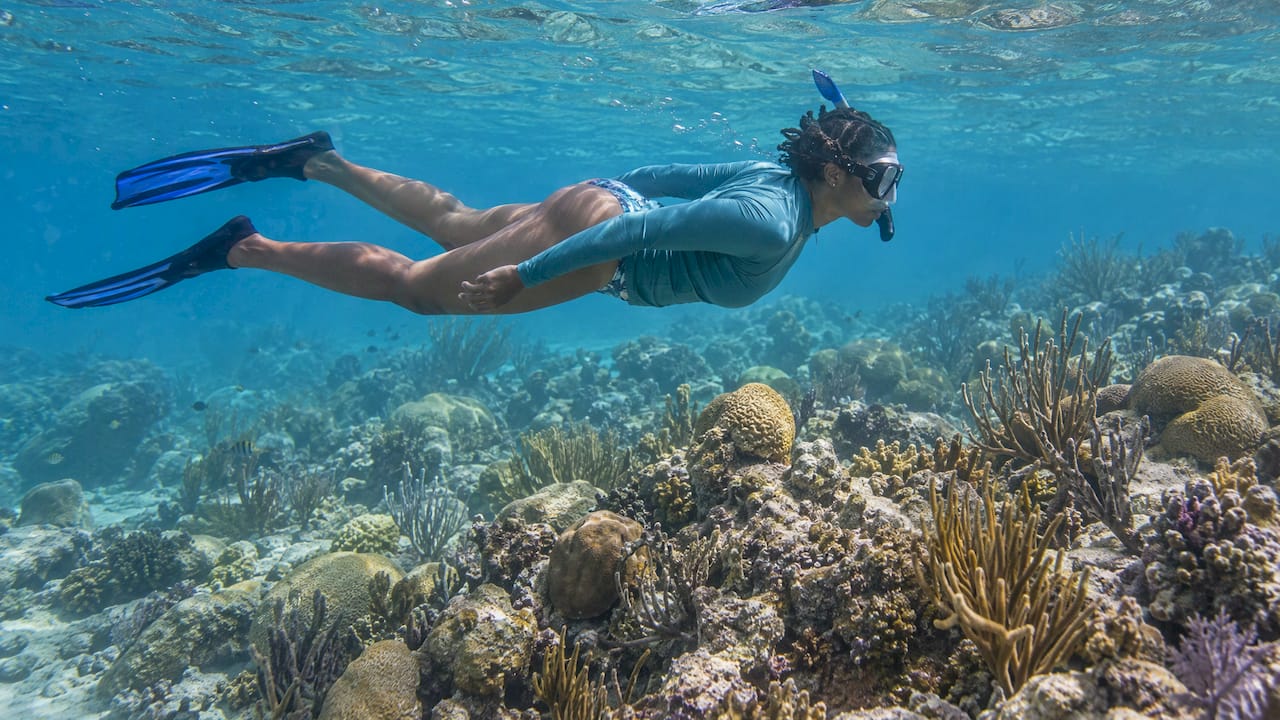
- You snorkel in calm bays, over reef flats or on short boat-day excursions.
- You want to turn quickly and stay clear of coral.
- You are a beginner or casual swimmer who wants less leg fatigue.
- You are packing light.
Swim2000’s 2026 guide describes short fins as zippier and easier to pack, needing less effort per kick, and suited to casual reef snorkelers who value maneuverability. Snorkel Pursuits says much the same for vacations: for reef flats, calm bays and short excursions, a short blade is the right call, and serious open-water swims or drift snorkeling justify the extra bulk.
The catch is power. Tropical Snorkeling’s 2026 hands-on tests warn that short travel fins, bodyboarding fins and fitness fins seriously lack power in the water, which matters for safety in a current. Its editors caution against buying short fins purely for luggage savings. So the answer is not simply “short”, it is “short with a real blade”.
Travel fins vs regular fins
Travel fins are short-blade fins designed to fit in a bag. The same Tropical Snorkeling review recommends the Scubapro Go Travel Fin and the SEAC Zoom as short fins that still have good propulsion, and notes that some open-heel fins fit a standard 22-inch carry-on. The gap between a good travel fin and a poor one is blade design, not just length.
On a yacht you also have a storage advantage. Cabin space is limited, so a compact pair that stows in a locker is easier to live with than a long pair that rolls around the saloon.
Real models and prices
Here are named fins sold in the United States, with the prices published by the retailers. Prices change, so check the listing before buying.
| Fin | Type | Listed price | Source |
|---|---|---|---|
| Akona Baja | Compact short TPR blade | $35 | Scuba.com |
| Cressi Palau Short Adjustable | Short, adjustable open-heel | $39.95 | Scuba.com |
| Cressi Palau Long Adjustable | Long, adjustable open-heel | $52.95 | Scuba.com |
| Scubapro Go Travel | Monprene, 25-degree pre-angled blade | $119 | Scuba.com |
| Cressi Agua Short | Full-foot travel fin | $36.95 | Captain Hook’s |
| Cressi Agua | Full-foot, longer blade | $44.50 | Captain Hook’s |
| Cressi Palau SAF Set | Short adjustable fins, mask and dry snorkel | $114.95 | Cressi America |
The pairs are instructive. Cressi sells both a short and a long Palau, and both an Agua and an Agua Short, so you can compare directly within one brand. Captain Hook’s positions the Agua Short as the easier-to-pack choice for warm-water snorkeling, carry-on packing and boat-day handling, and the longer Agua as the all-around vacation fin.
If you plan to snorkel with a dry snorkel or a full-face mask as well, see our guides on dry vs semi-dry snorkels and full-face vs traditional masks so the set works together.
How to choose for a charter week
Use these questions in order.
- How strong a swimmer are you? If you swim confidently and plan to cover distance, a mid-length or longer blade makes sense. If you mostly float and look, a short travel fin is plenty.
- Where will you snorkel? Sheltered bays and reef flats favor short blades. Exposed points with surge favor more thrust. Our ranking of BVI snorkeling spots shows what you will find at each stop, so you can match fins to the plan.
- How much room do you have? A carry-on-friendly short fin saves a checked-bag fee and a headache. A long pair may need strapping to the outside of a bag.
- Who is swimming? Children and mixed-ability groups do better in short or adjustable fins that match each person, because everyone keeps closer to the same pace.
- Will you dive? If scuba or SNUBA is on your list, longer scuba-style fins are the norm. Our comparison of SNUBA vs scuba explains which fits your group, and the diving and snorkeling overview covers the sites.
As a rule: if you pack only one pair, choose a short or mid-length fin with a proper, flexible blade from a known brand. If you are a strong swimmer who wants to roam, bring a longer pair and keep it off the coral.
Getting the fit right
The right length in the wrong size is the wrong fin. The CDC’s snorkeling guidance (archived 2023) says fins come in full-foot and open-heel types, should be snug but not too tight, since tight or loose fins may cause blisters, and should be flexible and lightweight. Booties are optional but protect your feet.
A quick fit check:
- Snug, not pinching. SwimOutlet compares it to a firm handshake and says that if you are between sizes, size up because feet swell during exercise.
- Full heel coverage. The same guide names an exposed heel as the top cause of fin blisters.
- The wiggle test. Your toes should move slightly without jamming against the end of the pocket.
- The tiptoe test. Scuba.com suggests standing on tiptoe: the fin should hug your heel and rise with your foot. If your heel lifts and leaves the fin behind, it is too large.
- Match your socks. If you will wear neoprene socks or booties, try the fins on with them, and size up to allow for the extra layer.
- Do not trust size labels across brands. US, European and “medium” labels are not interchangeable, so compare adjacent sizes and check heel retention, toe room and instep pressure.
Break the fins in at home or in a pool before you travel. A blister on day one is a long week.
Our view on fins for a BVI week
We have run family-owned charters out of Tortola for 30 years, since 1996, and the snorkeling questions we hear are always practical. How much do I pack? Will the kids keep up? Do I need the big fins?
Our answer is almost always the same. Your yacht is your base, so you can step off the stern at a quiet bay, swim a short loop and climb back aboard. That style of snorkeling rewards a light, maneuverable fin that you will actually wear, not the heaviest blade in the shop. The best pair is the one that fits well and gets used every day.
We build trips around the people on board. A couple after a quiet reef morning, a family with mixed swimmers and a group of friends chasing the next island all need different things. That is why we plan itineraries with each guest instead of handing out a standard route, and why the stops we suggest match how you want to swim.
Pack fins you have tried on, in the size that fits, and spend your energy on the water and the view.
alexia
Put the right fins on a boat that fits your trip
With fins sorted, the bigger decision is the yacht. Virgin Charter Yachts has operated in the British Virgin Islands and Caribbean since 1996, with a fleet of modern power catamarans from Fountaine Pajot, Leopard, Aquila, Aventura, Lagoon, Horizon and Two Oceans.
Bareboat weekly rates published on our site run from £6,000 to £10,000 for a 3-cabin power catamaran, £8,000 to £14,000 for a 4-cabin and £12,000 to £20,000 for a 5+ cabin luxury power catamaran, as shown on the bareboat pricing page. Crewed charters range from $25,000 to $35,000 per week for a premium catamaran for 4 to 6 guests, up to $70,000 to $120,000 per week for a high-end luxury catamaran or motor yacht, on the luxury crewed pricing page.

To compare boats side by side, use our yacht fleet comparison, or start from virgincharteryachts.com and tell us who is coming and how you like to spend a day on the water.
FAQ
Are longer or shorter fins better?
Neither wins everywhere. Longer fins give more thrust and suit strong swimmers, currents and scuba. Shorter fins are lighter, quicker to turn and easier to pack, which makes them the better fit for most calm-water vacation snorkeling.
What are travel fins, and are they as good as regular fins?
Travel fins are short-blade fins made to fit in luggage. Good ones, like the Scubapro Go Travel, keep decent propulsion. Very basic short fins can lack power in a current, so choose a model known for thrust.
What are long fins good for?
Long fins suit open-water swims, currents, freediving and scuba, where each kick needs to move you further. They also help swimmers practice a smooth, hip-driven kick and a strong dolphin kick, provided the legs are strong enough to drive them.
What muscles do short fins work?
An EMG study found that short fins activate the thighs and buttocks more than the shanks. The kick is quicker, so the hips and thighs do most of the work, and many coaches use them for tempo and technique.
Should I size up in fins?
If you fall between sizes, size up, because feet swell during exercise. Try them with the socks or booties you will wear, and check that the heel is fully covered and your toes are not jammed against the end.
Sources
- Do Longer Fins Improve Ocean Rescues? (MDPI, 2024)
- 11 Best Snorkeling Fins in 2026 (Divein)
- Muscle activity during fin swimming (ResearchGate)
- Finding the Right Training Fins (U.S. Masters Swimming)
- How to Choose Swim Fins (Kiefer Aquatics)
- How to Choose Swim Fins (SwimOutlet)
- Short Fins vs. Long Fins For Snorkeling (Divinglore)
- Snorkel Fins: How to Choose (Bestsnorkelspots)
- The Ultimate Guide to Choosing Swim Fins (Yucca Fins)
- How to Choose Snorkel Fins (CAPAS)
- Finding The Best Snorkeling Fins (Snorkel Around the World)
- 10 Best Swim Fins for Snorkeling (Swim2000)
- Best Snorkel Fins for Travel (Snorkel Pursuits)
- Best Snorkeling Fins, Hands-on Tests (Tropical Snorkeling)
- Best Fins For Travel (Scuba.com)
- Cressi Agua vs Agua Short (Captain Hook’s)
- Cressi Palau SAF Set (Cressi America)
- CDC: Physical Activity, Snorkeling (archived)
- Scuba & Snorkeling Fins: Guide to Types & Fit (Scuba.com)
- How Snorkel Fins Should Fit (Maui Snorkeling)
Recommended
- How to Pack for Your BVI Yacht Charter Vacation
- BVI Packing List for Yacht Charters: What to Bring
- BVI Bareboat Packing List: What to Bring & Skip
Did You Know?
The BVI are only accessible by boat. Check out our charter yachts that can get you there. View Our Fleet