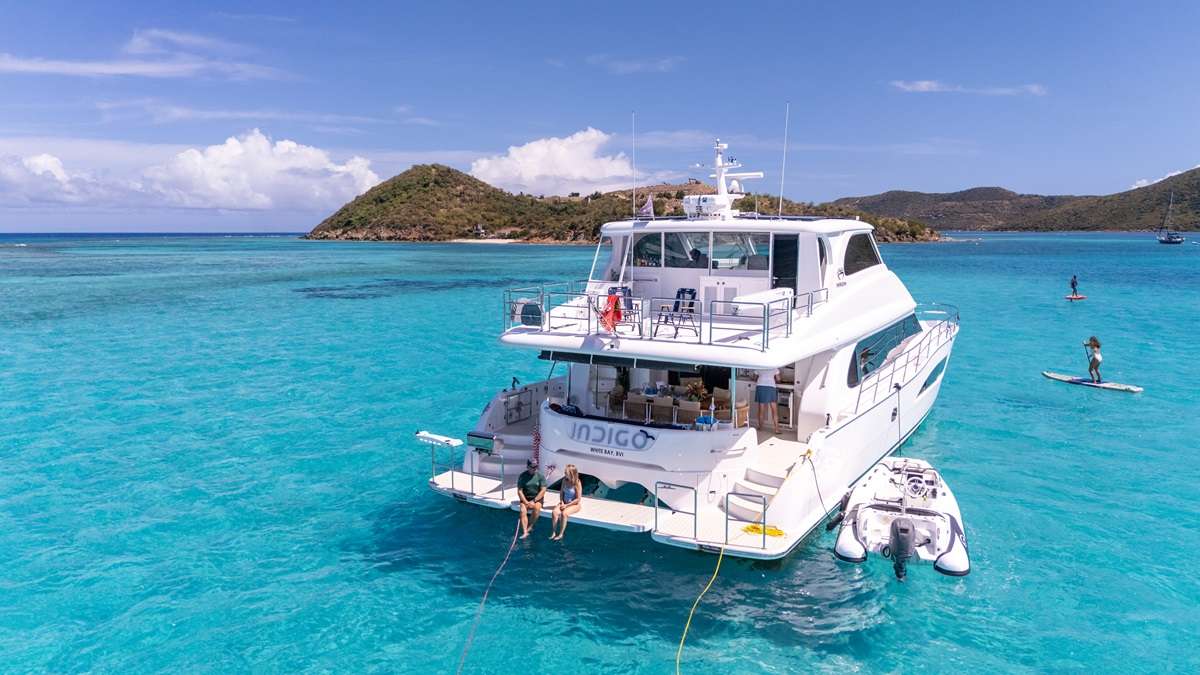

Planning your first yacht charter in the British Virgin Islands comes with a lot of questions.
Do you need a captain's license? What's actually included? How do you get to Tortola? Do you need to reserve mooring balls? What happens on the first day? And how do you know which yacht is right for your group?
Virgin Charter Yachts has been helping guests charter yachts in the BVI since 1996, and many of the same questions come up again and again.
Here are straightforward answers to 25 of the questions we hear most often from guests planning a BVI yacht charter.
1. What Is the Difference Between a Bareboat and Fully Crewed BVI Yacht Charter?
A bareboat charter means you charter the yacht and someone in your group is responsible for operating it. With VCY, our bareboat fleet consists of power catamarans, and we review the proposed skipper's boating experience before approving the charter.
A fully crewed yacht charter includes a professional captain and chef. The captain handles the yacht and itinerary, while the chef prepares your meals and the crew takes care of the day-to-day operation of the yacht.
There is also a middle option: you can charter a bareboat and hire a professional captain.
The biggest question is usually whether operating the yacht is part of the vacation you want or whether you'd rather have everyone in your group be a guest.
Learn more: Bareboat vs. Captain vs. Fully Crewed Yacht Charter
2. Do I Need a Captain's License to Bareboat Charter in the BVI?
Not necessarily.
What matters is your actual boating experience, particularly your experience operating vessels of a similar size and type.
Before approving a bareboat charter, we review your boating resume and experience. Someone who has substantial experience operating larger twin-engine powerboats may be very comfortable transitioning to a power catamaran even if they don't hold a professional captain's license.
If your experience isn't sufficient for the yacht you're considering, we can discuss other options, including hiring a professional captain.
Learn more: BVI Bareboat Charter Guide
3. How Much Boating Experience Do I Need to Charter a Powercat?
There isn't one specific number of years or one license that automatically qualifies every guest.
We look at the type and size of boats you've operated, how recently you've operated them, and your experience with close-quarter maneuvering, docking and other practical boat-handling skills. In general, we want to see ownership of a dual, in-board engine yacht of similar size and displacement - typically within 10' of what you are looking to charter.
A 50-foot powercat is very different from a small recreational boat, so we want to make sure the yacht you're considering is appropriate for your experience.
Tell us honestly about your boating background when you inquire. We can help determine which yachts are a realistic fit.
4. Can I Hire a Captain If I Don't Have Enough Experience?
Yes.
If you don't have sufficient experience to operate the yacht yourself—or simply don't want to be responsible for the yacht during your vacation—a professional captain can be arranged.
Keep in mind that a bareboat with a captain is still different from a fully crewed charter. On a bareboat, you remain responsible for provisioning, meals and many of the normal day-to-day aspects of life aboard.
A fully crewed yacht generally includes both a professional captain and chef and is designed around a higher level of service. Most BVI crewed catamarans are also offered on an all-inclusive basis.
5. What Is Included in a VCY Bareboat Charter?
Your VCY bareboat is a fully equipped yacht.
Our powercats include bed linens, bath and beach towels, normal galley appliances and kitchenware, cooking utensils, dock lines, fenders, safety equipment, navigation equipment, a dinghy and outboard, and a starter supply of basic household items.
Food and beverages are not included, so you'll provision the yacht separately. Fuel used during your charter, applicable cruising fees, optional dockage, shore-based activities and optional rental equipment are also additional.
You do not need to pack towels, sheets, pots, pans or boating equipment in your suitcase.
Learn more: What's Included in Your Charter
6. What Is Included in a Fully Crewed BVI Yacht Charter?
Most fully crewed catamarans in the BVI are offered on an all-inclusive basis.
The rate generally includes the yacht, professional captain and chef, guest accommodations, meals and snacks aboard, standard ship's bar and beverages, normal cruising fuel, water and use of the yacht's onboard water toys.
Crew gratuity, transportation to and from the yacht, meals and drinks purchased ashore, optional shore excursions and certain specialty activities are generally additional.
There are exceptions, particularly larger motor yachts that operate using an APA (Advance Provisioning Allowance) rather than an all-inclusive rate. We'll explain exactly what's included with each yacht when we send you options.
Learn more: Crewed Charter Guide
7. How Much Does a BVI Yacht Charter Cost?
There isn't one standard BVI charter price.
The cost depends on the yacht, charter type, travel dates, number of guests, cabin configuration and length of charter.
Bareboat pricing is primarily based on the yacht itself, with provisioning, fuel and other expenses added separately.
Most fully crewed BVI catamarans use an all-inclusive rate, so their advertised price includes considerably more of the vacation.
When comparing options, don't look only at the advertised weekly rate. Compare what is included and how well the yacht's layout works for your group.
Learn more: BVI Yacht Charter Costs: Complete Guide
8. Are Fully Crewed BVI Yacht Charters All-Inclusive?
Most are, but not all.
Most crewed catamarans in the BVI include the captain and chef, meals aboard, standard beverages and ship's bar, normal cruising fuel and use of onboard water toys in the charter rate.
Larger motor yachts and some other luxury yachts may operate on a plus-expenses basis using an APA.
That's why two yachts with similar advertised prices aren't necessarily comparable. Always look at what is actually included.
9. How Far in Advance Should I Book a BVI Yacht Charter?
There isn't one rule, but the more specific your requirements are, the earlier you should book.
Book earlier if you're traveling over Christmas, New Year, Presidents' Week, spring break or another popular holiday; if you need five or six private double cabins; if you want a particular yacht or crew; or if your travel dates can't move.
The most popular yacht-and-crew combinations can book well in advance, often 9-12 months in advance for the holiday weeks.
If your dates and yacht selection are flexible, excellent options can sometimes still be available closer to departure.
10. Can My BVI Yacht Charter Start on Any Day of the Week?
With VCY bareboat charters, yes, subject to yacht availability.
You aren't limited to a traditional Saturday-to-Saturday charter schedule. You can start/end any day of the week and a charter starts at 12 noon on the first day and ends at 12 noon on the last day.
That can be particularly helpful when coordinating flights, avoiding the busiest travel days or finding the best airfare.
Crewed yacht schedules vary by yacht and existing bookings, so we'll check the specific dates you want when recommending options.
11. How Many Nights Should I Charter in the BVI?
Seven nights is the most common charter length and gives you enough time to experience several different parts of the BVI without turning the vacation into a race from island to island.
The islands are relatively close together, so you don't need to spend hours underway every day.
A typical week might include Norman Island, Cooper Island, Virgin Gorda and North Sound, Anegada and Jost Van Dyke, with plenty of flexibility depending on your group and conditions.
If you have more time, adding extra nights lets you slow the pace down even further.
The minimum number of nights for most yachts is 5-nights.
Learn more: 7-Night BVI Yacht Charter Itinerary
12. How Do I Get to the British Virgin Islands?
You generally have two main options.
You can fly directly into Tortola's Terrance B. Lettsome International Airport (EIS) and take a taxi to Nanny Cay, or fly into St. Thomas (STT) in the U.S. Virgin Islands and continue to Tortola by public ferry or private water taxi.
Guests can also connect through San Juan to Tortola.
Which route is best depends on your home airport, schedule, group size and airfare.
Learn more: Getting to the BVI: Flights, Ferries & Private Water Taxis
13. Should I Fly Into Tortola or St. Thomas?
Neither option is always better.
Flying directly into Tortola (EIS) is convenient because once you've cleared BVI immigration and customs, you're already on Tortola and can take a taxi directly to Nanny Cay.
Flying into St. Thomas (STT) can provide more flight choices from the United States, but you'll then need to continue to the BVI by ferry or private water taxi.
For larger groups, a private water taxi can be particularly convenient because the cost is divided among more people.
Compare the entire travel day, not simply the airfare.
14. What Is a Sleep Aboard?
A Sleep Aboard allows VCY bareboat guests to move onto their yacht beginning at 5:00 PM the evening before the charter, subject to availability.
It's a convenient alternative to booking a hotel. You can unpack, get settled and wake up the following morning already aboard your yacht.
A Sleep Aboard does not give you an earlier charter departure. Your charter still officially begins at 12 noon the following day, and our team may need access to the yacht that morning to complete final preparations.
15. What Happens on the First Day of a VCY Bareboat Charter?
Before departure, you'll complete your BVI chart briefing and receive a detailed one-on-one briefing aboard your yacht, which normally takes approximately 1.5–2 hours.
Then one of our checkout captains travels aboard with you for your included on-water checkout from Nanny Cay to Norman Island.
The checkout captain takes the yacht off G Dock, and you'll demonstrate close-quarter maneuvering near the fuel dock. At Norman Island, your group demonstrates that you can work together to pick up and properly secure a mooring ball.
Once the checkout is complete, the captain arranges their own transportation back to Nanny Cay.
You stay at Norman Island and begin your vacation.
Learn more: Your First Day on a BVI Bareboat Charter
16. How Do Mooring Balls Work in the BVI?
Mooring balls are the normal way charter guests secure their yachts overnight throughout much of the BVI.
You'll find a combination of first-come, first-served moorings and reservable BoatyBall moorings, depending on the location.
When you pick up a mooring, the skipper maneuvers the yacht while someone at the bow retrieves and secures the mooring pendant. That's why teamwork is an important part of your first-day checkout.
Some locations also offer marina dockage, but many popular BVI destinations are primarily or entirely mooring-based.
Learn more: BVI Mooring Balls vs. Marinas
17. Do I Need to Reserve BoatyBalls Before My Charter?
You don't need to reserve every overnight stop before your charter begins.
Some BVI mooring fields offer BoatyBall reservations, while other moorings remain first come, first served.
How much you reserve depends partly on the time of year and how structured you want your itinerary to be.
During busy periods, having reservations for certain nights can provide peace of mind. At other times, keeping your plans flexible is one of the best parts of a BVI charter.
Our team can explain the current system and help you understand where reservations may be useful.
18. Can I Visit Anegada on a Bareboat Charter?
Yes, and Anegada can be one of the highlights of a BVI charter.
Unlike the mountainous islands that make up most of the BVI, Anegada is low, flat and surrounded by reefs, so the approach requires more attention.
There are channel markers to follow into the mooring area, and conditions should always be considered before making the trip.
One approach we often recommend is spending the previous night in North Sound. In the morning, you can evaluate the weather and sea conditions and decide whether Anegada makes sense that day.
Power catamarans have a relatively shallow draft, which is helpful in Anegada's shallow waters, but careful navigation is still important.
Learn more: Anegada Guide
19. Can I Take My Charter Yacht Into the USVI?
For a VCY bareboat, no. Our bareboat fleet is restricted to the British Virgin Islands.
Most fully crewed yachts we book also operate exclusively within the BVI, although some yachts can legally charter between the BVI and USVI.
If visiting both territories is important to you, tell us before choosing a yacht. Requiring BVI/USVI capability will significantly reduce the number of available yachts.
For a typical seven-night charter, there is more than enough to see and do without leaving the BVI.
20. What Should I Pack for a BVI Yacht Charter?
Less than you probably think.
The BVI is casual, and storage aboard a yacht is different from a hotel room.
Bring lightweight casual clothing, swimsuits, sun protection, comfortable shoes or sandals for going ashore, personal toiletries, medications and your travel documents.
Soft-sided luggage is much easier to store aboard than large hard-shell suitcases.
VCY bareboats already include linens, bath and beach towels, kitchen equipment and normal onboard essentials, so you don't need to bring household or boating supplies. Virgin Charter Yachts
Learn more: What to Pack for a BVI Charter
21. How Do I Provision a Bareboat Charter?
We recommend ordering your food and beverages before you arrive and having them delivered directly to your yacht at Nanny Cay.
Think realistically about how your group will eat. Most guests enjoy breakfast and lunch aboard but also want to experience BVI restaurants and beach bars for some dinners.
One of the most common mistakes is simply ordering too much food.
There are also opportunities around the BVI to replenish basics such as drinking water, ice and groceries during the week.
And if you have unopened or leftover provisions at the end of your charter, you can leave them aboard. Usable food and beverages are shared among our cleaning and dock staff—one of the appreciated perks of working around the charter fleet.
Learn more: BVI Bareboat Provisioning Guide
22. Can a Crewed-Yacht Chef Accommodate Allergies or Dietary Restrictions?
Usually, yes.
Before a fully crewed charter, guests complete a preference sheet covering food preferences, dislikes, dietary requirements, allergies and beverage preferences.
Your chef uses that information to plan menus specifically for your group.
If someone has a serious allergy or particularly complicated dietary requirement, tell us before selecting the yacht. That gives us the opportunity to make sure the chef we're recommending is comfortable accommodating your specific needs.
23. What Is the Best Time of Year for a BVI Yacht Charter?
There isn't one best month for everyone.
December through April is the traditional high season, with trade winds, warm weather and nearly everything operating—but also more boats and higher demand.
May through July can be one of our favorite periods. The islands are generally quieter, the seas can be flatter, and restaurants and activities are still operating.
August through October is the quietest period and falls within Atlantic hurricane season. Some businesses close temporarily, and many crewed yachts may be unavailable during part of this period.
The best time depends on whether your priority is weather, crowds, yacht availability, price or school and holiday schedules.
Learn more: Best Time of Year for a BVI Yacht Charter
24. How Many People Can Stay on a BVI Charter Yacht?
It depends entirely on the yacht and its layout.
Don't assume a longer yacht automatically accommodates more guests.
One 50-foot powercat might have six double cabins for 12 bareboat guests, while a much larger luxury crewed yacht might accommodate only eight guests because substantially more space is devoted to each suite and the yacht's living areas.
VCY has bareboat powercats accommodating groups up to 12 guests and fully crewed powercat options for up to 10 guests.
The better question isn't simply “How many people can this yacht sleep?”
It's “Where will everyone in my group actually sleep?”
Learn more: How to Choose the Right Size Power Catamaran
25. How Do I Choose the Right Yacht for My Group?
Start with your group, not the yacht.
Tell us:
- How many people are traveling?
- How many are couples?
- Are there children?
- How many private double cabins do you need?
- Do you want bareboat or fully crewed?
- If bareboating, what is your boating experience?
- What amenities matter to you?
- What dates are you considering?
- What is your approximate budget?
For a bareboat charter, we'll compare powercats based on layout, features and the experience of your proposed skipper.
For a fully crewed charter, we go further than simply comparing yacht photographs. We consider the captain and chef, their experience together, cabin layout, service style, water toys, amenities and the overall personality of the yacht and crew.
A beautiful yacht with the wrong layout or crew isn't the right yacht for your vacation.
Still Have Questions About Planning Your BVI Yacht Charter?
You don't need to understand every detail before contacting us.
Tell us your dates, group size, approximate budget and what kind of vacation you're imagining, and we can help narrow down the choices.
Virgin Charter Yachts has been based in the British Virgin Islands since 1996, and our team at Nanny Cay works with both bareboat power catamarans and fully crewed yachts.
That means we can help you compare the different ways to charter rather than assuming the same type of yacht is right for every guest.
Sometimes the best choice is a bareboat powercat your group operates yourselves.
Sometimes it's a bareboat with a professional captain.
And sometimes what you're really looking for is a fully crewed yacht where everyone in your group gets to be on vacation.
Did You Know?
The BVI are only accessible by boat. Check out our charter yachts that can get you there. View Our Fleet