
One of the first questions guests ask when planning a BVI yacht charter is:
“What size power catamaran do we need?”
It sounds like a question about length — 44 feet, 50 feet, 60 feet or even 80 feet.
But after helping guests choose yachts in the British Virgin Islands for decades, we've found that length is rarely the most important number.
A 50-foot power catamaran can accommodate 12 guests in six private cabins, while an 80-foot luxury powercat might accommodate only eight guests in four much larger suites.
So instead of asking how many feet of yacht you need, start with a better question:
What layout and type of yacht will work best for the people traveling with you?
Whether you're considering one of our bareboat power catamarans or a fully crewed luxury powercat with a captain and chef, here's how we recommend choosing.
Start With Your Group, Not the Length of the Yacht
Before comparing yachts, think about more than the number of people traveling.
Think about who those people are.
Six guests could mean three couples, parents with four children, two couples with two teenagers, or a multigenerational family.
All four groups have six guests.
They may need completely different yachts.
Three couples will probably want three comfortable double cabins with private heads. A family traveling with children may be perfectly happy with bunks or smaller cabins if it gives the parents a larger master suite.
That's why simply filtering a yacht search for “sleeps six” doesn't tell you nearly enough.
Yacht Length Doesn't Tell You How Many Guests It Can Accommodate
This is one of the biggest misconceptions we see when people begin comparing power catamarans.
A longer yacht doesn't automatically have more guest cabins.
Manufacturers use space very differently. One yacht might devote an entire hull to a large owner's suite. Another might use that same space for two or three guest cabins.
Some yachts prioritize enormous salons, flybridges and outdoor entertaining areas. Others maximize sleeping capacity.
The difference becomes even more pronounced when comparing bareboat and fully crewed yachts.
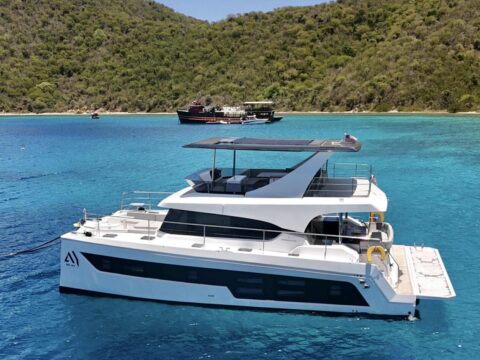
For example, Unwinding, our Aventura 50 bareboat powercat, has six private double cabins and six heads and can accommodate up to 12 guests.
At the other end of the spectrum, a luxury 80-foot Sunreef powercat may accommodate eight or ten guests — but in substantially larger suites with considerably more living space and a professional crew taking care of the charter.
Neither configuration is better.
They're designed for completely different vacations.
How Many Cabins Do You Actually Need?
Once we know how many guests are traveling, the next question is how many real guest cabins the group needs.
For adult couples, our preference is usually straightforward:
One proper double cabin per couple.
If four couples are traveling together, we'd generally start by looking for four private double cabins rather than a yacht that reaches eight guests by including secondary sleeping spaces.
Families can often be much more flexible.
Children and teenagers may be perfectly comfortable in bunks or smaller cabins, and those layouts can sometimes allow the parents to have a substantially larger master cabin.
The important question isn't:
“How many people can this yacht sleep?”
It's:
“Where will everyone in my group actually sleep?”
Maximum Capacity and Comfortable Capacity Are Not Always the Same
This is particularly important when comparing yachts online.
A yacht's maximum guest capacity tells you how many guests it can accommodate.
It doesn't tell you whether that arrangement makes sense for your group.
Additional sleeping capacity on some yachts may come from bunk beds, smaller cabins, forepeak accommodations or convertible salon areas.
Those spaces can work extremely well for children or certain family groups.
They're much less appealing if you're traveling with five adult couples who expect five comparable private cabins.
Before choosing a yacht, look past the Max Guests number and examine the actual layout.
Don't Forget the Heads
Bathrooms matter too, particularly for groups of couples.
If you're traveling with three, four or five couples, having an ensuite head for each cabin can make a significant difference during a week aboard.
Families may be perfectly comfortable sharing.
Again, there isn't one layout that's universally better.
The right configuration depends on who's traveling.
Bareboat Powercats: More Guests Don't Necessarily Require a Bigger Boat
VCY's bareboat fleet is a good example of why you shouldn't shop by yacht length alone.
Our bareboat power catamarans include different layouts from Fountaine Pajot, Leopard, Aventura and Aquila, so two yachts of relatively similar size can offer very different sleeping arrangements and living spaces.
For larger groups, the most dramatic example is Unwinding, an Aventura 50.
Despite being approximately 50 feet long, she offers six private double cabins and six heads for up to 12 guests. That's an unusually high-capacity layout for a bareboat power catamaran.
Meanwhile, another powercat of similar or greater length might have only four guest cabins because significantly more space has been devoted to each cabin or to common living areas.
That's why we wouldn't tell a group of ten:
“You need at least a 55-foot yacht.”
We'd ask who the ten people are and how they want to sleep.
Fully Crewed Powercats: Bigger Usually Means More Space, Not More Guests
The equation changes considerably when you move into the fully crewed market.
A fully crewed yacht includes a professional captain and chef — and sometimes additional crew on the larger yachts — so some of the yacht's accommodations and operating spaces are dedicated to the crew.
As the yachts become larger, the emphasis also tends to shift from fitting more people aboard to giving each guest substantially more space.
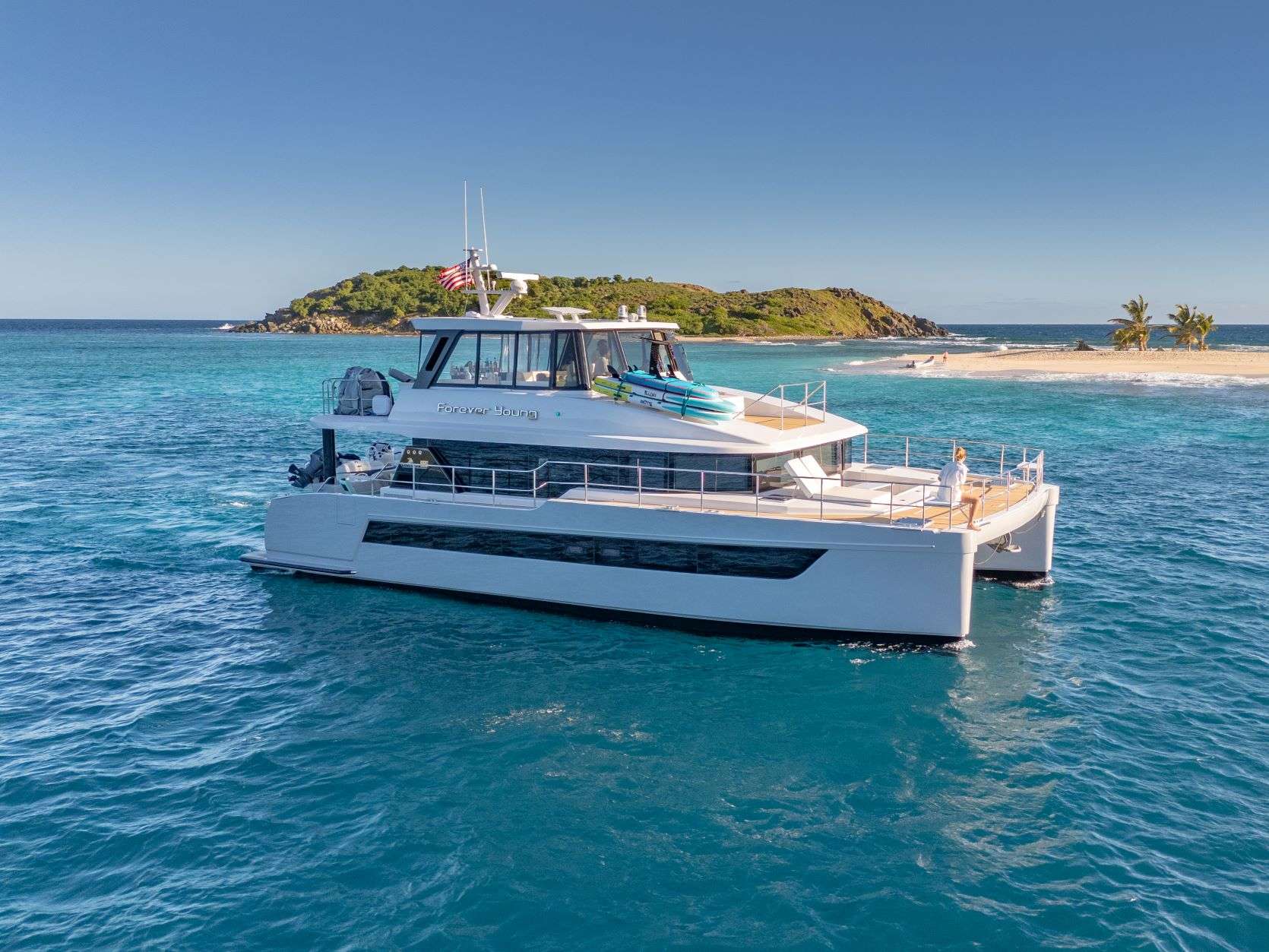
For example, VCY currently offers fully crewed powercat options ranging from yachts such as Forever Young, a Two Oceans 555 for six guests, through larger Horizon and Lagoon powercats and all the way to SOL, an 80-foot Sunreef Power Eco for eight guests.
An 80-foot powercat obviously gives eight guests dramatically more yacht than a much smaller eight-guest bareboat.
You're paying for larger cabins, expansive indoor and outdoor living areas, luxury amenities, crew service and an entirely different level of experience — not simply additional beds.
What If You Have 10 Guests?
Ten is an interesting group size because there are excellent choices in both bareboat and fully crewed power catamarans.
For bareboat guests, we can look at yachts with five appropriate guest cabins or layouts that otherwise work well for your particular group.
For a fully crewed charter, there are also powercats designed specifically around five guest cabins.
The important question becomes whether those ten guests are five couples or a mixture of adults and children.
For five couples, five genuine private double cabins with ensuite heads is much more important than the overall length of the yacht.
VCY's current crewed powercat offerings include options accommodating up to 10 guests, while our bareboat fleet can accommodate groups as large as 12.
What If You Have 12 Guests?
This is where bareboat and fully crewed powercat options diverge.
If you have 12 guests and specifically want a power catamaran, VCY has a very unusual bareboat option: the six-cabin Aventura 50 Unwinding.
She has six private double cabins and six heads, allowing 12 bareboat guests to travel together without putting anyone in a salon conversion.
For a fully crewed power catamaran, however, the options currently top out at 10 guests.
There are larger fully crewed yachts that accommodate 12 guests — including motor yachts and sailing catamarans — but not a 12-guest fully crewed powercat in the options we currently offer.
That's an important distinction if you're beginning your search with a group of 12.
Rather than assuming you simply need a bigger powercat, talk to us about which part of the equation matters most: keeping all 12 guests together, having a fully crewed experience, or specifically chartering a power catamaran.
Couples and Families Often Need Different Layouts
Group makeup becomes especially important when comparing yacht sizes.
Couples
For groups of couples, we'd prioritize:
- A private double cabin for each couple
- Ideally an ensuite head for each cabin
- Relatively comparable accommodations if everyone is sharing the charter cost
- Enough common space for everyone to dine and relax together
A yacht with four beautiful queen cabins may be a much better choice for four couples than a larger yacht that technically sleeps ten but relies on bunks or secondary sleeping areas.
Families
Families generally have much more flexibility.
Children may love bunk rooms. Teenagers may be perfectly happy in smaller cabins. A family may prefer an owner's-layout yacht that gives the parents an enormous master suite while the children use smaller accommodations elsewhere.
That's why two families of eight can contact us and receive completely different yacht recommendations.
Think About Where You'll Spend Your Time During the Day
Cabins are important at night.
During a BVI charter, though, much of your day is spent outside.
Look carefully at the common areas:
Flybridge: Can your entire group comfortably spend time together while underway?
Aft cockpit: Is there enough seating around the table for everyone to eat together?
Forward cockpit or bow: Is there another comfortable place to relax when people want to spread out?
Salon: Is there enough indoor living space when everyone wants to get out of the sun?
Swim platform: How easy is it for your group to get into the water and use the dinghy?
As powercats get larger, this is often where you really notice the difference.
Moving from a 50-foot yacht to a 60-, 70- or 80-foot luxury crewed powercat isn't necessarily about adding more guests.
It's often about giving the same number of guests considerably more space.
Bareboat or Fully Crewed?
Before deciding how large a powercat you want, it's worth deciding what kind of vacation you want.
With a bareboat charter, someone in your group operates the yacht. You choose your own itinerary, handle the boat and have the privacy and independence of having the yacht to yourselves.
With a fully crewed charter, the captain handles the yacht and navigation while the chef prepares your meals. The experience is much more service-oriented, and your group can focus entirely on enjoying the vacation.
VCY offers both, so we don't need to steer every guest toward the same type of charter.
We've also written a separate Bareboat vs. Captain vs. Fully Crewed Yacht Charter Guide that explains those differences in much more detail.
If You're Bareboating, Consider the Size You're Comfortable Operating
For bareboat guests, there is one additional consideration that doesn't apply to a fully crewed yacht:
Someone in your group has to operate it.
A larger powercat gives you more living space, but it also gives you more yacht to maneuver around a marina and manage when picking up a mooring.
If you're an experienced powerboat owner accustomed to operating larger twin-engine vessels, a larger powercat may feel very natural.
If most of your experience is on substantially smaller boats, choosing a yacht you're comfortable operating may be more important than gaining another few feet of living space.
VCY reviews the proposed skipper's boating experience before approving a bareboat charter and can help determine which yachts are appropriate for that experience.
With a fully crewed yacht, of course, this isn't part of the decision — the professional captain operates the yacht.
So, What Size Power Catamaran Do You Actually Need?
Instead of starting with yacht length, start by answering these questions:
- How many guests are traveling?
- How many are adults and how many are children?
- How many couples need private double cabins?
- Does each couple want a private ensuite head?
- Are any guests comfortable with bunks or smaller cabins?
- How important are large outdoor living areas?
- Do you want to operate the yacht yourself or have a professional crew?
- If bareboating, what size yacht are you experienced operating?
- Is your priority maximizing sleeping capacity or maximizing space and luxury for each guest?
Once we know those answers, the appropriate yacht size becomes much clearer.
Compare Actual BVI Power Catamarans
If you know your group size and want to see specific bareboat choices, our Which BVI Power Catamaran Is Best for 6, 8, 10 or 12 Guests? guide compares actual yachts and layouts in the VCY bareboat fleet.
If you're considering a fully crewed charter, we can compare everything from smaller three-cabin powercats for six guests through large luxury options such as Horizon powercats and 80-foot Sunreefs.
Because Virgin Charter Yachts offers our own BVI bareboat powercat fleet and fully crewed yacht charters, we can start with your group and the vacation you want rather than trying to fit you into one type or brand of yacht.
Let Us Help Match Your Group to the Right Powercat
We've been helping guests charter yachts in the British Virgin Islands since 1996, and choosing the right yacht is one of the most important things we do before a guest ever arrives.
Sometimes the answer is a larger yacht.
Sometimes a smaller yacht has exactly the right cabin configuration and saves you money.
Sometimes a family of 12 can fit beautifully aboard a 50-foot bareboat, while a group of eight chooses an 80-foot fully crewed yacht because they want substantially more space and luxury.
The goal isn't to charter the biggest power catamaran.
It's to choose the yacht that gives your group the best experience.
Tell us how many people are traveling, how your group is made up, whether you're interested in bareboat or fully crewed, and what matters most to you. We'll help narrow down the options.
Did You Know?
The BVI are only accessible by boat. Check out our charter yachts that can get you there. View Our Fleet