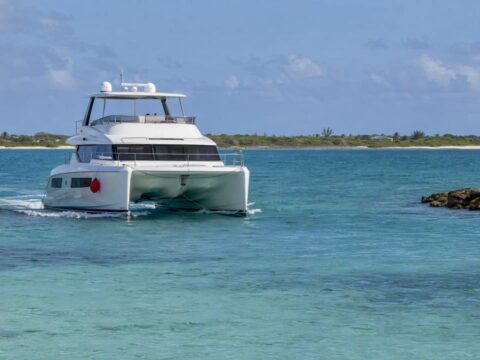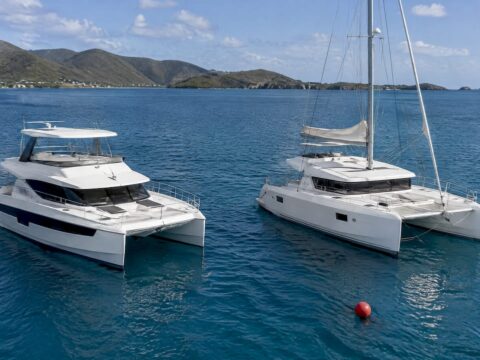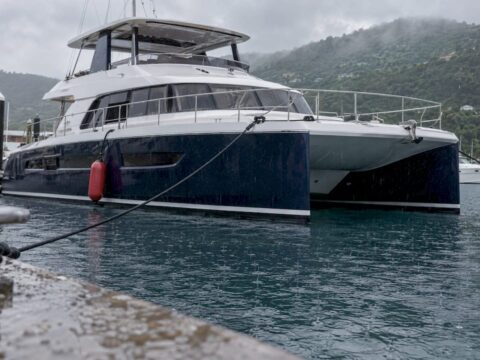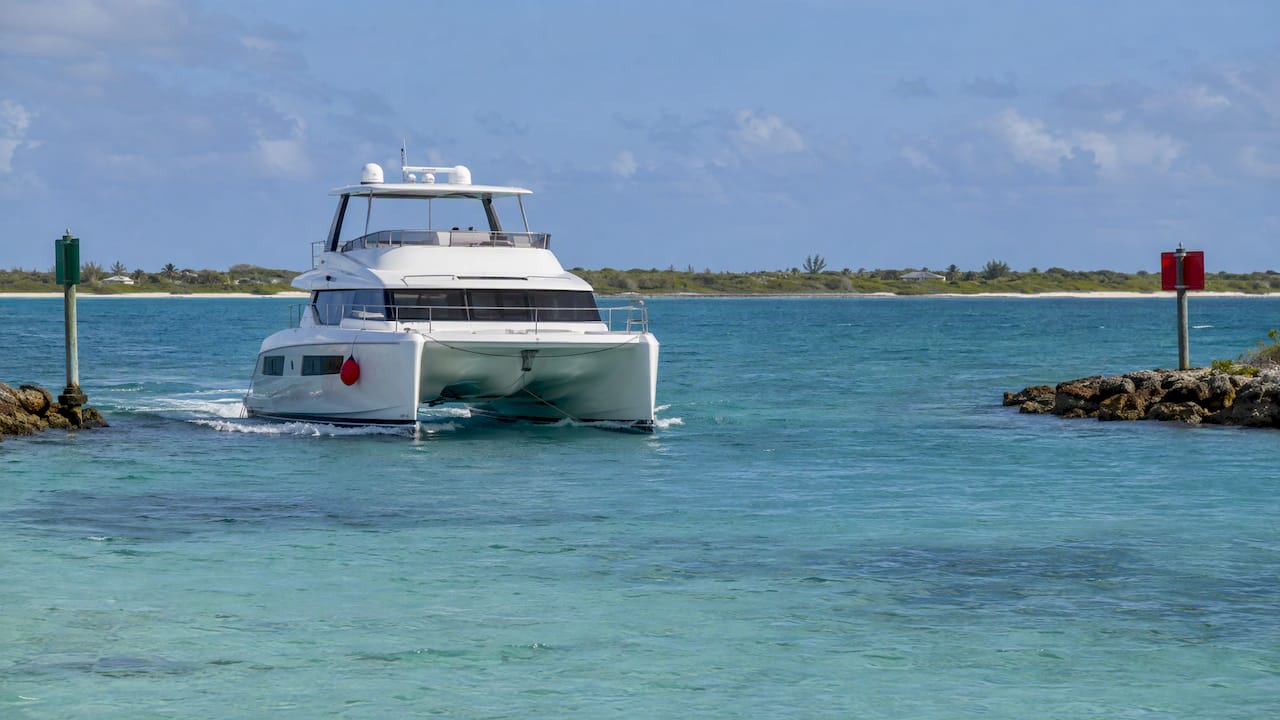

Anegada is the one British Virgin Island you cannot simply sail toward and hope for the best. It is a flat coral island ringed by a reef, and the safe way in is a single marked channel at Setting Point. The crossing from Virgin Gorda is about 11 miles, it rewards a settled day and an early start, and the island pays you back with empty beaches and grilled lobster. We are Virgin Charter Yachts, a family-owned charter company based on Tortola since 1996, and this is how we would plan the trip for friends who are chartering a power catamaran for the week.
TL;DR
- Cross from North Sound, Virgin Gorda, in good weather with the sun high overhead, so you can read the reef. Anegada is only about 28 feet high, so you will not see it until you are close.
- Anegada is not a BVI port of entry. Clear into the BVI first, then head north.
- Fill fuel and water before you go. There is no fresh water on the island and no marina.
- Plan two nights if you can: one for the beaches, one for a lobster dinner you reserve by mid-afternoon.
- If you would rather not pilot the reef yourself, add a captain to your charter.
Table of Contents
- Why Anegada is different from the rest of the BVI
- Clearing in: the entry steps before you sail north
- The crossing from North Sound
- Weather and season
- Where to anchor or moor
- Fuel, water and provisions: load up before you leave
- What to do once you are in
- Our view: Anegada is a day you plan, not a day you improvise
- Choosing your boat and crew for Anegada
- FAQ
- Sources
Why Anegada is different from the rest of the BVI
Most BVI islands are volcanic and steep, so you spot them from miles away. Anegada is the opposite. Cruising Guides describes a coral-and-limestone island about 11 miles long and no more than 28 feet high, fringed by Horseshoe Reef, the third-largest continuous reef in the Eastern Caribbean. The same guide says the reef has claimed more than 200 known shipwrecks, and that the island was once marketed as the “Forbidden Cruise”. Today a well-marked channel leads into Setting Point.
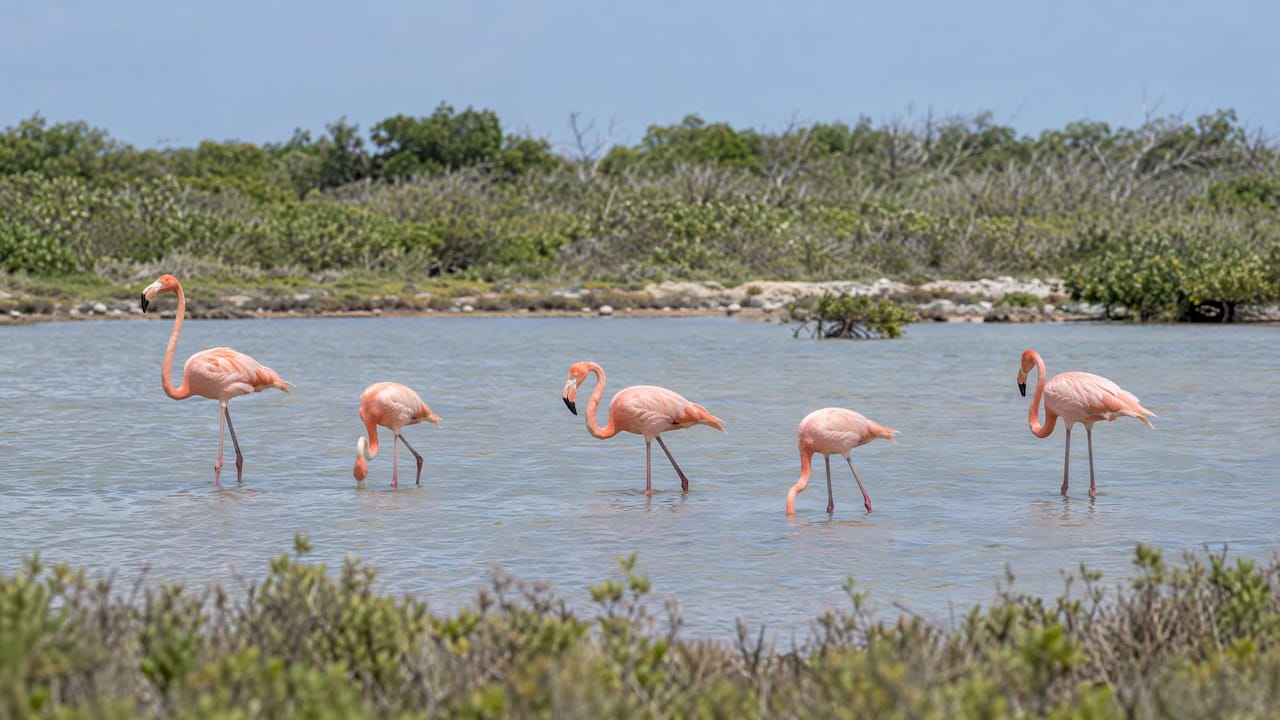
That low profile is also the appeal. BVI Tourism describes reefs, underwater caves and shipwrecks for snorkelers and divers, quiet beaches at Cow Wreck, Flash of Beauty, Bones Bight and Windlass Bight, and Arawak conch mounds at the East End. Lonely Planet’s BVI guide notes barely 300 residents, with donkeys, cattle and flamingos for company.
If you are still deciding whether it belongs on a first trip, our piece on whether to visit Anegada on your first BVI yacht charter walks through that choice, and our Anegada charter guide covers the island itself.
Clearing in: the entry steps before you sail north
This is the question that catches first-time charterers. Anegada is not on the list of BVI ports of entry. BVI Tourism’s Arriving by Sea page lists Road Town, West End on Tortola, Great Harbour on Jost Van Dyke and St. Thomas Bay on Virgin Gorda. Every entering vessel must clear with BVI Customs and Immigration immediately on arrival and keep valid passports and boat registration papers on hand.
The same page sets out the process through SailClear, the online entry system:
- Register and upload the boat and crew documents.
- Create an entry notification.
- Complete the online Immigration and Customs form 72 hours before arrival.
- Give your SailClear ID at the port of entry.
Port hours matter too. Road Town is open 8:30am to 8:00pm daily. West End is open 8:30am to 4:30pm Monday to Thursday and 8:30am to 6:00pm Friday to Sunday. Great Harbour and St. Thomas Bay are open 8:30am to 4:30pm daily. After-hours entry can be arranged in advance for an additional fee. Rules and fees change, so check that page before you travel.
There is one more form. Customs Breeze reports that since 1 January 2025 most travelers must complete an online embarkation card that covers Immigration and Customs in one submission. Yachting Pages says US citizens need no visa and that BVI Immigration typically issues a one-month entry stamp.
On a charter you will normally clear in at the start of the week, so by the time you point the bow at Anegada the paperwork is behind you. Keep your passports and the boat papers aboard anyway.
The crossing from North Sound
The usual jumping-off point is North Sound, Virgin Gorda. Our Virgin Gorda guide covers the bays you can overnight in beforehand. Cruising Guides gives the passage as 11.2 miles and suggests leaving by 8:30am so you reach Setting Point around 11:00, with the sun high enough to show coral heads as dark patches.
The route in brief
The published route is below. Treat it as a briefing and check it against current charts and your plotter.
| Leg | Heading or position | What to watch |
|---|---|---|
| North Sound to waypoint BV410 | 008°M to 18°42.40N 64°24.50W | A current of 1 to 2 knots sets you west, so stay west of the rhumb line |
| BV410 to the outer markers | 076°M | Prawny Shoal and the “Two Sisters” coral heads lie just southeast of the entrance, so do not go east of the line |
| Outer markers to the mooring field | Follow the markers; the channel turns northwest | Stay in 20 feet of water or more until you have positively identified the markers |
Source for the route and hazards: Cruising Guides. The channel follows the “red right returning” convention used in the Americas, per the Potters By The Sea navigation page, which also notes that you can call the Anegada Reef Hotel on VHF 16 if you cannot find the markers.
Rules of thumb for the passage
- Pick your day. Plan for a settled day with good overhead light. Re-plan if the wind is forecast above 20 knots.
- Do not follow other boats. They may cut across markers. Steer your own course to the buoys.
- Never approach at night. The US Coast Pilot, as summarized by SailSpo, calls the low island extremely dangerous at night because of strong, irregular currents.
- Do not anchor on the reef. Anchoring on Horseshoe Reef is illegal under BVI regulations, according to Underwater Atlas.
A word on who should skipper. The reef demands attention, and BVI charter companies may restrict access for less experienced skippers or require a local pilot. For our own bareboat rules, read where bareboat charters can go in the BVI before you plan the route.
Weather and season
The BVI’s best weather runs from December to April, with dry conditions and sea temperatures in the upper 70s to low 80s Fahrenheit, according to The Traveler. That is also when winter swell becomes the thing to watch. SailSpo notes that from October to May, North Atlantic rollers break on Anegada’s exposed reefs and the trades can blow 20 knots or more for days. In white water the channel buoys can disappear, so the buoys you were counting on may not be visible.
Here is how that plays out in practice:
- Check the forecast for the swell as well as the wind. A big northerly swell is a reason to postpone, not to push on.
- Anegada has little shelter. The Sailboat Liveaboard guide describes northeast trades of 15 to 22 knots with open-water exposure on all sides.
- Plan to be back at your Virgin Gorda mooring with a day in hand. Leaving early if a front is forecast is easier than leaving in a rush.
- Late summer and autumn are hurricane season, so the same guide advises monitoring conditions then.
One seasonal bonus: Lonely Planet says the island’s Lobster Festival is celebrated in late November, and The Traveler notes that restaurants across the island run special menus for it. Check the dates with the BVI Tourism board before you plan around it.
Where to anchor or moor
Setting Point is the main harbor, on the island’s southwest corner, and you reach it only through the buoyed channel. SailSpo describes depths of about 6.5 to 8 feet inshore over sand with good holding, and a mooring field suited to catamarans. That suits power catamarans well, since their shallow draft is exactly what this harbor favors.
The practical picture:
- Moorings. There are plenty of first-come, first-served balls and roughly 10 reservable BoatyBall moorings. Arriving around 10 to 11am, when overnight boats are leaving, helps you find a free one.
- Fees. SailSpo cites mooring fees of US$35 to US$55 per day on one operator’s 2026 flotilla sheet. Expect to pay a collector who comes by boat or pay ashore, and confirm the current rate.
- The shallow spot. Walker Mangum’s navigation page warns of an uncharted shallow, muddy area west and southwest of the Anegada Reef Hotel mooring balls, near 18°43.20’N 64°23.25’W, where groundings are common for boats drawing five feet or more. Keep clear of it.
- Second anchorage. Pomato Point is sheltered from north, northeast and east, but open to the southeast through west, according to Yacht Broker Reviews. Leave if the wind goes southeast or south.
- Tenders. Dinghy and outboard theft is a BVI-wide problem, so lift and lock your tender at night.
Fuel, water and provisions: load up before you leave
Anegada has no marina or haul-out. The Sailboat Liveaboard guide says water and fuel are extremely limited, small amounts of petrol may be available for dinghies, and diesel supply is inconsistent. SailSpo adds that there is no documented fuel or water dock for yachts, and advises you to arrive with full tanks and to fill up in North Sound or Tortola. It also notes that ice is available at the Setting Point store.
There is no fresh water on the island. The nearest sources are Leverick Bay, 13 nautical miles away, or Marina Cay at 17, according to bvipirate.com. Leverick Bay Marina has dockside fuel, water, ice, showers, laundry, a grocery store, a bar and a restaurant, per BoatyBall, and you can reach it on VHF 16.
A short checklist before you cast off from Virgin Gorda:
- Fuel tanks full.
- Water tanks full.
- Drinks, ice and provisions loaded, so you are not relying on the island’s small shops.
- Passports and boat papers aboard.
- Dinner reservation made by radio or phone, since lobster is cooked to order.
If water worries you, it is worth choosing a boat that makes its own. We list bareboat charters with a water maker and bareboat yachts with a generator for exactly this kind of trip.
What to do once you are in
Two nights is the sweet spot. Cruising Guides recommends at least two days to explore the beaches and enjoy Anegada lobster.
- Snorkeling. Loblolly Bay, Bones Bight, Flash of Beauty and Windlass Bight all get a mention from Cruising Guides. BVI Tourism points to needlefish, bonefish, stingrays and parrotfish on the reefs.
- Beach lunch. Cow Wreck Beach Bar is the lunch recommendation from Cruising Guides. It is across the island from Setting Point, so most visitors go by taxi.
- Lobster dinner. Cruising Guides advises booking by 4pm for fresh lobster grilled on the beach at the Anegada Reef Hotel. Yachting Pages also names the Lobster Trap, the Wonky Dog and the Pink Flamingo at the settlement.
- Wildlife and history. You can see flamingos at the salt ponds and visit the Arawak conch mounds at the East End.
More ideas on where to eat across the islands are in our guides to BVI restaurants and beach bars and restaurants to visit by yacht. If you are building the whole week, our 7-night first-timer itinerary shows where Anegada fits, and the family itinerary does the same with kids aboard.
Our view: Anegada is a day you plan, not a day you improvise
We have been on Tortola for 30 years, and the pattern is the same every season. The guests who love Anegada most are the ones who treated the crossing as part of the trip rather than a transfer. They left early, they had the tanks full, they booked dinner by radio, and they stayed two nights.
That is why we match the boat and the crew to the plan. A power catamaran gives a family or a group of friends space to spread out and a stable ride across open water. Our fleet of Fountaine Pajot, Leopard, Aquila, Aventura, Lagoon, Horizon and Two Oceans catamarans is curated for maintenance and comfort, and that matters on a day when you want nothing to go wrong.
If you are chartering bareboat and want a second pair of eyes on the reef, a captain is the straightforward answer. If you want the whole trip handled, our crewed charters take the navigation and the planning off your hands. Either way, tell us you want Anegada when you book, and we will build the week around it.
alexia
Choosing your boat and crew for Anegada
The right setup depends on who is aboard and how much of the helm you want.
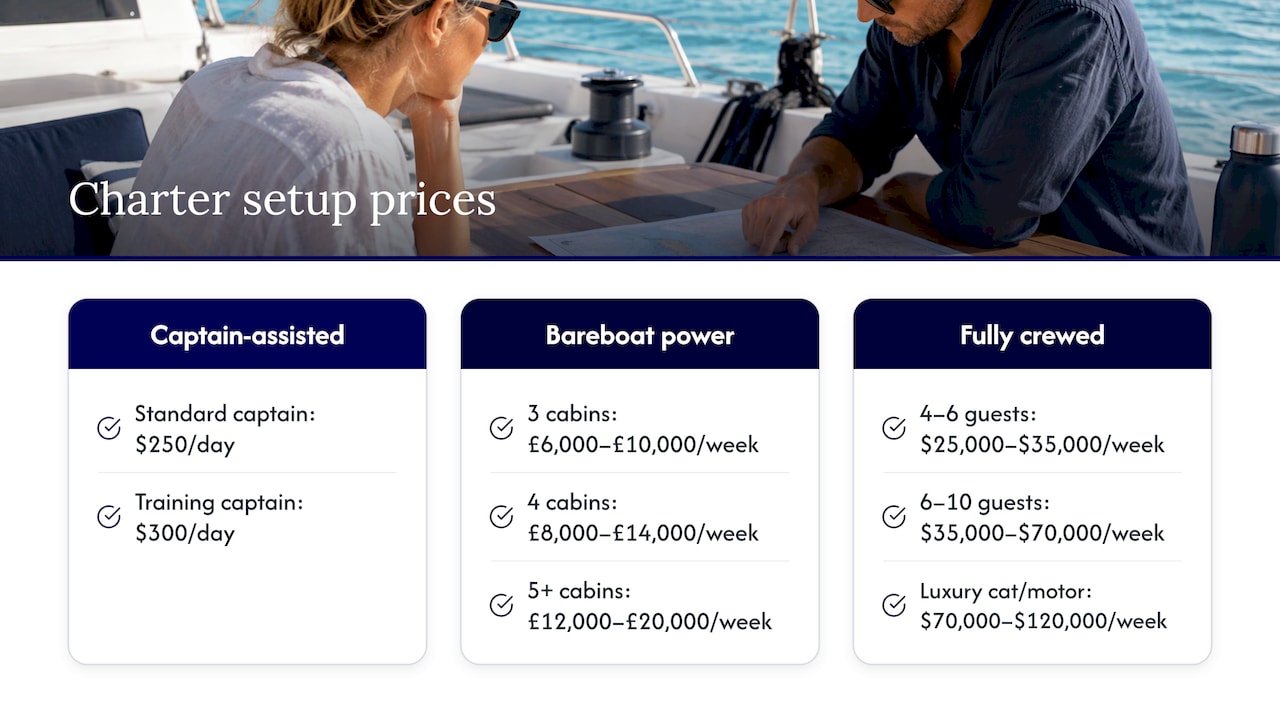
Bareboat with a captain. You keep the freedom of a bareboat week, with a professional alongside for the Anegada crossing. Our standard captain is $250 per day, and a training captain is $300 per day. Read how skippered hire works if you hold a license but want local reef knowledge.
Bareboat on your own. Our bareboat power catamarans are priced per week, and the pricing page lists them at £6,000 to £10,000 for a 3-cabin, £8,000 to £14,000 for a 4-cabin and £12,000 to £20,000 for a 5+ cabin luxury power catamaran. Our bareboat charter guide explains what the week involves.
Fully crewed. On our crewed charter pricing page, a premium catamaran for 4 to 6 guests is $25,000 to $35,000 per week. A luxury catamaran for 6 to 10 guests is $35,000 to $70,000, and a high-end luxury catamaran or motor yacht is $70,000 to $120,000. If you are comparing the two styles, crewed versus bareboat lays out the differences.
Wi-Fi is a $250 one-off charge per charter, and you can see what else is covered on our what’s included page.
Ready to add Anegada to your week? Tell us the dates, your group and how hands-on you want to be, and we will recommend the yacht and crew that fit. Browse our luxury crewed charters or start from our home page.
FAQ
How far is Anegada from Virgin Gorda by yacht?
The passage from North Sound, Virgin Gorda, is about 11.2 miles, according to Cruising Guides. Leave by about 8:30am to reach Setting Point around 11:00. Plan for a 1 to 2 knot westward current along the way.
Can I clear into the BVI at Anegada?
No. Anegada is not among the ports of entry listed by BVI Tourism, which are Road Town, West End, Great Harbour on Jost Van Dyke and St. Thomas Bay on Virgin Gorda. Complete SailClear and clear in at one of those first, then sail on to Anegada.
Is there fuel and water at Anegada?
Not reliably. There is no fresh water on the island, and diesel supply is inconsistent. Fill your fuel and water tanks in North Sound or Tortola before you cross, and carry ice, drinks and provisions with you.
How long should I stay?
Two nights is a good plan. That gives you one day for the beaches and snorkeling, and an evening for a lobster dinner without rushing back across the reef. Keep an eye on the swell forecast, since a large northerly swell is a reason to stay put.
When is the best time to sail to Anegada?
The BVI’s best weather runs from December to April. That is also when winter swell can affect the reef, so choose a calm day with strong overhead light and check the forecast the evening before. The lobster festival falls in late November, so confirm the dates if you want to be there.
Sources
- Exploring the Virgin Islands Part I: Sailing to Anegada, Cruising Guides
- Guide to the British Virgin Islands, Lonely Planet
- The Island of Anegada, British Virgin Islands Tourism
- Arriving by Sea, British Virgin Islands Tourism
- Tortola and BVI Entry Requirements 2026, Customs Breeze
- Superyacht Destination Guide: British Virgin Islands, Yachting Pages
- Potters By The Sea: Navigation
- Winter North Swell and Horseshoe Reef Hazard, SailSpo
- Anegada / Horseshoe Reef, Underwater Atlas
- Ultimate Guide to the British Virgin Islands, The Traveler
- Anegada Yacht Cruising Guide, Sailboat Liveaboard
- Setting Point Mooring Field and Anchorage, SailSpo
- Sailing to Anegada, Yacht Warriors
- Navigating to Anegada, Walker Mangum
- Anegada Island Yacht Guide, Yacht Broker Reviews
- Anegada Fuel and Water, SailSpo
- Navigating to Anegada, bvipirate.com
- Leverick Bay Resort and Marina, BoatyBall
Recommended
- Anegada Charter Guide | Beaches, Lobster & Coral Reefs
- Should You Visit Anegada on Your First BVI Yacht Charter?
- BVI Bareboat Cruising Restrictions: Where Can You Go?
- Best BVI Restaurants to Visit by Yacht: Where to Dock and Dine
Did You Know?
The BVI are only accessible by boat. Check out our charter yachts that can get you there. View Our Fleet