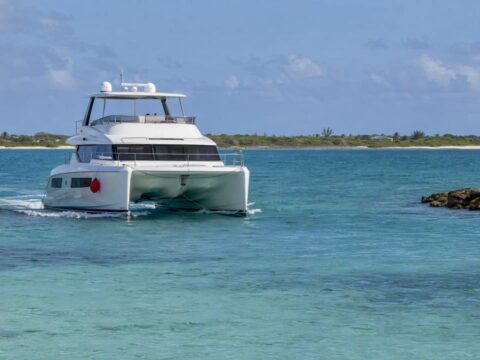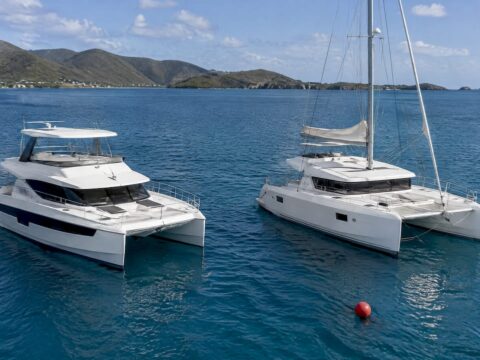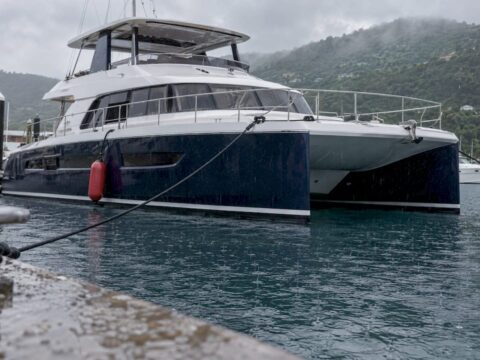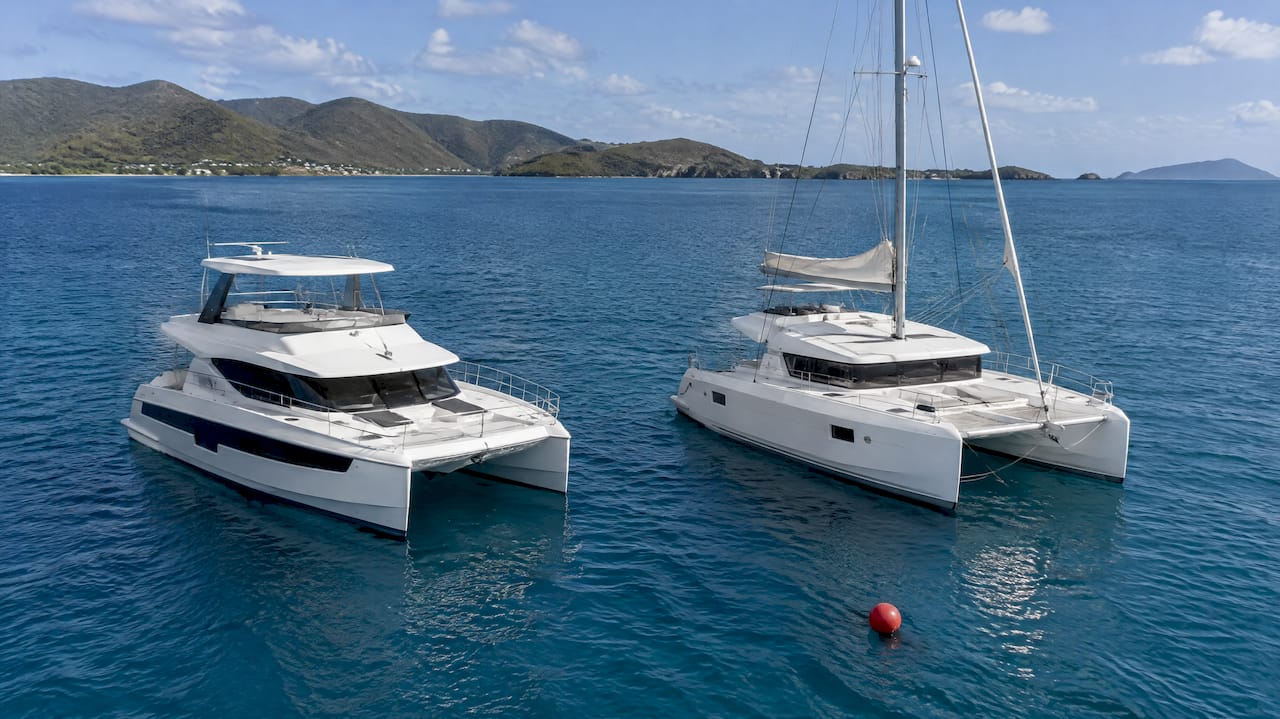

Leopard and Lagoon both build catamarans that suit Caribbean cruising, so the better choice depends on how you want to spend the week. Lagoon is the name to look at if you want maximum interior volume. Leopard is the name to look at if you want a build and layout shaped around charter use. For a vacation in the British Virgin Islands, where the anchorages are a short hop apart, a Leopard or Aquila power catamaran adds the speed and range that make a one-week itinerary easy. Here is how the two brands compare, and how to pick a boat for your trip.
TL;DR
- Lagoon and Leopard are both proven charter brands. Lagoon leans toward interior volume, and Leopard has a long record of building for charter fleets.
- Leopard’s own figures put the 45 about 1,300 lb lighter than a Lagoon 450F, one concrete difference in how the boats are built.
- If you are comparing for a vacation rather than a purchase, a power catamaran gives you cruising speeds of 15 to 18 knots and more island time per day.
- Our bareboat power cats run £6,000 to £20,000 per week depending on size, and crewed yachts start at $25,000 per week.
- Buying? The model matters more than the badge: compare equipment, age and ex-charter history, not just the brand.
Table of Contents
- Who this comparison is for
- Leopard vs Lagoon at a glance
- Comfort and layout: how the two feel on board
- Lagoon 46 vs Leopard 45: the numbers
- What each costs to buy
- Build quality and what to inspect
- Where power catamarans change the comparison
- Leopard vs Aquila power cats
- Fountaine Pajot as a third option
- Choosing by trip style
- What a charter costs
- Plan your week with us
- FAQ
- Sources
Who this comparison is for
People search “Leopard vs Lagoon” for two different reasons. Some are buying a boat and want to know which hull holds value and feels better offshore. Others are planning a Caribbean vacation and want to know which catamaran to charter. Both groups are covered below, and the sections on trip planning are written for the second group, since that is where most of our guests come from.
A quick definition helps. A catamaran has two hulls joined by a bridge deck, which gives a wide, stable platform with a large social area. A sailing catamaran uses a mast and sails, with small diesel engines as backup. A power catamaran has no mast and uses larger engines as its main drive. Leopard builds both types and Lagoon is best known for its sailing cats. We charter power catamarans, so the comparison keeps coming back to what that means on the water.
Leopard vs Lagoon at a glance
The table sets out the points where buyers and charter guests most often tell the two brands apart. The Leopard figures come from the builder’s own pages. The price comparison comes from a BoatNews review of the Fountaine Pajot FP 41 that lists the Lagoon 42 and Leopard 42 as direct rivals.
| Criteria | Leopard | Lagoon |
|---|---|---|
| Design team | Works with Robertson & Caine and naval architects Simonis Voogd, per Leopard | Known for large, open saloons and high interior volume |
| Certification | Says it is the only catamaran brand certified to NMMA/ABYC and CE standards, per Leopard | CE category boats, widely used in charter fleets |
| Weight example | Leopard 45 about 32,000 lb displacement, per Yatch US | Lagoon 450F about 1,300 lb heavier than the Leopard 45, per Yatch US |
| 42 ft class new price (Europe, ex-VAT) | Leopard 42 listed above €629,000 | Lagoon 42 listed from €593,000, per BoatNews |
| Power cat range | Leopard 40, 45, 46, 50 and 53 Powercat | Primarily sailing catamarans |
Treat the price row as a starting point. Specification, year and region change the number, and so does whether a boat is new or an ex-charter unit.
Comfort and layout: how the two feel on board
Lagoon’s reputation is space. Its saloons are large and airy, and many guests describe the boats as floating apartments. That suits groups who spend most of the day at anchor, swimming and eating in the cockpit.
Leopard’s layout approach is built around charter flow: cabins with their own heads, a galley that connects to the cockpit, and generous shaded outdoor space. The Leopard 46, which replaced the Leopard 45, is offered with 3, 4 or 5 double-cabin layouts, according to Leopard’s model page. Leopard’s 2025 comparison chart lists wraparound coachroof windows, an expanded galley and upgraded navigation systems as the 46’s changes over the 45.
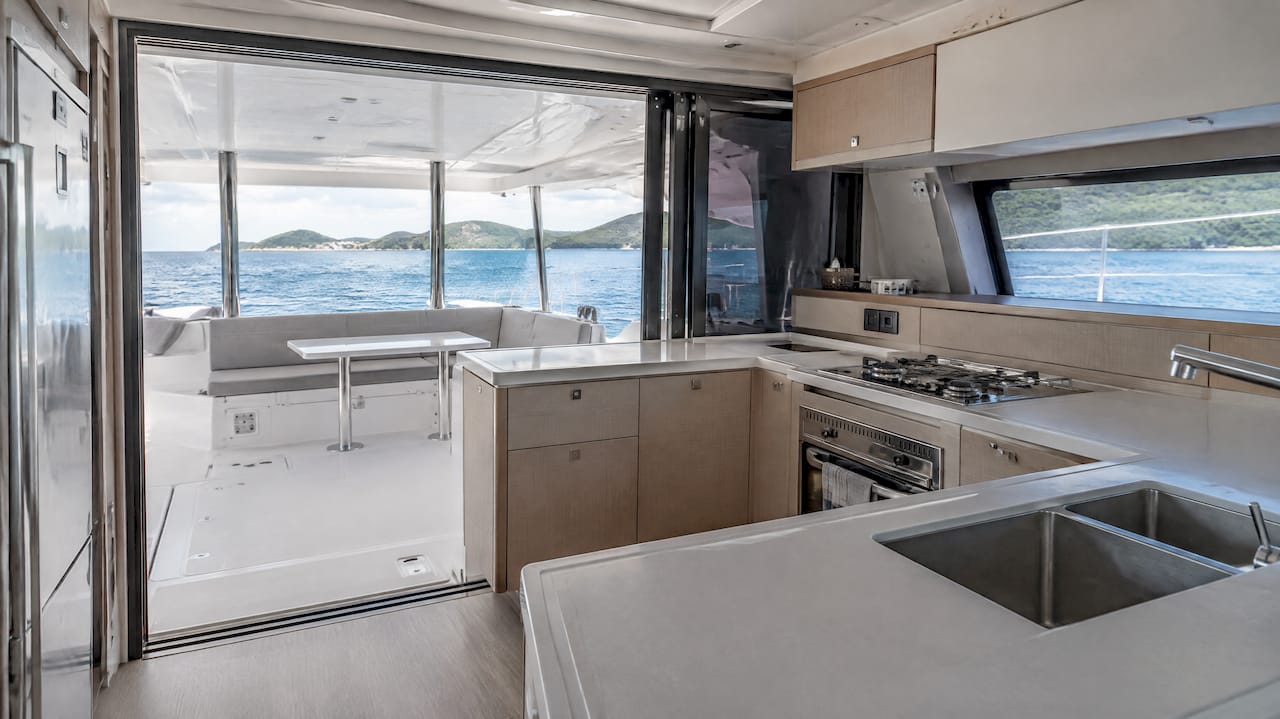
If you travel with children or a larger group, cabin count and bathroom count matter more than any brand label. Count the people, then count the heads.
Lagoon 46 vs Leopard 45: the numbers
The model pairing that readers search for most is the Lagoon 46 against the Leopard 45. The Leopard side is well documented. Yatch US’s October 2026 review lists the Leopard 45 at:
- 42 ft 11 in waterline and 24 ft 1 in beam
- 4 ft 11 in draft
- about 32,000 lb displacement
- 1,328 sq ft of upwind sail area
- 185 gallons of diesel and 206 gallons of fresh water
- a 70 ft air draft, which rules out the 65 ft fixed bridges on the Intracoastal Waterway
The Leopard 46 that followed is slightly larger on paper. Leopard lists 45 ft 7 in overall length, a 24 ft 1 in beam, 5 ft 5 in draft, 1,512 sq ft of sail area and standard twin 45 hp Yanmar diesels, with an optional hybrid electric drive.
For a Lagoon 46, ask the seller or the charter company for the same list: displacement, sail area, tank sizes and engine hours. A comparison only works when each figure comes from the same kind of source.
What each costs to buy
Prices vary widely with year and spec, so use ranges rather than single numbers. The Leopard 45 sold new for about $555,000 sail-away in 2017, according to Yatch US. Asking prices today run from roughly $380,000 for early ex-charter boats to about $760,000 for 2020 to 2021 privately owned boats, with a median recorded sale near $549,000. The model has been discontinued, so used boats are the only way to buy one.
The Leopard 454 is listed at a typical base price of $600,000 to $750,000, according to OurYachtWorld. Our own ownership programs give you another route to the water without carrying every cost yourself, and our team can walk you through how that works.
Build quality and what to inspect
The forum arguments about which brand is tougher are endless. What helps is a short inspection list that works on any catamaran:
- Engine hours and service records. Ex-charter boats rack up hours quickly, so ask for maintenance logs.
- Hull and bulkhead condition. Look at the bridge deck underside and bulkhead tabbing for cracks or repairs.
- Standing rigging and sails on a sailing cat, or engine mounts and drive legs on a power cat.
- Cabinetry and hatch seals. Water intrusion often shows first around windows, hatches and edges of joinery.
- Equipment age. Air conditioning, generators, watermakers and electronics are the items that fail first in the tropics.
Budget for the unexpected. Whatever the brand, set money aside after purchase for upgrades and surprises.
Where power catamarans change the comparison
A sailing catamaran in the BVI spends much of its time motoring anyway between close anchorages, and wind in the sheltered channels is variable. A power catamaran removes that trade-off. You get steady speed, a flybridge for steering and sunbathing, and a layout that leaves the whole bridge deck free for living space.
Leopard’s numbers show the effect. The Leopard 40 Powercat has twin 250 hp engines as standard, 370 gallons of fuel and listed cruise and maximum speeds of 15 and 23 knots. Leopard’s range brochure puts the 40 at a 350 nautical mile range at 15 knots and 65 liters per hour total consumption. The larger Leopard 53 Powercat cruises at 17 knots with a 420 nautical mile range, from 562 gallons of fuel, according to the same brochure.
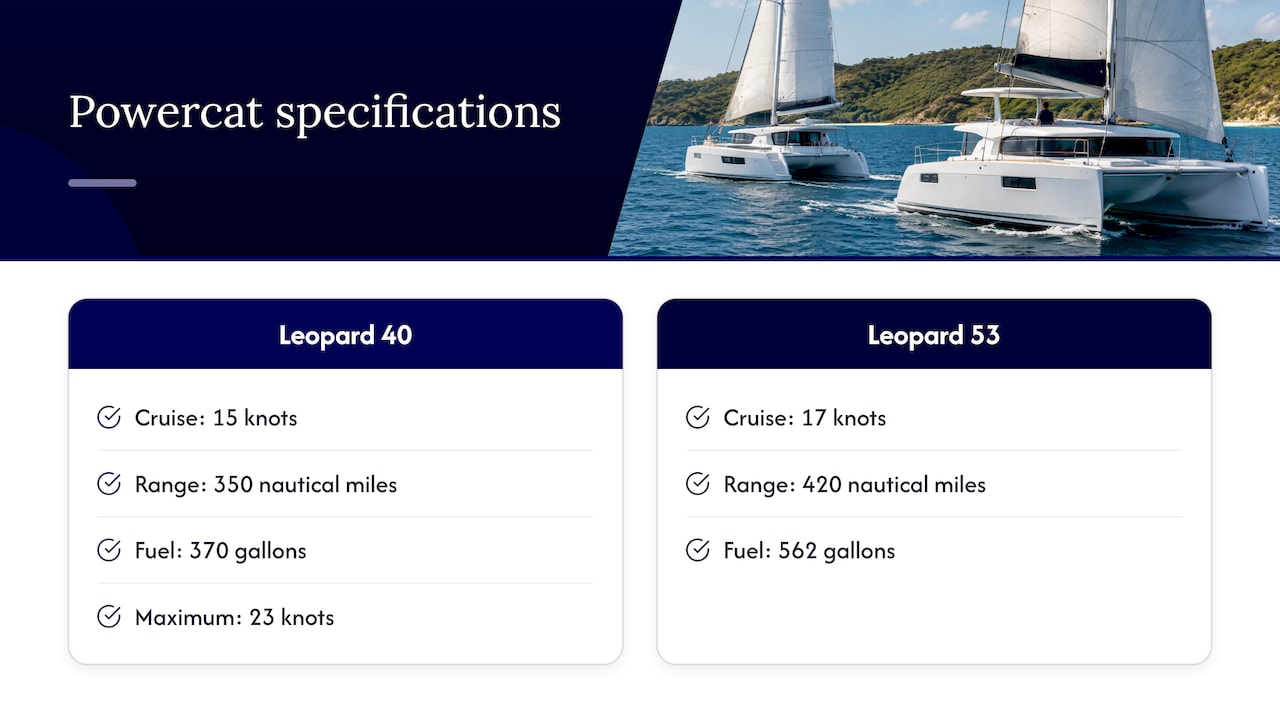
In the BVI, where many popular anchorages sit between 5 and 15 nautical miles apart, those speeds turn a morning transfer into a short ride and leave the afternoon for snorkeling.
Leopard vs Aquila power cats
Aquila is the other power catamaran name guests ask about. YachtBuyer’s February 2025 review of the Aquila 50 reports a 52 ft 2 in length, a 25 ft 6 in beam, 16 to 18 knots cruising speed, about 22 knots top speed, 423 gallons of fuel and 211 gallons of water, with twin Volvo Penta D6-480 engines. An optional Morelli & Melvin Hydro Glide foil system is reported to improve fuel efficiency by up to 40% and top speed by up to 35%.
In practice, both brands deliver spacious flybridge cruisers with generous cockpits. Our bareboat fleet includes Leopard and Aquila models, and we have written head-to-head guides for the two classes charterers ask about most: Leopard 53 vs Aquila 545, Fountaine Pajot MY6 vs Leopard 53 and Aventura 50 vs Leopard 53.
Fountaine Pajot as a third option
Fountaine Pajot is often added to the Leopard and Lagoon comparison. The brand’s FP 41 is a good example of its approach: 12.10 m long with a 6.91 m beam, a 17.7 m² aft cockpit and a 13.5 m² saloon, with hybrid thermal/electric drive and up to 2,300 Wp of solar, according to BoatNews. Its €404,400 ex-VAT entry price for a 3-cabin boat sits below the Lagoon 42 and Leopard 42 figures in the same review. Fountaine Pajot also builds power catamarans, and the MY6 comparison above covers how it lines up against the Leopard 53.
Choosing by trip style
| Your trip | What to look for | Where to start |
|---|---|---|
| Family with children | Several cabins with own heads, shaded cockpit, stable ride | 3-cabin or 4-cabin power catamaran |
| Couples | One large owner’s cabin, flybridge, privacy | Smaller power cat or a crewed yacht |
| Group of friends | Four or five cabins, big social space | 5+ cabin luxury power catamaran |
| Island-hoppers | Speed and range for longer days | Larger power cat with 15 to 18 knot cruise |
| Hands-off luxury | Captain, chef and crew | Crewed catamaran or motor yacht |
Our power catamaran layouts guide explains how each cabin arrangement works for different groups. If you are traveling with a bigger party, check the rules first in our guide on whether 12 people can bareboat a catamaran in the BVI.
What a charter costs
Our published weekly prices as read on 15 September 2026:
| Yacht class | Price per week |
|---|---|
| 3-Cabin Power Catamaran (bareboat) | £6,000 to £10,000 |
| 4-Cabin Power Catamaran (bareboat) | £8,000 to £14,000 |
| 5+ Cabin Luxury Power Catamaran (bareboat) | £12,000 to £20,000 |
| Premium Catamaran, 4 to 6 guests (crewed) | $25,000 to $35,000 |
| Luxury Catamaran, 6 to 10 guests (crewed) | $35,000 to $70,000 |
| High-End Luxury Catamaran / Motor Yacht (crewed) | $70,000 to $120,000 |
Bareboat pricing is on our bareboat pricing page and crewed pricing is on our luxury crewed pricing page. If you want a captain on a bareboat, a standard captain is $250 per day and a training captain is $300 per day, listed on our charter costs page. Wi-Fi is a one-off $250 per charter, listed on our what’s included page.
Compare that with a purchase in the hundreds of thousands of dollars. A week on the water lets you try a brand’s layout and handling before any commitment.
Our view: charter first, then decide
We have run charters from Tortola for 30 years as a family-owned operation, and we choose our fleet for maintenance and comfort rather than for a single badge. Our boats come from Fountaine Pajot, Leopard, Aquila, Aventura, Lagoon, Horizon and Two Oceans, because each builder does something well.
The question we hear most is which brand is best. Our answer is that it depends on your group and your plan for the week. Families usually want cabin count and shade. Couples want a private flybridge. Groups want a big cockpit and a fast way between anchorages. A power catamaran covers all of those in the BVI, which is why it is the center of our fleet.
If you are thinking about ownership, spend a week on the model you like first. Our team knows the boats and the islands, and we plan each itinerary around the people on board.
alexia
Plan your week with us
We have chartered bareboat and crewed yachts in the British Virgin Islands and the Caribbean since 1996. Our fleet is built around modern power catamarans from the brands in this comparison, and our team plans tailor-made itineraries around your group’s size and style. Start with the bareboat pricing page to see the classes, or visit Virgin Charter Yachts to talk to the team directly.

To see a specific boat, look at Caribbean Cat, one of the yachts on our charter page.
FAQ
Is Leopard better than Lagoon?
Neither is better for everyone. Lagoon is associated with large interior volume, and Leopard has a long record of charter-focused building. Choose the model whose layout fits your group, then check its age, equipment and maintenance history.
Is the Leopard 45 lighter than a Lagoon 450?
According to Yatch US, the Leopard 45 displaces about 32,000 lb, around 1,300 lb less than a Lagoon 450F. Lighter weight can help with handling and fuel use, though loaded weight changes with equipment and supplies.
How fast is a Leopard power catamaran?
The Leopard 40 Powercat lists a 15 knot cruising speed and a 23 knot maximum, per Leopard. The Leopard 53 Powercat cruises at 17 knots, according to the range brochure.
How much does it cost to charter a power catamaran in the BVI?
Our bareboat power catamarans run £6,000 to £20,000 per week depending on size, and our crewed catamarans and motor yachts run $25,000 to $120,000 per week. The exact price depends on the yacht and the season, so check the pricing pages for the current rates.
Should I charter before buying a catamaran?
A week aboard shows you how a layout works with your group before you spend six figures. Used Leopard 45s alone have ranged from about $380,000 to $760,000, per Yatch US.
Sources
- Leopard Catamarans US
- Leopard 46 | Leopard Catamarans US
- Leopard 40 Powercat | Leopard Catamarans US
- Leopard Range Brochure
- 2025 Leopard 45 and 46 Comparison Chart
- Leopard 45 Catamaran Review, Yatch US
- Leopard 454 Catamaran, OurYachtWorld
- Aquila 50 Yacht Review, YachtBuyer
- Fountaine Pajot FP 41 review, BoatNews
Recommended
- Aventura 50 vs Leopard 53 | BVI Bareboat Charter
- Leopard 53 vs Aquila 545 | BVI Bareboat Charter
- Fountaine Pajot MY6 vs Leopard 53 | BVI Charter
- Power Catamaran vs Sailing Catamaran for a BVI Charter
Did You Know?
The BVI are only accessible by boat. Check out our charter yachts that can get you there. View Our Fleet