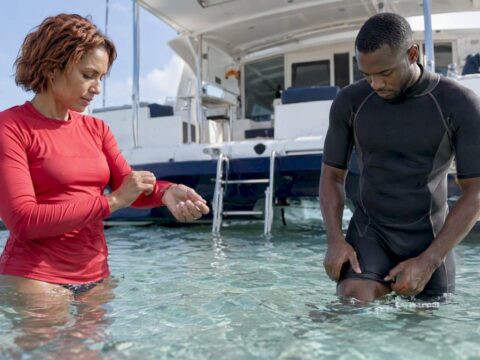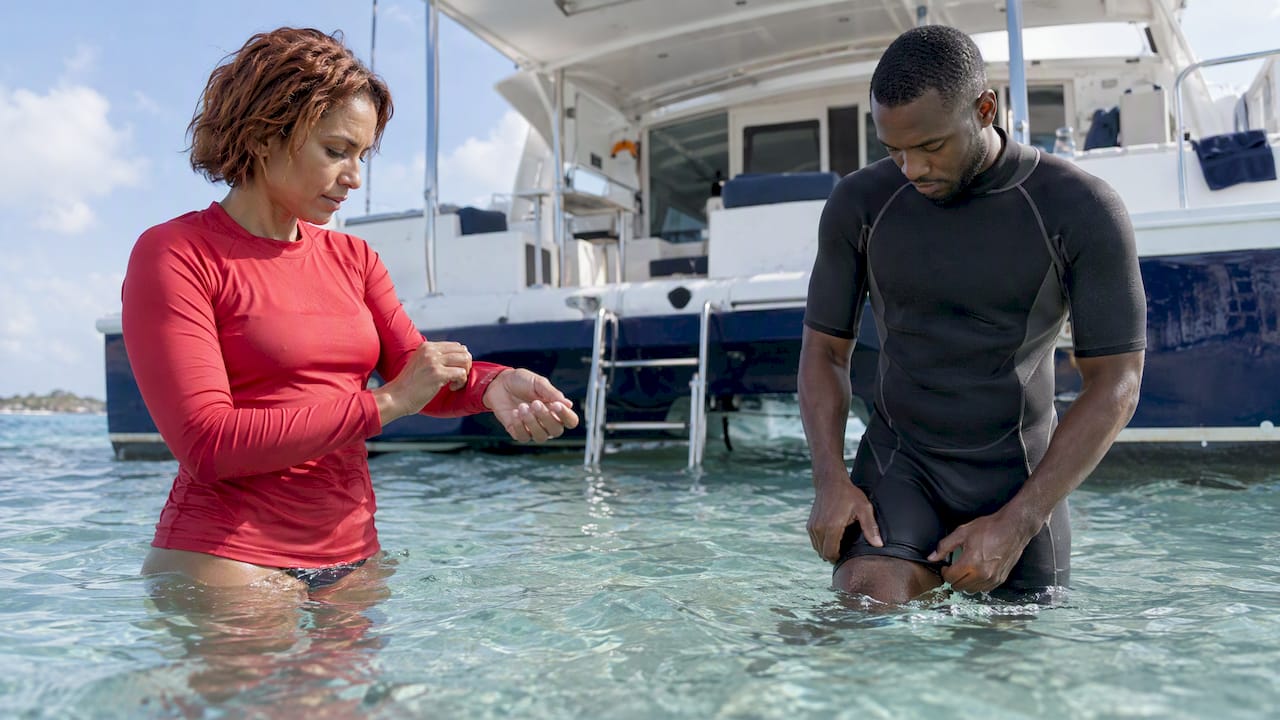

A rash guard is a snug, quick-drying shirt that blocks sun and prevents chafing. A wetsuit is a neoprene suit that traps a thin layer of water against your skin to keep you warm in cold water. In warm tropical water, such as the British Virgin Islands, the rash guard is the one most people want. A wetsuit only earns its place when the water or the wind is cool enough to make you shiver.
That is the short version. The rest of this guide covers how the two differ, where a swim shirt fits in, how to match the choice to water temperature and activity, and what we tell guests to pack for a Caribbean yacht charter.
TL;DR
- A rash guard protects against sun, chafing and stings. A wetsuit insulates. They solve different problems.
- A swim shirt is a looser version of a rash guard. The difference is mostly fit and personal preference.
- Tortola’s sea temperature rarely falls below the mid-70s °F, so for a BVI charter a long-sleeve rash guard is usually all you need.
- Wear a wetsuit when the water is around 70°F or cooler, or when you will spend long stretches immersed and not moving.
- Pack one or two UPF 50+ long-sleeve rash guards, and skip the wetsuit.
Table of Contents
- What each one actually is
- Side-by-side comparison
- Water temperature decides most of it
- Will a rash guard keep you warm?
- Sun protection is where the rash guard wins
- Which one for which activity
- Should you wear a rash guard under a wetsuit?
- How to choose a good rash guard
- Perspective: what we tell charter guests
- What to pack for a BVI charter
- Ready to be on the water?
- FAQ
- Sources
What each one actually is
Rash guard
A rash guard is a breathable, form-fitting shirt, usually made of nylon or polyester blended with spandex. It was designed for active water sports. It protects the skin from sunlight and chafing and is not meant to hold warm water against your body. Because it is made for the water, you are supposed to swim in it: it resists water absorption and dries fast.
Flatlock seams matter more than they sound. Quiksilver notes that flatlock stitching reduces chafing while you paddle or swim, which is why a cheap cotton tee is a poor substitute.
Swim shirt
A swim shirt is the same idea with a different cut. A rash guard is generally snug or compressive to cut drag and chafing during active watersports, while a swim shirt is cut more like a regular shirt, with a looser, relaxed fit. SwimOutlet describes the swim shirt as intended for casual comfort at the pool or beach.
So if you searched “rash guard vs swim shirt”, the honest answer is that fit is the main difference, and the choice is largely personal. Choose snug if you will swim, snorkel or paddle a lot. Choose loose if you want something breezy to wear on deck and in the shallows.
Wetsuit
A wetsuit is neoprene. It works by trapping a thin layer of water between the neoprene and your skin, which your body then warms. Yes, you get wet inside a wetsuit. Thickness sets the warmth: Camping World explains that suits commonly run from about 2mm to 5mm, with thicker neoprene for colder water.
Side-by-side comparison
| Rash guard | Swim shirt | Wetsuit | |
|---|---|---|---|
| Main job | Sun, chafing and irritant protection | Sun protection, casual comfort | Warmth in cool or cold water |
| Fit | Snug, compressive | Loose, relaxed | Very snug, sealed at wrists and ankles |
| Material | Nylon or polyester with spandex | Similar synthetics | Neoprene |
| Warmth | Minimal | Minimal | High, rising with thickness |
| Sun protection | UPF 50+ on most quality pieces | Typically UPF 30 to 50+ | Covers skin, but only as far as the cut goes |
| Best in | Warm water, active use | Warm water, relaxed use | Water around 70°F or below |
| Heat on deck | Cool and quick-drying | Cool and airy | Hot and bulky out of the water |
| Packing size | Tiny | Tiny | Large and slow to dry |
Water temperature decides most of it
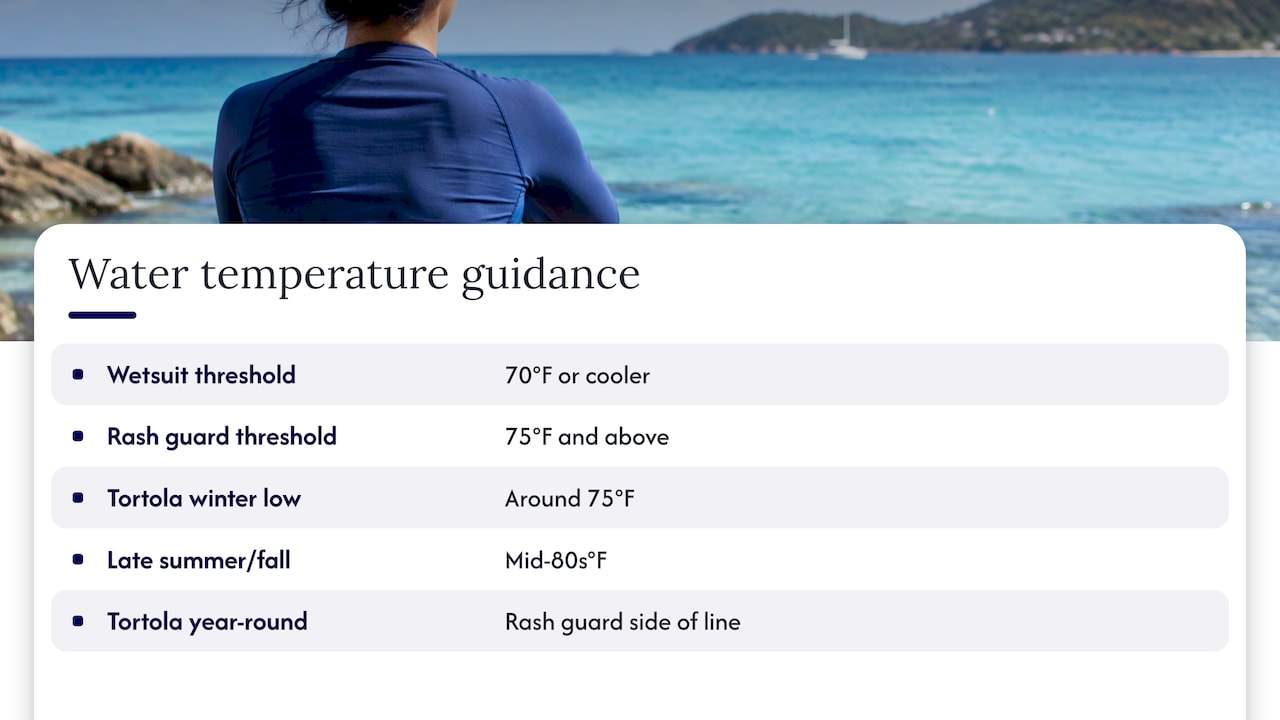
The simplest rule is temperature. For warm water, Sharkskin says a rashie is enough for sun and abrasion protection at 24°C (about 75°F) and above. At the cold end, REI advises wearing a wetsuit or dry suit when the water is 70°F or cooler, unless you are in protected, close-in waters.
Now look at the Caribbean. Tortola’s monthly sea temperatures run from lows around 75°F in the coolest weeks of winter to the mid-80s in late summer and early fall. That puts the BVI on the rash guard side of the line all year. A wetsuit there would mostly make you overheat.
Some people still feel cool in 79°F water after an hour of snorkeling, because water pulls heat from the body much faster than air does. If that sounds like you, the fix is not a full wetsuit. It is a thicker or thermal rash guard, or a shorty, worn only for the long snorkel stops.
Will a rash guard keep you warm?
Not much. A typical rash guard worn alone does not provide much warmth, and thermal or thicker versions add only modest warmth. They are not a replacement for cold-water insulation. Treat a rash guard as a layer that takes the edge off a breeze after you climb out, not as a way to swim in cold water.
Sun protection is where the rash guard wins
On a boat in the tropics, sun is the real hazard. You are exposed from above and from the glare off the water, and snorkeling puts your back to the sun for an hour at a time.
Most quality rash guards carry a UPF 50+ rating, and unlike sunscreen the protection does not wash off or need reapplying. The U.S. National Park Service recommends UV-blocking shirts such as rash guards while swimming, along with sunscreens that use only titanium dioxide or zinc oxide on exposed skin. That second point matters in the BVI, where much of the snorkeling is on living reef. Covering up means less sunscreen in the water.
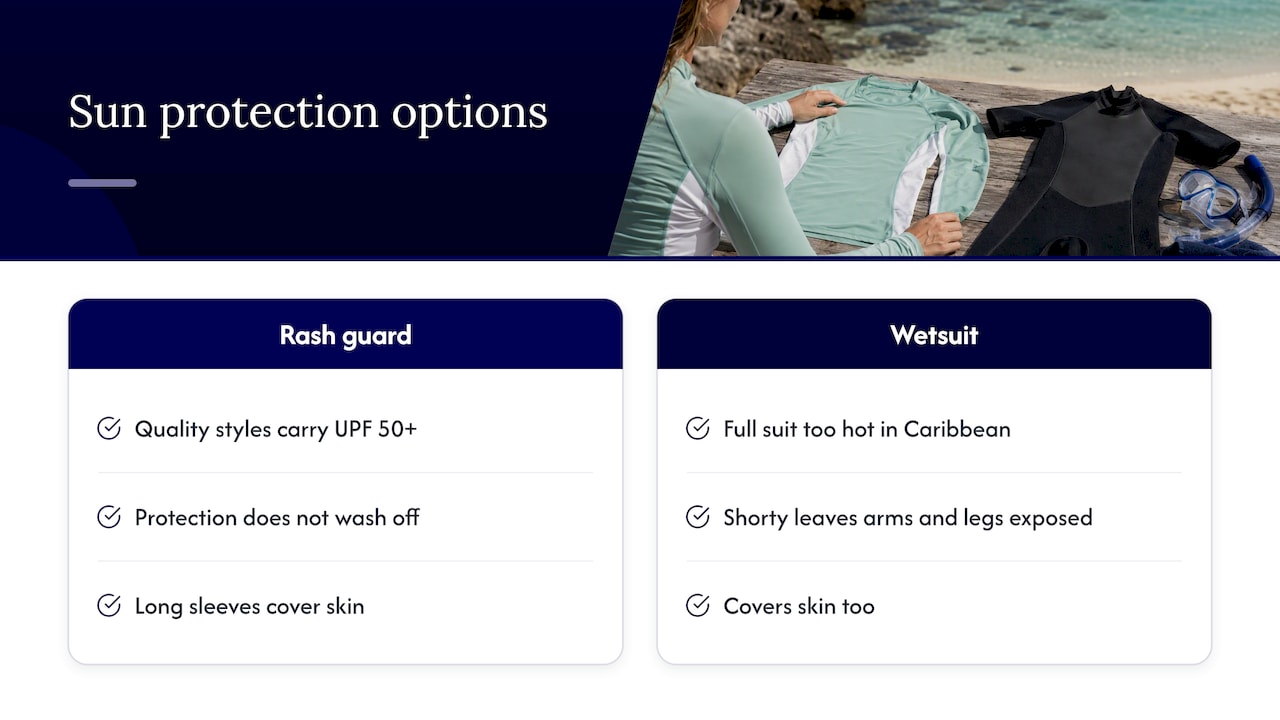
A wetsuit covers skin too, but a full suit is far too hot for a Caribbean afternoon, and a shorty leaves arms and legs exposed. For sun alone, a long-sleeve rash guard with swim leggings or board shorts is the better setup.
Which one for which activity
- Snorkeling: Long-sleeve rash guard. It covers the back and shoulders, and it helps with minor scrapes and with jellyfish or sea lice irritation, which a bare back does not.
- Paddleboarding and kayaking: Snug rash guard. SwimOutlet recommends a snug fit for active sports to minimize drag. REI notes that rash guards suit paddling in mild conditions.
- Swimming off the boat: Either a rash guard or a swim shirt. Choose fitted over baggy: OpenWaterHQ points out that baggy rash guards can be disallowed at pools because floating fabric is a drowning risk.
- Lounging on deck and beach stops: A looser swim shirt is perfectly good.
- Cold water, surfing in winter, long dives: Wetsuit.
One caution on the water-safety side. Neither a rash guard nor a wetsuit is a flotation device. If you have children or weaker swimmers aboard, read our note on snorkel vests versus life jackets before you pack.
Should you wear a rash guard under a wetsuit?
Some surfers do, for added protection against friction. It can reduce skin irritation, though it changes how the suit fits. If you do use a wetsuit, say on a cool-season trip elsewhere, a thin rash guard underneath helps with chafing at the neck and underarms. It is also easier to peel off than neoprene against bare skin.
How to choose a good rash guard
- Check the UPF rating. Look for UPF 50+ on the label.
- Pick the right coverage. Long sleeves for snorkeling and paddling, short sleeves if you run hot.
- Get the fit right. REI suggests looking for a comfortable fit that stays put, quick-drying fabric and coverage that suits your activity. Snug, but not restrictive across the shoulders.
- Avoid cotton. REI says cotton absorbs water and stays wet, so choose nylon, polyester or another quick-drying synthetic.
- Care for it. Rinse in cool fresh water after each use and air-dry in the shade to preserve the UPF coating and the spandex.
Perspective: what we tell charter guests
We have run charters from Tortola for 30 years as a family-owned operation, and the question comes up before nearly every trip. Our answer is consistent: bring rash guards, leave the wetsuit at home.
Over the years, the guests who struggle are rarely cold. They are sunburned on day two. A long-sleeve rash guard solves that more reliably than any sunscreen routine, and it means your reef-safe sunscreen goes on only the face, hands and feet. On a catamaran you are in and out of the water all day, so something that dries in minutes is worth more than any amount of insulation.
Our practical advice: pack two, so one is always dry. Add a looser swim shirt for the evening sail between anchorages if you like. If someone in your group gets cold easily, a thin shorty for snorkeling is plenty. Everything else goes on our packing lists, and we are happy to talk through it when we plan your itinerary with you.
— alexia
What to pack for a BVI charter
A rash guard is one item on a longer list. These pages cover the rest:
- BVI packing list for yacht charters for the full checklist.
- Water shoes versus sandals for what goes on your feet at beach stops and the dinghy dock.
- How to pack for your BVI yacht charter for soft bags and weight.
- Provisioning for a bareboat week for food and drink, so more of your luggage space can go to clothes.
If you are insuring the trip, our guides on charter travel insurance and yacht charter insurance explain what each one covers.
Ready to be on the water?
If you are still choosing where to wear that rash guard, we can help. Our bareboat power catamarans run from £6,000 to £10,000 per week for a 3-cabin, £8,000 to £14,000 for a 4-cabin and £12,000 to £20,000 for a 5+ cabin luxury power catamaran, as published on our bareboat pricing page. If you would rather have a captain and crew, our luxury crewed charters range from $25,000 to $35,000 per week for a premium catamaran for 4 to 6 guests, with full crewed pricing shown by yacht size. Tell us who is coming and what you want to do, and we will build the itinerary around it.
FAQ
Should you wear a rash guard under a wetsuit?
You can. Some surfers and divers wear one for added protection against friction and chafing. It is a trade-off, because it changes how the suit fits and how water moves inside it. In warm water you will not need the wetsuit at all.
Are you supposed to swim in a rash guard?
Yes. Rash guards are engineered for the water, so they resist water absorption and protect you from sun, chafing and irritants. Choose a fitted one rather than a baggy cut, since loose floating fabric can be restricted at some pools.
Does your body get wet under a wetsuit?
Yes. A wetsuit traps a thin layer of water between the neoprene and your skin, and your body warms it up to insulate you. A suit that is too loose lets that layer flush out and you lose the benefit.
Will a rash guard keep you warm in the water?
Only slightly. A standard rash guard adds little warmth, and thermal versions add modest warmth at best. For genuinely cold water, you need a wetsuit. In 75°F-plus Caribbean water, a rash guard is usually comfortable on its own.
What is the difference between a rash guard and a swim shirt?
Mostly fit. A rash guard is snug and compressive for active sports, while a swim shirt is looser and more like a regular shirt. Both can offer UPF protection, so pick on comfort and how active you will be.
Sources
- Tortola water temperature, seatemperature.net
- Protect Yourself, Protect the Reef, U.S. National Park Service
- What to Wear Kayaking: Layering Tips, REI
- Swimsuits: How to Choose, REI
- What Is a Rash Guard? How to Choose the Right One, SwimOutlet
- Understanding Wetsuits, Drysuits, and Rash Guards, Camping World
- Rashie vs Wetsuit vs Technical Waterwear, Sharkskin
- What is a Swim Shirt? What are Rash Guards?
- What Is A Rash Guard? Essential Information, Diver Below
- Do Rash Guards Keep You Warm? Down to Scuba
- Rashguards: Everything You Need To Know, Quiksilver
- Can a Rash Guard Be Used for Swimming? OpenWaterHQ
Recommended
- Full Face Snorkel Mask vs Traditional: Safety Guide
- Dry Snorkel vs Semi Dry: Which One Should You Buy?
- SNUBA vs Scuba: Which Underwater Adventure Fits You?
Did You Know?
The BVI are only accessible by boat. Check out our charter yachts that can get you there. View Our Fleet