
Provisioning your yacht is one of the fun parts of planning a BVI bareboat charter — but it's also surprisingly easy to overdo it.
First-time charter guests often start planning their grocery order as though they're stocking a vacation house for seven days: seven breakfasts, seven lunches, seven dinners, snacks, drinks and enough bottled water for the entire week.
That's usually far more food than you need.
A BVI bareboat charter isn't seven days at sea. You'll be visiting islands with restaurants, beach bars, resorts, markets and places to pick up additional supplies along the way.
After helping guests charter the BVI for 30 years, our biggest provisioning advice is simple:
Don't try to predict every meal before you arrive.
Provision for the meals you know you'll want aboard, leave room for spontaneous meals ashore, and remember that you can pick things up during the week.
Here's how we recommend thinking about provisioning for a typical 7-night BVI bareboat charter.
Start With Your Itinerary — Not a Grocery List
Before deciding how much food to order, think about where you're likely to be during the week.
A typical first-time BVI itinerary might include Norman Island, Peter Island, Cooper Island, Virgin Gorda and North Sound, Anegada and Jost Van Dyke.
Several of those destinations have restaurants that are part of the experience.
You may want dinner ashore at Cooper Island. Anegada is famous for its lobster dinners. North Sound has several restaurant choices. Jost Van Dyke has beach bars and restaurants that many guests specifically want to visit.
If you provision seven dinners before considering any of that, there's a good chance you'll return to Nanny Cay with a refrigerator full of food.
Plan your itinerary and your likely meals ashore first. Then build your grocery order around what's left.
Breakfast: This Is Where We Would Provision Generously
Breakfast is the meal most bareboat groups consistently eat aboard.
There's something pretty great about waking up on a mooring ball, making coffee and having breakfast on the flybridge before deciding where you're heading next.
Breakfast is also easy to provision.
Depending on your group, consider:
- Eggs and breakfast meats
- Yogurt and granola
- Fresh fruit
- Cereal
- Bread, bagels or English muffins
- Butter, jam and cream cheese
- Coffee and tea
- Juice
- Milk or non-dairy alternatives
One of our favorite additions is frozen French pastries from the French Deli. They're easy to keep aboard and make a simple breakfast feel considerably more special.
If your group loves breakfast, this is one area where we'd rather have a little extra than not enough.
Lunch: Keep It Easy
Lunch aboard a yacht tends to be casual.
You may have spent the morning snorkeling, swimming or exploring an island and don't necessarily want to stop everything to prepare an elaborate meal.
Think easy food that people can make when they're hungry:
- Sandwiches and wraps
- Deli meats and cheeses
- Salads
- Fruit
- Hummus and vegetables
- Chips and dips
- Charcuterie
- Burgers or something simple for the grill
We generally wouldn't plan seven completely different lunches.
A few flexible ingredients that can be combined in different ways are much easier aboard and create less waste.
Dinner: This Is Where Most Groups Over-Provision
Dinner is where we'd be conservative.
It's easy to sit at home before your trip and imagine cooking dinner aboard every evening.
Then you arrive in the BVI.
Someone wants lobster on Anegada. Someone else wants to eat at Cooper Island. You decide to stay at a marina in North Sound and walk to dinner. Everyone spends the afternoon at a beach bar on Jost and nobody feels like cooking.
That's part of the vacation.
For a seven-night charter, think realistically about which nights your group actually wants to cook aboard.
Maybe your group loves cooking and wants four or five dinners aboard. Great — provision for that.
Another group might only want two.
There's no correct number.
The mistake is assuming you'll eat aboard every night simply because you have a galley.
Plan a Few Really Good Dinners Aboard
Rather than ordering ingredients for seven dinners you may never make, we prefer planning a few meals that everyone will actually look forward to.
A nice steak or seafood dinner on the yacht can be one of the best evenings of the charter.
Grilling is particularly easy on a powercat, and Steakation is a good option for guests looking for quality meats.
Add some vegetables, potatoes or a salad and you have an easy dinner without spending half the evening in the galley.
Pasta is another useful option because it's easy, stores well and works for a night when nobody feels like going ashore.
The goal isn't to recreate your kitchen at home.
Keep meals relatively simple and spend your vacation enjoying the BVI.
Don't Forget the “Everyone Is Hungry Right Now” Food
This category may be more important than elaborate meal planning.
Charter days involve swimming, snorkeling and being outside. People get hungry.
Make sure you have plenty of easy things people can grab without preparing a meal:
- Chips and salsa
- Crackers
- Cheese
- Hummus
- Nuts
- Fruit
- Granola or protein bars
- Cookies
- Easy appetizers
If you're traveling with children, this becomes even more important.
And if your group has one particular snack they absolutely can't live without, order more than you think you'll need.
Drinks: Think About Your Group, Not a Formula
We don't think there's a useful universal formula for how much beer, wine, soda or alcohol a group needs for seven days.
You know your group better than we do.
Instead, think about what people actually drink at home.
If nobody drinks beer, don't order cases of it because it seems like something people drink on boats.
If everyone drinks sparkling water, order plenty.
If your group loves wine with dinner, make sure you have wine you'll actually enjoy.
For guests looking for a larger or more specialized selection of wine, Champagne and spirits, there are beverage suppliers in the BVI that offer more choice than a standard grocery order.
Our complete BVI Provisioning Guide includes our current recommendations for grocery, beverage and specialty suppliers.
Drinking Water: Don't Fill the Yacht With Hundreds of Small Bottles
Guests often underestimate how much space individual bottles of water consume.
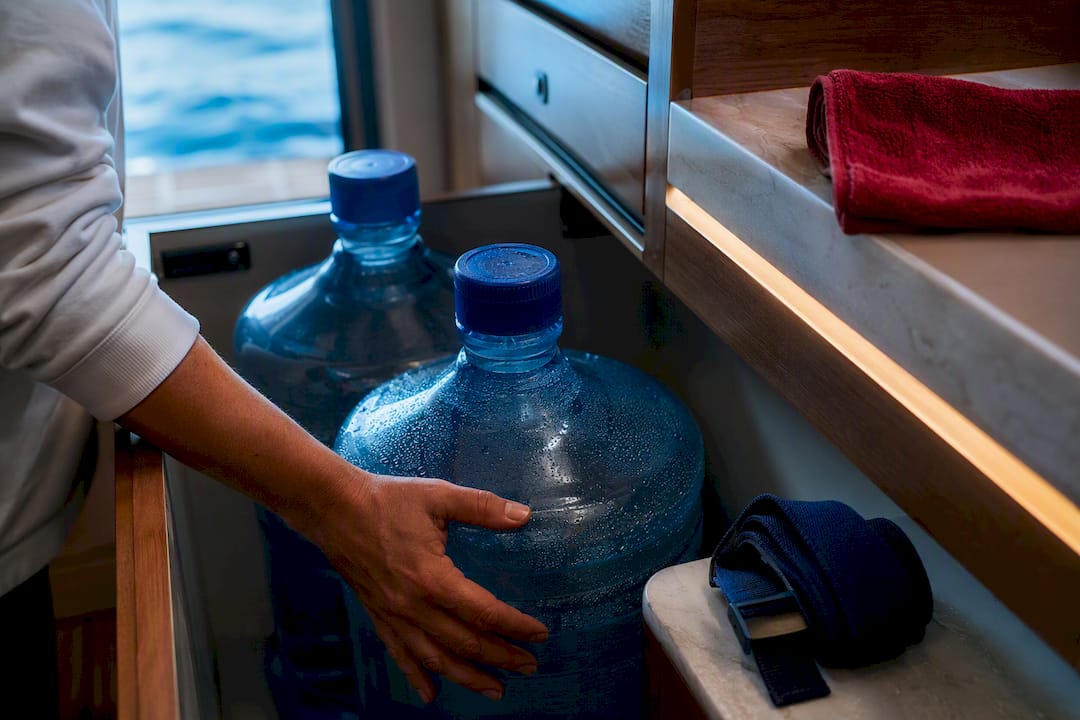
We recommend ordering larger drinking-water containers rather than relying entirely on cases of small plastic bottles.
Bring or purchase reusable bottles for everyone aboard and refill them as needed.
You also don't need to panic about calculating the exact amount of drinking water you'll consume for the entire week. Supplies can be replenished during the charter if necessary.
Leave Some Space in the Refrigerator
This sounds obvious, but it's worth saying:
Don't fill every refrigerator and freezer compartment before you leave Nanny Cay.
You'll probably pick things up during the week.
You might find something you want at a market. You may bring leftovers back from dinner. Someone may decide they want more drinks or ice.
A little unused refrigerator space is useful.
It's also considerably easier to find things when the refrigerator isn't packed so tightly that you have to unload half of it every time someone wants a yogurt.
Remember That You Can Buy Things During Your Charter
You aren't leaving civilization for seven days.
There are opportunities around the BVI to pick up groceries, drinks, ice and other basics.
Selection varies considerably by island, so we wouldn't intentionally leave Nanny Cay without important items. But forgetting something doesn't mean your week is ruined.
This is another reason we recommend not over-provisioning “just in case.”
Start with what you reasonably expect to use and replenish things during the week if necessary.
What About Dietary Restrictions?
If someone in your group has a significant dietary restriction, that's one area where we recommend planning more carefully.
Gluten-free, dairy-free, vegetarian and other specialty products are available in the BVI, but the selection may not be identical to what you're accustomed to at home.
Order important specialty items in advance rather than assuming you'll find a particular product on a smaller island during the charter.
For guests with specific dietary requirements, Bobby's Marketplace can be particularly useful for some specialty and gluten-free products.
And if there's one very specific packaged item someone absolutely needs, consider bringing it with you if permitted.
Should You Bring Food From Home?
Generally, you don't need to.
Groceries, meat, beverages and most everyday items are readily available in Tortola.
There are exceptions. If you have a favorite specialty item that you know won't be easy to replace, bringing it may make sense.
But we wouldn't recommend using valuable luggage space to transport ordinary groceries that can easily be purchased in the BVI.
A Simple Way to Plan Your Provisioning
Instead of making one enormous grocery list, we recommend doing this in order:
1. Decide which dinners you definitely want ashore.
If Anegada lobster is a must, don't order dinner for that night.
2. Decide which meals you definitely want aboard.
Breakfast every morning? Great. Provision seven breakfasts.
3. Keep lunches flexible.
Order ingredients that can become sandwiches, salads, snacks or simple lunches rather than seven separate menus.
4. Choose a few dinners you're excited to cook.
Good steaks, burgers, pasta, fresh seafood — whatever your group enjoys.
5. Add snacks and drinks.
This is where knowing your group matters more than any generic provisioning calculator.
6. Then look at the total order and ask: “Are we really going to eat all of this?”
If the answer is questionable, take a few things out.
What Happens to Leftover Provisions at the End of Your Charter?
Don't worry if you return to Nanny Cay with food and drinks left aboard.
You are welcome to leave any unwanted provisions on the yacht at the end of your charter. Our team will remove everything during the turnaround and usable food, drinks and other provisions are shared among our cleaning and dock staff.
It's actually considered one of the perks of working charter turnarounds — you never quite know what might be left behind!
So there's no need to throw away perfectly good food or try to pack everything up before you leave. If you don't want to take it with you, simply leave it aboard and our team will take care of it.
Of course, we'd still rather help you provision realistically in the first place. Returning with a few leftover drinks, snacks or ingredients is normal. Returning with enough untouched food for another seven-day charter probably means you ordered a little too much.
The Most Common Provisioning Mistake
It isn't forgetting something.
It's buying too much.
Guests understandably want to make sure everyone has everything they could possibly need before leaving the dock.
But the BVI is full of great restaurants, beach bars and places you'll decide you want to experience once you're actually here.
Leave yourself some flexibility.
If you finish the week with an almost-empty refrigerator, ate a few great meals aboard and discovered some favorite BVI restaurants along the way, you probably provisioned about right.
Ready to Place Your Provisioning Order?
Once you've decided approximately what your group needs, our complete BVI Bareboat Provisioning Guide explains the practical side of provisioning, including our recommended grocery, beverage and specialty suppliers and how to arrange delivery to Virgin Charter Yachts at Nanny Cay.
Our team is also happy to answer provisioning questions before your charter. After 30 years of helping guests explore the BVI, we've seen a lot of grocery orders arrive at G Dock — including plenty that could probably have fed the guests for another week.
Provision for the vacation you're actually going to have, not seven days of being stuck aboard the yacht.
Did You Know?
The BVI are only accessible by boat. Check out our charter yachts that can get you there. View Our Fleet