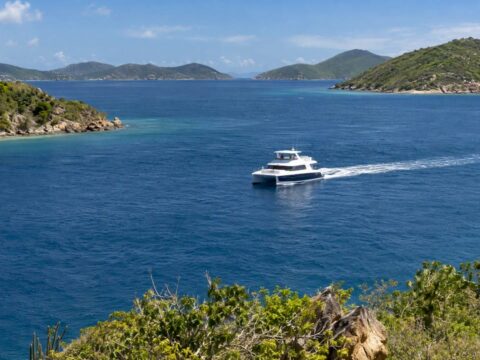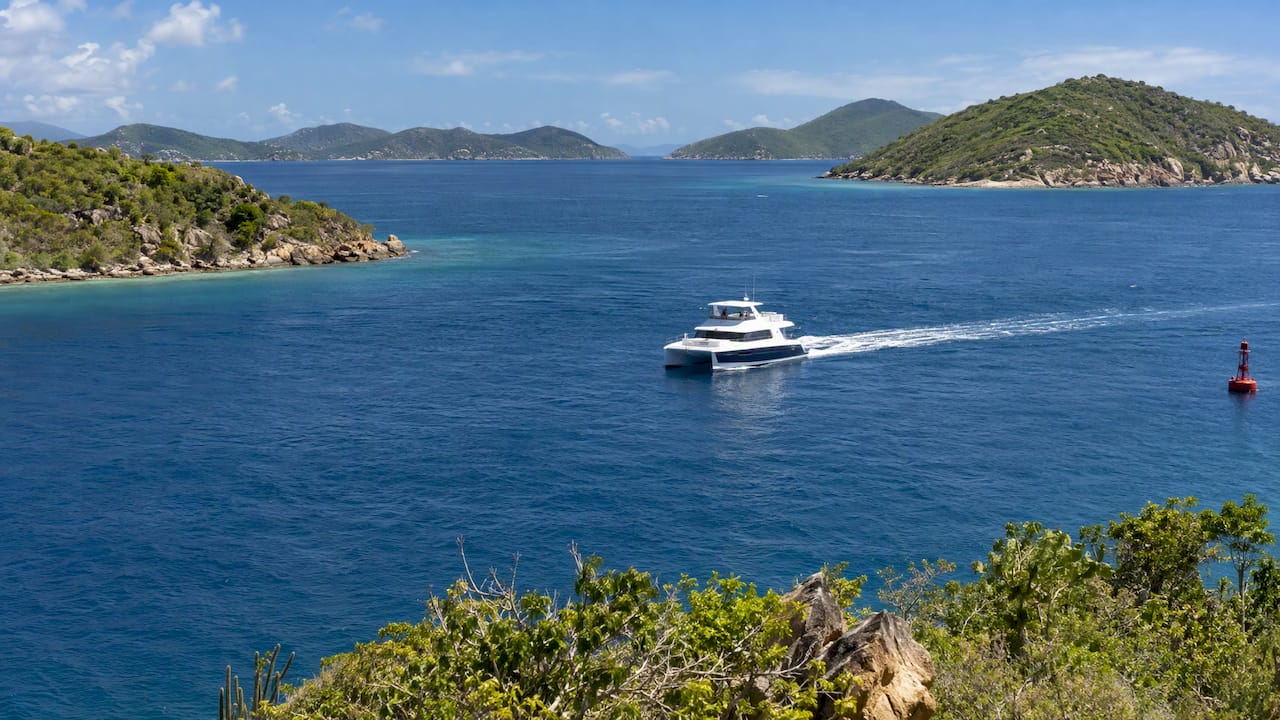

The best Caribbean yacht itinerary is a compact one: a week in a single island group, short hops of one to three hours, a swim stop before lunch and a protected anchorage by dusk. The British Virgin Islands (BVI) and neighboring US Virgin Islands (USVI) do this better than anywhere else in the region. We are a family-owned charter company that has been based on Tortola for 30 years, so the routes below start where we know the water best, then show how a longer island-hopping trip is built.
TL;DR
- For one week, stay in one island group. The BVI and USVI can be combined in a single itinerary with short daily hops and a night in a different bay each time.
- Longer Caribbean trips link island groups with open-water passages. Most hops between neighboring islands run 20 to 50 nautical miles, and a few, such as the BVI to St. Martin, are overnight sails.
- Plan around the season. Hurricane season officially runs June 1 to November 30, so winter and spring are the usual window for a Caribbean charter.
- Match the boat to the crew. Bareboat catamarans in the BVI run from £6,000 to £10,000 per week for a 3-cabin boat, and fully crewed catamarans start at $25,000 per week.
Table of Contents
- What a Caribbean yacht itinerary really is
- A seven-day BVI and USVI itinerary
- Planning a 10-day route
- Island hopping beyond the Virgin Islands
- When to go
- Tailoring the route to your crew
- Choosing the boat for your itinerary
- Book your route with us
- Our perspective
- FAQ
- Sources
What a Caribbean yacht itinerary really is
An itinerary is a sequence of anchorages, each reachable in a comfortable day. Unlike a cruise ship schedule, nothing is fixed. You set the pace, so the same route can be a lazy snorkeling week for a family or a lively beach-bar week for a group of friends.
The Caribbean divides roughly into a few cruising areas, and each rewards a different kind of trip:
- The Virgin Islands (BVI, USVI, Spanish Virgin Islands): dozens of islands within sight of each other, sheltered water and short hops. The easiest place for a first charter.
- The northern Leewards (St. Maarten, St. Barths, Anguilla): more cosmopolitan, with French and Dutch culture, fine dining and longer passages.
- Antigua, Guadeloupe and Martinique: history, big harbors and rugged volcanic islands.
- St. Lucia, St. Vincent and the Grenadines, Grenada: small islands, reefs and the Tobago Cays, with more sailing between stops.
One published collection of day-by-day routes lists seven-day options in every one of these areas, plus a 10-day one-way trip from St. Vincent to Grenada through the Tobago Cays, Union Island and Carriacou, according to All At Sea’s Caribbean charter itineraries. The takeaway is that a good week stays inside one area, and a longer trip strings areas together.
A seven-day BVI and USVI itinerary
If you have one week, this is the route we would send a friend on. It follows the logic of our 7-day BVI itinerary for sailing and island-hopping and our 7-night first-timer route, and you can adjust it freely.
Day 1: Tortola, then a short first hop
You board in Tortola, get your briefing and provisions, and keep the first leg short. Many guests make for Norman Island or one of the quiet bays on the south side of the chain, so the first night is calm and you learn the boat in easy water.
Day 2: Snorkeling and the Baths
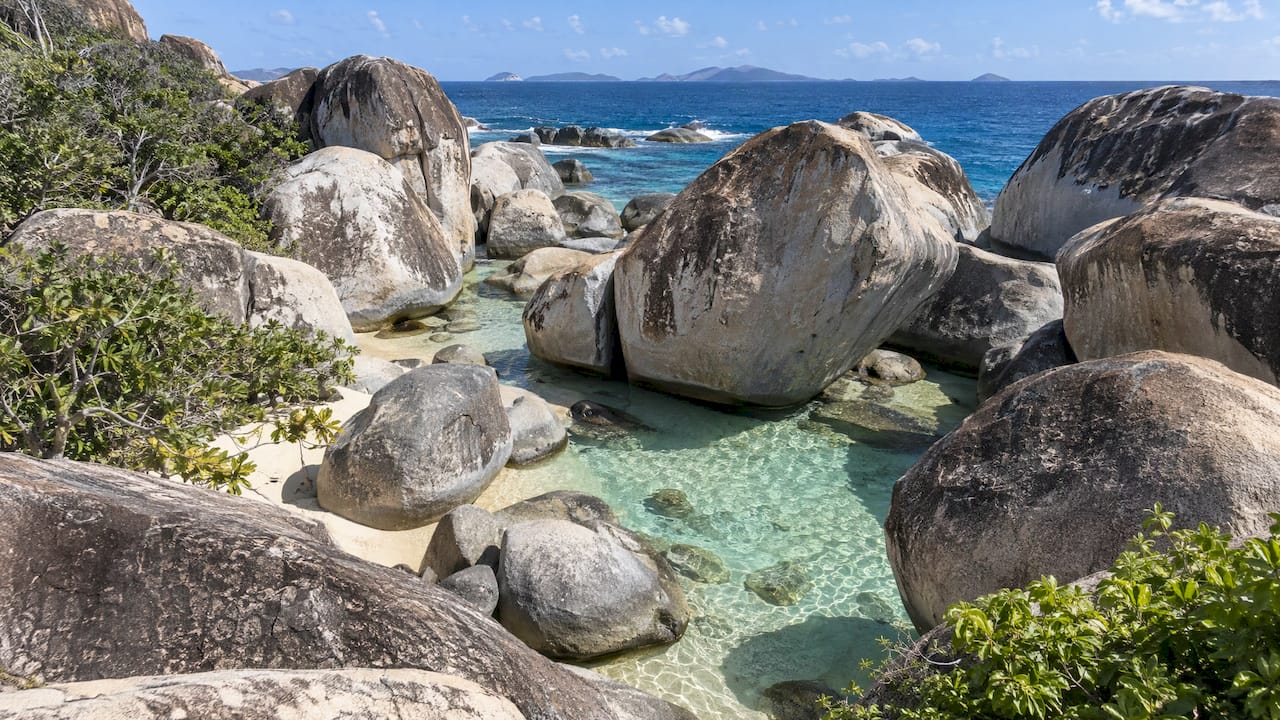
Head east toward Virgin Gorda. The Baths, a maze of granite boulders and tide pools, is best early before day boats arrive. Families with children usually love this stop, and couples get a quieter evening in a bay nearby.
Day 3: North Sound
North Sound on Virgin Gorda is a sheltered base with restaurants and beaches. It is a good place to slow down, swim, paddle and enjoy a long dinner.
Day 4: Anegada or Cooper Island
Anegada is a flat coral island famous for lobster and long empty beaches, and it sits further out. If your group prefers shorter days, swap it for Cooper Island or Salt Island, which offer good snorkeling and a relaxed anchorage.
Day 5: Jost Van Dyke
Jost Van Dyke is the party stop: beach bars, live music and a casual atmosphere. Groups of friends often make this the highlight of the week.
Day 6: Crossing into the USVI
From Jost Van Dyke it is a short crossing to St. John or St. Thomas. St. John is largely national park, with white beaches and snorkel trails. Our BVI and USVI combined itinerary shows how to include this leg, and our comparison of USVI versus BVI helps you decide how much time to give each.
Day 7: Back toward Tortola
Spend the last day near the base with a final swim and a relaxed return, so checkout is never rushed.
Two practical points. Crossing between the BVI and the USVI means clearing customs and immigration, which you do at a designated port of entry, and arriving anywhere else can bring a fine. Keep passports and boat papers ready. Also, mooring balls in the BVI are commonly priced around $35 a night in busy bays, so budget for several nights, and consider arriving at popular anchorages by early afternoon.
Planning a 10-day route
Ten days gives the Virgin Islands breathing room. You can add Anegada without feeling rushed, spend two nights in a favorite bay and still cross to the USVI. Our 10-day BVI itinerary lays out this version. For most families and couples this is the sweet spot: enough days to stop thinking about the clock, short enough to fit school or work calendars.
Island hopping beyond the Virgin Islands
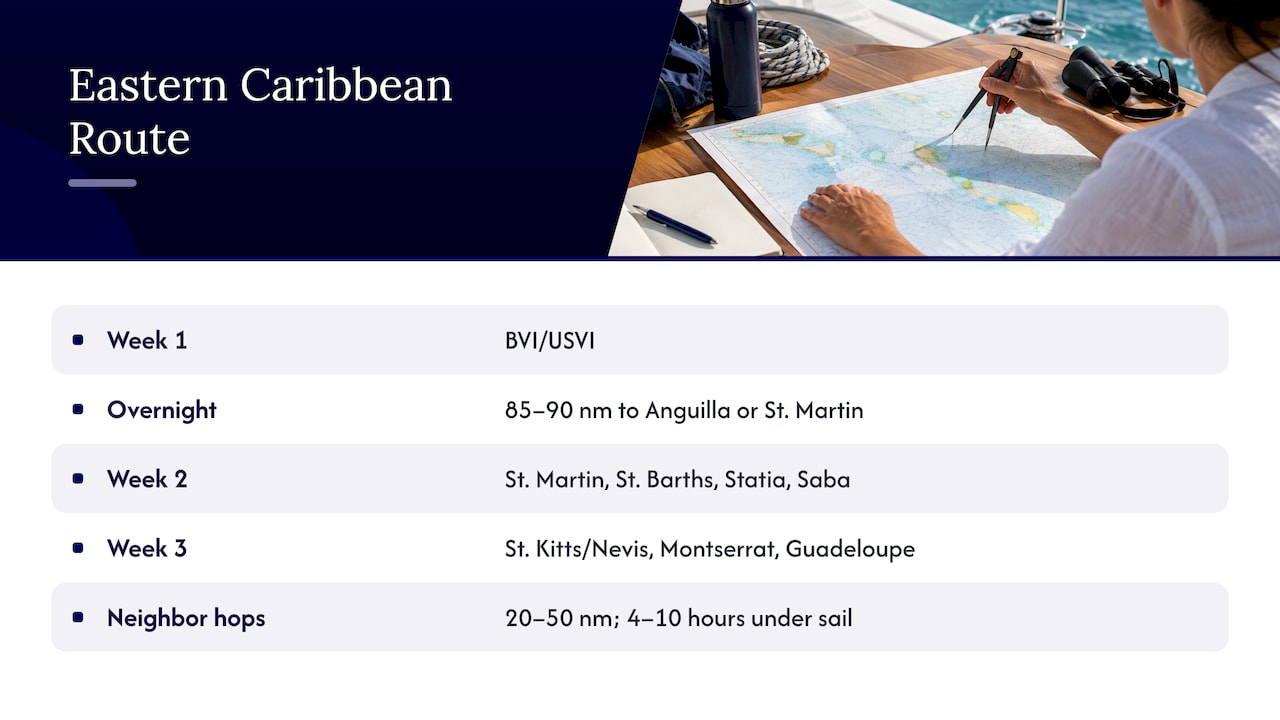
A two- or three-week trip can link island groups. A sample plan: week one in the BVI and USVI, then an overnight passage of roughly 85 to 90 nautical miles to Anguilla or St. Martin. Week two covers St. Martin, St. Barths, Statia and Saba. Week three continues to St. Kitts and Nevis, Montserrat and Guadeloupe, according to the Eastern Caribbean itinerary on Portzante. The same guide notes that hops between neighboring islands mostly run 20 to 50 nautical miles, or about 4 to 10 hours under sail in typical trade winds, and that Antigua to St. Martin and the BVI to St. Martin are normally done overnight.
Which direction to travel
Direction matters because the trade winds blow from the east. The long-standing advice from cruising writer Don Street, published in Caribbean Compass, is to go south first and work north: a run from the Virgins straight to Grenada, about 410 to 415 miles, followed by easy island hopping back up the chain, replaces a roughly 1,300-mile loop with up to 500 miles of hard windward work by a loop of about 1,000 miles of mostly easy sailing. That is a point to weigh for any one-way or multi-week plan.
Why shorter often wins
On a long itinerary, every overnight passage uses up a day on each end. If your goal is beaches, snorkeling and dinners ashore, a week or ten days inside one island group gives you more of all three than a week spent in transit. That is why most of our guests choose the Virgin Islands, and why we put our effort into making that cruising ground work for each crew.
When to go
The Atlantic hurricane season runs from June 1 to November 30, according to NOAA. Charter demand therefore concentrates in the winter and spring months, with steady trade winds and dry weather. Our guides to the best time to visit the BVI and month-by-month charter timing cover the details, including why booking six to twelve months ahead helps for holiday weeks.
Two habits make any itinerary better in any month: check the forecast each morning, and keep a sheltered backup anchorage for each day. Winter swells from the north can make some anchorages uncomfortable even on a sunny day, so the flexibility to swap one bay for another is the real value of a private yacht.
Tailoring the route to your crew
| Crew | Pace | What to build in |
|---|---|---|
| Families with children | Hops of 1 to 2 hours, two nights at favorite bays | Shallow beaches, snorkeling, paddleboards, early anchoring |
| Couples | Slower, with a long lunch stop each day | Quiet bays, sunset anchorages, a night ashore in a restaurant |
| Groups of friends | Moderate, with one or two lively stops | Jost Van Dyke, North Sound, a mix of beach days and evenings out |
| Adventurous travelers | Longer days, off-the-beaten-path stops | Anegada, the USVI national park coves, a longer crossing |
Notice what changes is not the islands, but how long you stay at each. Building in a rest day for every three sailing days keeps everyone happy.
Choosing the boat for your itinerary
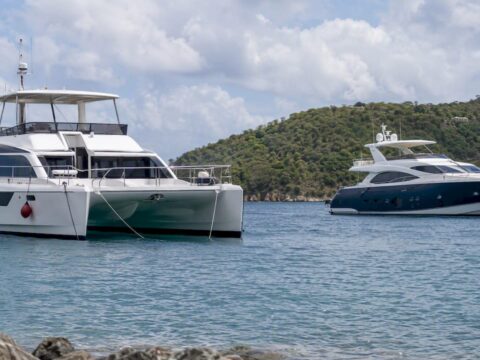
Short daily hops suit power catamarans well. They are stable at anchor and give you wide shaded decks and space for everyone, and our fleet features modern power catamarans from Fountaine Pajot, Leopard, Aquila, Aventura, Lagoon, Horizon and Two Oceans. Our guides to power versus sailing catamarans and to crewed versus bareboat charters walk through the choice.
Our published weekly prices by boat size are:
| Charter type | Boat | Price per week |
|---|---|---|
| Bareboat | 3-cabin power catamaran | £6,000 to £10,000 |
| Bareboat | 4-cabin power catamaran | £8,000 to £14,000 |
| Bareboat | 5+ cabin luxury power catamaran | £12,000 to £20,000 |
| Crewed | Premium catamaran (4 to 6 guests) | $25,000 to $35,000 |
| Crewed | Luxury catamaran (6 to 10 guests) | $35,000 to $70,000 |
| Crewed | High-end luxury catamaran or motor yacht | $70,000 to $120,000 |
If you want a captain on a bareboat, our standard captain is $250 per day and a training captain is $300 per day, listed on our charter costs page. A captain also lets you relax about navigation and customs on a route that crosses into the USVI, and our skippered hire page explains how that works.
Book your route with us
We plan the itinerary with you before you arrive, from the number of cabins to how many nights you want at each stop. Browse our bareboat charter pricing or luxury crewed charters, and tell us the dates and the crew. We will build the week around them.

Our perspective
After 30 years on Tortola, we have watched hundreds of itineraries succeed and the pattern is simple: the guests who come home happiest are the ones who did less, better. They chose one island group, anchored early, swam before lunch and let the weather pick a day or two for them.
That is why we curate a fleet of well-maintained power catamarans rather than the largest fleet possible. A boat that starts every day without drama lets you change your plan at breakfast, which is what an itinerary is for.
We are family-owned, and you deal directly with the people who know these anchorages. Tell us who is coming, how old the children are and what a perfect day looks like, and we will shape the week to match.
alexia
FAQ
How many days do I need for a Caribbean yacht itinerary?
Seven days is the minimum that feels like a real trip, and it covers a full route in the BVI and USVI. Ten days adds Anegada and slower mornings. Multi-island trips between island groups usually need two weeks or more because of the overnight passages.
Can I go island hopping between different Caribbean countries?
Yes. Each country has its own customs and immigration, so you clear in at a designated port of entry in each one. The Virgin Islands make this easy, because the BVI and USVI sit a short crossing apart.
What is the best time of year for a Caribbean yacht charter?
Hurricane season officially runs June 1 to November 30, according to NOAA, so most charter travel falls in the winter and spring months. Our BVI timing guide explains the differences month by month.
Should I choose a bareboat or a crewed charter?
Choose bareboat if you want privacy and the freedom to run the day yourselves, with a captain available by the day if you want one. Choose crewed if you want a captain, chef and crew to handle everything. Our bareboat charter guide and crewed charter guide cover both.
Sources
- NOAA: Tropical Cyclone Climatology
- All At Sea: Caribbean Sailing Itineraries, Day-by-Day Charter Routes
- Portzante: Eastern Caribbean Sailing Itinerary
- Caribbean Compass: South to North is the Winning Strategy
Recommended
- 7-Night BVI Yacht Charter Itinerary for First-Time Visitors
- 5-Day BVI Itinerary for First-Timers
- The Best 7-Day BVI Itinerary for Sailing and Island-Hopping
- BVI + USVI Combined Charter Itinerary
Did You Know?
The BVI are only accessible by boat. Check out our charter yachts that can get you there. View Our Fleet