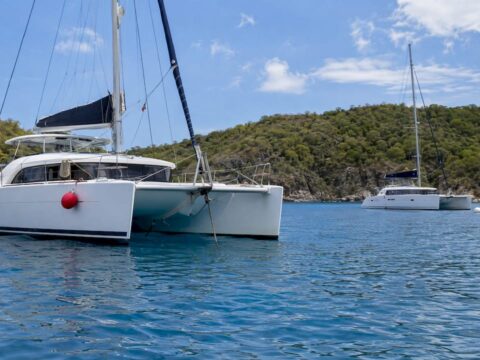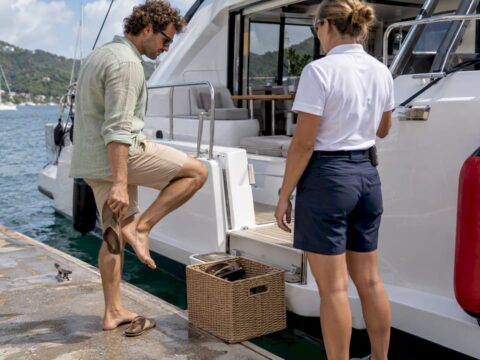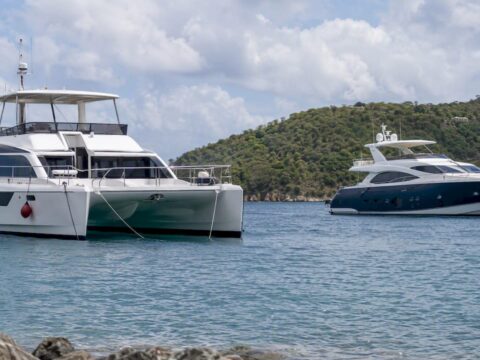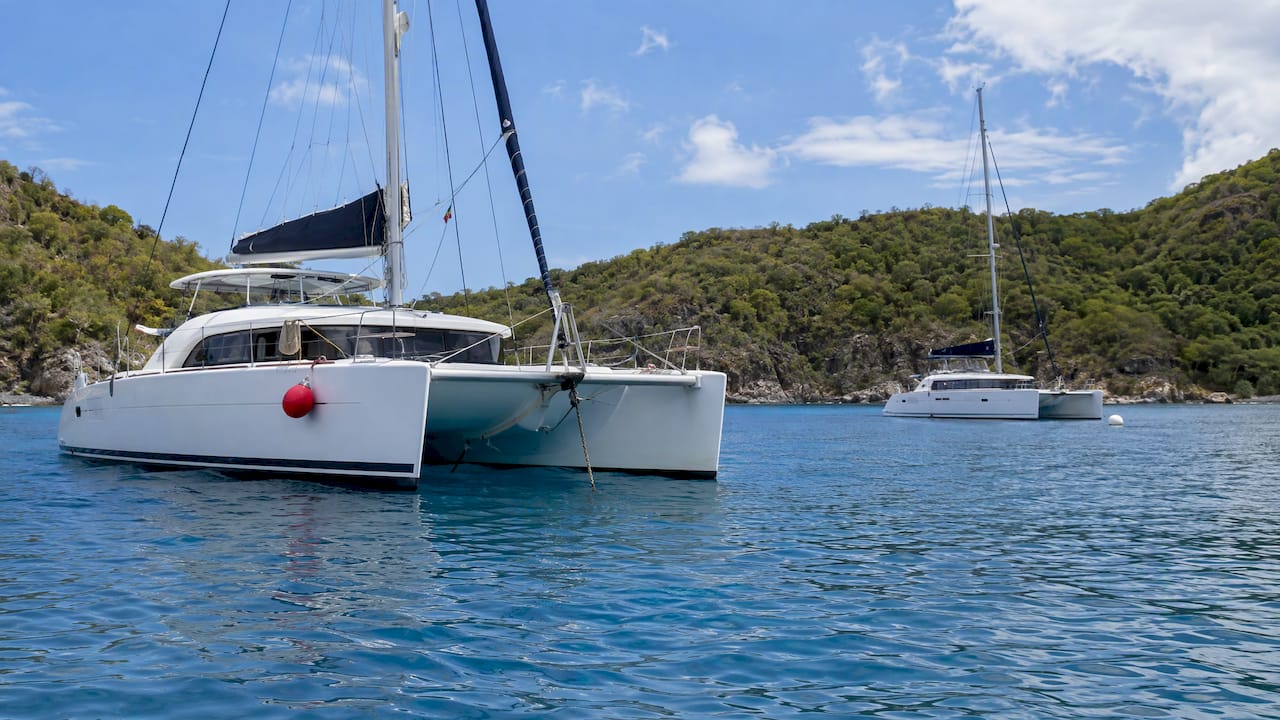

Anchoring means dropping your own anchor and holding the boat with it for a few hours or a night. Mooring means tying up to a heavy fixed anchor that someone else installed and maintains, usually a floating buoy. In the British Virgin Islands, on a charter, you will do both. Mooring balls are the default in the popular bays, and anchoring is the flexible option when the balls are full or you want a quieter spot. The skill that matters most on a BVI week is knowing which to pick at 4 p.m. and having a plan if your first choice is gone. At Virgin Charter Yachts we have run charters out of Tortola for 30 years, and we reserve mooring balls for guests through our BoatyBall booking service.
TL;DR
- Anchoring uses your own gear, is temporary, costs nothing in fees, and lets you pick the spot, but it needs the right bottom, enough scope and a clear swing circle.
- Mooring ties you to a permanent seabed anchor via a buoy. It is faster, holds in a smaller footprint, and suits crowded bays, but you pay a nightly fee and usually have to reserve.
- In the BVI, most popular bays are built around mooring balls. National Parks Trust buoys are day use only, and overnighting on them is illegal.
- At night, every vessel at anchor, including one on a ball, must show an all-round white light.
- Best approach: reserve a ball for your busiest bays, keep anchoring as your backup, and plan each evening before you leave the dock.
Table of Contents
- What is the difference between anchoring and mooring?
- Anchoring vs. mooring vs. marina: side by side
- How anchoring works, and where it goes wrong
- How mooring works in the BVI
- BVI anchoring rules to know
- Which should you choose? By trip type
- Why a charter with local support makes this easy
- Our view: plan the night, not just the day
- FAQ
- Sources
What is the difference between anchoring and mooring?
The core difference is whose gear holds the boat. Lippert’s boating guide describes anchoring as securing the boat in open water with its own anchor on a line or chain. It is temporary, it has a larger swing radius, and the skipper can do it anywhere the depth and seabed allow. Mooring is tying to a permanent system of a seabed weight, chain and floating buoy, installed and maintained by a marina, a harbor or an owner. It gives more stability and takes up less room.
Two terms are worth knowing before you charter:
- Ground tackle is the anchor, chain and line (the rode) the boat carries. The BoatUS Foundation notes that U.S. federal law does not require it, but a boat should carry an anchor big enough to hold overnight or in an emergency.
- A mooring ball is the buoy you see floating on the surface. It is attached to a heavy weight or a screw fixture on the bottom. Cruising World reports that the bottom weights are often 500 or 1,000 pounds, built from mushroom anchors, cast iron or concrete blocks.
Docking is a third thing: tying alongside a pier or marina berth. Technically it is also a form of mooring, but in everyday use “mooring” means the buoy, as Amnautical’s guide explains.
Anchoring vs. mooring vs. marina: side by side
| Mooring ball (reserved or first come) | Anchoring | National Parks Trust day buoy | Marina berth | |
|---|---|---|---|---|
| Gear | Permanent, maintained by owner | Your boat’s own anchor and chain | Pinned into bedrock by the Trust | Dock, shore power, water |
| Overnight | Yes | Yes, where allowed | No, illegal overnight | Yes |
| Typical cost | Nightly fee | No fee | Permit required | Highest of the four |
| Swing room | Small, set by the pennant | Large, set by your scope | Small | None |
| Effort at arrival | Low: pick up the pennant | Higher: choose spot, set, test | Low | Medium: docking skills |
| Main risk | Ball taken before you arrive | Dragging in wind shifts | Time limit | Cost, availability |
The BoatUS Foundation points out that a public mooring is usually far cheaper than dockage for the night. We cover the BVI’s version of that trade-off in our guide to mooring balls vs. marinas.
How anchoring works, and where it goes wrong
Anchoring gives you freedom. You can tuck into a cove with no balls, stay clear of the crowd and leave whenever you like. Sy.com’s guide to choosing puts the value of anchoring in that choice of position in permitted areas. The price of that freedom is that the quality of the hold is entirely yours.
Check the bottom
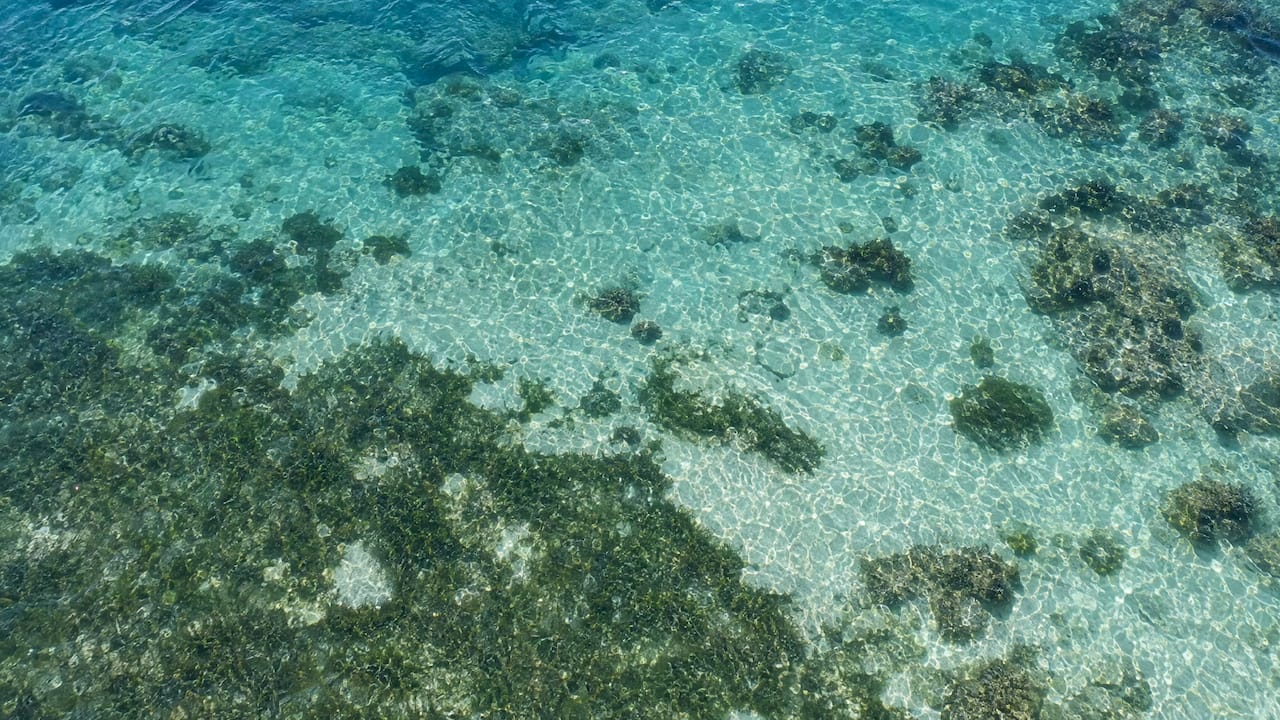
Learn to Sail’s guide grades holding ground: mud and clay are excellent, sand and gravel are good, rock and weed are poor. In practice, look for the pale, clear sand patches and avoid dark patches that signal grass or rock. On a charter, a pre-departure briefing is the moment to ask where each bay’s bottom is reliable.
Let out enough scope
Scope is the ratio of anchor line to water depth. Sources differ a little by conditions:
- Learn to Sail gives the RYA rule of thumb of at least 4 times the depth for all-chain rode and 6 times for chain and rope, with more in bad weather.
- Amnautical states a normal range of 5:1 to 7:1, with 3:1 only as an absolute minimum in calm weather.
- Cruising World advises a long scope of chain, 4:1 in a breeze and 6:1 or more above 25 knots.
A worked example: you anchor in 12 feet of water and the bow is 4 feet above the surface, so you count 16 feet of depth. At 5:1, that is 80 feet of chain and line out. Now picture that on a catamaran in a small bay with three other boats. That circle is the reason crowded bays work better on balls.
Prove it holds, then watch the swing
Learn to Sail recommends confirming the hold with fixed reference points on shore and a gentle reverse-power test. It also advises keeping your swinging circle clear of other boats. Sy.com adds that a 180-degree wind shift can turn a comfortable afternoon into a poor night, so check the whole circle for shallows, quays and neighbors. Amnautical also warns that a steep pull angle, above about 25 degrees, cuts holding power considerably. That is another reason to let out more line, not less, as the breeze builds.
How mooring works in the BVI
Mooring is how most charter guests spend most nights in the BVI. You motor up to a ball, a crew member picks up the pennant (the short line from the buoy) with a boat hook, and you cleat it to the bow. No setting, no testing, no anchor chain noise at 2 a.m.
A few BVI specifics:
- Balls are owned and maintained by businesses. Allatsea’s Caribbean guide reports around 400 BoatyBall moorings in the Virgin Islands, mostly in the BVI, with maintenance by Moor Seacure.
- Reservation is by app. Safety Anchor Alarm’s 2026 BVI guide says reservable orange balls are released at 7 a.m. with a short booking window, with a 12 p.m. check-in and check-out. It also reports a $15 cancellation fee after 3 p.m. without rebooking. Same-day reservations were reported by Allatsea at $40 or $55 per night. Fees and terms change, so confirm in the app.
- There are limits. The same guide reports one vessel per ball, a maximum length of 60 feet and 20 net tons, no extending the pennant, and an instruction to leave the ball if surface wind exceeds 40 knots or is forecast to within 12 hours.
- Mooring ball colors differ from the U.S. buoys you may know. In U.S. waters, the BoatUS Foundation says public mooring balls are white with a blue band. In the BVI, the National Parks Trust uses its own color code, covered below.
The 7 a.m. window is where many first-time guests lose out. Popular bays such as the Baths, Cooper Island and the Bight can fill early, so a reservation made that morning helps to guarantee where you sleep. Our guides on beating the 7 a.m. rush and reserving BVI mooring balls online walk through the routine in detail, and skippers will like the bay-by-bay reservation tactics.
Day buoys are not overnight balls
The BVI National Parks Trust installs its Halas System buoys by cementing stainless steel pins into bedrock, which limits damage to the seabed. These buoys are color coded: orange for non-diving day use, yellow for commercial use, white for diving only and blue for dinghies only. They are first come, first served, have a 90-minute limit, and it is illegal to use them overnight. A National Parks Mooring Permit is required by law, and the Trust says permits are sold by charter companies, dive shops and its Road Town office. Foreign vessels buy them at Customs on entry.
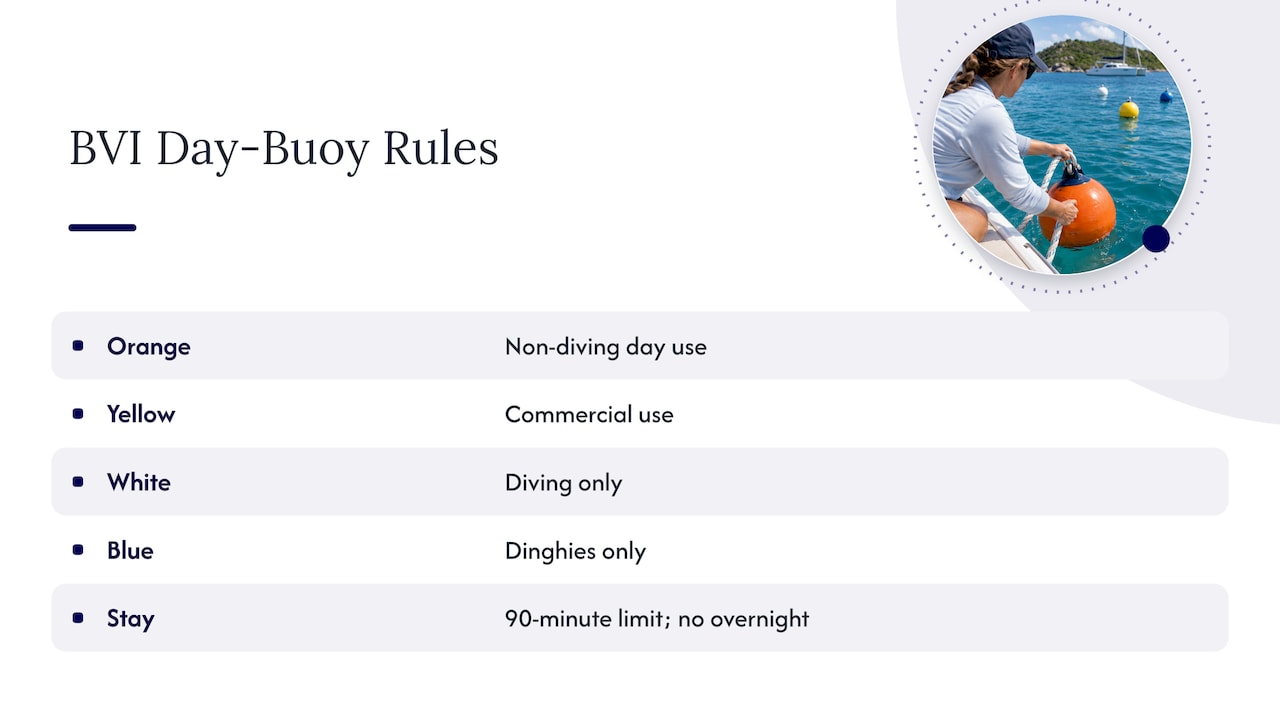
So at a snorkel stop, the orange buoy is for your lunch and swim. Your overnight ball is a separate booking. The Trust also reminds boaters that they stay responsible for their vessel on a Trust buoy, so check the pick-up line and down-line before everyone jumps in the water.
BVI anchoring rules to know
You can anchor in many BVI bays, but you cannot do it anywhere. Here is the framework:
- Protected and prohibited areas. Under the BVI Ports Authority Regulations 1995, the Authority can designate prohibited anchorages, safe anchorages and hurricane shelters as special protected areas, and masters must observe them. In severe weather, the Managing Director can order extra precautions for anchoring, mooring or berthing.
- Lights at night. Safety Anchor Alarm states that COLREGS Rule 30 applies in BVI waters: every vessel at anchor, including on a mooring ball, must display an all-round white light from sunset to sunrise.
- Cruising limits. Where you can go depends on your permit and your charter’s territory. Our pages on the BVI cruising permit and bareboat cruising restrictions explain the boundaries.
- Intra-territory trading. The Government of the Virgin Islands announced restrictions in 2025 on commercial vessels moving between BVI harbours, ports and anchorages. That applies to commercial operators, not to the guests on a licensed charter.
As rules and fees are updated, check the live pages of the Trust and the Ports Authority before you sail, and ask us for the current guidance.
Which should you choose? By trip type
Families. Choose a ball. Children are in and out of the water, nobody wants a 3 a.m. anchor watch, and you will not be near the dinghy dock fumbling with a chain. Use anchoring for a calm, empty lunch stop.
Couples. Reserve balls for the destination bays, then anchor in a quiet cove for a sunset dinner on a night with a settled forecast. That mix gives you the romance of a private anchorage with the security of a booked ball on busier nights.
Adventurous travelers and island hoppers. Anchoring is how you make a plan flexible. Read the weather each morning, then decide whether to chase a ball or find a sandy patch. Our BVI charter FAQ covers the routines that come up most.
Groups. A larger party usually means a larger boat, so check each ball’s length and weight limit when you reserve. Anchoring needs even more swing room for a big hull.
Yacht enthusiasts and prospective owners. The same trade-offs apply to your own boat at home. Moorings tie up less space, and anchoring gives you independence. If you are weighing a purchase, see our yacht ownership options.
A simple daily decision
- Check the forecast for wind direction through the next morning, not only the afternoon.
- Reserve a ball at 7 a.m. for the bay you most want.
- Have a backup bay with good sand where you could anchor.
- Arrive early enough to see the bay and the swing of the boats already there.
- Light the anchor light at dusk, whichever you chose.
The Sy.com guide adds a useful point about private buoys: check who owns them, what they are rated for and what condition they are in. A buoy that is fine in light wind may not be rated for a storm. A BVI ball booked through a reservation service takes that question off your plate.
Why a charter with local support makes this easy
The hard part of anchoring vs. mooring is not the theory. It is making good calls in a new place, with a full boat and a tired crew. That is where a captain or a local planning team helps. We offer a standard captain at $250 per day if you want an experienced hand for the first days, and a training captain at $300 per day if you want coaching on the boat. Fully crewed charters remove the question entirely, because the crew chooses and handles the overnight spot. See luxury crewed charters.
For bareboat guests, our power catamarans are published at £6,000 to £10,000 per week for a 3-cabin, £8,000 to £14,000 for a 4-cabin and £12,000 to £20,000 for a 5+ cabin luxury model, on our bareboat pricing page. Our crewed catamarans range from $25,000 to $120,000 per week depending on size, on the crewed pricing page. Our fleet includes Fountaine Pajot, Leopard, Aquila, Aventura, Lagoon, Horizon and Two Oceans power catamarans, with a wide, stable layout that many guests enjoy at anchor or on a ball.

Tell us how you want to spend your evenings, quiet coves or lively bays, and we will build the itinerary and the mooring plan around it. Start with our power catamaran charter guide or reserve with our BoatyBall concierge.
Our view: plan the night, not just the day
We have been based on Tortola for 30 years, and the most common mistake we see in planning is treating the overnight as an afterthought. Guests plan the beaches and the restaurants, and then arrive in a bay at 5 p.m. to find the balls taken.
Our advice is to decide your nights first. Reserve balls for the bays that matter, keep anchoring as your flexible second option, and let the day fill in around that. A reservation also frees you to enjoy the stop instead of worrying about it.
That is why we offer a pre-arrival concierge for BoatyBall reservations at the 7 a.m. window. As a family-owned operation, we would rather you step aboard with the evenings already in hand, and keep your attention on the water, the people with you and the view.
Anchoring is part of the BVI too, and a good captain on a quiet night in a sandy cove is hard to beat. Whether you want to learn it yourself or have someone do it for you, we will match the charter to your comfort level.
alexia
FAQ
Is anchoring or mooring safer?
Both are safe when done properly. A ball removes the work of setting and testing an anchor, and it takes up less swing room in a crowded bay. Anchoring relies on your bottom, scope and weather judgment. Sources agree that in strong wind you should check the rating of any ball and have an exit plan, and BoatyBall asks boats to leave when surface wind exceeds 40 knots.
Can I anchor anywhere in the BVI?
No. You can anchor in many bays with a suitable bottom, but the Ports Authority can designate prohibited anchorages and protected areas, and Trust waters have their own rules. Marine parks are managed to protect coral and seagrass. Ask us for the current guidance for each bay on your route.
Can I stay overnight on a National Parks Trust buoy?
No. The Trust says its buoys have a 90-minute limit, are first come, first served, and overnight use is illegal. Use them for a swim or snorkel, then move to a reserved ball or an anchorage for the night.
Do I need a light when moored or anchored at night?
Yes. Safety Anchor Alarm states that under COLREGS Rule 30, every vessel at anchor in BVI waters, including on a mooring ball, must show an all-round white light from sunset to sunrise.
What is the difference between mooring and docking?
Docking is tying alongside a pier, quay or marina berth. Mooring in everyday use means picking up a buoy attached to a permanent seabed anchor. Technically, docking is one kind of mooring, but sailors usually keep the words apart.
Sources
- Anchoring vs. Mooring: What’s the Difference? | Lippert
- Mooring vs. Anchoring | Cruising World
- Anchoring & Mooring | BoatUS Foundation
- Anchoring and Mooring | Learn to Sail
- Anchoring vs. Docking vs. Mooring | Amnautical
- Mooring vs Anchoring | Sy.com
- Marine Conservation Programme | BVI National Parks Trust
- BVI Anchoring Rules & Mooring Balls | Safety Anchor Alarm
- Caribbean Mooring, Docking & Anchoring Guide | Allatsea
- BVI Ports Authority Regulations 1995
- Limited-Time Access for Commercial Vessels in the Territory | Government of the Virgin Islands
Recommended
- Never Miss a BVI Mooring for Skippers: Bay by Bay Reservation Tactics
- BVI Mooring Balls: Beat the 7 AM Booking Rush on Your First Charter
- BVI Mooring Balls vs. Marinas
Did You Know?
The BVI are only accessible by boat. Check out our charter yachts that can get you there. View Our Fleet