
If you skipper a charter boat carrying paying guests anywhere in British Virgin Islands waters, you need a cruising permit, and fees are billed per person per day rather than as a flat vessel charge. Home based charter boats pay a lower daily rate than foreign based ones. Add National Parks Trust fees and entry charges on top, and factor in the 2025 amendment, which pushed rates higher and tightened the rules for foreign operators.
- Foreign-based charter boats now pay US$16 per person per day, which can significantly increase costs for week-long trips with multiple guests.
- Permit applications must be filed at least 14 days before arrival, with advanced paperwork shortening clearance times to one or three hours.
- Penalties for operating without a permit can reach several thousand dollars, and recent fee amendments have raised costs and tightened rules for foreign operators.
- Local BVI-based charters cost only US$4 per person per day, making them more cost-effective, especially after the 2025 regulation changes.
- Additional expenses like National Parks fees and mooring charges can add over US$1,300 to a foreign-flagged, week-long charter, impacting overall trip budgeting.
Table of Contents
- What Counts as a BVI Cruising Permit, and Who Needs One?
- How Much Does a BVI Cruising Permit Actually Cost?
- How Do You Apply for and Clear a BVI Cruising Permit?
- What Happens If You Skip the Permit or Miss the 2025 Rule Changes?
- What Will a BVI Charter Actually Cost Once Permits and Park Fees Are Added?
- What Should Captains and Charterers Check Before Arrival?
- How Virgin Charter Yachts Handles Permit Compliance for Clients
- What the 2025 Fee Changes Mean for How You Plan a BVI Trip
- Sources
What Counts as a BVI Cruising Permit, and Who Needs One?
The Cruising and Home Permit Act, 2021 sets the legal foundation, and it splits charter boats into two categories that determine your fee rate and paperwork.
- Home based charter boat: a vessel registered and habitually based in the BVI, operating under BVI licensing.
- Foreign based charter boat: a vessel based outside the territory (commonly the USVI) that enters BVI waters to carry paying passengers, even for a single day trip.
- Exemptions: small tenders and dinghies operating within roughly one mile of a parent vessel, and vessels used solely by BVI residents for private, noncommercial purposes, generally fall outside the permit requirement.
The Harneys guide to the 2021 Act makes clear that any charter boat cruising BVI waters must carry a valid permit at all times, and the captain, not just the charter company, bears responsibility for keeping it current. If you’re running a bareboat charter yourself rather than hiring crew, this duty falls squarely on you as skipper.
How Much Does a BVI Cruising Permit Actually Cost?
Fees run per person per day, and the gap between categories is significant. The official fee schedule published by BVI Maritime sets the baseline rates, and industry reporting confirms how they play out on the water.
- Home based charter boats: US$4 per person per day.
- Foreign based charter boats: US$16 per person per day, four times the home based rate.
- Vessel entry fees: charged separately at the port of clearance, in addition to the per-person permit charge.
- National Parks Trust fees: mooring and day-use charges at protected sites like the Baths or Norman Island, layered on top of the cruising permit.
Blue Water Sailing’s coverage of the 2025 changes notes that foreign-based charters now face roughly $16 per person per day, with National Parks fees reported as high as $55 per week per boat in some anchorages.
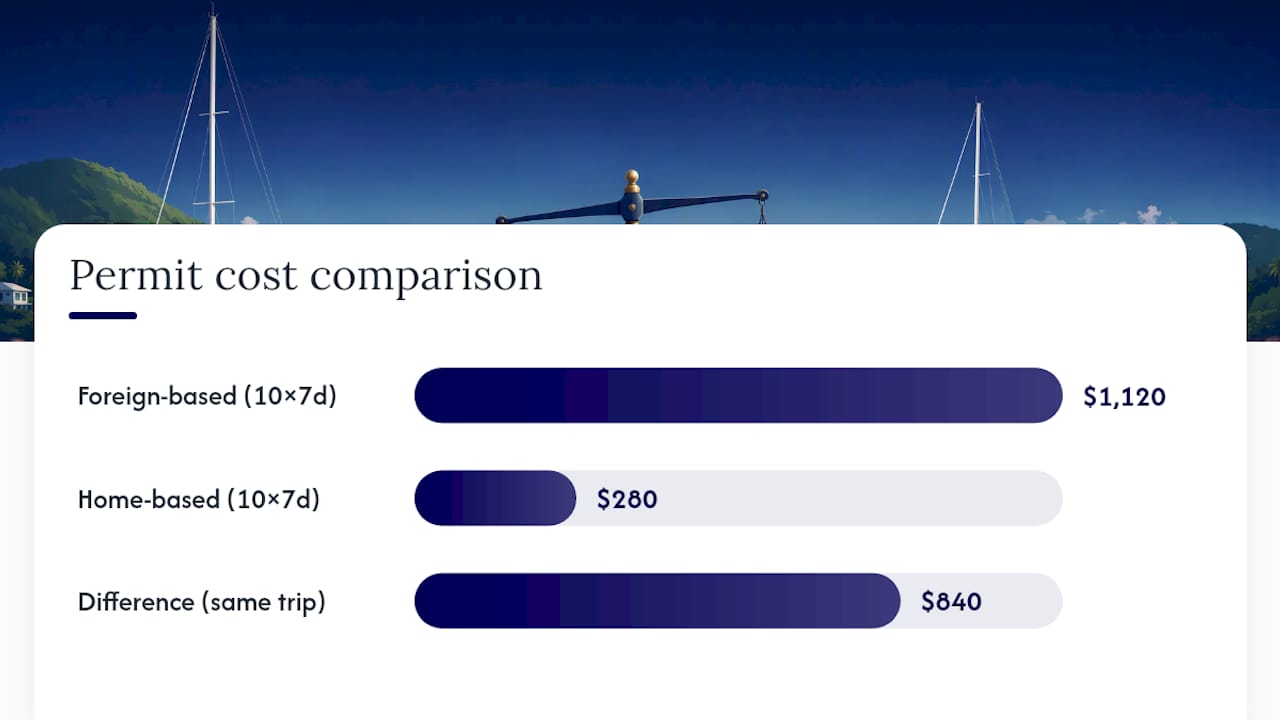
Statistic Callout: A week-long charter with 10 guests on a foreign-based boat runs $16 x 10 x 7 = $1,120 in cruising permit fees alone, before a single park mooring or entry fee is added. The same trip on a home-based boat costs $280 in permit fees, a difference of $840 for identical guest counts and days.
How Do You Apply for and Clear a BVI Cruising Permit?
Applications route through the Commissioner of Customs and, for commercial vessels, the CRVL (Commercial Recreational Vessel Licensing) process.
- File through the Commercial Recreational Licensing portal, which lists required uploads: registry certificate, insurance documents, and a trade license where applicable.
- Foreign-based charter boats must submit notification roughly 14 days before arrival; pre-filing shortens delays at clearance.
- Clear immigration and customs at one of the designated ports of entry: Road Town, West End, Great Harbour on Jost Van Dyke, or Virgin Gorda, and use SailClear for advance arrival notices where the port supports it.
- Keep crew and guest lists, vessel registration, and proof of insurance on board; officers ask for these at clearance and periodically during patrol checks.
Clearance itself typically takes one to three hours when paperwork is filed in advance, though same-day walk-ins without pre-filing can stretch longer during busy arrival windows.
Pro Tip: File your SailClear notice and CRVL documents at least three days before your 14-day window closes, not on the deadline itself. Customs officers flag incomplete submissions for follow-up, and a bounced form with no buffer days can strand you offshore waiting for clearance.
What Happens If You Skip the Permit or Miss the 2025 Rule Changes?
Exemptions are narrower than most captains assume, and the penalties for skipping a permit are steep enough to wipe out any savings.
- Short first-24-hour grace exemptions apply in limited circumstances but do not cover multi-day cruising without a permit on file.
- Tenders under roughly one mile of the mother ship and BVI resident private use remain the clearest exemptions.
- Fines for operating without a valid permit can reach several thousand US dollars, plus compounding daily charges per person for each day of unpermitted operation.
- Repeat or willful noncompliance risks permit cancellation for the vessel or operator going forward.
The Cruising and Home Port Permit (Amendment) Act, 2025, effective June 1, 2025, restructured fees and added new operational limits specifically targeting foreign-based operators.
The amendment tightens the definitions around foreign-based operations and raises the cost of noncompliance, effectively closing loopholes that some cross-border charter operators had relied on before June 2025.
For any operator running US-based charters into BVI waters, that rule change is now the single biggest cost variable in the trip.
What Will a BVI Charter Actually Cost Once Permits and Park Fees Are Added?
Three quick scenarios show how permit and park costs stack against a base charter rate.
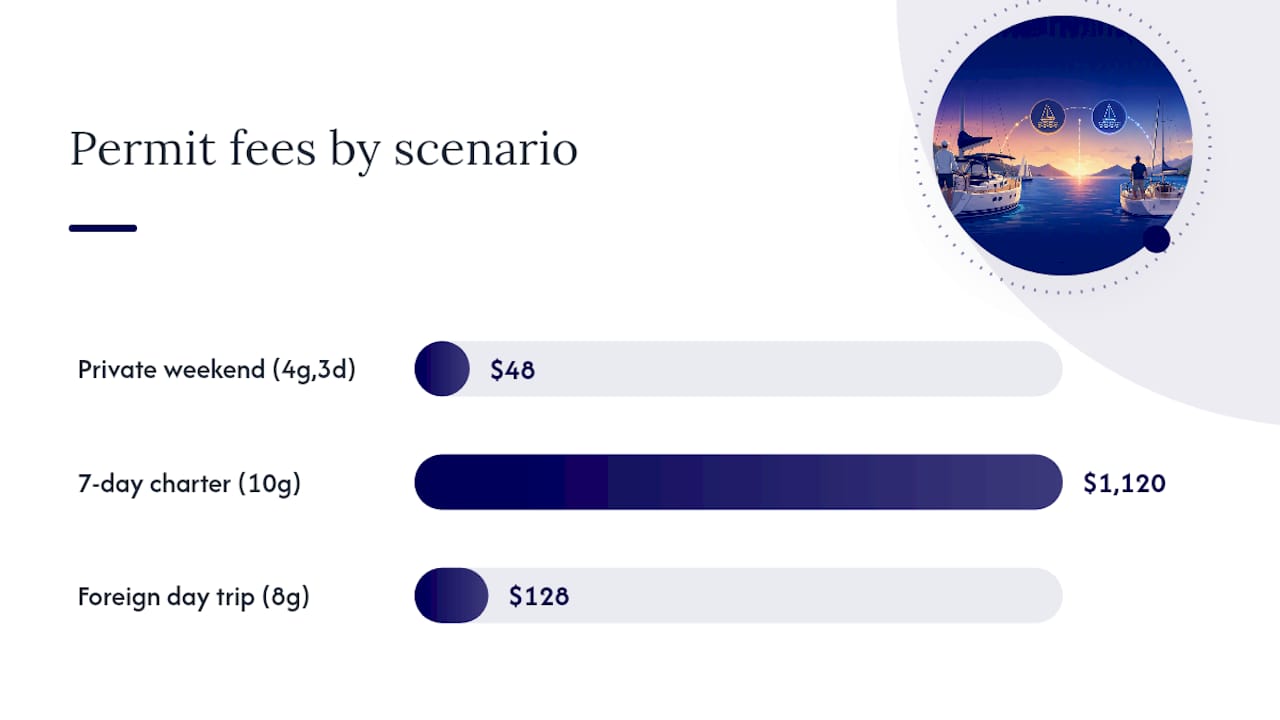
- Private weekend, 4 guests, home-based boat, 3 days: $4 x 4 x 3 = $48 in permit fees, plus roughly $20 to $30 in park mooring fees for a Baths or Norman Island stop.
- 7-day charter, 10 guests, foreign-based boat: $1,120 in permit fees (calculated above), plus an estimated $150 to $200 in combined National Parks and mooring charges across a typical BVI itinerary.
- Foreign-based commercial visit, 8 guests, single day trip: $16 x 8 x 1 = $128 in permit fees, plus a separate vessel entry fee at clearance.
Statistic Callout: On a 10-guest, 7-day foreign-based charter, permit and park fees combined can exceed $1,300, a figure that has more than doubled for many foreign operators since the 2025 amendment took effect.
Hidden costs to build into any charter cost breakdown include mooring ball fees at popular anchorages, waste disposal charges at marinas, and agent handling fees if you use a clearance agent. Most experienced charterers place permit and park fees inside the Advance Provisioning Allowance (APA) or as a fixed contract line item, rather than treating them as a surprise on the final bill.
What Should Captains and Charterers Check Before Arrival?
A short pre-departure checklist saves hours at clearance and avoids fines entirely.
- Carry vessel registration, insurance certificates, and a printed crew and guest manifest.
- Leave a copy of your CRVL application and cruising permit with your clearance agent or charter base before departure.
- Use a local customs agent for foreign-based commercial visits; they typically handle CRVL submission, port coordination, and document verification.
- Confirm National Parks Trust mooring availability at popular stops before arrival, especially during high season.
- Time your arrival outside peak midday clearance windows at Road Town when possible.
Pro Tip: Call ahead to your chosen park mooring field the morning of arrival, not the night before. Mooring balls at spots like the Baths fill fast in high season, and a captain who confirms availability by radio avoids circling offshore waiting for a spot to open.
How Virgin Charter Yachts Handles Permit Compliance for Clients
Virgin Charter Yachts has operated as a family-owned charter business based in Tortola for 30 years, and that local footing means permit and clearance logistics are handled as part of the planning process rather than left to guests to figure out. Clients booking a crewed charter benefit from established agent contacts and itinerary planning that accounts for park fees and mooring availability before departure. For bareboat clients, Virgin Charter Yachts provides guidance on required documents and clearance steps so first-time BVI sailors aren’t caught off guard by the 14-day notification window or park fee stacking described above. Because Virgin Charter Yachts is a BVI-based charter company, charter guests benefit from the lower home-based cruising permit fees of $4/person/day.
What the 2025 Fee Changes Mean for How You Plan a BVI Trip
The math is straightforward: a $16 per person per day rate for foreign-based boats versus $4 for home-based ones means every cross-border day trip now carries a real cost penalty. That shift, flagged by VIPCA’s industry commentary, is already nudging charterers toward BVI-based operators rather than short hops from the USVI.
If you’re cost-sensitive, the smartest move is minimizing the number of person-days billed at the foreign rate, either by basing your charter locally or structuring itineraries around fewer border crossings.
For anyone comparing a motor yacht charter based in the BVI against a cross-border alternative, the permit math now tips clearly toward the local option.
Sources
- Cruising and Home Port Permit (Amendment) Act, 2025
- Guide - Cruising and Home Permit Act 2021 (Harneys)
- Commercial Recreational Licensing | Government of the Virgin Islands
- BVI Cruising Fees Slam Door on USVI Charters and Many Cruisers (Blue Water Sailing)
Recommended
- BVI Yacht Charter Cost: What U.S. Travelers Should Budget
- BVI Charter Costs — Full Breakdown
- BVI Bareboat Guide: Planning Your Ideal Sailing Trip
- BVI Charter Costs — Full Breakdown
Did You Know?
The BVI are only accessible by boat. Check out our charter yachts that can get you there. View Our Fleet