
If you want more living space and calm anchorages for a family or group charter, a power catamaran is usually the better call. If you’re planning long offshore passages or need to squeeze into a narrow, older marina, a motor yacht often makes more sense. The trade-offs come down to three things: interior room and stability at anchor versus berthing ease and resale liquidity, plus how each hull handles fuel burn at the speeds you’ll actually run.
- Power cats offer 15 to 25% more interior and deck space than similar-sized monohulls, with a flat, single-level saloon and separate cabins.
- They reduce slamming forces by about 25% in choppy seas, but this depends heavily on design features like hull geometry and bridge-deck clearance.
- Fuel efficiency at low speeds favors power cats, though at planing speeds, a purpose-built motor yacht may use less fuel for longer offshore passages.
- Twin engines give power cats better maneuverability and redundancy, making docking easier and increasing safety during longer coastal trips.
- Higher costs of maintenance, haul-outs, and marina fees for cats stem from their larger wetted surface area and wider berthing requirements.
Table of Contents
- Motor Yacht vs Powercat: The Core Differences
- How Do You Choose Between a Motor Yacht and a Power Cat?
- What Charter Guests Actually Experience Aboard Each Hull
- An Editor’s Honest Take on the Hull Debate
- Book the Right Hull for Your Trip
- Sources
Motor Yacht vs Powercat: The Core Differences
The debate over motor yacht vs powercat design rarely comes down to one clean winner. Naval architects call the single-hull boat a “monohull,” and that’s the term you’ll hear from brokers and surveyors even when everyone else says “motor yacht.” Both hull types can carry the same brands, the same horsepower, and similar price tags. What changes is how the hull shape distributes space, handles waves, burns fuel, and gets serviced.
Stability and how each hull rides
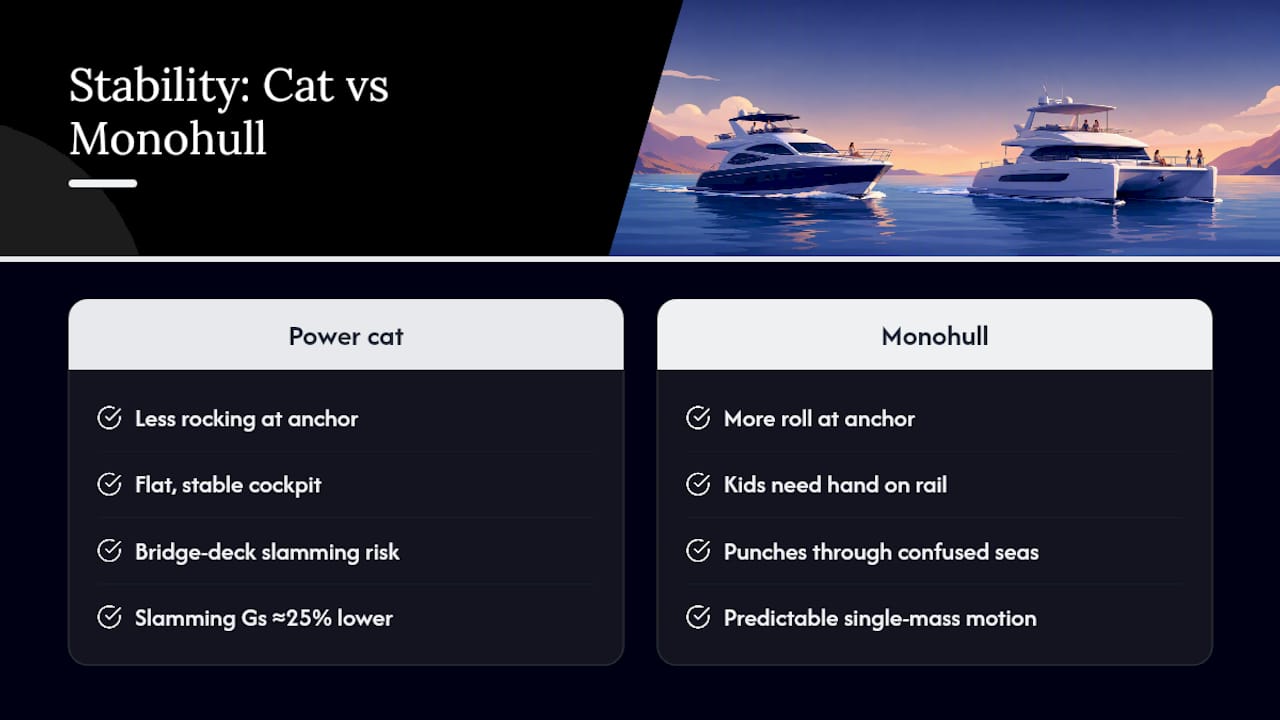
A power cat’s twin hulls give it a wider stance in the water, which translates to less rocking at anchor. That matters more than most first-time charterers expect. Sundowners on a rolling monohull get old fast; a flat, stable cockpit on a cat means drinks stay in the glass and kids can move around without a hand on the rail.
The trade-off shows up in rough, short-period seas. A catamaran’s bridge deck, the underside of the platform connecting the two hulls, can slam against wave crests when the swell gets steep and close together. This is often called 'porposing' as it mirrors the motion of a porpoise jumping in and out of the water. Published testing and expert reporting on cat performance have found some designs cut wave-slam accelerations by roughly 25% compared to similar monohulls, but that number depends heavily on tunnel geometry and bridge-deck clearance. CFD wave-resistance research on staggered-hull catamarans shows exactly why: a taller wing deck and a properly tuned tunnel reduce slamming risk, while a cheaply designed one won’t. A monohull, by contrast, rolls more at rest but tends to punch through confused seas with a more predictable, single-mass motion that offshore sailors often prefer on long passages.
Statistic Callout: Accelerometer tests cited by marine researchers show some catamaran hulls reduce slamming G-forces by about 25% versus a comparable monohull in short, choppy seas, though the figure varies by design and sea state.
Interior and deck space
This is where the powercat advantages become obvious the moment you step aboard. Because the beam runs the full length of the boat instead of tapering to a point at the bow, cats typically deliver 15 to 25% more usable interior and deck space than a monohull of the same overall length. That extra width shows up as:
- A flat, single-level saloon with no steps between the galley and lounge
- Private cabins split across two hulls, giving couples or families genuine separation
- A wide cockpit and foredeck that can seat a dozen guests without anyone standing
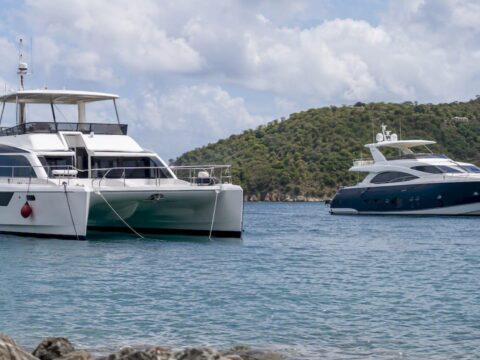
A 45 to 50 foot motor yacht comparison against a similarly sized cat almost always favors the cat on raw square footage. A 40-50 ft monohull can be 14-17' wide, but a similar length powercat can often be 22-28' in width. What the monohull gives up in width, it partly recovers in vertical volume, since a deep-V hull can stack a lower deck or engine room beneath the saloon that a cat’s shallower hulls can’t match as easily.
Fuel burn and cruising speed
Fuel efficiency depends entirely on what speed you actually run. At displacement or economy cruising speeds, roughly 8 to 10 knots, a cat’s twin slender hulls push less water and burn less fuel than a heavier monohull moving the same distance. Push a cat into planing speeds, though, and the advantage can shrink or reverse. The wave-making resistance curve for catamarans rises faster once you cross into higher planing regimes, meaning a cat chasing 25 knots can demand disproportionately more horsepower than a similarly sized monohull built for speed from the keel up. If your trip plan is mostly island hopping at a relaxed pace, the cat wins on fuel. If you want to cover 200 miles offshore in a day at 22 knots, a purpose-built motor yacht may burn less per mile.
Handling, engines, and redundancy
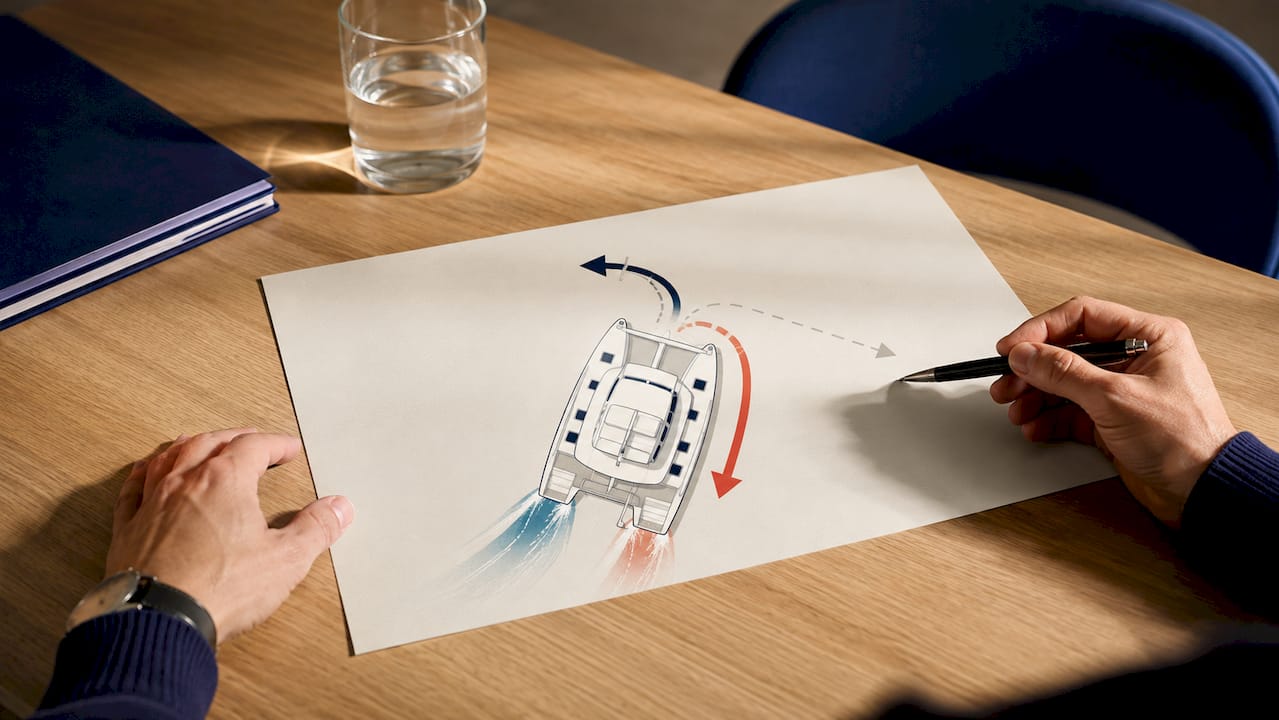
Twin engines set well apart give cats a real maneuvering edge. You can pivot a power cat nearly within its own length by putting one engine in forward and the other in reverse, which makes tight-marina docking far less stressful than in a single-engine monohull. That same twin-engine layout also means a mechanical failure on one side rarely ends the trip. Charter operators and owners consistently cite this redundancy as one of the strongest safety arguments for cats on longer coastal runs. A single-engine motor yacht is simpler to maintain, with one power plant, one set of filters, and one shaft seal, but it also means one failure point.
Maintenance, haul-out, and running costs
Two hulls generally mean two of almost everything: engines, generators sometimes, filters, and anodes. That duplication raises parts inventory and can push routine service costs higher over a season, even though each individual job (an oil change, an impeller swap) is no more complex than on a monohull. Antifouling is another line item worth budgeting for; a cat’s total wetted surface area across two hulls often exceeds a monohull’s single hull, so bottom paint and haul-out labor cost more per visit. Many yards also need wider lift slings or specialized trailers to haul a catamaran, and not every boatyard is equipped for it, which can limit where you service the boat.
Berthing, resale, and market demand
Marina berths are priced by width in a lot of ports, and a cat’s extra beam means real money. Busy marinas, especially in the Mediterranean and other high-demand cruising grounds, commonly charge multihull surcharges in the 30 to 50% range over standard monohull rates, and some older marinas simply don’t have slips wide enough to take a cat at all. On the resale side, catamaran demand has grown steadily as charter fleets have shifted toward them, which has kept used-cat values relatively firm in many markets. Motor yacht comparison shoppers looking at resale should also factor in that monohulls still dominate brokerage listings in most regions, meaning more buyers to sell to but often more competition on price too.
How Do You Choose Between a Motor Yacht and a Power Cat?
Work through this before you call a broker or click “book” on a charter listing.
- Define the primary use. Weekend coastal cruising with friends, a full liveaboard season, or a serious offshore passage each point toward a different hull.
- Count your crew and guests. Groups of 8 or more almost always feel more comfortable spread across a cat’s separate cabins and wide cockpit.
- Check your home marina or charter base. Measure the actual berth width available and ask about multihull surcharges before you fall in love with a boat you can’t dock affordably.
- Set a realistic budget that includes duplicated costs. Two engines, two sets of filters, and wider haul-out slings add up over a season of ownership.
- Think about resale and charter potential. If you might sell in five years or put the boat into charter, ask a broker which hull type is moving faster in your target market right now.
When you’re inspecting a specific boat, ask pointed questions rather than general ones. Request the fuel burn figures at your actual cruising RPM, not just the top-speed number in the brochure. Ask for engine hours on each side separately, since uneven hours on a cat can signal one engine worked harder than the other for years. Check bridge-deck clearance in person and ask directly whether the hull has ever suffered slam damage. Crawl into the engine compartments yourself if you can. Tight, hard-to-reach engine rooms on some cat models turn routine maintenance into a bigger job than it should be.
What Charter Guests Actually Experience Aboard Each Hull
On the water, these trade-offs stop being abstract fast. A group of 10 to 12 guests aboard an Aventura 50 power catamaran spreads naturally across four or five cabins with real separation, while the flat cockpit turns into a dinner table for the whole group without anyone feeling cramped. That layout is exactly why most charter fleets, including ours, lean heavily on cats for social and family trips.
Virgin Charter Yachts handles the parts that make cat ownership headaches disappear for guests: proactive maintenance scheduling so both engines get serviced without downtime, provisioning built around each power catamarans unique galley layout, and crew who know each model’s quirks. For island hopping through shallow Caribbean anchorages, a power cat’s shoal draft and stability at anchor beat a monohull almost every time.
An Editor’s Honest Take on the Hull Debate
Ask most brokers which hull is better and you’ll get a hedge. Ask a family who just spent a week aboard a rolling monohull in a windy anchorage, and you’ll get a straight answer fast. Our own bias runs toward power cats for anything social, group-based, or anchored more nights than it’s underway; the stability alone changes how people sleep and eat on a boat.
Book the Right Hull for Your Trip
You don’t have to choose in theory when you can compare both hulls on the water. Virgin Charter Yachts runs a fleet that spans modern power catamarans from Fountaine Pajot, Leopard, Aquila, Aventura and Lagoon alongside motor yacht options from Horizon and Sunreef, so you can charter the exact layout this article describes rather than guess from a brochure. Our family-owned team has worked out of Tortola for 30 years, which means we know which cat handles a squally afternoon well and which motor yacht berths easily in a tight BVI marina.
If group comfort and stable anchorages matter most, look at our power catamaran charter options in the BVI. If you’re still weighing hull types for your specific itinerary, our monohull versus catamaran breakdown goes deeper on vessel-by-vessel fit. Ready to see availability and pricing for your dates? Request your quote and book your boat today.
Sources
- Power Catamarans: A comprehensive guide — BoatTrader
- Boats
- Power-Cat Advantages for Cruising — Yachting Magazine
- CFD prediction of the wave resistance of a catamaran with staggered demihulls — University research
Recommended
- Monohull vs Catamaran: Which Should You Choose?
- BVI Bareboat Charter for 12 Guests | Aventura 50 Powercat
- Best BVI Power Catamaran for 6, 8, 10 or 12 Guests
- Power Catamaran Charter BVI: Your Complete 2026 Guide
Did You Know?
The BVI are only accessible by boat. Check out our charter yachts that can get you there. View Our Fleet