
A charter power catamaran in the British Virgin Islands typically burns somewhere between 10 and 35 gallons of diesel per hour at cruising speed, and far less when you slow down. Over a normal week of island hopping, that adds up to a few hundred gallons and a fuel bill in the low thousands of dollars, not tens of thousands. The exact figure depends on the yacht, your speed, the generator and how many miles you cover.
TL;DR
- Cruising at 12 to 18 knots, expect roughly 10 to 36 gallons per hour depending on boat size and engines. Slow down to 7 to 9 knots and the burn can drop below 6 gallons per hour on some hulls.
- A typical BVI day is short. The islands in the Sir Francis Drake Channel sit about 5 to 15 nautical miles apart, so most days are one to three hours of engine time.
- One published week aboard a three-cabin Aquila 443 used just over $1,500 of fuel, with the generator running around the clock.
- Speed is the biggest lever. Going from 18 knots to a relaxed cruise cuts consumption sharply, and range stretches with it.
- Ask how fuel is handled on your specific yacht when you request a quote, because bareboat and crewed charters are not always structured the same way.
Table of Contents
- Real burn rates from published tests and charter reports
- What a BVI week actually looks like
- Worked example: three days in the Sir Francis Drake Channel
- What changes your fuel use
- What fuel costs and how to budget it
- Is fuel included in the charter price?
- Our perspective
- Choosing a yacht with fuel use in mind
- Tips to keep your fuel use low
- Ready to plan your own BVI power catamaran week?
- FAQ
- Sources
Real burn rates from published tests and charter reports
No two power catamarans burn alike, so the most honest answer is a range built from measured numbers. Here is what recent tests and operator reports show.
| Yacht and engines | Speed | Fuel burn | Source |
|---|---|---|---|
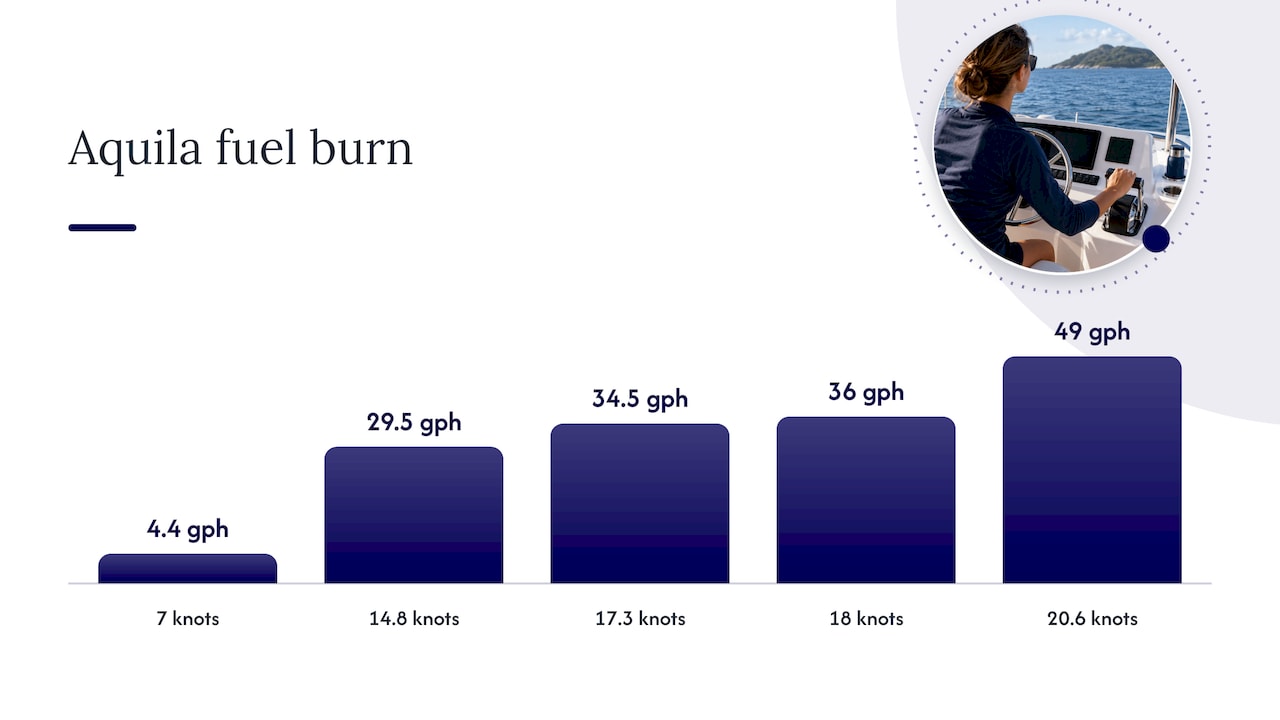
| Aquila 46 Yacht, twin 480 hp Volvo Penta D6 | 7 knots (eco-cruise) | 4.4 gph | Yachting Magazine |
| Aquila 46 Yacht | 14.8 knots | 29.5 gph | BoatTEST |
| Aquila 46 Yacht | 17.3 knots | 34.5 gph | BoatTEST |
| Aquila 46 Yacht | 18 knots | 36 gph | Yachting Magazine |
| Aquila 46 Yacht | 20.6 knots (top speed) | 49 gph | BoatTEST |
| 57-foot BVI charter cat, twin OXE300 diesel outboards | 18 to 22 knots | about 24 gph | OXE Marine |
| Twin Yanmar 220 hp powercat, BVI charter week | 12 to 15 knots | 10 to 15 gph | PropTalk |
| Africat 42 delivery, BVI to Florida | 9 knots | 5.7 gph combined | Virgin Islands Yacht Broker |
The pattern is clear. Burn climbs steeply as you approach top speed. On the Aquila 46, moving from 14.8 knots to 20.6 knots raises fuel flow from 29.5 to 49 gallons per hour, while speed rises only about 40 percent. Per mile, the fast end of the scale is expensive.
The Leopard 53 Power Catamaran shows the same logic from the builder’s side. Robertson and Caine lists a 562 US gallon tank, 17 knot cruise and a range of 420 nautical miles at 15 knots, stretching to 1,600 nautical miles at 5 knots. You will never need that range in the BVI, but it tells you how much slowing down changes the picture.
What a BVI week actually looks like
The British Virgin Islands are built for short hops. The Sir Francis Drake Channel offers line-of-sight navigation between islands spaced roughly 5 to 15 nautical miles apart. A 10-mile run at 15 knots takes 40 minutes. Most of your day is spent at anchor, on a mooring ball, snorkeling or on a beach.
Two real-world reports put numbers on that:
- A week on a powercat in the BVI at a 15-knot cruise, with twin Yanmar 220 hp diesels, used only 105 gallons of the 264 gallons of tankage.
- A three-cabin Aquila 443 reviewed by Motor Boats Monthly used just over $1,500 of fuel for the week of island hopping, with the generator running 24/7 and a couple of hundred miles covered, on a charter costing around $16,000.
Those two weeks bracket what most charterers should plan for: fuel is a real line item, but a modest one next to the charter fee itself.
Worked example: three days in the Sir Francis Drake Channel
Here is simple arithmetic you can adapt. These are illustrations built from the published burn rates above, not quotes for any specific yacht.
Take a yacht that burns about 30 gallons per hour at 15 knots, close to the Aquila 46’s measured 29.5 gph at 14.8 knots.
| Day | Route (approx.) | Distance | Engine time at 15 knots | Fuel at 30 gph |
|---|---|---|---|---|
| 1 | Tortola to Norman Island | 12 nm | 48 min | about 24 gal |
| 2 | Norman Island to Virgin Gorda | 20 nm | 80 min | about 40 gal |
| 3 | Virgin Gorda to Jost Van Dyke | 22 nm | 88 min | about 44 gal |
That is roughly 108 gallons across three travel days. At an assumed $5 per gallon for illustration, about $540. Add generator hours for air conditioning, and the weekly total grows. Slow down to a relaxed 10 knots and the same legs take longer but cost noticeably less per mile, because the engines are working far below their top end.
The formula is easy to keep in your head:
- Divide each leg’s distance by your speed to get hours.
- Multiply hours by the burn rate for that speed.
- Add generator hours at their own hourly rate.
- Multiply total gallons by the local fuel price.
What changes your fuel use
Speed and engine load
Speed is the dominant factor. The Aquila 46 data shows it plainly: 4.4 gph at 7 knots against 36 gph at 18 knots. The Leopard 53 test goes further: between 13 and 18 knots, range stays roughly constant at around 450 nautical miles, while at 8 knots it extends to 1,550 nautical miles. In plain terms, once you are planing along, going faster costs you the same distance per tank but gets you there sooner. Dropping to a displacement pace is where the big per-mile savings sit.
Boat size and engines
A 46-foot catamaran with 480 hp engines and a 57-foot boat with outboards are different machines. Hull shape matters as much as horsepower. The operator of one 57-foot BVI charter cat credits diesel outboards and a wave-piercing, partially planing hull for burning about 24 gph at 18 to 22 knots. Larger five-cabin and luxury yachts carry more weight and more systems, so expect higher totals at the same speed.
Generator and air conditioning
In a power catamaran, the generator often runs the air conditioning, and one charter planning article notes that fuel consumption depends on daily distance and how often you run the generator. Overnight cooling is where many charterers’ fuel quietly goes. Anchoring in a breezy spot and using hatches and fans in the evening can trim generator hours.
Weather and sea state
Head seas and strong trade winds in open channels such as the Anegada Passage raise load on the engines. Plan longer crossings for calmer mornings and you will usually burn less and ride more comfortably.
One engine or two
It is tempting to shut one engine down. A delivery skipper who tried it on an Africat 42 found that dragging the idle hull saved engine hours but not real fuel, so he went back to both engines. Run both at a modest speed instead.
What fuel costs and how to budget it
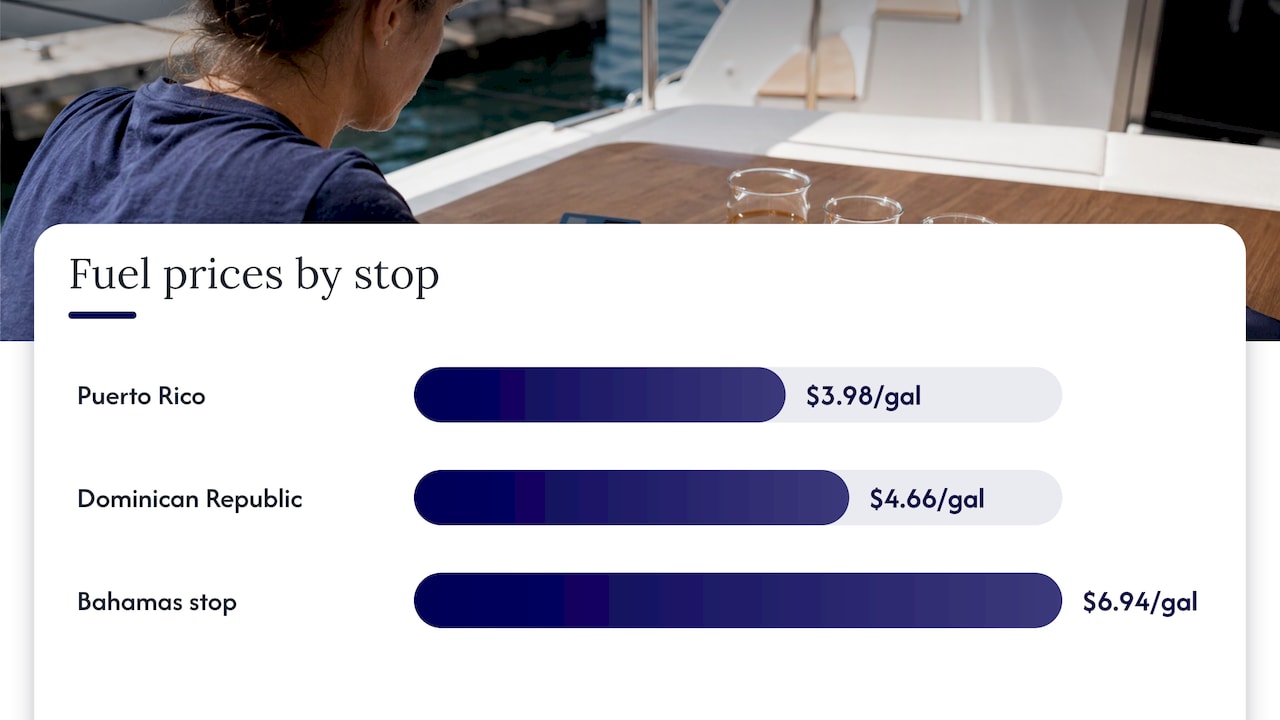
Fuel prices vary by island and by year, so use a fresh quote rather than an old number. For reference, a 2024 delivery from BVI to Florida logged $3.98 per gallon in Puerto Rico, $4.66 in the Dominican Republic and as much as $6.94 per gallon at a Bahamas stop. Those are delivery stops, not BVI charter prices, but they show how wide the spread can be.
A practical budget method:
- Estimate your daily engine hours from your itinerary.
- Pick a realistic cruising speed, not top speed.
- Add two to four generator hours a day if you plan to use air conditioning.
- Multiply by a conservative per-gallon price and add a cushion.
For most one-week itineraries, the result lands in the low thousands of dollars, consistent with the roughly $1,500 reported on the Aquila 443 week. Longer or faster itineraries, larger yachts and heavy generator use push it up.
Is fuel included in the charter price?
It depends on the yacht and the type of charter, so treat it as a question to settle at the quote stage rather than an assumption. Our charter costs breakdown and what’s included page set out what the charter fee covers and what sits on top, such as a captain at $250 per day for a standard captain or $300 per day for a training captain, and a one-off $250 Wi-Fi fee per charter. For the wider picture of how a bill comes together, our full BVI charter cost guide is the place to start.
If you want to see how other regions present overnight charter pricing, you can compare a luxury overnight sailing charter in Tasmania with what you see in the Caribbean.
Our perspective
We have run charters out of Tortola for 30 years, and the fuel question comes up on almost every booking call. Our answer is the same each time: in the BVI, fuel is a manageable part of the trip, and you control most of it.
The islands are close together. We plan itineraries so guests spend their time anchored in beautiful places, not running flat out between them. A relaxed cruise gets you to the next bay in an hour or so, and it is easier on the engines, quieter on deck and kinder to your budget.
This is also why we curate the fleet the way we do. Our power catamarans come from builders such as Fountaine Pajot, Leopard, Aquila, Aventura, Lagoon, Horizon and Two Oceans, and we keep them exceptionally maintained, because well-kept engines and clean hulls are what give a boat its best efficiency. When you tell us your group size, your dream islands and how much time you want on the move, we can match you to a yacht and sketch a route with realistic engine hours.
We would rather talk you through a plan than hand you a generic estimate. That is the advantage of a family-owned team that lives where you will be sailing.
alexia
Choosing a yacht with fuel use in mind
If you are comparing yachts, think in terms of how you will use them:
- Couples and small families: A three-cabin power catamaran covers most itineraries comfortably. Our bareboat range for a 3-cabin power catamaran is published at £6,000 to £10,000 per week on our bareboat pricing page.
- Larger groups: Four-cabin yachts are listed at £8,000 to £14,000 per week, and 5+ cabin luxury power catamarans at £12,000 to £20,000 per week, on the same page.
- Crewed charters: If you would rather leave route planning, engine hours and fuel logistics to a professional crew, see our luxury crewed charters. Premium catamarans for 4 to 6 guests are listed at $25,000 to $35,000 per week, luxury catamarans for 6 to 10 guests at $35,000 to $70,000, and high-end luxury catamarans and motor yachts at $70,000 to $120,000, all on the crewed pricing page.
For a deeper look at model choices, read our guides on the best power catamarans for BVI charters and power catamaran vs sailing catamaran. Our own power catamaran fuel consumption guide goes further into BVI costs.
Tips to keep your fuel use low
- Pick a cruising speed and stick to it. Smooth, steady throttle beats bursts of speed.
- Plan short legs. The BVI geography rewards it.
- Cluster generator time. Run it when you also need to charge batteries, make water or cool the cabins before bed, rather than all day.
- Choose a protected mooring. Less wind noise and rolling means fewer reasons to leave the generator on.
- Travel light. Extra weight on board means extra fuel at every speed.
- Talk to your charter team early. Tell us your itinerary and we can suggest realistic engine hours and a route that suits your yacht.
Ready to plan your own BVI power catamaran week?
If you would like a yacht matched to your group and an itinerary built around short, easy cruising days, our team in Tortola can put it together with you. Start with our bareboat charter pricing or tell us about your trip directly.

Browse our power catamaran charter guide for the BVI, or visit Virgin Charter Yachts to request a quote.
FAQ
How many gallons per hour does a power catamaran burn?
Published tests show a wide range. An Aquila 46 burned 4.4 gph at 7 knots and 29.5 gph at 14.8 knots, and a charter powercat with twin 220 hp Yanmars used 10 to 15 gph at 12 to 15 knots. Larger, faster boats burn more. The best planning figure is the one for your specific yacht at your intended speed.
How much fuel will I use in a week in the BVI?
It depends on your itinerary, but reported weeks are modest. One BVI week on a twin-Yanmar powercat used 105 gallons, and a three-cabin Aquila 443 week cost just over $1,500 in fuel with the generator running constantly. A conservative estimate from your own daily engine hours is more reliable than any single average.
Does running the generator use a lot of fuel?
It adds up, mainly because air conditioning is often powered by the generator and may run overnight. You can trim it by using fans and hatches when conditions allow and by clustering generator time. Our team can tell you how a given yacht is set up.
Is it cheaper to go slower?
Per mile, yes. The Leopard 53 test shows range extending from about 450 nautical miles at 13 to 18 knots to 1,550 nautical miles at 8 knots. In the BVI, where legs are short, slowing down costs you only a few minutes per hop.
Is fuel included in my BVI charter fee?
This varies by yacht and charter type, so confirm it when you request your quote. Our charter costs and what’s included pages explain what the fee covers and the extras that sit on top, like captains and Wi-Fi.
Sources
- Leopard 53 Power Catamaran, Robertson and Caine
- Leopard 53 PC test, Robertson and Caine
- Voodoo Charters OXE300 user case, OXE Marine
- Aquila 46 Yacht Power Catamaran, BoatTEST
- Aquila 46 Yacht Reviewed, Yachting Magazine
- Charter Series: From Sailors to Powercat Converts, PropTalk
- Powercat Delivery BVI to Florida
- BVI Yacht Charter review: Island hopping aboard an Aquila powercat, Motor Boats Monthly
- Bareboat Charter BVI 2026 guide, GetBoat
Recommended
- Power Catamaran Fuel Consumption: Real Burn Rates and BVI Costs
- Power Catamaran Charter BVI: Your Complete 2026 Guide
- 30+ Years’ Tortola Expertise: Best Power Catamarans for BVI Charters
- Power Catamaran vs Sailing Catamaran for a BVI Charter
Did You Know?
The BVI are only accessible by boat. Check out our charter yachts that can get you there. View Our Fleet