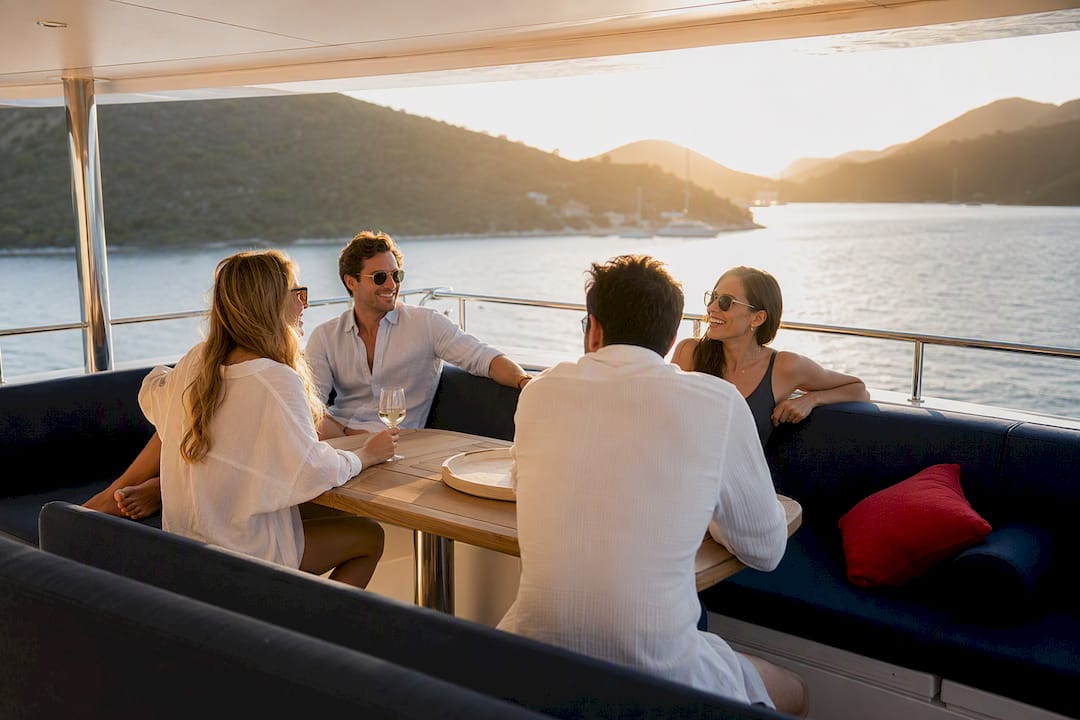

Yes, a flybridge power catamaran is worth the premium when your priorities are guest space, steady comfort, and commanding visibility at anchor and underway. You gain a third social deck, near-monohull-rivaling interior volume on a shorter footprint, and sightlines that make crowded anchorages and reef-strewn channels far less stressful. The trade-offs, higher windage, tighter marina fit, and added cost, are real, but for most families, groups, and charter guests they’re worth managing rather than avoiding.
- The additional windage and weight from a flybridge can increase fuel consumption, complicate docking in gusty marinas, and restrict slip options due to height limits.
- Most owners and charterers prefer flybridge models for their social spaces and elevated visibility, which improve safety and situational awareness in crowded waters.
- A typical flybridge structure adds between 450 and 1,500 pounds, affecting handling in crosswinds and increasing the importance of active throttle control.
- The layout suits families, social groups, and charter clients seeking extra space and views, but performance purists and marina-constrained owners should verify clearance before purchase.
- Booking a short charter helps determine if a flybridge creates the desired social experience without incurring unnecessary costs or fit issues.
Table of Contents
- What a flybridge adds to a power catamaran
- Why catamarans ride steadier than monohulls
- The flybridge as a third living room
- Seeing more, sooner: the visibility advantage
- What a flybridge costs you in fuel and handling
- Who actually benefits most from this layout
- What ownership actually costs beyond the sticker price
- What we see across real charters
- The bottom line on choosing a flybridge layout
- Why we steer many charter clients toward this layout
- Try the flybridge layout yourself in the BVI
- Sources
What a flybridge adds to a power catamaran
A flybridge is a raised, open helm deck built above the main salon roof, usually accessed by an interior or exterior stair. It turns a two-level layout into three: cockpit, salon, and sky lounge. That third tier changes how people actually use the boat. Instead of everyone clustering in one cockpit, groups spread out naturally, some fishing off the stern, others sunbathing topside, a couple steering from the flybridge helm while dinner comes together in the galley below.
The benefit categories worth understanding before you commit to this layout are:
- Ride stability and comfort from the twin-hull platform itself
- Extra deck and living space the flybridge specifically contributes
- Improved visibility and situational awareness from the raised helm
- Maneuverability and engine redundancy
- Fuel and handling trade-offs tied to added weight and wind exposure
Each cuts a different way depending on whether you’re chartering for a week or budgeting for ownership.
Why catamarans ride steadier than monohulls
The stability comes from geometry, not luck. Two hulls set wide apart create a much broader stance than a single-hull boat of the same length, which resists the side-to-side roll that makes monohulls rock at anchor and in a beam sea. Roll doesn’t disappear entirely, but the amplitude drops sharply, and that difference is what people actually feel.
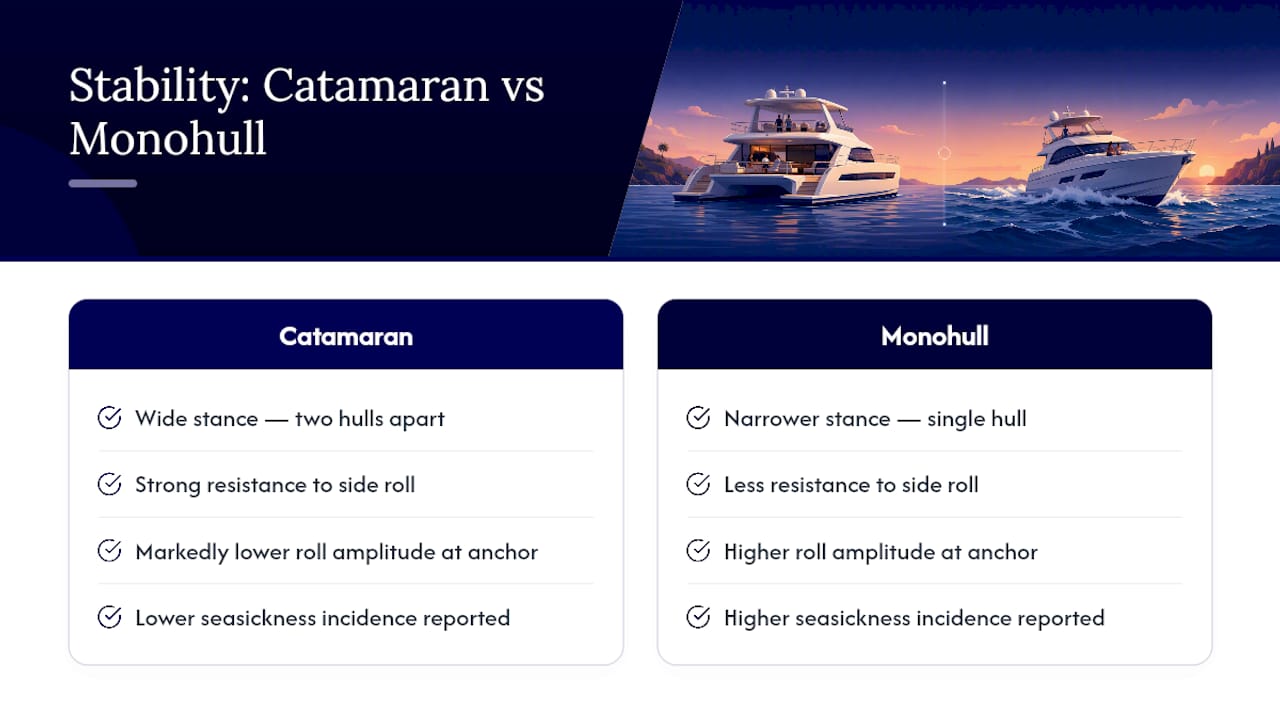
Statistic Callout: Owners and charterers consistently report a lower incidence of seasickness and easier mobility aboard power catamarans compared with monohulls of similar size, a pattern especially noted among families and first-time boaters who are most sensitive to motion.
Practically, that means less time spent bracing against a counter and more time actually walking around while underway. Kids sleep better. Guests who’d normally spend the first day of a charter queasy on deck instead show up for breakfast. Interior volume and stability on a power catamaran frequently rival monohulls a class size larger, which is part of why designers push buyers to stop comparing boats by length alone and start comparing how they actually feel underway.
The flybridge as a third living room
Beam is the quiet superpower of a catamaran, and it shows up as usable square footage more than any brochure photo can convey. Wider beam translates into roughly 1.25 times the deck and cabin area of a monohull built to the same length, and the flybridge stacks a whole additional layer on top of that gain.
Most flybridge layouts include some combination of:
- A second helm station with full instrumentation
- Convertible sunbed and lounge seating
- A wet bar, grill, or fridge for topside entertaining
- Shade coverage via hardtop or retractable canvas
- Storage for paddleboards, toys, or extra gear
On a typical week-long BVI itinerary, that flybridge becomes the default sunset spot, the place where the whole group gathers for a first look at Norman Island or The Baths, while the salon stays free for card games or a quiet retreat from the sun. If you’re weighing options, the 52′ luxury powercat is a useful real-world example of how that third deck gets used across a full charter day.
Pro Tip: Ask how the flybridge stair is configured before booking. A wide, gently angled stair gets used constantly; a steep ladder-style stair often gets ignored by anyone over 60 or under 10.
Seeing more, sooner: the visibility advantage

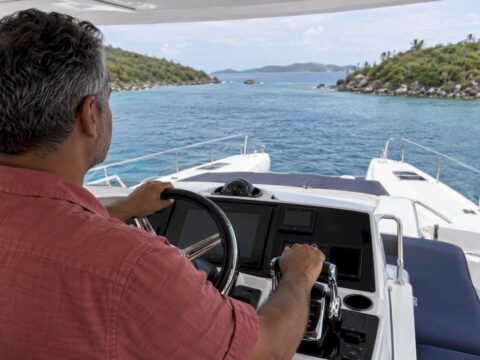
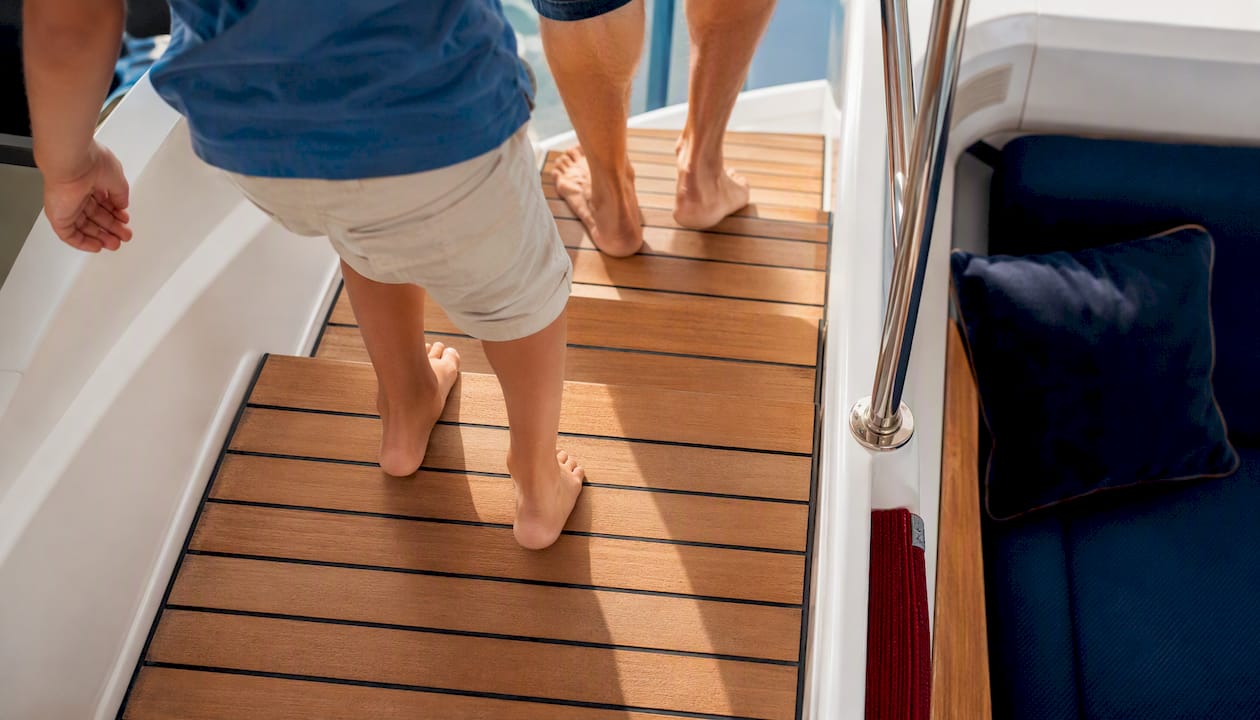
Height changes what you can see and how early you see it. From a flybridge, you’re often eight to ten feet higher than a standard monohull helm, and that elevation turns a hazy patch of water into an obvious sandbar or coral head long before it becomes a problem.
That advantage matters most in specific situations:
- Threading narrow cuts or reef passages where color changes signal depth
- Picking a spot in a crowded anchorage without guessing at swing radius
- Spotting dinghies, paddleboarders, or swimmers in a busy harbor
- Reading approaching weather across open water
An elevated, unobstructed view from the flybridge improves safety and navigation in exactly these crowded, close-quarters situations, which is where most cruising mishaps actually happen. The trade-off is exposure: in a squall or a cold-weather crossing, an open flybridge helm is miserable compared to an enclosed lower station, which is why some owners want both and choose designs with a fully functional interior helm as backup.
What a flybridge costs you in fuel and handling
Nothing on a boat is free, and the flybridge’s weight sits high, right where it does the most damage to stability under load and the most good for windage in a crosswind. Flybridge structures can add 450 to 1,500 pounds depending on materials and equipment, and all of that sits above the waterline.
The practical effects show up in a few places:
- Fuel burn climbs faster at higher cruising speeds because of the extra frontal area pushing against wind
- Docking gets trickier in gusty marinas since the boat catches wind like a sail above the rail
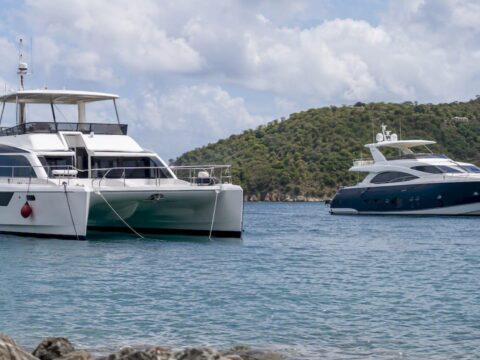
- Beam and overhead clearance can rule out narrower or lower-covered slips
- Handling in a stiff crosswind requires more active throttle work at low speed
None of this cancels the catamaran’s core fuel advantage. Powercats generally need less horsepower to reach a given cruising speed than a comparable monohull, and that efficiency gap often outweighs the windage penalty except at higher speeds. Mitigation is mostly a design and equipment question. Joystick docking controls take the guesswork out of tight slips, folding hardtops cut wind resistance when running fast, and some builders now integrate the helm closer to the cockpit flow specifically to shave weight and windage without giving up the social deck entirely.
Who actually benefits most from this layout
The flybridge earns its keep for some missions and gets in the way on others.
- Families and multi-generational groups gain the most, since the extra deck lets kids, grandparents, and everyone in between find their own space without feeling crowded.
- Social hosts and charter groups benefit from the flybridge as a dedicated entertaining zone, especially for sunset cocktails or watching an approach into a new harbor.
- Anglers and day-trippers often like the elevated spotting height for reading water, though a lower cockpit-focused layout can suit dedicated fishing trips better.
- Performance purists chasing top speed or minimal fuel burn per mile may find the added weight and windage a real cost that outweighs the social payoff.
- Marina-constrained owners with tight slip height or narrow berths should check clearance before falling for the layout, since beam and overhead limits are non-negotiable.
Industry guidance backs this up directly: match deck circulation and layout to your intended use rather than comparing hull length alone, since a couple cruising quietly and a ten-person charter group need almost opposite things from the same square footage.
What ownership actually costs beyond the sticker price
Berthing is where the flybridge’s extra beam and height show up on a bill. Many marinas price slips by width, and a catamaran’s wider stance often lands it in a pricier bracket than a monohull of the same length, sometimes with a separate surcharge for boats over a certain overall height.
Before committing to a purchase or a long-term charter management deal, ask about:
- Insurance rates specific to catamarans in your intended cruising area
- Servicing costs for flybridge-specific gear like the second helm’s electronics and hydraulic steering
- Recent maintenance records on both engines, since twin-engine redundancy only pays off with consistent upkeep
- Slip availability at your home marina for the boat’s actual beam and bridge clearance, not just its length
Pro Tip: Get the exact beam and overall height in writing before you fall in love with a specific model. A boat that’s perfect on paper can be homeless at your local marina if the flybridge pushes it past clearance.
Readers exploring ownership routes can compare typical cruising range and fuel patterns in the BVI charter guide before deciding whether ownership or chartering fits their actual usage better.
What we see across real charters
Across three decades running charters out of Tortola, the pattern holds steady: groups who try a flybridge power cat rarely go back to a monohull. Guests gravitate to the top deck within the first hour, and the BoatUS observation that flybridges function as a major social space matches what our crews report trip after trip. If you want to see the layout in person before booking a full week, the best power catamaran options by group size page breaks down which models fit which party sizes.
The bottom line on choosing a flybridge layout
Choose a flybridge power catamaran when comfort, social space, and visibility matter more to your trip than shaving fuel costs or squeezing into a narrow slip. Confirm marina clearance, ask about recent engine maintenance, and if you’re unsure, book a short charter before committing to ownership. A week on the water settles the question faster than any spec sheet.
Why we steer many charter clients toward this layout
Charter guests consistently gravitate toward the flybridge within the first day, not because a brochure told them to, but because the space simply works for how groups actually spend time together on the water, as seen in a private charter safari experience that highlights the pinnacle of luxury travel. Virgin Charter Yachts helps clients weigh that social payoff against genuine trade-offs like marina fit and cost, rather than pushing one layout by default. The right answer depends on the mission, not the marketing.
Try the flybridge layout yourself in the BVI
There’s no substitute for standing on a flybridge deck at sunset to know whether the layout fits your group. Virgin Charter Yachts has spent 30 years matching Tortola-based families, groups, and couples to the right catamaran instead of the biggest one, and that local, family-run approach means you get honest advice on whether a flybridge model actually suits your itinerary before you book.
Our fleet includes flybridge power cats from Fountaine Pajot, Leopard, Aventura and Aquila, available as either fully crewed charters or bareboat rentals for experienced skippers. If you’re weighing ownership instead, our yacht sales program covers the same brands discussed here. For groups planning an event or corporate gathering, the group and corporate charter page outlines how a flybridge deck handles larger parties on the water. Ready to see the layout firsthand? Check current availability on the 52′ luxury powercat and book a date before your ideal week fills up.
Sources
Recommended
- Monohull vs Catamaran: Which Should You Choose?
- Best BVI Power Catamaran for 6, 8, 10 or 12 Guests
- Power Catamaran Charter BVI: Your Complete 2026 Guide
Did You Know?
The BVI are only accessible by boat. Check out our charter yachts that can get you there. View Our Fleet