
A security deposit is money you hand over before departure and can get back. A damage waiver is a fee you pay to reduce what you could owe if the yacht is damaged, and it is not returned. Most charters use one or both, so the useful question is not which is better. It is what your contract says each one covers, what it leaves out, and how much cash you would have tied up or at risk during the week. This guide walks through both, with the numbers Caribbean charterers see and a checklist for reading your own paperwork.
If you are planning a bareboat or crewed week in the British Virgin Islands, we recommend settling this before you pay the balance, not at the dock. Our team can walk you through the terms for the yacht you choose when you plan your trip with us.
TL;DR
- A security deposit is a refundable hold or payment that the charter company can draw on for damage or unpaid extras. A damage waiver is a non-refundable fee that limits your financial exposure for covered damage.
- Many Caribbean charters combine the two: a waiver fee plus a smaller deposit. Check the contract for the exact amounts on your yacht.
- Waivers have exclusions. Tender and outboard, sails and rigging, propeller and underwater damage, grounding and negligence are commonly named.
- Ask when and how the deposit comes back, and where it is held, before you sign.
- Travel insurance is a separate product from both. It protects your trip and belongings, not the yacht.
Table of Contents
- What each one actually is
- Side by side
- What the numbers look like in the Caribbean
- What a damage waiver usually leaves out
- When the deposit comes back
- What if the damage costs more than the deposit or waiver limit?
- Bareboat or crewed: how the choice changes
- Waiver, deposit and travel insurance are three different things
- A checklist before you sign
- Our perspective
- Plan your week with the terms clear
- FAQ
- Sources
What each one actually is
Both tools answer the same worry: what happens if something gets scraped, snapped or broken on a boat that is not yours. They answer it in opposite ways.
A security deposit is a sum held against possible costs. You pay it, or authorize a card hold, before embarkation. If the yacht comes back in good order and your account is settled, the deposit is returned. If something is damaged, the company deducts the repair cost up to the amount held, and the contract says what happens beyond that.
A damage waiver is a fee you pay for the operator to agree to limit or waive part of your liability for covered damage. It is a modification to your charter contract, not an insurance policy you buy on the open market. That distinction matters, because the exact reach of the waiver lives in the contract wording and not in any general rule. SailStarter’s 2026 guide makes the same point: a waiver generally comes as an upfront charge under the operator’s terms, a deposit as a pre-embarkation hold, and a waiver can still sit alongside a separate damage deposit.
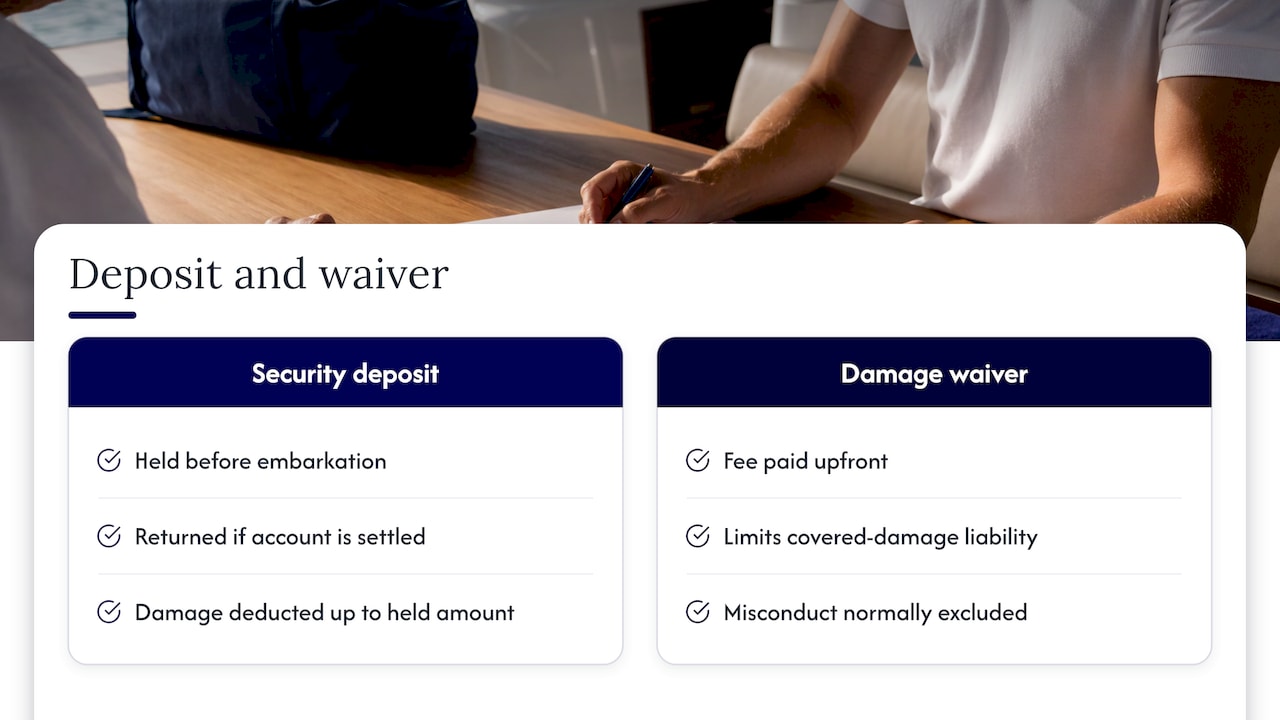
A waiver also does not shield you from everything you might do. Misconduct such as reckless or negligent handling is normally carved out, so treat it as protection against ordinary accidents, not a license to stop paying attention at the helm.
Side by side
| Security deposit | Damage waiver | |
|---|---|---|
| What it is | Refundable money held against damage or unpaid extras | Non-refundable fee that limits your liability for covered damage |
| When you pay | Before embarkation, often as a hold or payment | With your booking paperwork, usually per day or per charter |
| Do you get it back? | Yes, if nothing is deducted | No, it is the price of the reduced exposure |
| Effect on your cash | Ties up funds for the week and until release | A fixed, known cost |
| Main risk | Deductions, and delay before release | Exclusions and any remaining excess |
| Best read for | Amount, holder, release timing | Covered items, exclusions, limit |
Neither is the cheaper choice in every case. A low waiver with a high deposit and a higher waiver with a low deposit can leave you in a similar position. Compare the total you pay, the total you could lose, and the cash you must have available.
What the numbers look like in the Caribbean
Prices vary by operator, yacht size and season, so treat published figures as ranges and confirm yours in writing. One 2026 analysis of Caribbean charter extras put a non-refundable damage waiver at $55 to $125 per day and a refundable deposit at $513 to $2,038, alongside a BVI cruising tax of $4 per person per day and a National Parks Trust permit.
Those ranges are wide because the yachts are different. A compact bareboat monohull and a large power catamaran do not carry the same repair exposure. Our own bareboat power catamarans list from £6,000 to £20,000 per week depending on size, and the bareboat pricing page shows each class, so you can see how the base fee scales before you add extras. For a fuller view of what sits on top of the weekly rate, our BVI charter cost breakdown is the place to start, and the what’s included page shows what the charter fee already covers.
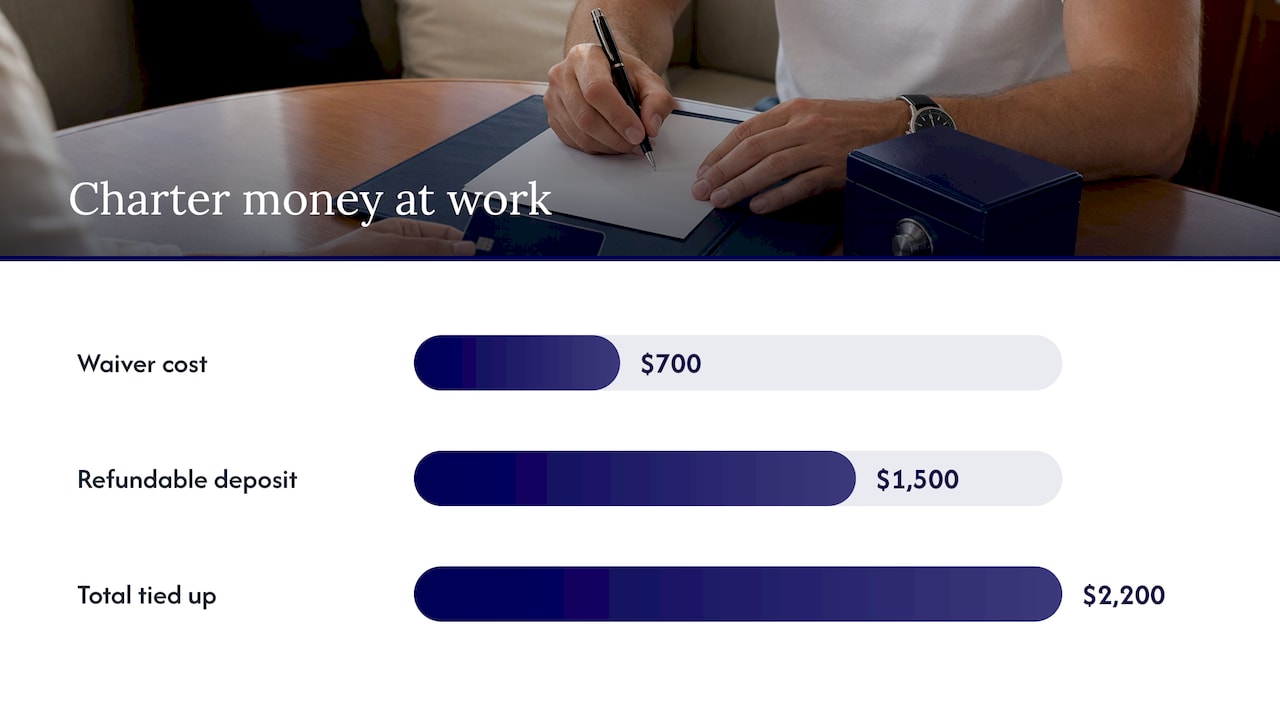
A worked example makes the trade-off concrete. Say a waiver costs $100 per day on a seven-day charter. That is $700, gone for good. If the same charter carries a $1,500 deposit, you need $1,500 of available credit or cash on top, and you recover it if the boat returns clean. Total money at work is $2,200, but only $700 is a certain cost. Those figures are illustrative, not a quote.
What a damage waiver usually leaves out
The single most useful habit is to read the exclusions line by line. Across the industry, the items that most often fall outside a waiver are:
- The tender (dinghy) and outboard engine. Often excluded outright, even though they are the items most likely to get knocked about.
- Sails, rig and running rigging. Relevant mostly on sailing yachts, less so on power catamarans.
- Propeller, drive legs and anything below the waterline. Marine damage often concentrates here.
- Grounding. Some contracts exclude it or treat it separately.
- Negligence or sailing outside the permitted area. Cruising limits in the contract are conditions of cover.
- Personal property. Phones, cameras, passports and luggage belong to your own travel insurance.
- A remaining excess. Even a waiver can leave a fixed amount payable per incident.
This list follows Aurevia Escapes’ 2026 explainer, which notes that a waiver excluding tender, sails and propeller protects you against events that rarely happen. The practical lesson is to match the exclusions to the yacht you are booking. On a power catamaran there is no sail inventory to worry about, but the propellers, drives and tender are the items to check first.
When the deposit comes back
People assume a refundable deposit means instant money. It rarely does. The timing and the holder are set in the contract, so find three things: where the money sits, when release is due, and what the company may deduct.
The American Yacht Charter Association and Worldwide Yachting Association model agreement is a useful benchmark for charters under US-style practice. Its June 2020 text provides that a security deposit is held by an escrow agent and, to the extent unused, refunded without interest within 24 working hours after the end of the charter or settlement of any outstanding questions, whichever is later. That agreement is written for crewed yacht charters, and individual operators set their own terms, so use it as a yardstick for what a neutral arrangement looks like, not as a promise about any one company.
If your deposit is a card hold rather than a payment, ask when the hold drops, and remember your bank can take extra days to free the funds. Do not plan to spend that credit on the way home.
What if the damage costs more than the deposit or waiver limit?
The contract answers this, and the answer differs between a bareboat and a crewed charter. The same model agreement says the charterer is covered as an additional assured under the owner’s insurance policy and, absent conduct that voids the cover, is not liable for a single accident’s damage to the vessel or to third parties caused by the charterer’s or guests’ negligence or willful act. That is the model, not a universal rule.
The idea of being named on someone else’s policy is familiar from other travel services as well. For a plain-language look at how it works with a chartered car and driver, see what car service insurance really covers. For yachts, ask who the insurer is, whether you are named as an additional assured, and what conduct would void the cover. Our yacht charter insurance guide explains how these layers fit together.
Where a waiver or deposit has an upper limit, anything above it is a question of the contract’s liability clause. Read it before you pay the balance.
Bareboat or crewed: how the choice changes
On a bareboat charter you or your skipper handle the yacht, so the waiver and deposit terms matter most to you. Our bareboat charter guide covers the setup, and a licensed captain can be added if you want a professional at the helm. Captains are listed at $250 per day for a standard captain and $300 per day for a training captain.
On a crewed charter a professional captain and crew run the yacht, and the weekly fee is all-inclusive in a way that simplifies much of the extras question. Crewed weeks on our fleet are listed from $25,000 for a premium catamaran for 4 to 6 guests, up to $120,000 for the high-end luxury catamarans and motor yachts, on the crewed pricing page. The crewed vs bareboat comparison helps decide which fits your group.
Waiver, deposit and travel insurance are three different things
Families and couples often assume one covers the others. It does not.
- Deposit: your money held as security.
- Waiver: a contractual limit on what you owe for covered yacht damage.
- Travel insurance: your own policy for cancellation, medical care, delays and belongings.
A waiver will not pay for a missed flight, and travel insurance will not usually pay for damage to the yacht. Our guide to charter travel insurance lists what yacht charterers should look at for the trip itself.
A checklist before you sign
- Amounts: the waiver fee, whether it is per day or per charter, and the deposit total in dollars or pounds.
- Currency: our bareboat prices are in pounds and crewed prices in dollars, so check which currency the deposit uses.
- Exclusions: tender, outboard, propellers, underwater damage, grounding, personal property.
- Excess: is there a fixed amount you still pay per incident?
- Conditions: cruising area, night sailing, skipper qualifications.
- Holder: who holds the deposit and how it is released.
- Timing: how long after return the deposit comes back.
- Documentation: an itemized statement if anything is deducted.
SailStarter frames this as reading your current signed documents, not relying on a general comparison, and that is the right instinct. A waiver can reduce a stated exposure without making every event vanish, and a deposit can be refundable without being available the moment you hand back the keys.
Our perspective
Most guests who contact us have the same question: how much could this week cost me if something goes wrong? The honest answer starts with the yacht and the contract, not a rule of thumb.
We have been family-owned and based on Tortola in the British Virgin Islands for 30 years, and our fleet of modern power catamarans is curated for excellent maintenance. A well-kept yacht is the first protection you have: fewer surprises on board, fewer arguments at check-in.
Our approach is to put the numbers in front of you early. You talk to our staff directly while planning, and we go through what is included in the charter fee so the extras are not a surprise at the dock. Whether you choose a bareboat power catamaran or a crewed yacht, you should know your waiver, your deposit and your travel cover before you pay the balance.
Read the exclusions for the tender, the propellers and the rest, ask about release timing, and keep the paperwork. That is what a relaxed week looks like.
alexia
Plan your week with the terms clear
We built our charters around personal service: a curated fleet of power catamarans from Fountaine Pajot, Leopard, Aquila, Aventura, Lagoon, Horizon and Two Oceans, and staff who help you plan a trip that suits your group. Browse the bareboat power catamarans or the luxury crewed charters, then talk to us about the terms for the yacht you like.
FAQ
Is a damage waiver the same as insurance?
No. A damage waiver is a modification to your charter contract that limits what you owe for covered damage. Insurance is a separate policy with its own insurer and terms. Read the waiver wording to see what it covers and which items it excludes.
Do I get a damage waiver fee back?
Generally no. The waiver is the price of the reduced exposure, so it is not refunded when the yacht returns undamaged. A security deposit is the part designed to come back, provided nothing is deducted.
Can I have both a waiver and a security deposit?
Yes, and many charters do. The waiver limits what you could owe for covered damage, while a smaller deposit may still be held for excluded items or extras. Your contract shows how the two work together on your yacht.
Does travel insurance cover yacht damage?
Usually it covers your trip and belongings, such as cancellation, medical care and baggage, not damage to the chartered yacht. Check the policy wording and our charter travel insurance guide before you buy.
Sources
- SailStarter: Charter Damage Waiver vs Deposit
- Aurevia Escapes: Yacht Charter Security Deposit and Damage Waiver Explained
- HelmShare: How yacht charter investment returns are generated
- AYCA/MYBA model charter agreement, June 2020
Recommended
- Charter Travel Insurance: What Yacht Charterers Need to Know
- Yacht Charter Insurance: What Every Charterer Must Know
- Charter Travel Insurance: What Yacht Charterers Need to Know
Did You Know?
The BVI are only accessible by boat. Check out our charter yachts that can get you there. View Our Fleet