BVI Bareboat Charter Guide
Choose the right BVI powercat based on your group, experience, cabins and how you want to charter
Learn what experience you need to captain a BVI bareboat and when a checkout or hired captain may be right for you.
Your VCY powercat is already equipped with the essentials you need for a week on the water.
Plan food, drinks and supplies ahead so your vacation can start as soon as you arrive.
Arrange snorkel gear, paddleboards, floating mats, eFoils or a larger RIB before your charter
What to expect once you leave Nanny Cay and begin your BVI bareboat charter.
Choosing the Right Powercat
Virgin Charter Yachts specializes in bareboat power catamarans in the British Virgin Islands, with a multi-brand fleet including Fountaine Pajot, Leopard, Aquila and Aventura.
When choosing a powercat, don’t start with length. Start with your group.
Consider how many adults and children are traveling, how many couples need private cabins, whether every couple needs a private head, and whether children are comfortable in bunks or smaller cabins.
A 50-foot powercat with five or six guest cabins may actually work better for a large group than a larger yacht with fewer cabins.
For adult couples, we generally recommend one proper double cabin and one private head per couple. Families can be much more flexible because bunk rooms, twin beds and smaller cabins can work extremely well for children.
What Size Powercat Do You Need?
Yacht length doesn’t tell you nearly as much as the layout.
VCY powercats range from layouts for smaller families and couples to yachts accommodating groups of up to 12 guests.
Depending on the yacht, you’ll find three-, four-, five- and six-cabin configurations. Some layouts are particularly good for couples because every cabin has a double bed and private head. Others use bunk rooms or smaller cabins that are excellent for families with children.
One of the most unusual layouts in our fleet is the Aventura 50 Unwinding, with six double guest cabins and six heads for up to 12 guests.
The best question isn’t simply, “How many people does this yacht sleep?”
It’s “How will my particular group sleep?”

Charter Captain
Before your charter, we will ask you to complete a boating resume outlining your previous yacht ownership, charter and captaining experience.
You do not need a USCG captain’s license to be approved for a BVI bareboat charter with Virgin Charter Yachts. The most important factor is hands-on experience operating a vessel similar in size, style and engine configuration to the powercat you want to charter.
When reviewing your experience, we look at the complete picture, including:
- Size and type of vessels you have operated
- Twin-engine experience
- Docking and close-quarters maneuvering
- Picking up mooring balls
- Navigation and chart-reading experience
- Coastal or ocean boating experience
- Previous bareboat charters
- Yacht ownership
- ASA, USCG or other boating certifications
Certifications are helpful and should absolutely be included on your boating resume, but hands-on experience operating a similar-size twin-engine vessel is generally more important than a particular license or certification.
Your First-Day Checkout Captain
VCY includes a checkout captain at the beginning of your charter.
Your checkout captain will leave Nanny Cay with you on your first day and travel with you to Norman Island.
This gives you a chance to get comfortable with the powercat and helm while an experienced BVI captain is aboard to answer questions and help you become familiar with how the yacht handles.
Before leaving the marina, you will have the opportunity to demonstrate close-quarters maneuvering and handling of the yacht.
Once you arrive at Norman Island, you and your crew will demonstrate your ability to safely pick up a mooring ball.
This is useful not only for us, but for you. Every yacht handles a little differently, and having someone aboard during that first trip gives you time to get comfortable with the engines, visibility, helm position and maneuvering characteristics before you are completely on your own.
Once the checkout is complete at Norman Island, the captain will arrange their own transportation back to Nanny Cay.
That means the checkout does not interrupt your first charter day. You continue on with your vacation from Norman Island while the captain returns to the base independently.
For many guests, this first trip to Norman Island is one of the best ways to start the charter — you get real on-water time aboard your specific yacht, practical experience picking up your first mooring, and an experienced captain available to answer any questions that come up.
Prefer to Have a Captain for the Entire Charter?
If you don’t want to captain the yacht yourself, we can also arrange one of the experienced freelance BVI captains we regularly work with.
A captain can operate the yacht throughout your charter while your group handles your own meals and day-to-day life aboard.
This can be a great option if you want the privacy and flexibility of your own powercat without responsibility for operating the yacht.
If you would rather have both a professional captain and chef, with meals, service and itinerary planning included, a fully crewed yacht may be a better fit.
What's Included on Your VCY Bareboat
Your VCY bareboat is fully equipped for your charter, so you don’t need to pack towels, linens, kitchen equipment or boating gear.
Here’s what you’ll find aboard:
VCY boats come stocked with:
- Soft goods
Bed linens, blankets, pillows, bath towels, beach towels, hand towels, washcloths and dish towels.
- Appliances
Blender, toaster, kettle, coffee maker, microwave, stove and oven (depending on the boat), refrigerator and freezer
- Kitchenware
Plates, bowls, cups, glasses, silverware, cooking utensils, pots and pans, mixing bowls, food-storage containers, wine opener and can opener
- VCY ‘Starter Kit’
Dish soap, hand soap, dish scrubber, travel-size shampoo, conditioner, body wash and soap, 1 roll toilet paper per bathroom, 1 roll paper towels and garbage bags
- Exterior
Dock lines, fenders, cooler, dinghy and outboard, boat hook, deck brush and bucket, fire extinguishers, first-aid equipment, flashlight, life preservers, life ring and basic toolkit.
- Navigational
Charts and cruising information, compass, depth instruments, VHF radio and onboard navigation equipment.
You are chartering a fully equipped yacht. You do not need to bring boating equipment in your luggage.
Read our complete BVI Bareboat Charter Packing List
Provisioning Your BVI Bareboat
Provisioning your yacht before arrival is one of the easiest ways to make your first charter day relaxing. Rather than spending your arrival day grocery shopping, you can place your orders in advance and have your provisions delivered directly to your yacht at Nanny Cay.
Before ordering, talk with your group about how you actually expect to eat during the week. Most guests enjoy a combination of meals aboard and meals ashore. Breakfasts and lunches are particularly easy aboard a powercat, while dinners are a great opportunity to experience the restaurants and beach bars throughout the BVI.
One of the most common mistakes is over-provisioning. You don’t need to plan three full meals aboard every day if you already know you’ll want to eat ashore.
For most bareboat groups, we recommend the following:
RiteWay — Our first recommendation for most groups. RiteWay has the largest overall grocery selection and offers yacht provisioning and delivery to Nanny Cay. It is a good one-stop option for produce, dairy, pantry items, snacks, beverages, frozen foods and most of what you’ll need for the week.
Bobby’s Marketplace — Another excellent choice for a large provisioning order. Bobby’s has a good selection of specialty and gluten-free foods and also offers yacht provisioning and delivery.
Steakation Butchers — A great option for supplementing your primary grocery order with specialty meats and seafood. If your group plans to grill steaks, burgers, seafood or other proteins aboard, Steakation is worth adding to your provisioning plans.
French Deli & Gourmet Shop — Excellent for specialty cheeses, charcuterie, meats and European foods. We particularly like their selection of frozen French pastries that you can keep aboard and bake for an easy breakfast during your charter.
You don’t have to order everything from one company. Many of our guests use RiteWay or Bobby’s for their primary grocery order and then add smaller specialty orders from Steakation or French Deli.
Plan Your Meals Before You Order
Think realistically about your itinerary. Many groups keep breakfast simple with coffee, fruit, yogurt, cereal, eggs or pastries. Lunch might be sandwiches, salads, snacks or something easy to prepare between stops.
Dinner is where we recommend leaving some flexibility. There are excellent restaurants and beach bars throughout the BVI, and after a full day of swimming, snorkeling and exploring, you may decide that taking the dinghy ashore for dinner sounds considerably better than cooking and cleaning up aboard.
We recommend placing larger provisioning orders in advance, particularly during busy charter periods. Availability of imported products can vary in the islands, and ordering early gives your provisioner more time to fill your order or make substitutions.
When you arrive, take a few minutes to check your provisions before leaving Nanny Cay. If something was missed, substituted or you suddenly remember something you forgot, there is a RiteWay grocery store conveniently located at Nanny Cay for last-minute items.
And don’t worry about getting your provisioning exactly right. You aren’t heading into the wilderness for seven days. Basic groceries, drinking water, ice and other supplies can be replenished at several locations around the BVI during your charter.
Our team at Nanny Cay is always happy to help with provisioning questions before you arrive.
Send all Provision orders to: Virgin Charter Yachts, G Dock, Nanny Cay, Tortola VG1110, British Virgin Islands
Be sure to let our staff know when your provisions are due to arrive, that way we can be sure your perishables are properly stored. We also recommend following up with the provisioning companies by phone to confirm delivery plans.
Beverage Provisioning
Drinking Water
We recommend including drinking water in your initial provisioning order. Gallon jugs are generally easier to store aboard than large quantities of individual water bottles and also create considerably less waste.
Your yacht has freshwater aboard for normal onboard use, and VCY powercats equipped with watermakers leave the base with the watermaker ready for use. Even so, most groups prefer to provision separate drinking water for the week.
You don’t need to worry about getting the quantity exactly right. Drinking water, ice and other basic provisions can be replenished at several locations around the BVI during your charter.
Beer, Wine & Spirits
Beer, wine and spirits can be ordered in advance and delivered to your yacht along with your other provisions.
For most groups, the easiest option is to include standard beer, wine, mixers, soft drinks and other beverages with your primary RiteWay or Bobby’s provisioning order.
If you are looking for a larger selection of wine, Champagne, spirits or particular brands, we recommend Caribbean Cellars or Tico. Both specialize in beverage provisioning and can deliver orders directly to your yacht at Nanny Cay.
If a particular wine, spirit or brand is important to your group, order it in advance. Selection in the BVI is very good, but specific imported brands aren’t always available everywhere.
Don’t forget the things that are surprisingly easy to overlook when placing a beverage order:
- Mixers and tonic water
- Club soda and sparkling water
- Soft drinks
- Juice
- Coffee and tea
- Ice
- Limes, lemons and other cocktail garnishes
As with food, think realistically about how much time you’ll spend aboard. You’ll have plenty of opportunities to enjoy beach bars and restaurants around the BVI, so there is usually no reason to provision as though you’ll never leave the yacht.
For most groups, our recommendation is simple: use RiteWay or Bobby’s for your main provisioning order, then supplement with Steakation, French Deli, Caribbean Cellars or Tico if you want specialty items.
Place your orders in advance, have them delivered to Nanny Cay, and check everything before you leave the dock.
And don’t worry about making the order perfect. You can replenish basic food, beverages, drinking water and ice during your charter, and our team is always happy to help with provisioning questions before you arrive.
Water Toys, Snorkeling & Dinghy Rentals
One of the best parts of a BVI bareboat charter is spending time in the water, and there are plenty of options for adding water toys and equipment to your yacht before you leave Nanny Cay.
Water Toys
For paddleboards, kayaks, floating mats and other water toys, we recommend BVI Island Surf and Sail.
Island Surf & Sail has a large selection of rental equipment, including:
- Stand-up paddleboards
- Kayaks
- Large floating mats
- Floats and water hammocks
- Underwater sea scooters
- Kids’ life jackets
- Other water and beach toys
One of the biggest advantages is convenience: they can deliver your equipment, securely set it up on the yacht before your charter, and pick it up again at the end of your trip.
We recommend reserving popular equipment in advance, particularly during busy charter weeks.
Snorkeling & Scuba Equipment
Snorkeling equipment is not provided aboard VCY bareboats, so if you plan to snorkel during your charter, you will need to bring your own equipment or arrange a rental.
Our recommendation is Blue Water Divers, conveniently located right at Nanny Cay Marina. They rent masks, snorkels and fins as well as scuba tanks and equipment for certified divers.
If you are a certified diver but don’t want to manage tanks and equipment throughout the week, Blue Water Divers can also arrange guided diving and rendezvous dives during your charter. This can be an easy way to add scuba diving to your itinerary without carrying a full set of dive equipment aboard all week.
Want a Larger RIB?
Every VCY bareboat already includes a 12-foot dinghy with a 15 HP outboard, which is suitable for normal transportation between your yacht and shore.
If your group would prefer a larger or faster RIB for the week, Island Time BVI at Nanny Cay rents larger RIBs, including 15- and 17-foot models, and can deliver the rental directly to you.
There is one important consideration before upgrading: A larger rental RIB must be towed behind your powercat.
The hydraulic tender platforms on our yachts are configured for the weight of the supplied 12-foot dinghy and 15 HP outboard. A larger, heavier rental RIB should not be carried on the hydraulic platform.
For most groups, the standard dinghy is all you need. A larger RIB is worth considering if you have a large group or specifically want the additional space and performance.
E-Foils & Sea Scooters
If your group wants to try something a little more adventurous during your charter, you can also rent eFoils and underwater sea scooters in the BVI.
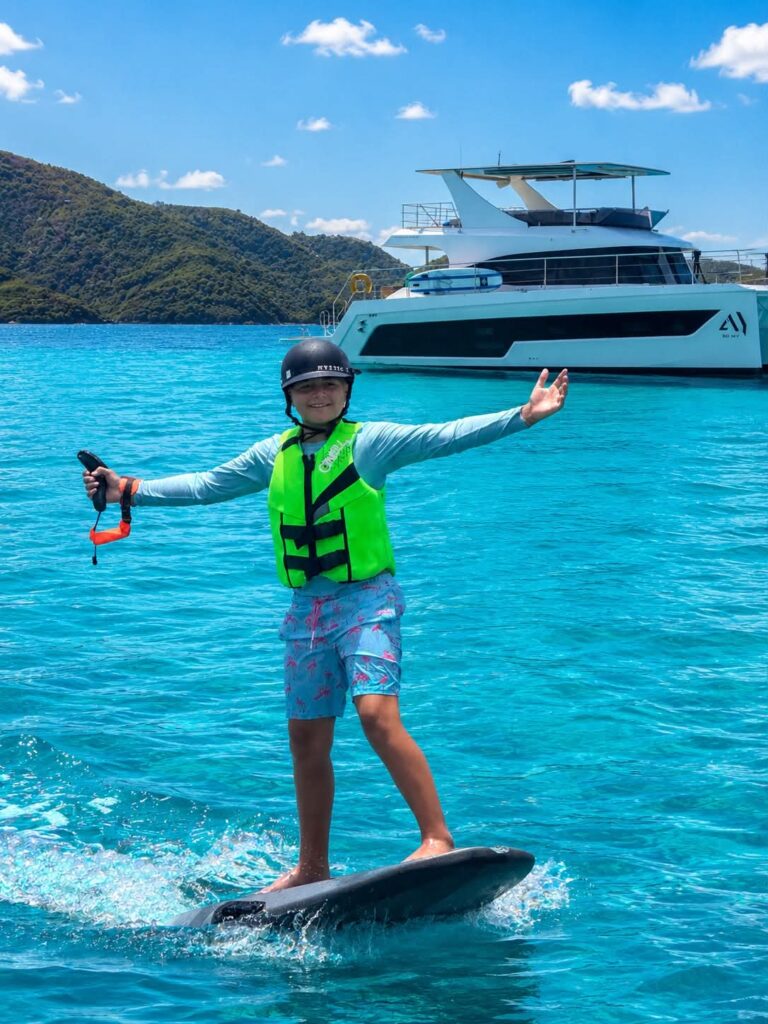
BVI EFOILS offers eFoil experiences in the British Virgin Islands, with bookings currently handled through Deep Bay Watersports. EFoils are electric hydrofoil boards that lift above the water as you gain speed, and they’re a fun option for guests who want to try something different during the week.
Rather than carrying an eFoil aboard for your entire charter, you can plan the experience as part of your itinerary.
For something easier for almost anyone in the group to enjoy, underwater sea scooters are a great addition for snorkeling. Island Surf & Sail rents sea scooters that can be delivered to your yacht along with paddleboards, kayaks, floating mats and other water toys.
Sea scooters are particularly fun around the BVI’s snorkeling sites and are easy to use without needing the instruction or balance required for an eFoil.
You don’t need to fill the yacht with every water toy available. For most groups, a paddleboard or kayak, floating mat and snorkeling equipment provide plenty to do. More active groups can add sea scooters, an eFoil experience or a larger RIB depending on what they want to do during the week.



Packing for Your Charter
Our number-one packing recommendation is simple: bring less than you think you need.
The BVI is extremely casual, and most guests spend the week in bathing suits, shorts, T-shirts and cover-ups.
Use soft-sided luggage that can collapse after you unpack. Towels and linens are already provided aboard, so leave those at home.
Life on Charter
Once you leave Nanny Cay, your powercat becomes your home for the week. Life aboard is casual, and one of the best parts of a BVI bareboat charter is having the freedom to set your own schedule.
Here are a few things to know before you head out.
Internet & Cell Service
VCY bareboats have onboard internet available for $250/wk, so you can stay connected while on charter. Coverage and speeds can vary depending on where you are in the islands, but most guests are able to use their phones, email and messaging throughout the week.
Your U.S. cell phone will generally work in the BVI as well, but remember that the British Virgin Islands are international for most U.S. cellular plans. The U.S. Virgin Islands may be included in your domestic plan while the BVI is not.
Before traveling, contact your cellular provider and confirm coverage in the British Virgin Islands or add an international travel pass. Doing this before you leave home can prevent unexpected roaming charges.
Mooring Balls & Overnight Stays
Mooring balls are a major part of cruising the BVI, and most nights you will stay on an approved mooring ball or at a marina.
Popular destinations may have a combination of:
- BoatyBall reserved moorings
- First-come, first-served mooring balls
- Marina dockage
Don’t worry if you aren’t able to reserve a BoatyBall. Many locations have first-come, first-served moorings in addition to the reservable balls, and several destinations also offer marina dockage.
Our concierge team is always happy to help with marina reservations during your charter.
VCY’s current insurance requirements do not permit anchoring, so your yacht should use approved mooring balls or marina dockage.
Read our Complete Guide to BoatyBall & BVI Mooring Balls →
Cruising Hours & Restrictions
VCY bareboats must be safely secured on a mooring ball or at a marina by 5 pm.
Fortunately, most BVI destinations are relatively close together, so there is rarely a reason to spend your entire day underway. Leave yourself plenty of time to reach your destination, find a mooring and get settled while there is still daylight.
Your chart briefing at Nanny Cay will cover the current cruising area, navigation information and any restricted locations before you depart.
One important restriction is White Bay on Jost Van Dyke. VCY bareboats are not permitted to enter White Bay under our current insurance requirements.
That doesn’t mean you have to miss White Bay. You can secure the yacht on a mooring ball in Great Harbor, and take your dinghy around to White Bay.
Cruising restrictions and insurance requirements can change, so always follow the current information provided during your VCY chart briefing rather than relying on an old cruising guide or something you found online.
Your BVI Itinerary
One of the biggest advantages of a BVI bareboat charter is that you don’t have to follow a rigid itinerary.
Popular stops include Norman Island, Peter Island, Cooper Island, Virgin Gorda, North Sound, Anegada and Jost Van Dyke.
But don’t make the mistake of trying to check every island off a list.
If you find a place your group loves, stay longer. If the weather changes or someone recommends a snorkeling spot you hadn’t planned on visiting, adjust your plans.
For most first-time guests, a seven-night charter gives you plenty of time to experience the BVI without spending the entire vacation racing from one destination to another.
See Our Suggested 7-Day BVI Yacht Charter Itinerary →
Staying Connected With the VCY Base
Once you leave Nanny Cay, you aren’t on your own.
If you have a question about the yacht or experience a problem during your charter, contact the VCY base.
Before arriving in the BVI, be sure the captain of your group downloads WhatsApp on their phone. We will add the captain to a WhatsApp chat with our mechanical team and customer service concierge. The chats are monitored from 8 am – 8 pm, and we can help you with dinner reservations, slip reservations, suggestions on things to see/do, and also assist you with troubleshooting if you encounter any mechanical issues.
Boats are complex machines, and occasionally equipment can fail. Many issues can be quickly diagnosed or resolved with help from our team. When necessary, we can also coordinate service around your location and itinerary.
For systems necessary to safely operate the yacht, including engines, transmissions and batteries, our team prioritizes getting you operational as quickly as possible.
If something isn’t working correctly, contact us rather than attempting a repair you aren’t comfortable making yourself.
Our team knows the yachts, knows the BVI and is here to support you throughout your charter.
Water, Fuel & Supplies During Your Charter
You don’t need to carry everything you could possibly need for the entire week when you leave Nanny Cay.
There are locations around the BVI where you can replenish drinking water, ice and basic provisions during your charter. Fuel can also be obtained at several locations if needed.
Your VCY team can point you toward the most convenient options based on your itinerary.
For most seven-night charters, good planning before departure makes things simple — but forgetting something doesn’t mean you need to return to Tortola.
For a typical 7-night charter, you will not need to plan to refuel during your charter. You should leave on your first day with plenty of fuel for a week of charter.
Dining Ashore
Part of the fun of a BVI bareboat charter is deciding each day whether you want to eat aboard or head ashore.
The islands have everything from casual beach bars to excellent waterfront restaurants. Many guests eat breakfast and lunch aboard and then mix dinners aboard with dinners ashore throughout the week.
Some restaurants and marinas accept reservations, and during busy periods we recommend making reservations for anywhere you particularly want to visit.
Our concierge team is also happy to help with restaurant and marina reservations.
Explore BVI Restaurants & Beach Bars →
What to Pack
You need much less than you probably think.
The BVI is extremely casual, and most guests spend their week in bathing suits, shorts, T-shirts and cover-ups.
Our biggest recommendation is to bring soft-sided luggage that can collapse after you unpack. Towels and linens are already provided aboard, so there is no reason to use valuable luggage space bringing them from home.
We have put together a complete packing guide covering clothing, toiletries, sun protection, medications, cash and credit cards, phones, travel documents and what you can leave at home.
Read Our Complete BVI Bareboat Charter Packing List →
Relax — You’re on Island Time
You don’t need to plan every hour of your charter before you leave the dock.
Have a general itinerary, understand where you need to be each evening, and then leave yourself room to change plans.
Some of the best BVI charter days are the ones where you discover a snorkeling spot you love, stay for another swim, have lunch aboard and decide you don’t need to go quite as far as you originally planned.
After all, having the freedom to decide where you go and when you go there is exactly why you chose a bareboat charter.
Get A Quick Quote