
Yacht ownership programs let you hold title to a luxury vessel while a professional charter manager markets it, crews it, and maintains it — generating revenue that offsets operating costs and, in the right structure, delivers predictable monthly income or meaningful U.S. tax advantages. If your priority is maximum time on the water, a performance (revenue-share) program with flexible owner weeks fits best. If predictable cash flow matters more, a guaranteed-income arrangement is the cleaner choice. Either way, the single best next step is to schedule a try-before-you-buy test charter on the specific model you’re considering, or request a tailored ROI estimate from a vetted BVI-based provider before committing capital.
- Lifestyle-first buyers: performance programs with 8–12 owner weeks per year
- Cash-flow-focused buyers: guaranteed-income programs with fixed monthly payouts (typically 4–8 owner weeks per year)
- Tax-optimization buyers: LLC-structured charter business with documented profit intent and a qualified CPA
Table of Contents
- How do yacht ownership programs and charter management actually work?
- What are the main program types, and which one fits your priorities?
- What do the finances actually look like, and how does U.S. tax treatment work?
- How do you choose a program and vet a provider?
- What do typical ownership contracts look like?
- How to run a test charter that actually tells you something
- What regulatory and safety rules affect commercial chartering?
- How Virgincharteryachts supports owners in the BVI
- Key Takeaways
- What most buyers get wrong about “hands-free” ownership
- Ready to explore ownership with Virgincharteryachts?
- Useful sources for your due diligence
How do yacht ownership programs and charter management actually work?
The operational model is simpler than most buyers expect. You provide the asset and the capital; the manager handles everything else that turns a yacht into a revenue-producing business.
The core flow:
- Owner purchases the vessel, arranges financing, approves major refits, and schedules personal use weeks
- Charter manager markets the yacht, handles bookings, sources and trains crew, manages provisioning, schedules maintenance, processes payments through escrow, and delivers monthly owner statements
- Charter guest pays the weekly charter rate; funds flow into escrow before release to the owner’s account net of management fees and covered expenses
Zero operating cost programs transfer routine expenses — insurance administration, berth fees, scheduled maintenance — to the manager in exchange for longer fleet availability. What owners typically retain: capital financing, final approval on structural refits, and the scheduling of personal use weeks.
Operational safeguards worth verifying in any contract include CYBA-style escrow workflows (funds typically released 30–45 days before charter), monthly itemized owner statements, and documented maintenance logs tied to manufacturer service intervals. These aren’t marketing features — they’re the paper trail that protects your asset and, if you’re structuring for U.S. tax purposes, demonstrates active business operations to the IRS.
What are the main program types, and which one fits your priorities?
Charter management programs cluster into three architectures. Understanding the trade-offs before you talk to a provider saves a lot of back-and-forth.
Guaranteed-income programs
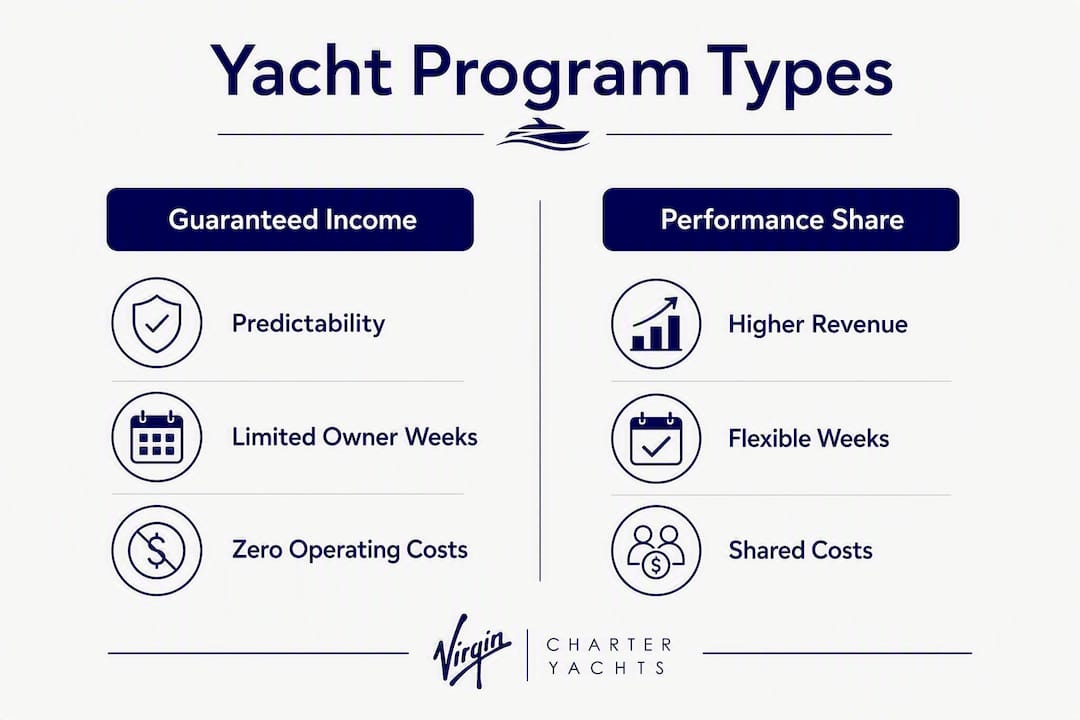
The manager pays you a fixed monthly or seasonal amount regardless of how many charters actually occur. Predictable cash flow, easier loan servicing, and clear budgeting. The trade-off: owner weeks are usually more restricted (often a few owner weeks per year), blackout periods cover peak season, and the guaranteed rate is typically set conservatively below what a strong charter season would actually produce. Also, some CPA and financial advisors do not believe that guaranteed income payments are acceptable in the eyes of the IRS If you are trying to run your yacht as a business.
- Best for: buyers who need the income to service a loan or want certainty over upside
- Watch for: how the guarantee is funded (reserve accounts vs. manager’s operating cash) and what triggers a renegotiation
Performance (revenue-share) programs
Your payout is a percentage of actual charter revenue after management fees and covered operating costs. More owner sailing weeks (commonly owner weeks per year), more upside in a strong season, and more variability in a slow one. Profitability depends heavily on charter market demand, maintained condition, and effective marketing.
- Best for: buyers who want flexibility, more personal use, and are comfortable with seasonal income swings
- Watch for: realistic charter-week assumptions — model 15 weeks, not 25, as a conservative baseline
Hybrid programs
A guaranteed floor plus a revenue-share kicker above a threshold. You get downside protection and some participation in a strong season. Contract complexity is higher, so read the threshold definitions carefully.

| Program type | Predictability | Owner weeks (typical) | Operating costs covered | Revenue upside |
|---|---|---|---|---|
| Guaranteed income | High | 2–8 weeks/year | Usually broad (berth, insurance, maintenance) | Capped at guarantee |
| Performance/revenue-share | Variable | 8–12 weeks/year | Varies; often partial | Uncapped, season-dependent |
| Hybrid | Moderate | 6–10 weeks/year | Varies by contract | Moderate (above floor) |
What do the finances actually look like, and how does U.S. tax treatment work?
Upfront and ongoing costs
Upfront costs typically include a deposit (commonly 10–20% of vessel price), import or VAT considerations depending on flag state and home port, initial provisioning, insurance setup, and a yard commissioning check. Ongoing costs in a standard program include haul-out cycles, wear-item replacement (sails, upholstery, dinghy engines), crew wages on crewed vessels, and marina fees.
Zero operating cost programs cover many of these line items — but read the fine print. Most carve out exceptions for major structural repairs or owner-requested refits. Get a clear written definition of what “zero cost” covers and what triggers an owner chargeback before signing.
Revenue shapes and sample scenarios
Weekly charter rates for high-end catamarans and motor yachts range from $15,000 to $100,000+ per week depending on vessel size, season, and destination. With multiple charter weeks annually and a substantial share of revenue after management fees, well-maintained luxury yachts in high-demand destinations can generate gross revenue. Bareboat charter yachts tend to have a higher ROI because you do not have the built in higher fixed cost from permanent crew on a fully-crewed yacht. The revenue from chartering your yacht will typically cover your operational expenses; dockage, maintenance, insurance etc.
U.S. tax considerations
Structuring a yacht as a for-profit business through an LLC and placing it in commercial charter can unlock significant U.S. tax advantages: depreciation deductions, potential 100% bonus depreciation through Section 179 or Section 168 treatment in the first year, and the ability to deduct operating expenses against charter income. The IRS requires genuine profit intent, professional management contracts, and clean financial records that demonstrate active business operations. Without that documentation, the IRS can disallow deductions entirely.

Pro Tip: Keep a dedicated business bank account for all charter-related income and expenses, maintain a written management agreement, and file Schedule C or a partnership return through the LLC. A qualified CPA with marine or charter-business experience is not optional here — the rules around passive activity, hobby-loss classification, and depreciation recapture are specific enough that generic tax advice creates real exposure.
Profitability assumptions matter too. Independent analysis consistently shows that ownership can be profitable, but it requires careful selection of market, model, and management partner — optimistic charter-week projections are the single most common planning error.
How do you choose a program and vet a provider?
Selection criteria
Before you talk to any provider, rank these criteria by personal priority:
- Program type fit (guaranteed vs. revenue-share vs. hybrid)
- Operating-cost coverage and what’s explicitly excluded
- Owner weeks per year and blackout-date policy
- Reciprocal use options across other bases or destinations
- Fleet age, brand mix, and secondary-market resale demand
- Management team’s track record and marketing reach
- Contract clarity: fee schedules, dispute resolution, exit terms
Choosing brands and models with strong secondary-market demand is especially important because charter use accelerates wear. A Fountaine Pajot or Leopard catamaran holds resale value better after fleet use than a lesser-known builder — that matters when the program ends.
Questions to ask every provider
- Can you share audited or verified charter revenue history for this model at this base?
- What are the exact cancellation terms and early-exit penalties?
- Who holds charter funds, and what is the escrow release timeline?
- Where is maintenance performed, and who approves work orders above a set threshold?
- How are crew hired, trained, and supervised?
- What does your dispute resolution process look like, and is arbitration required?
- Can I speak with two or three current owners in this program?
- What does the resale or program-exit process look like, and do you provide brokerage support?
Red flags
- Vague or verbal fee schedules with no written breakdown
- No escrow process for charter funds
- Inability to produce documented maintenance logs or revenue history
- Aggressive warranty exclusions on wear items
- No defined exit path or resale support at program end
Pro Tip: Speak to a potential management company BEFORE making any purchase. Many companies require you to purchase the yacht through their team and brokers, and they often will not accept a yacht that you privately find and purchase. Additionally, a reputable charter company will have decades of experience knowing which models perform the best and will generate the most revenue. They also can guide you on any gaps in the market or their charter fleet, so you can purchase a yacht you know there will be demand for. Just because you think a yacht is perfect for charter, doesn't mean a potential charter guests will.
What do typical ownership contracts look like?
Contract lengths of several years are standard across most managed programs. Owner weeks typically fall in the owner weeks per year range, with peak-season blackout periods protecting the highest-revenue charter windows. Monthly settlements are common: the manager collects charter funds in escrow, deducts covered expenses and management fees, and remits the balance to the owner, usually within 30–45 days of each charter.
| Contract element | Typical range |
|---|---|
| Program length | 1–5 years |
| Owner weeks per year | 2–unlimited weeks (depending on program) |
| Peak-season blackout | Christmas, New Years, President's Day, Easter, Spring Break |
| Management fee typically a portion of gross charter revenue | 5-25% (crewed is lower, bareboat is higher) |
| Monthly settlement cycle within weeks post-charter | 30-45 days following the end of each month |
| Exit/resale support | Brokerage assistance at program end (varies by provider) |
How to run a test charter that actually tells you something
A brief test charter on the specific model you’re considering is the most useful due-diligence step most buyers skip or rush. Bring the people whose opinion matters: a co-owner if applicable, a prospective captain if you plan to bareboat, and family or close friends who will simulate the guest experience you’re buying into.
During the charter, pay attention to things the brochure won’t tell you:
- How the systems actually perform under daily use (watermaker, generator, AC, navigation electronics)
- Provisioning flow and galley practicality for the number of guests you’ll typically host
- Cosmetic wear patterns — upholstery, helm station, cockpit surfaces — and how quickly they show use
- Turnaround service quality: how the base handles cleaning, restocking, and minor repairs between charters
- Crew guest-management style on crewed models, and whether the briefing process feels professional
Pro Tip: Ask the provider to show you sample guest feedback and an actual owner statement for that model at that base. Real data from a live program tells you more than any projected revenue sheet.
Some programs credit part of the charter fee toward the purchase price — get that in writing before you book the test charter, not after.
What regulatory and safety rules affect commercial chartering?
The 12-passenger threshold
Carrying more than 12 passengers triggers a different commercial classification in most maritime jurisdictions, including the BVI. Below that threshold, most charter yachts operate under a simpler commercial certificate. Cross it, and you’re looking at compliance with passenger-specific codes, different crewing requirements, and more rigorous safety equipment standards. Most luxury charter catamarans and motor yachts in managed programs are configured and certified for 12 or fewer passengers precisely to avoid this.
Flag-state implications
BVI registration is widely used for charter yachts because the registry specializes in yacht registration, certificates are recognized worldwide, and the jurisdiction has recently updated its Merchant Shipping Act to streamline yacht-related administration. U.S. Coast Guard documentation is an alternative for U.S.-citizen owners, but it carries its own crewing and cabotage rules that affect where and how the vessel can charter commercially.
- BVI flag: internationally recognized, charter-friendly, straightforward registration for qualifying owners and entities
- U.S. documentation: preferred for domestic U.S. waters; creates complications for commercial chartering in foreign jurisdictions
- Other flags: vary significantly in recognition, cost, and charter eligibility
Standard commercial crewing requirements include certified officers (STCW or equivalent), mandatory safety equipment inventories, and regular vessel inspections. Managers in established programs handle compliance as part of their service, but owners should verify this explicitly in the contract.
This is general information, not legal or maritime advice. Consult a qualified marine documentation specialist and tax advisor before structuring ownership or registration for commercial charter.
How Virgin Charter Yachts supports owners in the BVI
Virgin Charter Yachts has operated from Tortola, BVI since 1996 — nearly three decades of local knowledge, established base relationships, and a fleet curated specifically for the Caribbean charter market. The family-owned structure means owners deal with company owners and the same local, BVI team throughout the program, not a rotating roster of account managers.
The fleet spans power catamarans and motor yachts from Fountaine Pajot, Leopard, Aquila, Aventura, Lagoon, Horizon, and Two Oceans. These brands were chosen for a specific reason: they hold charter appeal and secondary-market value better than generic alternatives, which matters when your program ends and you’re looking at resale. Strong secondary-market demand is one of the most overlooked factors in program selection.
Owner services include full charter management, escrow and payment handling, monthly owner statements, maintenance oversight, crew sourcing and training, and brokerage exit support. Try-before-you-buy credits are available for buyers who want to charter a specific model before committing.
To request a model availability list, sample program terms, or a tailored ROI estimate, contact Virgincharteryachts directly.
Key Takeaways
Aligning your program type to your primary priority — predictable income, owner flexibility, or tax optimization — is the single decision that determines whether a charter-management arrangement works for you.
| Point | Details |
|---|---|
| Match program type to your goal | Guaranteed income suits loan servicing; performance programs suit owners who want more sailing weeks and upside. |
| Model realistic charter weeks | Use a moderate number of charter weeks as a conservative baseline, avoiding overly optimistic projections; optimistic projections are the most common planning error. |
| Insist on escrow and monthly reporting | Verify CYBA-style escrow timing and documented maintenance logs before signing any contract. |
| Run a 7 day test charter | Charter the specific model first; get any purchase-price credit confirmed in writing before booking. |
| Virgin Charter Yachts for BVI ownership | Virgin Charter Yachts offers fleet brands with strong resale value, try-before-you-buy credits, and 30 years of local BVI management experience. |
What most buyers get wrong about “hands-free” ownership
The phrase “hands-free” sells programs, but it describes the operational workload, not the ownership mindset. The owners who get the best outcomes treat their yacht like an asset they’re responsible for, even when a manager handles the day-to-day.
The single most useful habit: schedule a quarterly review with your management team. Pull the maintenance logs, look at the charter performance data, and ask specific questions about upcoming service intervals or wear items. This takes two hours per quarter and protects both your resale value and your IRS position if you’re running the yacht as a business.
Private aviation operators apply the same discipline to fleet management. The best-run charter fleets — whether aircraft or yachts — share one trait: owners who stay engaged with performance data rather than assuming the manager has everything covered.
Virgin Charter Yachts’s local presence in Tortola means that when an owner calls with a question, the answer comes from someone who walked the dock that morning.
Ready to explore ownership with Virgin Charter Yachts?
Thirty years of BVI charter management, a fleet of proven brands, and a family-owned team that treats every owner’s asset like their own — that’s the practical difference Virgin Charter Yachts brings to a market full of global platforms that manage yachts from a spreadsheet.
Request an ownership consultation and ask for three specific things: a tailored ROI estimate for the model you’re considering, a sample monthly owner statement from a live program, and references from current owners. The Virgin Charter Yacht's team can also walk you through financing pre-qualification, BVI registration requirements, and try-before-you-buy charter availability for your preferred vessel.
Schedule your ownership consultation at virgincharteryachts.com — bring your target budget, preferred model type, and the number of owner weeks you want per year, and the team will build a realistic program picture from there.
Useful sources for your due diligence
Before structuring ownership or signing a program contract, verify current rules with primary sources and qualified professionals. The resources below cover the key areas:
- BVI vessel registration — Government of the Virgin Islands: Official eligibility rules, ownership categories, and the benefits of BVI flag registration for charter yachts. Start here for flag-state decisions.
- BVI ship registration application: The formal application process, qualified ownership categories (including EU/EEA entities and BVI-registered companies), and documentation requirements.
- BVI Maritime — why register a yacht: Covers the 12-passenger threshold, commercial certification requirements, and how BVI certificates are recognized internationally.
- HFW — BVI legislative update: Recent amendments to the BVI Merchant Shipping Act affecting vessel ownership, operation, and regulation — useful for understanding current compliance requirements.
- Is owning a yacht for charter profitable? — Worldwide Boat: Independent analysis of charter profitability factors; use this to stress-test revenue projections from any provider.
- Private aviation fleet management best practices — Bluebird: Cross-industry reference for charter pricing structures and repositioning cost management; useful for owners thinking about revenue optimization beyond the base program.
Before you structure ownership as a U.S. business: engage a CPA with charter or marine-business experience and a qualified marine documentation specialist. The intersection of IRS profit-motive rules, depreciation strategy, and BVI flag registration is specific enough that general advisors routinely miss the details that matter most.
Did You Know?
The BVI are only accessible by boat. Check out our charter yachts that can get you there. View Our Fleet