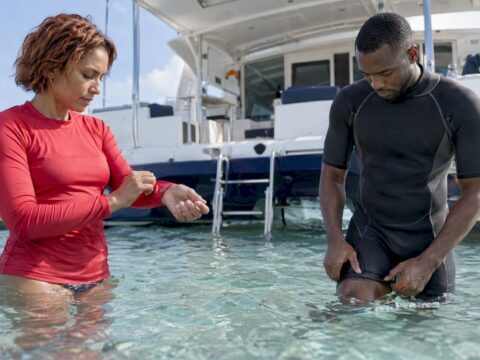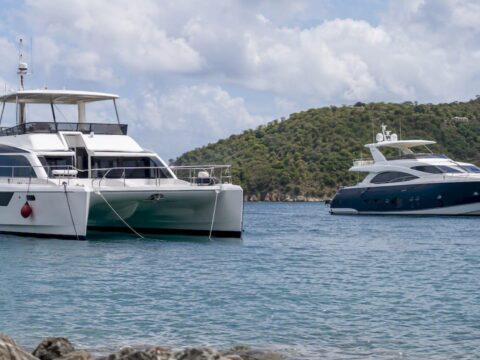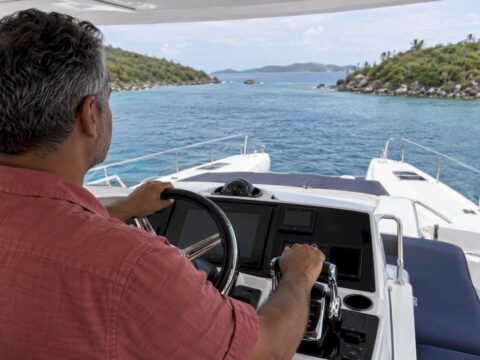

Professional yacht charter management places a shore-side team between you and every operational headache — bookings, maintenance, vessel monitoring, crew coordination, and storm preparedness — so your yacht earns charter revenue while you stay hands-off. For U.S. owners considering the British Virgin Islands or wider Caribbean, the model works best when your manager has deep local roots. Virgin Charter Yachts has operated out of Tortola, BVI for thirty years, and that long-term presence shapes everything from vendor priority to hurricane response.
What a full-service program typically covers:
- Bookings, pricing, and charter marketing
- Vessel monitoring and systems checks
- Scheduled maintenance and refit coordination
- Crew placement and guest services
- Storm preparedness and post-storm recovery
Table of Contents
- What does yacht charter management actually mean?
- How do bareboat, crewed, and ownership programs differ?
- How does a charter management program work step by step?
- What do fees and charter earnings look like?
- What BVI and Caribbean logistics should owners plan for?
- How do you choose the right charter manager?
- What should owners expect in year one?
- How does Virgincharteryachts deliver charter management in the BVI?
- Key Takeaways
- Why local relationships are the real competitive advantage
- Ready to start with Virgincharteryachts?
- Sources and further reading
What does yacht charter management actually mean?
Charter management is the professional operation of your yacht as a commercial asset. A manager handles the business side (marketing, bookings, guest handover, financial reporting) and the operational side (maintenance scheduling, vessel monitoring, provisioning, crew administration). You retain ownership; the manager runs the day-to-day.
Three program models cover most owners:
- Full-service charter management: The manager controls everything — marketing, bookings, crewing, technical upkeep, and monthly owner statements. Best for absentee owners who want revenue with minimal involvement.
- Owner-operated with management support: You handle some bookings or use the vessel frequently; the manager fills gaps and handles maintenance. Works for owners who spend significant time aboard.
- Ownership programs: Structured arrangements where you purchase a vessel (or a share) and the manager places it in charter for a defined period, often with guaranteed owner-use windows.
Who benefits most? Absentee owners seeking revenue offset, investors who want a tangible asset in a high-demand sailing destination, and vacationers who want turnkey ownership without the logistics burden.
Pro Tip: Match your availability pattern to the model before you sign anything. A seasonal owner who wants four weeks aboard in high season needs a very different contract structure than someone who rarely visits the vessel.
How do bareboat, crewed, and ownership programs differ?
The legal distinction matters more than most owners realize. Under a bareboat charter, the charterer assumes full operational and legal responsibility for the vessel — crewing, navigation, and insurance all shift to them. Under a crewed arrangement, the owner or manager retains operational control, providing the master and crew. That difference affects your insurance classification, liability exposure, and the revenue split your manager will offer.
| Model | Who crews | Owner liability | Typical revenue split |
|---|---|---|---|
| Bareboat | Charterer | Charterer assumes ops responsibility | Higher gross to owner |
| Crewed charter | Manager/owner provides crew | Owner/manager retains control | Lower gross; crew costs deducted |
| Ownership program | Manager provides crew | Shared per contract terms | Structured per program |
A charter management/consultancy agreement defines all of this in writing. For leisure yachting in the BVI, bareboat charters are the most common format, but crewed programs are growing as guests increasingly prefer a fully staffed experience. Ownership programs vary widely — some allocate owner-use weeks, others restrict them during peak season to maximize charter revenue.
How does a charter management program work step by step?
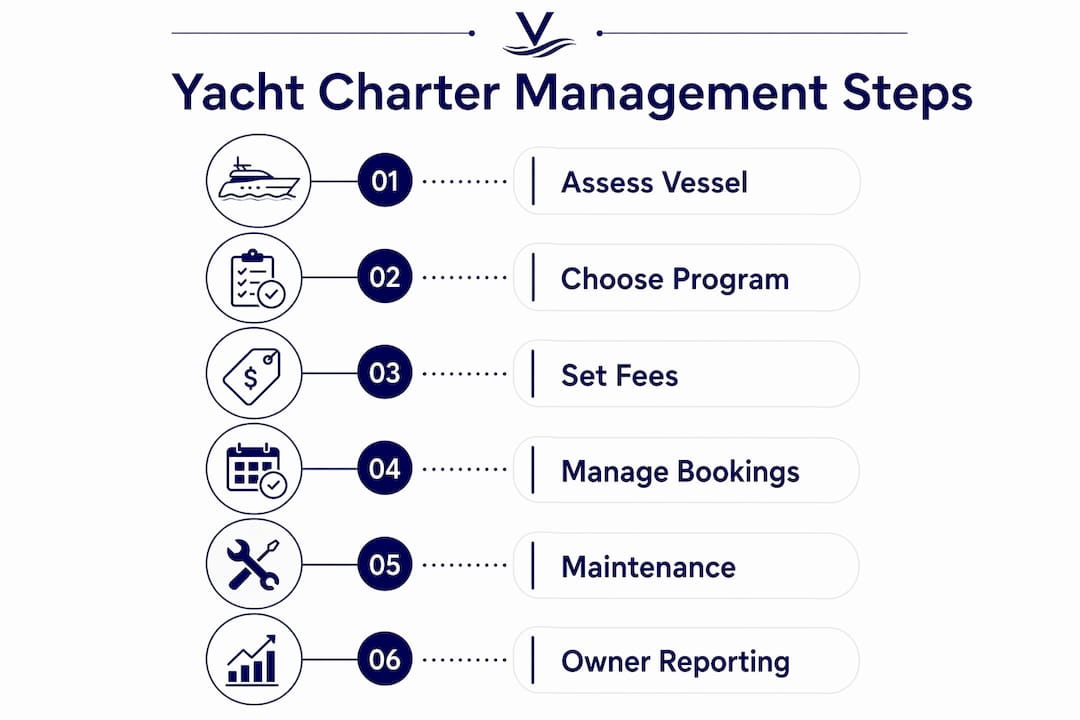
Enrollment through first charter typically takes several weeks to a few months. Here is the sequence most BVI managers follow:
- Pre-enrollment review: Vessel selection - it is important to speak with a charter manager before purchasing a yacht, so they can help advise on the best options on yachts for charter
- Initial charter setup: Add all the inventory, soft goods, water toys etc needed to operate as a successful charter yacht
- Marketing: Professional photography, listing on charter platforms, pricing strategy, and calendar launch.
- Crew assignment (crewed programs): Background checks, certifications verified, provisioning protocols, securing work permits to legally work in the BVI
- First booking and guest handover: Briefing, safety walk-through, and departure check.
- Post-charter cycle: Cleaning, systems check, maintenance log update, and owner statement issued.
Between charters, a good manager runs routine maintenance routines — starting engines and engine hour maintenance, generator oil changes and services, inspecting bilges and electrical systems, and cleaning inside and out. That cadence keeps the vessel charter-ready and protects its resale value.
What do fees and charter earnings look like?
Owners typically pay a management fee structured as a percentage of gross charter revenue, plus direct operating costs. The management fee covers the manager’s services; operating costs (dockage, fuel, crew wages, provisioning, insurance, and maintenance reserves) come out of charter income or are billed separately.
Common fee structures:
- Percentage of gross charter revenue: Most common in the BVI; the manager takes a share of every booking.
- Fixed monthly management fee: Less common for charter programs; more typical for private (non-charter) management.
- Commission on bookings only: Lighter-touch arrangements where the owner handles more operations.
Operating cost categories to budget for: marina fees, hull and liability insurance, annual haul-out and antifouling, engine servicing, crew wages (crewed programs), provisioning, and a maintenance reserve for unplanned repairs.
Net charter return depends on utilization rate, charter rate, season length, and vessel condition. A well-maintained, well-marketed yacht in a curated fleet with a dedicated charter manager consistently outperforms vessels listed generically across multiple platforms.
Pro Tip: Ask any prospective manager for the trailing 12-month utilization rate on a comparable vessel in their fleet. That single number tells you more than any projected earnings sheet.
What BVI and Caribbean logistics should owners plan for?
Location shapes cost and availability in ways that catch U.S.-based owners off guard. The BVI sits squarely in the Atlantic hurricane belt, and the June–November season demands a documented storm-preparedness plan before your vessel goes into charter.
Key operational realities:
- Hurricane prep: Pre-season refit, haul-out or safe-harbor decisions, and documented owner approvals for storm procedures. Local managers provide storm preparedness and recovery services, including acting as your agent during commissioning and post-storm repairs.
- Parts and logistics: Island supply chains run slower than mainland U.S. Managers with established vendor relationships get earlier refit slots and faster parts delivery, directly cutting charter cancellations.
- Customs and clearance: Every charter guest entering the BVI clears customs. A local manager handles the paperwork and keeps your vessel compliant with BVI Maritime Administration requirements.
- Marina availability: Tortola’s marinas fill during peak season (December–April) an annual slip contracts a are very hard to secure due to the very limited availability. A manager with long-standing berth relationships secures your slip and service windows.
Practical mitigation: Maintain a spare-parts inventory aboard, schedule preventive maintenance in the low season (May–June), and confirm your manager has priority access to at least two local marine contractors.
How do you choose the right charter manager?
Start with local presence and storm-preparedness credentials. A manager based in Tortola who has operated through multiple hurricane seasons is categorically different from one managing your vessel remotely.
Documents and proof to request before signing:
- Current insurance certificates (hull, P&I, and charter liability)
- Sample owner statements showing revenue, deductions, and net distributions
- Vessel maintenance logs for comparable yachts in their fleet
- Local vendor references (haulyard, engine service, electrical)
- Emergency response protocol and contact chain
Questions worth asking directly:
- What is your trailing utilization rate for a similar vessel in this market?
- How is the management fee calculated, and what does it exclude?
- What is the owner approval threshold for unplanned repairs?
- Who handles subcontractor billing, and how are those costs invoiced?
- What is your storm-season procedure, and who authorizes haul-out decisions?
Red flags: vague or delayed reporting, a single point of contact with no backup, resistance to sharing sample contracts or references, and no defined repair approval threshold. A manager unwilling to show you a real owner statement before you sign has something to hide.
What should owners expect in year one?
The first 12 months include upfront investment before meaningful charter revenue flows. Budget for initial conditioning, a maintenance reserve, and a marketing ramp period of 60–90 days before the first bookings confirm.
| Period | Milestone |
|---|---|
| Months 1–2 | Vessel selection/purchase, charter inventory, insurance setup |
| Months 1–3 | Marketing launch, photography, platform listings live |
| Months 2–4 | First bookings confirmed, crew placed (crewed programs) |
| Months 4–6 | Peak season utilization, monthly owner statements issued |
| Months 10–12 | Annual mainteance planning, budget review, contract renewal discussion |
Ongoing cadence after year one: monthly owner statements, quarterly condition reports, scheduled maintenance windows in the low season, and an annual budget meeting before the next charter season opens. Owners who stay engaged with that reporting cycle catch cost overruns early and keep their vessel competitive.
How does Virgin Charter Yachts deliver charter management in the BVI?
Virgin Charter Yachts has been based on Tortola, BVI since 1996 — 30 years of local operations, vendor relationships, and hurricane experience that a newer entrant simply cannot replicate. The fleet is deliberately curated: Fountaine Pajot, Leopard, Aquila, Aventura, Lagoon, Horizon, and Two Oceans power catamarans and motor yachts, maintained to a consistent standard that protects both guest experience and owner asset value.
Services the team delivers:
- Charter bookings, pricing strategy, and marketing
- Vessel monitoring and systems checks between charters
- Maintenance coordination with vetted local contractors
- Storm preparedness planning and post-storm recovery
- Guest services, provisioning coordination, and trip planning
- Ownership programs for buyers entering the charter market
Pro Tip: When evaluating any charter manager, ask specifically how many vessels one manager oversees. A curated fleet with a low manager-to-vessel ratio means faster response times and more attentive maintenance.
Owners interested in the program can start an inquiry directly at Virgincharteryachts.
Key Takeaways
Professional charter management in the BVI requires local presence, documented storm preparedness, transparent fee structures, and a curated fleet approach to deliver consistent owner returns.
| Point | Details |
|---|---|
| Local presence matters most | A Tortola-based manager with vendor relationships shortens repair times and reduces charter cancellations. |
| Storm prep is non-negotiable | Documented hurricane procedures and owner approval thresholds protect your asset and insurance claims. |
| Utilization drives returns | Ask for trailing 12-month utilization on comparable vessels before accepting any projected earnings. |
| Model fit before contract | Match your availability pattern to the right program — full-service, owner-operated, or ownership program. |
| Virgin Charter Yachts | Family-owned, Tortola-based since 1996, with a curated fleet of Fountaine Pajot, Leopard, Lagoon, Aquila catamarans. |
Why local relationships are the real competitive advantage
The part of charter management that rarely appears in a brochure is vendor priority. When a generator fails two days before a confirmed charter, the question is not whether your manager knows a technician — it is whether that technician picks up the phone on a Saturday and shows up first. That only happens when a manager has been paying invoices promptly and sending steady work to the same contractors for years.
In the BVI specifically, supply chain delays are a real operational variable. Parts that arrive in three days on the U.S. mainland can take two weeks to clear customs and reach a Tortola boatyard. A manager with established purchasing relationships and a maintained spare-parts inventory aboard each vessel absorbs that delay without canceling a booking. That is the practical value of 30 years on the same island — not a marketing claim, but a logistics reality that shows up directly in your utilization numbers.
Ready to start with Virgin Charter Yachts?
Many years of BVI operations means Virgin Charter Yachts already knows the vendors, the marinas, the customs procedures, and the storm protocols that protect your investment. The initial consultation covers your vessel’s current condition, your availability preferences, the right program model for your situation, and a realistic earnings projection based on comparable fleet performance.
Before you reach out, have these ready: your vessel’s maintenance log, current insurance certificates, a rough availability calendar, and any existing charter history. That preparation lets the first conversation move directly to program fit and contract terms rather than basic data gathering.
Contact the team at Virgin Charter Yachts to request a management consultation and get a clear picture of what your vessel can earn in the BVI charter market.
Sources and further reading
Owners who want to verify operational, legal, or contractual specifics will find these sources useful:
- B&G Marine Services — BVI-based yacht management operations, storm preparedness services, and subcontractor billing practices. Best for understanding local operational standards.
- Antilles Yachts Ltd — Monthly maintenance routines and owner approval threshold practices in the BVI. Useful for benchmarking recurring service expectations.
- IYR Charter Management — Curated fleet approach, dedicated charter manager model, and full-service shoreside support. Good reference for understanding management fee structures and marketing strategy.
- Charterparty — Wikipedia — Legal definitions of bareboat, time, and voyage charters and how operational responsibility is allocated.
- LSD.Law — Charter Agreement Definition — Plain-language definition of a charter agreement and the legal responsibilities it creates.
- LII / Legal Information Institute — Charter — U.S. legal definition of a charter and its application to vessel leasing.
- Virgincharteryachts — Primary contact point for charter management inquiries, ownership programs, and fleet details in the BVI and Caribbean.
Article generated by BabyLoveGrowth
Did You Know?
The BVI are only accessible by boat. Check out our charter yachts that can get you there. View Our Fleet