
Yacht charter insurance protects your money, your health, and your personal liability for a specific charter trip. The charterer almost always must buy it separately, and the cost is reasonable: charterer’s liability typically runs 2–4% of the charter fee, while trip cancellation coverage adds an additional portion of the total charter value. Your first move is to read the charter contract (MYBA or AYCA standard form), then contact a specialist marine broker before you pay the deposit. That timing matters because CFAR upgrades and pre-existing condition waivers must be purchased within 1–21 days of your initial deposit payment.
Table of Contents
- What yacht charter insurance actually covers — and who buys each layer
- How much does charter coverage cost? Realistic ranges and sample math
- What MYBA and AYCA contracts require from you
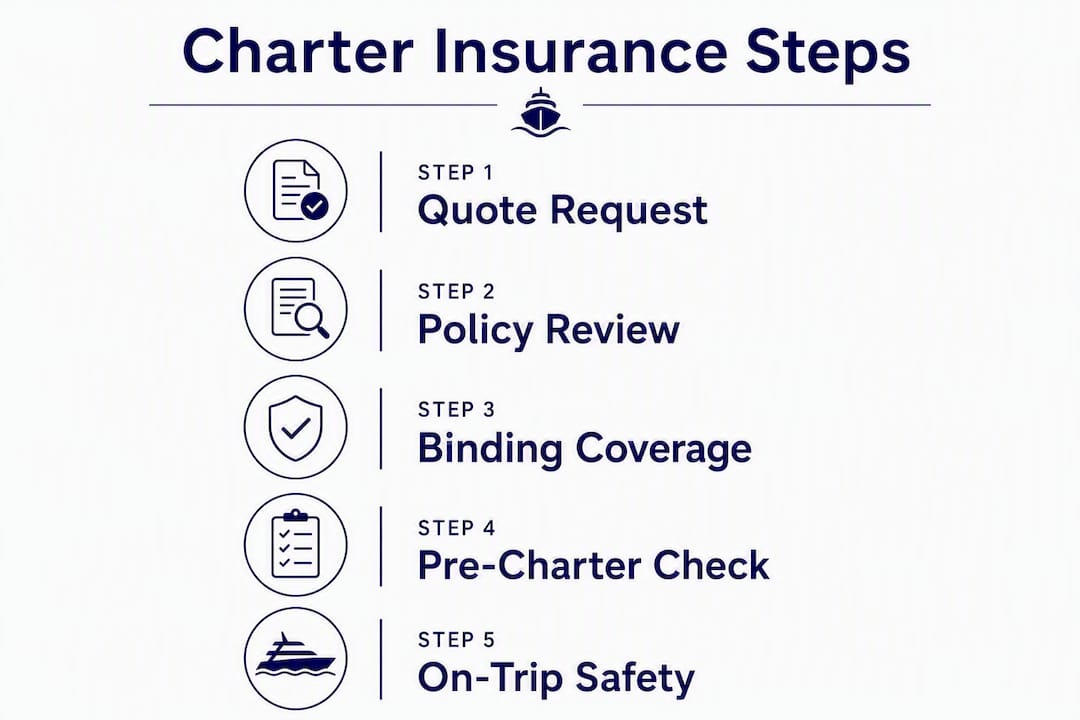
- How to arrange your coverage before the charter date
- Exclusions that catch charterers off guard
- What to do when something goes wrong on the water
- Key Takeaways
- A note from Virgincharteryachts on how we support your coverage
- Useful sources to verify figures and get quotes
What yacht charter insurance actually covers — and who buys each layer
Most charterers assume the yacht owner’s policy has them covered. It doesn’t. The owner’s Hull & Machinery (H&M) policy protects the vessel itself from physical damage; the owner’s Protection & Indemnity (P&I) policy covers third-party bodily injury and property damage caused by the vessel. Neither policy extends to the charterer’s personal liability, medical bills, or trip costs.
Here is how the full program breaks down:
- Hull & Machinery (H&M): Owner’s policy. Covers physical damage to the yacht’s structure, engines, and fixed equipment. H&M premiums run roughly 0.7–1.5% of the vessel’s agreed value annually. The charterer benefits indirectly because the owner’s deductible is typically secured by the charter security deposit.
- Protection & Indemnity (P&I): Owner’s policy. Covers third-party claims — a swimmer struck by the vessel, a marina dock damaged during docking. P&I premiums for charter-grade yachts vary widely.
- Charterer’s Liability: Charterer’s policy. This is the critical gap most people miss. It covers your legal liability to third parties and, crucially, can protect against personal indemnity clauses in the charter agreement that make you responsible for crew injuries caused by your negligence.
- Trip Cancellation / Curtailment: Charterer’s policy. Reimburses non-refundable charter fees if you must cancel or cut the trip short for a covered reason.
- Personal Medical & Medevac: Charterer’s policy. Offshore medevac from a Caribbean island to a mainland hospital can run $25,000–$80,000 depending on distance and aircraft. Specialist yacht-ready policies recommend at least $100,000 in emergency medical coverage and $250,000–$500,000 in evacuation limits.
- Scheduled Valuables Rider: Charterer’s policy. Watches, jewelry, and cameras brought aboard need a scheduled-articles rider if homeowner limits are insufficient. Premiums run roughly 0.5–1.5% of insured value annually.
- Personal Umbrella / Excess GL: Optional. Adds a layer above charterer’s liability limits for high-value charters or large guest groups.
Two quick claim scenarios: A guest on your chartered catamaran dives off the bow and strikes a swimmer in the water. The owner’s P&I responds to the swimmer’s injury claim, but if your negligent instruction caused the incident, the charter’s personal indemnity clause may redirect liability to you. That is when your charterer’s liability policy steps in. Separately, if a guest slips on deck and needs a helicopter evacuation, the owner’s policy covers nothing for that guest’s medical costs. Your personal medical and medevac coverage pays.
How much does charter coverage cost? Realistic ranges and sample math
The numbers below reflect industry practice for U.S.-market charterers booking Caribbean and BVI itineraries.
| Scenario | Charter Fee | Charterer’s Liability Est. | Trip Cancellation Est. | Medevac/Medical Est. |
|---|---|---|---|---|
| Economy airboat | — | $100–$200 | — | — |
| Mid-range luxury catamaran | $15,000 | — | $450–$1,200 | — |
Sample calculation — mid-range luxury catamaran, party of six:
- Charter fee: $15,000
- Charterer’s liability (3% of charter fee): $450
- Trip cancellation (5% of charter fee): $750
- Medical/medevac per person × 6: $1,200
- Scheduled valuables rider (watches, cameras, $20,000 insured value at 1%): $200
- Total estimated premium: ~$2,600
That is roughly 17% of the charter fee for a fully protected trip — not cheap, but compare it to absorbing a $15,000 non-refundable charter fee because a family member’s medical emergency forced cancellation.
A few price drivers worth knowing: cruising area matters significantly, with offshore Caribbean routes commanding higher medevac limits than coastal U.S. waters. Passenger count affects P&I exposure. Watersports activities (kiteboarding, jet skis) can trigger exclusions or surcharges. Higher deductibles lower premiums but shift more risk back to you. Most specialist brokers apply minimum premiums regardless of charter fee size, so a short weekend charter may cost proportionally more than a two-week voyage.
The CFAR math: Trip cancellation typically reimburses 100% of covered losses for named perils. A Cancel For Any Reason upgrade can reimburse up to approximately 75% of prepaid costs for any reason at all — and it must be purchased within the early purchase window to be valid.
What MYBA and AYCA contracts require from you
Standard charter agreements — particularly the MYBA (Mediterranean Yacht Brokers Association) form used widely in the Caribbean and BVI — transfer specific liabilities to the charterer through several key clauses. Reading clauses 14, 16, 19, and 23 (or their equivalents in the AYCA form) reveals four insurance obligations the charterer should address before boarding.
The most consequential: a personal indemnity clause that makes the charterer legally responsible for crew injuries caused by client negligence. Without a dedicated charterer’s liability policy, that exposure sits entirely with you.
Certificate checklist — request these before paying the balance or boarding:
| Document | What to Verify |
|---|---|
| Owner H&M certificate | Vessel name, agreed value, policy period, territory |
| Owner P&I certificate | Limit of liability, territory, named activities (watersports, charter) |
| Crew insurance confirmation | Coverage type, limits, and whether it extends to charterer-caused incidents |
| Charterer named as additional insured | Confirm on owner’s P&I where required by contract |
| Cancellation / force majeure clause | Understand what triggers a refund vs. forfeiture |
One point that surprises many charterers: the security deposit is not insurance. It is the deductible on the owner’s H&M policy, held in your name. A charterer’s liability policy can protect you from losing that deposit to a disputed damage claim, but only if the policy language explicitly covers security deposit liability. Confirm that language with your broker before binding.
How to arrange your coverage before the charter date
Timing is the single most important variable in buying charter coverage. Miss the early purchase window and you lose access to CFAR and pre-existing condition waivers.
- Pay the deposit, then buy insurance the same day. The CFAR purchase window is typically 1–21 days from your initial deposit payment. Waiting even a week can close that option permanently.
- Contact a specialist marine broker, not a general travel agent. Generic travel policies routinely exclude private charters because of “common carrier” definitions and non-standard vessel clauses. A broker who understands MYBA/AYCA wording reduces denial risk substantially.
- Gather your documentation. Underwriters need: the charter invoice (with full fee breakdown), vessel name and flag, passenger count and names, itinerary and cruising area, skipper credentials (for bareboat), and a list of high-value items to schedule.
- Request quotes from at least two specialist carriers. Ask each one specifically: Does the policy define “vessel” to include private bareboat and crewed charters? What is the territory? Does medevac coverage require using the insurer’s assistance network? Are watersports covered, and which ones?
- Review the binder carefully before the charter date. Confirm the vessel name matches the charter agreement exactly, the territory covers your itinerary, and the policy period begins before your departure.
- Carry proof of coverage aboard. A digital copy of the binder and the insurer’s 24-hour emergency contact number should be accessible to every adult in your group.
Turnaround for quotes is typically same-day to 48 hours for standard charters. Mega-yachts or unusual itineraries may require longer underwriting review. Most specialist brokers can bind coverage the same day a quote is accepted.

Exclusions that catch charterers off guard
Standard travel insurance fails yacht charterers in a specific, predictable way. Most policies are written around “common carriers” — airlines, cruise ships, scheduled ferries. A private bareboat or crewed yacht is not a common carrier, and Clause 22 (or equivalent vessel-definition language) in many travel policies explicitly excludes non-standard vessels. The claim gets denied before an adjuster even reads the details.
Beyond that structural problem, watch for these specific exclusions:
- Named-storm timing: Many policies exclude cancellation due to a named storm if the storm was already named when you purchased coverage. Buy early.
- Watersports and racing: Kiteboarding, jet skis, and any form of racing are commonly excluded or require a specific endorsement.
- Unauthorized tenders: Using a dinghy or tender not listed in the policy can void coverage for incidents involving that vessel.
- Captain-ordered cancellations: If the captain refuses to sail for safety reasons, that is an operational cancellation, not a charterer cancellation. Many policies do not cover it unless the language explicitly includes “cessation of service” or an equivalent trigger.
- Crew negligence: The owner’s P&I covers crew acting within their duties. If crew negligence injures a guest, the claim path is through the owner’s policy, not yours — but if your instruction contributed, the indemnity clause may redirect liability back to you.
- Personal property: No charter policy or CDW covers your phone, laptop, or camera. A scheduled-articles rider or homeowner’s floater is the only protection.
Pro Tip: Before binding any policy, ask your broker to confirm in writing: (1) the exact definition of “vessel” and whether it includes private bareboat and crewed charters; (2) whether “cessation of service” by the captain is a covered cancellation trigger; and (3) the precise territory wording. Those three answers will tell you whether the policy is yacht-ready or a generic travel plan dressed up with marine language.
What to do when something goes wrong on the water
Safety first, always. If there is a medical emergency, get the person stable and contact the captain immediately. The captain is responsible for vessel safety and will coordinate with local coast guard or maritime authorities. Your job is to support that process and document everything.
Once the immediate situation is under control:
Notify in this order: Captain and vessel owner, local maritime authorities (if required by the incident type), your charter broker, and your insurer’s emergency line. Most marine policies require notice “as soon as practicable” — in practice, that means within 24 hours for serious incidents.
For medevac specifically: call your insurer’s assistance network before arranging transport if at all possible. Insurers offering medevac may coordinate and advance costs only when they receive immediate notification. Arranging your own air ambulance without calling the insurer first can create reimbursement risk even for a covered event.
For property damage or third-party injury: photograph everything before anything is moved. Get the captain’s written statement. Collect contact information from any witnesses. Do not admit liability or make any payment to a third party before speaking with your insurer.
When a third-party bodily injury claim arises, the owner’s P&I is typically the first line of response. If the charterer’s negligence contributed, the charterer’s liability policy responds to that specific exposure. The two policies interact, and a specialist broker can help coordinate the claim between carriers.
Key Takeaways
Charterer’s liability and trip cancellation are the two policies every charterer must arrange independently — the owner’s hull and P&I policies do not cover your personal exposure, medical costs, or non-refundable charter fees.
| Point | Details |
|---|---|
| Buy insurance the day you pay the deposit | The CFAR and pre-existing condition waiver window is typically 1–21 days from initial deposit. |
| Charterer’s liability costs 2–4% of charter fee | Minimum premiums apply; confirm the policy covers security deposit disputes. |
| Trip cancellation typically costs 3–8% of charter fee | CFAR upgrades can reimburse up to ~75% of prepaid costs for any reason. |
| Standard travel insurance usually fails | Common carrier and vessel-definition exclusions routinely deny yacht charter claims. |
| Medevac limits matter in the Caribbean | Offshore evacuation can cost $25,000–$80,000; target at least $250,000 in evacuation coverage. |
A note from Virgincharteryachts on how we support your coverage
At Virgincharteryachts, we have been operating luxury bareboat and crewed charters in the British Virgin Islands and Caribbean since 1996. Insurance questions come up on nearly every booking, and we treat them as part of our pre-charter service, not an afterthought.

Before any client boards, we confirm that the vessel’s H&M and P&I certificates are current, the territory covers the planned itinerary, and crew coverage is in place. We share that documentation with clients on request so they can forward it to their own broker when arranging charterer’s liability or trip cancellation coverage.
We also keep a short list of questions we recommend every client ask their broker before binding: Does the policy cover private bareboat and crewed charters by name? Is the BVI and Eastern Caribbean within the policy territory? Does medevac coverage require using the insurer’s network? Those three questions alone filter out most policies that would fail at the claim stage.
If you are planning a charter with us and want to talk through the insurance checklist before booking, reach out to our team directly. We can walk you through the certificate items, suggest the right broker questions for your specific itinerary, and make sure nothing is left open before you cast off.
Useful sources to verify figures and get quotes
| Source | What it delivers |
|---|---|
| MHG Insurance — Charterer’s Liability | Specialist marine broker; charterer’s liability pricing and policy structure for U.S. charterers |
| InsureYonder — Best Travel Insurance for Yacht Charters | Yacht-ready travel policy benchmarks; CFAR purchase window guidance and medevac limit recommendations |
| Trillionaire Daily — Yacht Charter Insurance Guide | Comprehensive breakdown of owner vs. charterer policy responsibilities; H&M, P&I, and valuables rider pricing |
| Allan Winder — Why Clause 22 Sinks Your Charter | Detailed analysis of how standard travel policy vessel-definition language excludes private charters |
| Topsail Insurance — Boat vs. Travel Insurance | Explains why specialist marine brokers reduce claim denial risk; common carrier definition problems |
| Boat Tomorrow — Charter Yacht Insurance Guide | Practical breakdown of security deposit mechanics, CDW options, and personal travel insurance gaps |
This article is general information, not legal or insurance advice. Coverage terms, limits, and pricing vary by carrier and itinerary. Confirm current policy language and requirements with a licensed marine insurance broker or your charter operator before purchasing.
Article generated by BabyLoveGrowth
Did You Know?
The BVI are only accessible by boat. Check out our charter yachts that can get you there. View Our Fleet