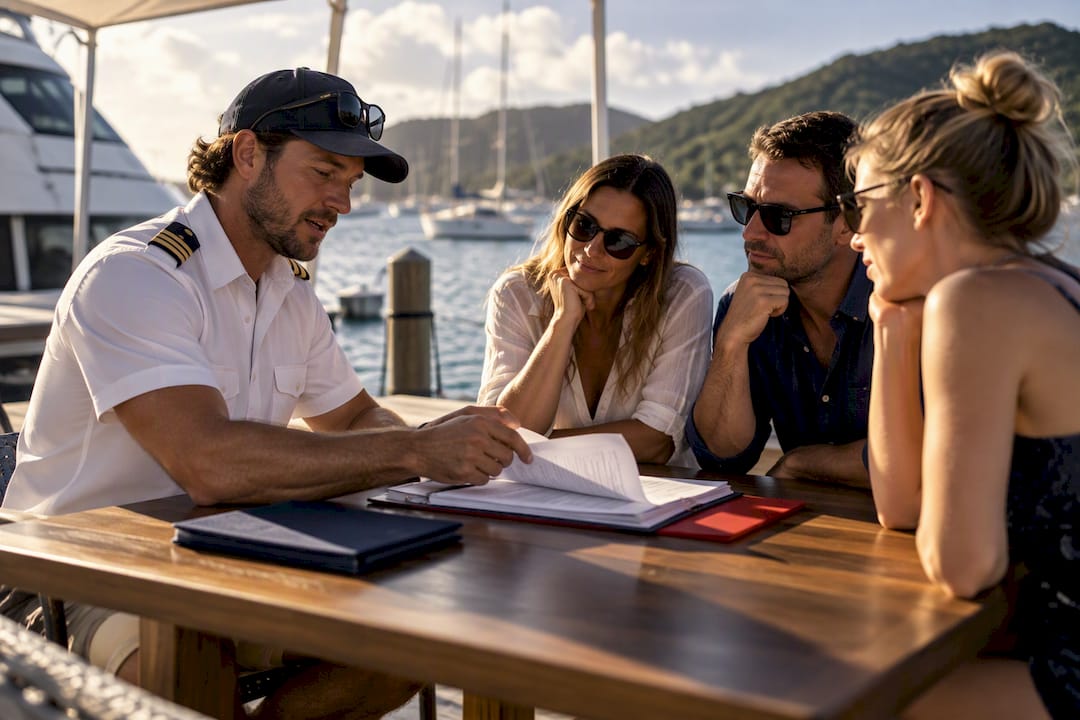

A captain only charter is a private yacht rental with a professional captain aboard while your group handles provisioning, cooking, and daily cleanup. It suits active, budget-aware groups who want a hand in running the boat without navigating themselves. Expect to pay a separate captain fee on top of the base charter rate, plus your own food and drink.
TL;DR:
- Guests must budget for additional expenses such as fuel, dockage, provisioning, and daily captain fees, which typically range from $250 to $300 per day.
- Confirm the vessel’s current inspection, the captain’s licensing, and insurance documentation before booking to avoid legal and safety risks.
- Groups comfortable with handling chores and basic navigation are ideal, especially if they want to save money and avoid full-service crew costs.
- Shorter routes, off-peak seasons, and self-provisioning can significantly lower the total cost of a captain only charter.
- The process of booking and planning generally takes several weeks and requires detailed coordination of credentials, paperwork, and provisioning arrangements.
Table of Contents
- What captain only charters include and what guests must provide
- Who captain only charters are best for
- Budgeting for a captain only week
- Captain credentials and the regulatory checks that protect you
- Preparing for departure: provisioning, chores, and etiquette
- Captain only vs fully crewed vs bareboat
- Who’s behind this guide to captain only charters
- How long the booking process actually takes
- What guests are expected to do on board
- Embarkation day: check-in, safety briefing, and what comes next
- Insurance you should confirm before you sail
- Weather, mechanical issues, and other risks worth planning for
- When we point guests toward captain only
- Let Virgin Charter Yachts plan your captain only week
- Where to verify the rules and plan further
- Sources
- FAQ
What captain only charters include and what guests must provide
The captain handles the parts of the trip that require licensing and local knowledge: navigation, anchoring or mooring, safety oversight, and building the day-to-day itinerary around weather and conditions. Everything related to daily living aboard falls to the guests.
That split is the whole point of this charter category. You are not hiring hospitality staff, you are hiring a skilled operator while keeping the rest of the trip in your own hands.
- The captain plans routes, handles docking and mooring, and makes final calls on safety.
- Guests buy and prepare food, wash dishes, tidy cabins, and cover consumables like fuel and dockage.
- Guests are also responsible for feeding the captain and covering their daily rate, which runs around $250 per day for a standard captain and about $300 per day for a training captain.
Some groups add a chef or stewardess for part of the trip, hire a provisioning service to stock the boat before arrival, or book water sports gear. These extras narrow the gap between captain only and a fully crewed charter, but they cost extra and are optional rather than included.
Who captain only charters are best for
Captain only works best for groups that want to be involved without steering the boat themselves. It falls short for anyone expecting hotel-level service or traveling with guests who need extra assistance.
- Experienced sailors or boaters who enjoy being part of the operation but want a licensed professional handling navigation and safety.
- Groups of six to ten friends or family who are comfortable cooking, cleaning, and splitting chores.
- Cost-conscious travelers who would rather put money toward a nicer boat than toward a full service crew.
- Groups with guests who have mobility issues, dietary complexity, or a strong preference for being served should look at fully crewed options instead.
- Larger groups approaching a boat’s maximum guest capacity often need the extra hands a full crew provides, since one captain cannot manage both operations and hospitality at scale.
If your itinerary involves long passages, tricky anchorages, or unpredictable weather windows, weigh that difficulty against how much cooking and cleanup your group actually wants to do.
Budgeting for a captain only week
The headline charter rate is only one line in the budget. A realistic estimate adds the captain’s daily fee, fuel, dockage or mooring fees, provisioning, and often an APA style “plus expenses” allowance that covers fuel and dock costs as they’re incurred rather than folded into the base price.
A 3-Cabin Power Catamaran runs 6,000 to 10,000 British pounds per week before captain fees and expenses, giving a sense of the entry point for a captain only style trip on a smaller boat.
A lower-cost captain only week on a 3-cabin boat might run the base charter rate, roughly $1,750 to $2,100 for a week of a standard captain at a daily fee, plus fuel, dockage, and groceries for your group. A higher-end week on a larger power catamaran adds a bigger base rate and proportionally more in fuel and provisioning, since bigger boats and longer routes burn more of both.
- Self-provisioning at a local grocery or marina store almost always beats paying a premium provisioning service.
- Shorter passages between anchorages cut fuel spend without shortening your trip.
- Off-peak season dates lower the base charter rate on many boats.
Captain credentials and the regulatory checks that protect you
Not every “captain only” arrangement is legally the same, and the difference matters more than most guests realize. Under U.S. guidance, a vessel enters commercial service, and faces stricter inspection and licensing rules, when it carries at least one passenger for hire or when the owner supplies or specifies the crew. MSIB 02-23 lays out three categories: recreational (REC), uninspected passenger vessel (UPV), and small passenger vessel (SPV), each carrying different inspection and credentialing requirements.
A true bareboat contract cannot supply crew in its terms, or the charter risks being reclassified as a commercial passenger operation, which exposes the owner and the operator to enforcement. Treat “captain only” as a service level you’re buying, not a legal category, and confirm which regulatory bucket your specific booking falls into before you pay a deposit.
- Ask whether the vessel carries a current commercial inspection if one applies to your itinerary.
- Ask what certificate the captain holds and whether it matches the vessel’s classification.
- Ask for a copy of the insurance certificate before transferring any funds.
Pro Tip: Get the captain’s license number and the vessel’s documentation in writing before you book, not on embarkation day.
Unclear contract language, vague answers about who “provides” the crew, and an operator who can’t produce inspection or insurance paperwork are the clearest warning signs to walk away.
Preparing for departure: provisioning, chores, and etiquette
Good preparation is what makes a captain only week feel relaxed instead of chaotic. Build your plan around a short checklist rather than winging it at the dock.
- Write an itemized meal plan for every breakfast, lunch, and dinner, including snacks and the captain’s meals, then shop from that list.
- Stock water and alcohol separately from food, since both run out faster than groups expect on a hot week.
- Confirm the captain’s dietary needs and preferences ahead of time so nobody discovers a conflict on day one.
- Split daily chores, cooking, dishwashing, and cabin tidying, among guests in advance so nobody assumes someone else has it covered.
- Follow the captain’s instructions on stowage, tender use, and waste handling without exception, since these calls are about safety and local rules, not preference.
Pro Tip: Pre-order groceries through a marina provisioning service when one is available so your list is waiting at the dock instead of eaten up by a grocery run on day one.
Provisioning in an island marina usually means smaller stores, higher prices, and less selection than a mainland supermarket, so build in flexibility on brands and substitute ingredients rather than a rigid shopping list.

Captain only vs fully crewed vs bareboat
Bareboat charter puts your group fully in charge, no captain, no crew, and suits confident, licensed boaters who want total independence. Captain only adds a licensed professional for navigation and safety while guests keep running the household side. Fully crewed adds a chef, stewardess, and full hospitality on top of the captain, suiting guests who want a hands-off, resort-style week.
- Cost climbs sharply from bareboat to captain only to fully crewed, largely because of added crew fees and hospitality staff.
- Hospitality level is the opposite: bareboat and captain only both expect guest labor, while fully crewed removes nearly all of it.
- Regulatory exposure changes with structure: a true bareboat cannot include crew supplied by the owner without risking reclassification, a point covered in detail in the crewed versus bareboat comparison.
Upgrade to fully crewed when your group wants zero chores or includes guests who need extra help; choose bareboat only if everyone aboard is a confident, qualified boater. For a deeper side-by-side, the BVI bareboat, captain, and crewed comparison breaks down each option by destination.
Who’s behind this guide to captain only charters
We are experienced in arranging luxury bareboat and crewed yacht charters in the British Virgin Islands and Caribbean. Our selection includes modern power catamarans from notable brands, maintained to a high standard.
We operate locally with extensive knowledge of the area, providing personalized assistance in itinerary planning and matching captains to groups.
How long the booking process actually takes
Most captain only charters take shape over a few weeks rather than a few days, though the timeline compresses if you’re flexible on dates and boat size. The process usually starts with an inquiry about dates, group size, and budget, followed by a conversation about which boat and captain arrangement fits.
Once you settle on a boat, expect a deposit to lock the dates, then a planning period where you firm up the itinerary, confirm provisioning arrangements, and answer the operator’s questions about dietary needs or special requests. This stretch is when you should also be verifying the captain’s credentials and the vessel’s paperwork, not after you’ve already paid in full.
Final payment typically comes due closer to departure, often with a provisioning list or shopping plan due around the same time so the boat can be stocked before you arrive. Popular weeks, especially winter and spring in the Caribbean, book out well ahead of the sailing date, so starting the inquiry process early gives you more choice of boat and captain rather than whatever is left close to departure.
The whole arc, from first inquiry to stepping aboard, tends to run smoother when you treat the planning period as a checklist rather than a single phone call. Confirming details in writing at each stage avoids the last minute surprises that cause the most frustration on trip day.
What guests are expected to do on board
Beyond cooking and cleaning, captain only guests take on a handful of tasks that keep the boat running smoothly day to day. None of these require training, but they do require paying attention to the captain’s instructions.
Guests typically help with light navigation tasks like watching for markers or hazards the captain points out, and lending a hand with lines during mooring or docking when asked. This isn’t the same as operating the boat, it’s assisting a licensed professional who’s still making every call.
Waste handling, including where and how trash and gray water are managed, usually follows specific local rules the captain enforces.
Groups that split these tasks clearly at the start of the week tend to have fewer friction points later. Assigning someone to line handling, someone to galley duty, and someone to general tidying works better than leaving it all unspoken and hoping it sorts itself out.
Embarkation day: check-in, safety briefing, and what comes next
Embarkation day usually starts with a check-in at the marina, where you’ll go over the contract, confirm the itinerary, and settle any outstanding balance or expense deposit. This is also when you should do a final walk-through of the boat with the captain to note its condition before you take it out.
Expect a safety briefing before you leave the dock. The captain will cover life jacket locations, fire extinguisher placement, how to use the marine radio in an emergency, and the basics of man overboard procedure. This briefing isn’t optional and it’s worth paying real attention to it even if you’ve chartered before, since equipment location varies boat to boat.
The captain will also walk through house rules specific to that vessel: how the heads work, water conservation habits, and any quirks of the galley or systems onboard. Disembarkation at the end of the week mirrors this process in reverse, a walk-through to check for damage, a final accounting of any expenses, and settling up on fuel, dockage, or provisioning costs that weren’t prepaid.
Building in a buffer on both ends, arriving a little early on embarkation day and not scheduling a tight flight on disembarkation day, avoids rushing through either the briefing or the final walk-through.
Insurance you should confirm before you sail
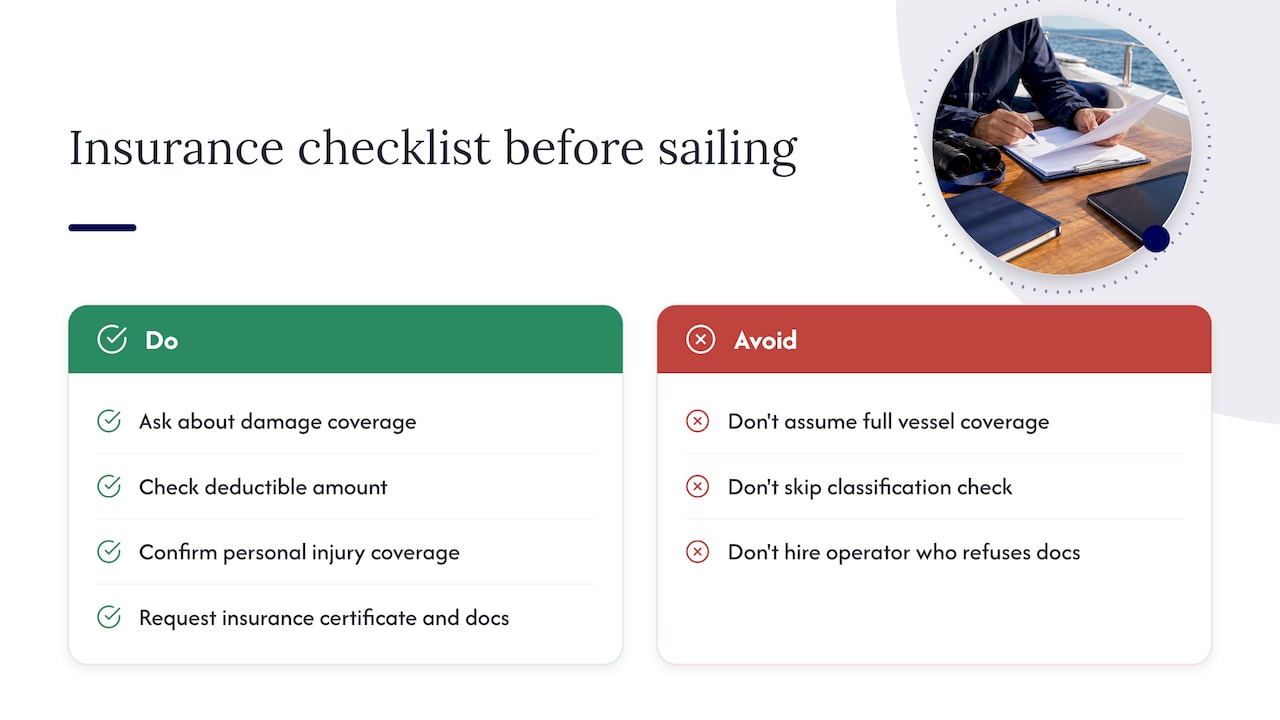
Insurance on a captain only charter usually splits into a few pieces, and it’s worth understanding each one rather than assuming everything is covered. The charter operator typically carries liability and hull insurance on the vessel itself, but that doesn’t necessarily cover every scenario involving your group.
Ask specifically about damage coverage, what happens if the boat runs aground or suffers mechanical damage during your charter, and whether you’re on the hook for a deductible. Many charters use a security deposit or damage waiver structure for exactly this reason, and it’s worth knowing the deductible amount before you sign anything.
Personal liability and injury coverage is a separate question from vessel damage. Depending on your homeowner’s or travel insurance, you may already have some coverage for injuries or lost belongings while traveling, but it’s worth a call to your provider to confirm before you assume it. Because operating as a commercial passenger vessel changes the insurance and liability picture significantly, confirming which classification applies to your charter, as outlined in MSIB 02-23, is also part of an insurance conversation, not just a legal one.
Get the insurance certificate in writing alongside the captain’s license and vessel documentation. An operator who hesitates to produce any of these three documents is a signal to keep looking rather than a detail to overlook.
Weather, mechanical issues, and other risks worth planning for
Weather is the most common disruption on any charter, and a captain only booking handles it differently than a bareboat trip would. The professional captain is making the call on whether to change the route, delay departure, or seek shelter, which takes that judgment call off your group’s shoulders, but it also means flexibility in your itinerary matters more than a fixed plan.
Mechanical issues, an engine problem, a generator failure, a broken winch, come up occasionally on any charter, and a competent captain is trained to troubleshoot and knows who to call locally if a repair is beyond what can be handled underway. This is one of the clearer advantages of having a licensed professional aboard rather than running the boat yourselves.
Regular maintenance on the vessel between charters lowers the odds of mechanical surprises mid-trip. A well-kept hull, for instance, affects fuel efficiency and handling, and operators who follow a maintenance routine, including scheduled hull cleaning, tend to run into fewer issues underway.
Building a day or two of slack into your itinerary, rather than a rigid island-a-day schedule, gives the captain room to adjust for weather without scrapping your trip. Travel insurance that covers trip interruption is worth considering given how weather can shift a Caribbean itinerary with little warning.
When we point guests toward captain only
Captain only is our go-to recommendation for active groups who want real involvement in the trip without taking on navigation themselves. The most common booking mistake is underestimating provisioning, guests consistently buy too little food and water for a full week. Build your grocery list for one extra day beyond what you think you need.
— alexia
Let Virgin Charter Yachts plan your captain only week
You don’t have to sort through captain credentials, provisioning logistics, and boat options on your own. Virgin Charter Yachts has been planning bareboat and crewed charters from Tortola for 30 years, and that includes matching groups with the right captain only setup for their itinerary and budget.

If you’re weighing options, start with the bareboat charter pricing page to see current rates by cabin count, then check the charter cost breakdown for captain fees and typical add-ons like Wi-Fi. For groups that decide they want more hospitality on board, the luxury crewed charter pricing shows what a fully staffed week costs by comparison. Reach out for a quote and we’ll help you land on the right boat and captain arrangement for your group.
Where to verify the rules and plan further
Confirm charter classification rules directly through MSIB 02-23 and the PaxForHire guide chart. For planning, see the charter cost breakdown and skippered hire details.
FAQ
How much does a captain-supplied charter typically cost?
A standard captain runs about $250 per day, and a training captain around $300 per day, on top of the base charter rate, which for a 3-cabin power catamaran runs 6,000 to 10,000 British pounds per week. Add fuel, dockage, and provisioning on top of those figures for a full budget.
What is the 12 person rule on a yacht?
Vessel capacity limits, including passenger counts, are set by each boat’s certification and vary by classification under U.S. guidance on recreational versus inspected passenger vessels. There’s no single universal passenger count rule; the correct limit depends on the specific vessel’s documentation, so confirm the exact capacity with the operator before booking.
What is the best catamaran charter in the BVI?
The right catamaran depends on your group size and how much hospitality you want included, from smaller 3-cabin power catamarans for captain only trips to larger crewed catamarans for full service weeks. Comparing cabin count, service level, and season is a better starting point than looking for one universal answer.
Do guests pay for their own charter, or is it complimentary?
On a standard captain only or crewed charter, guests pay the full charter rate along with expenses like fuel, provisioning, and the captain’s fee. Arrangements shown on some charter television shows, where guests receive a heavily discounted rate, are not representative of typical charter pricing.
Recommended
- Charter with Confidence: Your Guide to Bareboat Charter BVI!
- BVI Bareboat vs. Captain vs. Crewed Yacht Charter: Which Is Right for You?
- Crewed vs Bareboat Charter | Which Yacht Option is Best?
Did You Know?
The BVI are only accessible by boat. Check out our charter yachts that can get you there. View Our Fleet