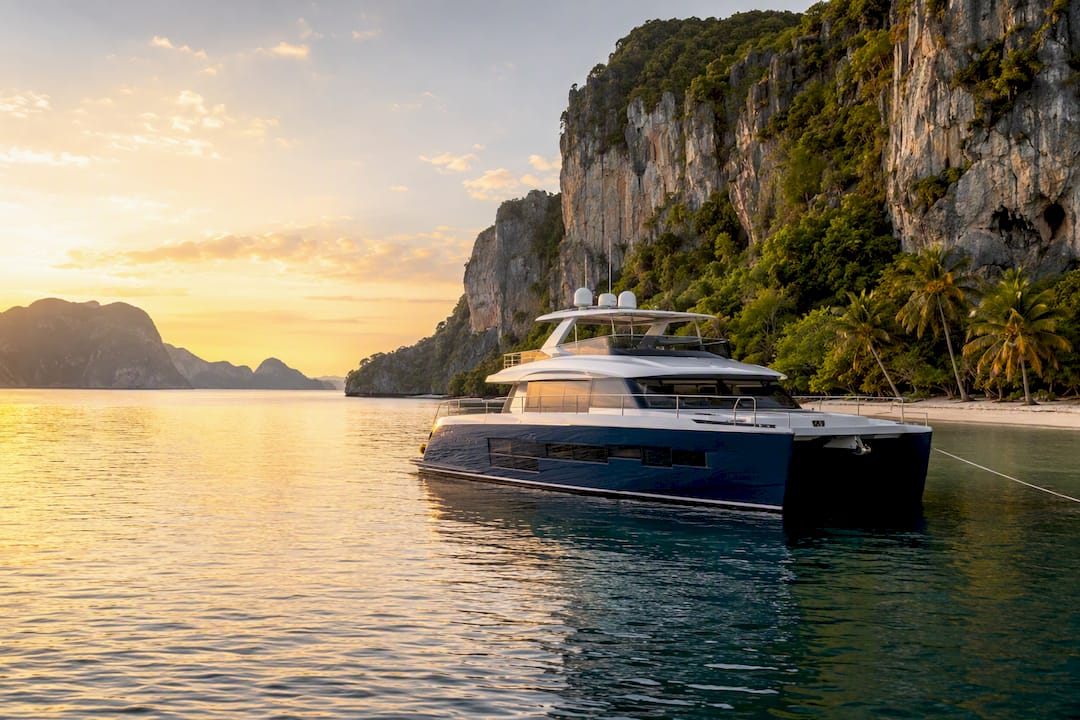

For affluent families and groups who want private, personalized island travel in the BVI and Caribbean, a private yacht charter, whether crewed or bareboat, beats staying on land and taking public ferries or private water taxis every time. Virgin Charter Yachts has run this exact comparison for clients since 1996: a water taxi or day boat gets you from point A to point B, but a chartered power catamaran gets you an entire archipelago on your own schedule. The math usually works out the same or better for groups who’d otherwise be paying for multiple water taxi runs and hotel rooms anyway. What follows covers what’s actually included, who it fits best, real cost breakdowns, and how to book one without the usual guesswork.
Key Takeaways
A private yacht charter beats scheduled water taxis and ferries for affluent groups because it trades a fixed timetable for total control over itinerary, privacy, and comfort.
| Point | Details |
|---|---|
| Charter over scheduled transport | A private yacht gives your group route control that no fixed ferry or taxi schedule can match. |
| Match yacht size to your group | Crewed catamarans sleeping 8 to 12 guests suit most multi-family or celebration trips. |
| Book early for peak season | Reserve months ahead for winter holidays and spring break to secure the yacht you want. |
| Choose a local, established operator | Virgin Charter Yachts offers a fleet from Fountaine Pajot, Leopard, Aquila, Aventura, Lagoon, Horizon, and Two Oceans with extensive Tortola-based crew expertise. |
Table of Contents
- What Does a Luxury Yacht Charter Actually Include?
- Who Actually Benefits Most From a Private Charter?
- What Does a Private Yacht Charter Actually Cost?
- How Far Ahead Should You Book, and What Should You Ask?
- Is a Yacht Charter Safe and Comfortable for Everyone?
- Why a Private Charter Beats an Island-Hopping Itinerary
- Water Taxi, Ferry, or Private Charter: How Do They Actually Compare?
- Which Option Is Better for the Environment?
- How Often Do Water Taxis and Ferries Actually Run?
- How Far Can Each Option Actually Take You?
- How Do Payments and Cancellations Work for a Charter?
- An Operator’s View From Tortola
- How Virgin Charter Yachts Makes Booking Easier
- Frequently Asked Questions
- Sources
What Does a Luxury Yacht Charter Actually Include?
A private charter isn’t just a boat with a captain. It’s closer to a floating villa with a crew that anticipates what you need before you ask. A cabin or crewed charter typically means multiple double cabins, each with an en suite bathroom, daily meals built around your preferences, and a crew running the logistics so you don’t have to think about fuel, moorings, or weather routing.
The standard package on a crewed charter looks like this:
- A licensed captain, and on larger boats a professional chef and one or more deckhands
- Private cabins with climate control and dedicated bathrooms, not shared berths
- A fully provisioned galley, with meals planned around your group’s tastes and any dietary needs
- A climate-controlled saloon, onboard entertainment, and Wi-Fi (availability varies by yacht and location)
- A tender for shore transfers, plus water toys such as paddleboards, snorkel gear, and on some yachts, sea scooters or e-foils
Virgin Charter Yachts curates its fleet from builders known for comfort and reliability at sea, including Fountaine Pajot, Leopard, Aquila, Aventura, Lagoon, Horizon, and Two Oceans. Each brand handles slightly differently, but all are chosen for stable, well-maintained power catamarans suited to family groups rather than performance sailing.
Who Actually Benefits Most From a Private Charter?
A charter earns its cost fastest for groups who’d otherwise be splitting into separate cabs and separate rooms anyway. Multi-family reunions, milestone celebrations, and multigenerational trips are the classic fits, since everyone stays together, eats together, and moves together without coordinating four different bookings.
Capacity matters here. Most crewed power catamarans comfortably sleep 8 to 12 guests across four to six cabins, which is the sweet spot for extended families or two or three couples traveling together. Smaller groups or confident sailors sometimes go bareboat, skipping the crew and captaining the vessel themselves; larger, more hands-off groups almost always do better crewed.
Seasickness deserves an honest mention. Power catamarans sit more stable in the water than monohulls, and a good captain plans short hops between protected anchorages rather than long open-water passages, which cuts down on discomfort for guests who are prone to it.
What Does a Private Yacht Charter Actually Cost?
Base fees for a crewed catamaran in the Caribbean commonly land in the low five-figure weekly range, with motor yachts running higher depending on size and crew. That base fee is only part of the picture, and it’s the part most first-time charterers underestimate.
The Advance Provisioning Allowance (APA) is a pooled deposit, usually paid upfront, that covers fuel, food, drinks, dockage, and other running costs during the trip. It gets reconciled at the end, and unused funds are typically refunded. Many yachts in the BVI actually price as 'all-inclusive' to make it easy for customers and guests to know the cost ahead of time. Since the Islands in the BVI are close together, the fuel is less variable than in locations like the Bahamas or the Mediterranean. This allows most catamarans to offer an 'all-inclusive' price that includes the yacht, all food and beverages, alcohol, fuel, permits etc. and no APA is collected. The all-inclusive rate does not include the recommended 15-20% crew gratuity.
| Line Item | What It Covers |
|---|---|
| Base charter fee | The yacht, crew, and standard equipment for the charter period |
| APA (Advance Provisioning Allowance) | Fuel, food, drinks, moorings, and day-to-day operational costs |
| Crew gratuity | Discretionary, typically calculated as a percentage of the base fee |
| Marina and permit fees | Docking, park fees, and local charges depending on itinerary |
Split across a group of typical charter guests, the per-person cost often compares favorably to a comparable stretch at a luxury resort, especially once you account for meals, water toys, and private transport that would otherwise be booked separately.
How Far Ahead Should You Book, and What Should You Ask?
Book early. Peak-season weeks (the winter holidays and mid-March spring break in the BVI) fill fast, and the most popular yachts in a fleet get reserved months out. If you have specific dates locked for a family event, start the conversation with your operator as soon as you can.
The BVI works especially well for this kind of trip because of its short passages, protected waters, and dense network of mooring balls, which means less time transiting and more time anchored somewhere worth anchoring. Once you’re aboard, the tender handles the rest, ferrying you to beach bars and coves that a scheduled boat would never reach.
Before you commit to a booking, work through this checklist with your broker or operator:
- Confirm exactly who’s included in the crew rate: captain only, or captain plus chef and deckhand
- Ask how the APA is calculated, collected, and reconciled at the end of the trip. Also find out if your yacht offers an all-inclusive pricing option.
- Get the cancellation policy in writing, including any weather-related contingencies
- Ask whether trip insurance covers the security deposit deductible
- Clarify which water toys are included versus available as paid add-ons
- Confirm airport transfer arrangements and your pickup point in Tortola or elsewhere
- Check whether any local permits or park fees apply to your planned itinerary
Is a Yacht Charter Safe and Comfortable for Everyone?
Comfort and safety questions come up constantly, especially from families with kids or older relatives who’ve never chartered before. The good news: a well-run charter addresses most of these concerns before you even step aboard.
Ask your operator directly about crew certifications, insurance coverage and deductible amounts, emergency procedures, and how they handle weather-related itinerary changes. A reputable, established operator will answer all of this without hesitation.
- Power catamarans offer a stable, flat platform that reduces motion compared to a monohull
- Short hops between protected anchorages limit time spent in open water
- Onboard medical kits are standard, and crews are trained in basic emergency response
- En suite bathrooms and air conditioning are standard on crewed cabin charters
Pro Tip: If seasickness is a concern for anyone in your group, request a cabin toward the center of the yacht, where motion is least pronounced, and pack over-the-counter motion sickness medication before you leave home rather than trying to find it on the island.
Why a Private Charter Beats an Island-Hopping Itinerary
Three scenarios show the gap clearly. A family reunion spread across three generations needs flexibility that a fixed ferry schedule can’t offer, since nap times, mobility limits, and everyone’s must-see beach rarely line up with a timetable. A milestone celebration, a fortieth birthday or an anniversary, benefits from a private crew who can plan a surprise dinner anchorage without a stranger overhearing the plan. A multi-stop reef-hopping trip rewards a captain who knows which cove is calm today and which one to skip because the swell picked up overnight.
- Family reunions gain from itinerary control that adjusts around kids, elders, and everyone’s pace
- Celebration trips benefit from private tenders and a crew that can plan around a surprise
- Reef-hopping groups get local knowledge on which anchorages are calm on any given day
One TravelPulse writer described a BVI cabin charter as delivering the intimacy of a private trip with the service level of a boutique hotel, a comparison that captures why groups keep choosing charters over resort stays. Route flexibility means you’re never locked into a single dock, and if the wind or crowds shift, the captain simply moves you somewhere better.
Water Taxi, Ferry, or Private Charter: How Do They Actually Compare?
Public water transport in the Caribbean serves a real purpose: getting a solo traveler or a couple from one port to another cheaply and on a fixed schedule. That’s the entire value proposition, and it’s a narrow one once you’re traveling as a group with specific preferences.
A scheduled ferry runs a fixed route at a fixed time, with a set drop-off point you don’t control. There’s no ability to linger at a beach you love or skip one that’s crowded, and your luggage travels with everyone else’s. A private charter flips every one of those constraints. You set the route, you decide how long to stay anchored off any given cay, and the crew adjusts the plan in real time based on weather or a group member’s request.
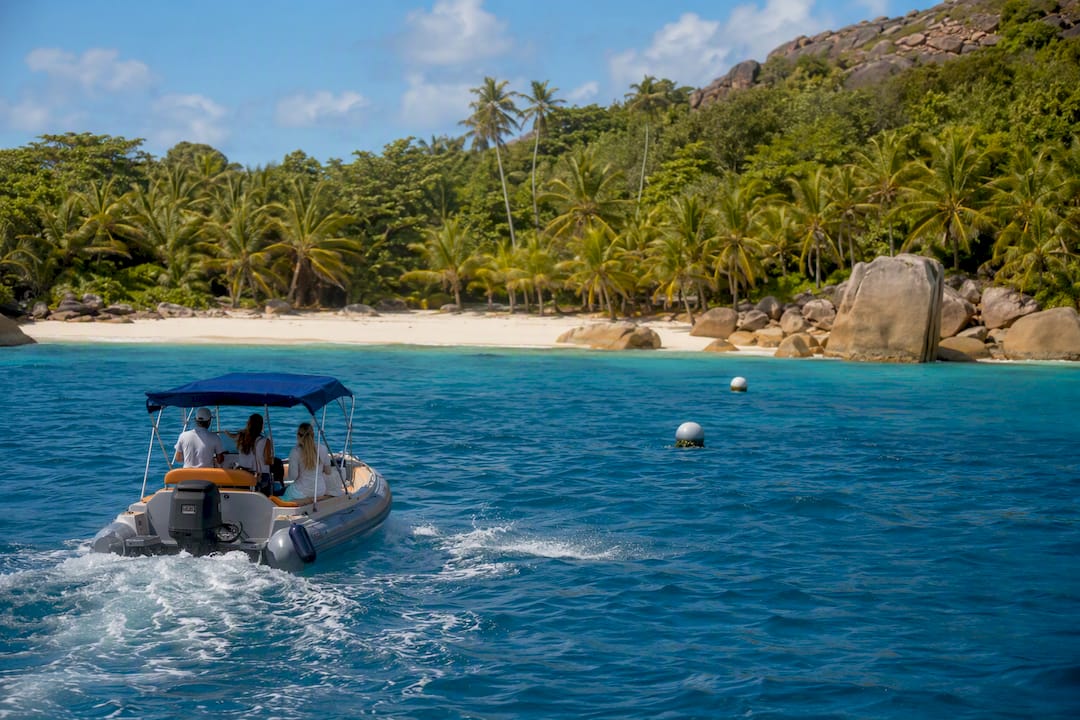
The cost comparison isn’t as lopsided as it first appears, either. A family of eight paying for water taxi fares, ground transfers, and multiple hotel rooms across a week can easily approach what they’d pay for a single chartered catamaran that includes lodging, meals, crew, and transport in one package. The difference is what you get for that spend: a scheduled service gets you somewhere, while a charter gets you an experience built entirely around your group’s preferences, with privacy that a shared ferry cabin simply can’t replicate.
Where scheduled transport wins is simplicity for a single short hop between two developed ports. Where it loses, decisively, is anywhere your plans require flexibility, privacy, or a group larger than a couple.
Which Option Is Better for the Environment?
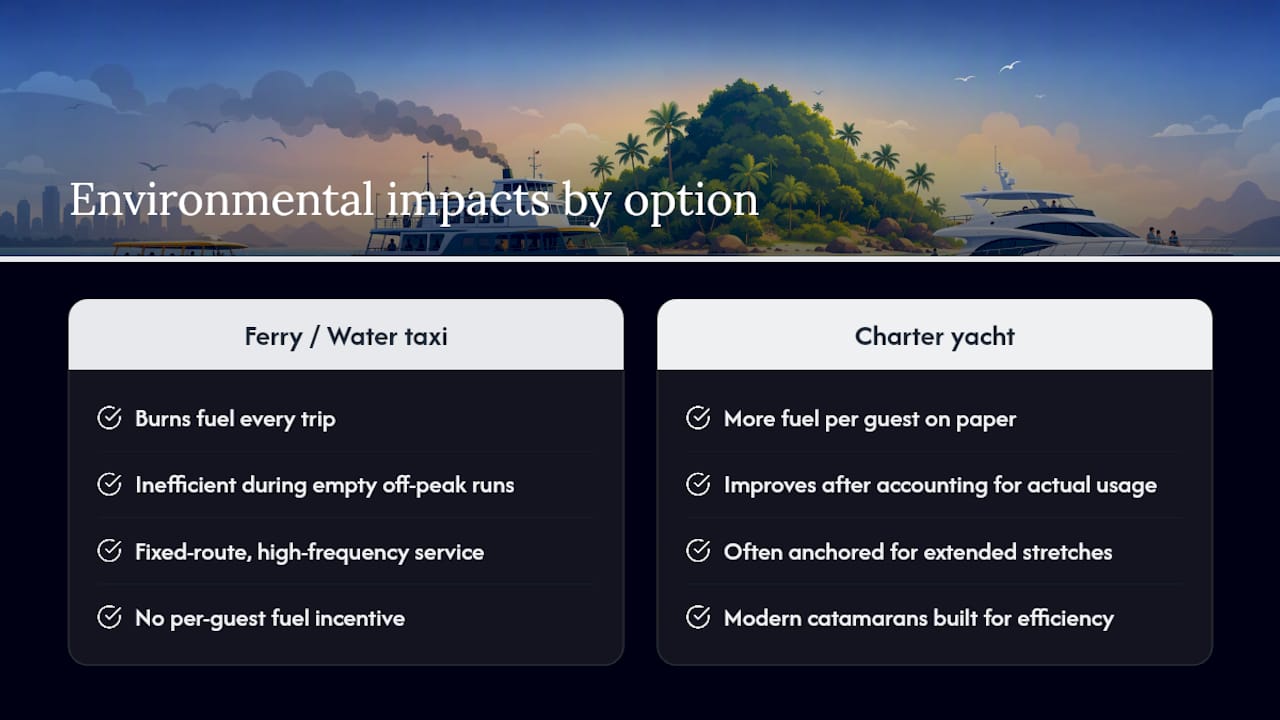
Environmental impact scales with vessel size, fuel efficiency, and how a route is used, and none of the three options is automatically the cleanest choice. A scheduled ferry or water taxi running a fixed route at high frequency burns fuel per trip regardless of how full it is, and empty or near-empty runs during off-peak hours are common inefficiencies in public schedules.
A private charter uses more fuel per guest on paper if a yacht carries fewer passengers than a full ferry, but the comparison shifts once you account for actual usage. A chartered catamaran typically stays anchored for extended stretches rather than running continuous back-and-forth routes, and modern power catamarans built by manufacturers like Fountaine Pajot and Lagoon are designed with efficiency in mind, since fuel costs come directly out of the APA that guests are paying.
Anchoring practices matter more than most travelers realize. A well-run charter uses established mooring balls rather than dropping anchor on reef systems, protecting the same coral ecosystems that make BVI snorkeling worth the trip. Ask your operator whether they follow local mooring guidelines. It’s a fair question, and any reputable operator will have a clear answer.
None of this makes one mode of transport a clear environmental winner across the board. What matters more practically for a group traveling together is that a single chartered yacht consolidates what would otherwise be several separate taxi trips, hotel stays, and transfers into one vessel and one itinerary.
How Often Do Water Taxis and Ferries Actually Run?
Scheduled service in the BVI and neighboring islands typically operates on a handful of daily departures between major ports, with frequency dropping off significantly in the off-season and on smaller, less-trafficked routes. Peak-season schedules run more often, but even then, most routes offer only a few fixed departure windows per day rather than continuous service.
This creates a real planning constraint for groups. Miss a departure and you’re waiting hours for the next one, and connecting between more than two islands in a single day on scheduled transport is often impractical. Weather cancellations compound the problem, since a single rough-water day can cancel a route entirely with little notice.
A private charter sidesteps the scheduling problem completely. There’s no timetable to catch because the yacht and crew are dedicated to your group for the full duration of the charter. If your plans change mid-trip, the captain adjusts. That flexibility is arguably the single biggest practical advantage a charter holds over any public alternative, especially for groups trying to see multiple islands in a limited number of days.
How Far Can Each Option Actually Take You?
Coverage area is where the gap between public transport and a private charter becomes most obvious. Scheduled ferries and water taxis run fixed routes between established ports, which means they only reach the handful of islands with the infrastructure to support regular passenger traffic.
A private charter isn’t limited to developed ports at all. The tender that comes standard on most crewed charters gets guests to secluded coves and beach bars that scheduled services simply can’t reach, since there’s no dock or infrastructure required. The BVI’s dense network of protected anchorages and mooring balls means a charter yacht can visit far more of the archipelago in a week than scheduled transport could cover in the same time.
Route flexibility compounds this advantage. A ferry passenger commits to a destination before leaving the dock. A charter guest can decide that morning to skip a planned stop because a captain heard the snorkeling is better two coves over, and simply go. For groups trying to actually explore an island chain rather than check a few ports off a list, that flexibility is the entire point of chartering in the first place.
How Do Payments and Cancellations Work for a Charter?
Most operators structure payment in two parts: a deposit to secure the booking, typically due at the time of reservation, and the remaining balance due closer to the charter date. The Advance Provisioning Allowance is collected separately, usually shortly before departure, since it funds the trip’s actual running costs rather than the charter fee itself.
Cancellation terms vary by operator, so get this in writing before you pay a deposit. Ask specifically about the cutoff dates for a full or partial refund, what happens if a hurricane or named storm affects your travel window, and whether the operator requires or recommends travel insurance that covers charter deposits. Many charter guests purchase separate insurance specifically to cover the security deposit deductible in case of an unexpected cancellation or early return.
Payment methods typically include wire transfer and credit card, though credit card payments sometimes carry a processing fee that wire transfers avoid. If you’re booking during peak season, expect a shorter window between deposit and final payment than you’d get for an off-season charter, simply because operators are managing tighter turnaround between bookings on their most popular yachts.
An Operator’s View From Tortola
Virgin Charter Yachts has operated as a family-owned business based in Tortola for three decades, working directly with charter groups rather than through a distant call center.
That local presence shapes how bookings get handled: knowing which anchorage is calm on a given day, which yacht in the fleet suits a specific group size, and how to reconcile an APA fairly at the end of a trip.
For groups who want the Caribbean on their own terms rather than a ferry’s terms, a private charter run by people who actually live there remains the recommendation.
How Virgin Charter Yachts Makes Booking Easier
Virgin Charter Yachts is the alternative to guessing your way through brokers and fleet websites: one Tortola-based team that knows every yacht in its own fleet personally, rather than reselling charters on boats it’s never stepped aboard.
That fleet spans Fountaine Pajot, Leopard, Aquila, Aventura, Lagoon, Horizon, and Two Oceans, so whether you want a crewed catamaran with a chef planning every meal or a bareboat charter you captain yourselves, there’s a yacht sized and equipped for your group. The team handles pricing questions, and itinerary planning before you ever set foot on the dock, and thirty years of local knowledge means your captain knows which cove to pick on any given day, not just which ones are on a map.
If you’re planning a family reunion, a milestone celebration, or simply want island time without a ferry schedule dictating your days, request a quote and check yacht availability directly with the Virgin Charter Yachts team before your preferred dates fill up.
Frequently Asked Questions
Is a private yacht charter more expensive than taking water taxis and ferries between islands/hotels? Per fare, yes. Per group experience across a full week, often not by much once you add hotel rooms, meals, and multiple taxi transfers that a charter already includes in one price.
What’s the real difference between bareboat and crewed charters? Bareboat means your group captains the yacht yourselves, which suits experienced sailors and smaller parties. Crewed means a licensed captain and often a chef run the trip, which fits larger groups and anyone who wants a hands-off vacation.
How far in advance should I book a charter for the BVI? Book several months ahead for winter holiday or spring break dates, since the most popular yachts in any fleet reserve out early.
Are private charters safe for people prone to seasickness? Power catamarans offer a stable platform, and a good captain plans short hops between protected anchorages to minimize motion, which helps most guests significantly.
Sources
- Crewed Yacht Charter Caribbean: 2026 Costs & Destinations | GetBoat Blog
- Choosing Sea Over Suite: Exploring the British Virgin Islands on a Cabin Charter | TravelPulse
- Luxury Crewed Catamaran Charter in the British Virgin Islands - Eat Drink Vacation Repeat
Did You Know?
The BVI are only accessible by boat. Check out our charter yachts that can get you there. View Our Fleet