
You can charter a yacht and stay comfortable even if motion sickness worries you. The strategy is straightforward: start preventive medication before you board, rest and hydrate for 24–48 hours beforehand, choose a catamaran or stabilizer-equipped vessel, and tell your captain upfront. Most guests who follow these steps sail without significant disruption, and those who do feel queasy on day one typically adapt within 24–72 hours.
The five things to do right now if you are concerned about seasickness:
- Start your chosen medication on schedule before departure, not after nausea hits. Prevention is dramatically more effective than treatment once symptoms begin.
- Sleep well and hydrate for the 48 hours before boarding. Fatigue and dehydration are the two biggest amplifiers of motion sickness.
- Book a catamaran or stabilizer-equipped motor yacht. The stability difference compared to a monohull is substantial for sensitive guests.
- Sit or stand mid-ship on deck, fix your gaze on the horizon, and breathe fresh air the moment you feel off.
- Tell the captain before you leave the dock. An experienced skipper can adjust the route, timing, and your position on the boat.
Charter is still the right call with these precautions. The vast majority of guests stay comfortable, and the ones who struggle early almost always find their sea legs within a couple of days.
Key Takeaways
Preventive medication started before boarding, combined with a catamaran or stabilizer-equipped vessel and early communication with your captain, gives motion-sensitive guests the best chance of a comfortable charter from day one.
| Point | Details |
|---|---|
| Start medication before boarding | Preventive meds taken before exposure are far more effective than treatment once nausea begins. |
| Hydrate and rest for 48 hours | Fatigue and dehydration amplify susceptibility; arrive at the dock rested and well-hydrated. |
| Choose a catamaran | Catamarans roll significantly less than monohulls and are the top recommendation for motion-sensitive guests. |
| Get on deck and fix the horizon | Fresh air, a distant horizon, and mid-ship seating are the fastest effective onboard interventions. |
| Virgin Charter Yachts | The fleet of power catamarans and local BVI routing expertise is specifically suited to guests who want stable, comfortable passages. |
Table of Contents
- Why seasickness happens on a yacht charter
- What to do in the 24–48 hours before you board
- Anti-nausea medications that charterers actually use
- Natural remedies and devices: what the evidence actually shows
- What to do on deck when nausea starts
- How boat and route choices change your seasickness risk
- How to talk to your captain about seasickness
- Medical warnings and when to get help
- Virgin Charter Yachts plans charters with stability in mind
- Sources
Why seasickness happens on a yacht charter
Seasickness is a sensory conflict: your inner ear detects motion, but your eyes, fixed on a stationary cabin wall or a phone screen, report that nothing is moving. The brain receives contradictory signals and responds with nausea, sweating, and dizziness.
The technical term is vestibular mismatch. Your brain is constantly predicting what the next moment of movement will feel like based on what it sees and feels. When those predictions fail repeatedly, the system throws an error, and that error feels like nausea. This is exactly why being below deck is so much worse than being on deck: below, your eyes see a still room while your body rolls with every wave.
The good news is that the brain adapts. Continuous exposure over 24–72 hours typically results in a marked reduction of symptoms for most people, particularly on charters with anchored overnights that give the vestibular system a nightly reset. A noticeable share of people experience significant seasickness on their first ocean passage, but that number drops sharply by day two or three. The tactics that work, including looking at the horizon, steering, and breathing fresh air, all reduce the sensory gap the brain is trying to reconcile.
What to do in the 24–48 hours before you board
The single most important pre-charter rule: start your medication before motion exposure begins, and arrive at the dock rested and hydrated. Medication taken after nausea starts is far less effective, and a dehydrated, sleep-deprived body is far more vulnerable.
48 hours before departure:
- Sleep at least 7–8 hours each night. Skip the late-night pre-trip celebrations.
- Drink 2–3 liters of water per day, especially in warm Caribbean climates where you are already losing fluids.
- Eat light, low-fat meals. Avoid heavy, greasy, or spicy food the night before sailing.
- Cut back on alcohol. Even one heavy night raises susceptibility the next day.
The morning of departure:
- Eat a light breakfast before taking oral medications. An empty stomach makes side effects worse.
- Take dimenhydrinate (Dramamine) 30–60 minutes before boarding, or meclizine (Bonine) 1 hour before, or the night before for an early departure.
- Apply a scopolamine patch 4–8 hours before you expect to be underway, ideally the evening before a morning departure.
- Pack ginger candies or capsules, Sea-Bands, a spare set of any prescription meds, rehydration salts, plastic bags, a light jacket, and motion-friendly snacks like crackers or pretzels.
Pro Tip: Talk to your physician before the trip, not the morning you leave. Prescription scopolamine patches require a doctor’s visit, and your doctor can flag any interactions with other medications you take. If you are traveling to the BVI or Caribbean, confirm that any controlled medications are properly labeled and documented for travel.
Fatigue and dehydration are the two factors most guests underestimate. Arriving at the dock after a red-eye flight or a long night out is one of the most reliable ways to guarantee a rough first day on the water.
Anti-nausea medications that charterers actually use
Prevention before exposure is the core rule. The most effective medications for seasickness on a yacht charter are meclizine, dimenhydrinate, the scopolamine patch, and, for those seeking newer options, tradipitant. Each has a different timing window, side-effect profile, and availability in the United States.
Harvard Health summarizes the key options and their timing, and notes that the scopolamine patch carries an FDA heat-related caution: in hot environments, the patch can deliver more medication than intended, raising the risk of side effects.
| Medication | When to take it | Typical dose / duration | Prevention vs. treatment | Common side effects | U.S. availability |
|---|---|---|---|---|---|
| Dimenhydrinate (Dramamine) | 30–60 min before boarding | every 4–6 hours | Strong for prevention; moderate for treatment | Drowsiness, dry mouth | OTC |
| Meclizine (Bonine / Antivert) | 1 hour before, or night before | once daily | Strong for prevention; moderate for treatment | Mild drowsiness, dry mouth | OTC |
| Scopolamine patch (Transderm Scop) | 4–8 hours before exposure | One patch behind the ear; lasts 72 hours | Strongest for prevention; limited once sick | Dry mouth, blurred vision, drowsiness, heat sensitivity | Prescription |
| Tradipitant (Nereus) | As directed by physician | Per prescription | Prevention and treatment; newer clinical data | Nausea, headache (generally well tolerated) | Prescription (FDA approved) |
A few practical points for multi-day charters. Set phone reminders for re-dosing oral medications, since it is easy to lose track of time on the water. Store all medications in a labeled, waterproof bag in your cabin. Scopolamine patches should be kept away from heat sources and direct sunlight, and you should wash your hands thoroughly after handling one to avoid accidental eye contact, which causes temporary pupil dilation.
Meclizine is the most popular choice among experienced charterers because it causes less drowsiness than dimenhydrinate and only requires one daily dose. Dimenhydrinate is widely available and works well, but the sedation can be significant, especially in the heat. The scopolamine patch is the strongest preventive option and is worth discussing with your doctor if you have a history of severe motion sickness.
Tradipitant received FDA approval for motion sickness and represents a newer mechanism of action. It is worth asking your physician about if other options have not worked well for you in the past.
Natural remedies and devices: what the evidence actually shows
Several low-risk remedies can help some people, but the evidence is genuinely mixed, and none of them match the effectiveness of prescription or OTC medications for prevention. Think of them as useful additions to your kit, not replacements.
Ginger is the most evidence-supported natural option. It works best as a preventive rather than a cure, and the forms that are easiest to carry on a charter are ginger capsules (typically 500–1,000 mg taken 30–60 minutes before departure), ginger chews, or crystallized ginger. Ginger ale with real ginger content can help settle mild nausea once it starts. Evidence rating: moderate.
Peppermint in the form of tea, hard candy, or essential oil on a cloth can ease mild nausea for some people. The mechanism is not fully understood, but it is low-risk and easy to pack. Evidence rating: limited but low-risk.
Acupressure wristbands (Sea-Bands) apply pressure to the P6 (Nei-Kuan) point on the inner wrist. Sea Tow’s guidance notes that evidence for wristbands is mixed, but they are inexpensive, drug-free, and worth trying, especially for guests who cannot take medications. Evidence rating: mixed.
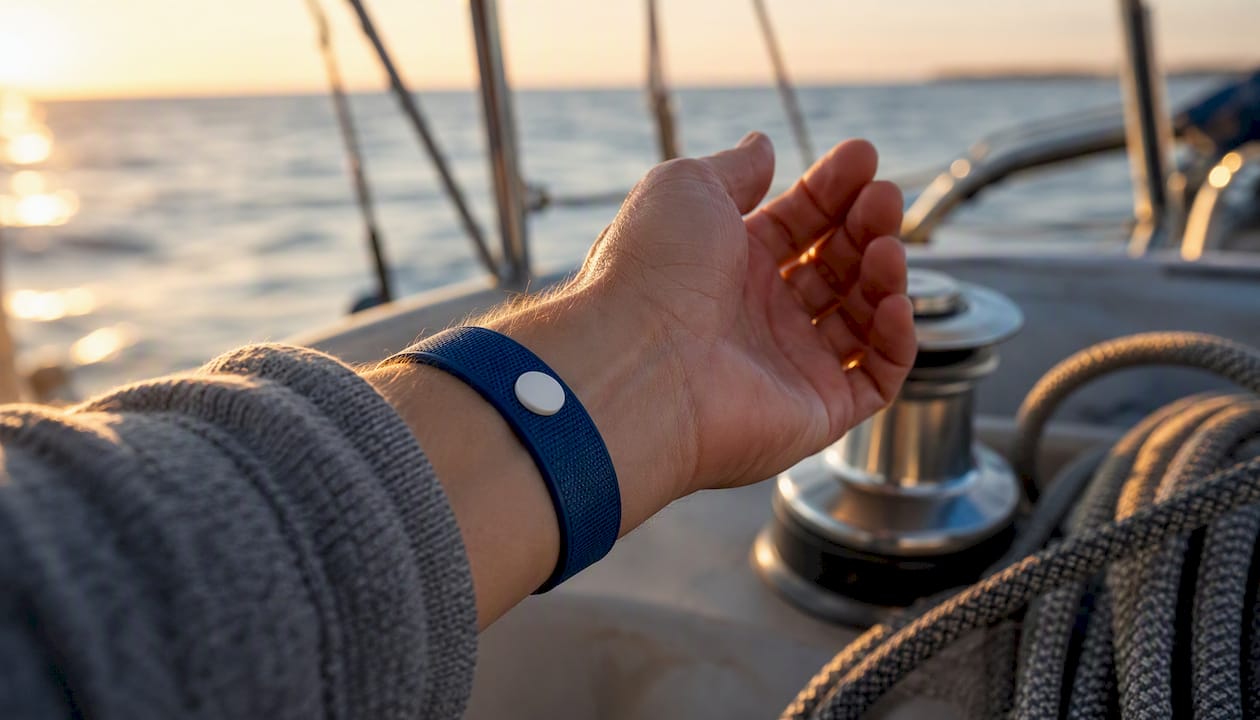
Reliefband is a neuromodulation wristband that delivers mild electrical pulses to the median nerve at the P6 point. It is available OTC in the United States and costs more than a standard Sea-Band. Some users report meaningful relief. Evidence rating: mixed, but stronger than passive acupressure for some individuals.
Motion-sickness glasses (artificial horizon glasses with colored liquid in the frames) have been marketed as a drug-free solution. A small trial published in 2026 showed no clear benefit over placebo. They are low-risk and inexpensive, but the evidence does not support relying on them as a primary strategy.
Pro Tip: Combine ginger and a Sea-Band or Reliefband with your chosen medication rather than substituting for it. On a multi-day charter, having multiple tools in your kit means you are not scrambling if one approach stops working.
Keep ginger candies and wristbands in a small pouch in your day bag, not buried in a cabin locker. When nausea starts, you want them within reach in seconds, not minutes.
What to do on deck when nausea starts
The fastest effective immediate action is: get fresh air, fix your gaze on the distant horizon, keep your head still, and sip water. Do these first, before anything else.
Get on deck immediately
Going below when you feel sick is one of the most common mistakes. Below deck, the sensory conflict intensifies. Get to the cockpit or forward deck, sit or stand mid-ship near the waterline where motion is least pronounced, and face forward.
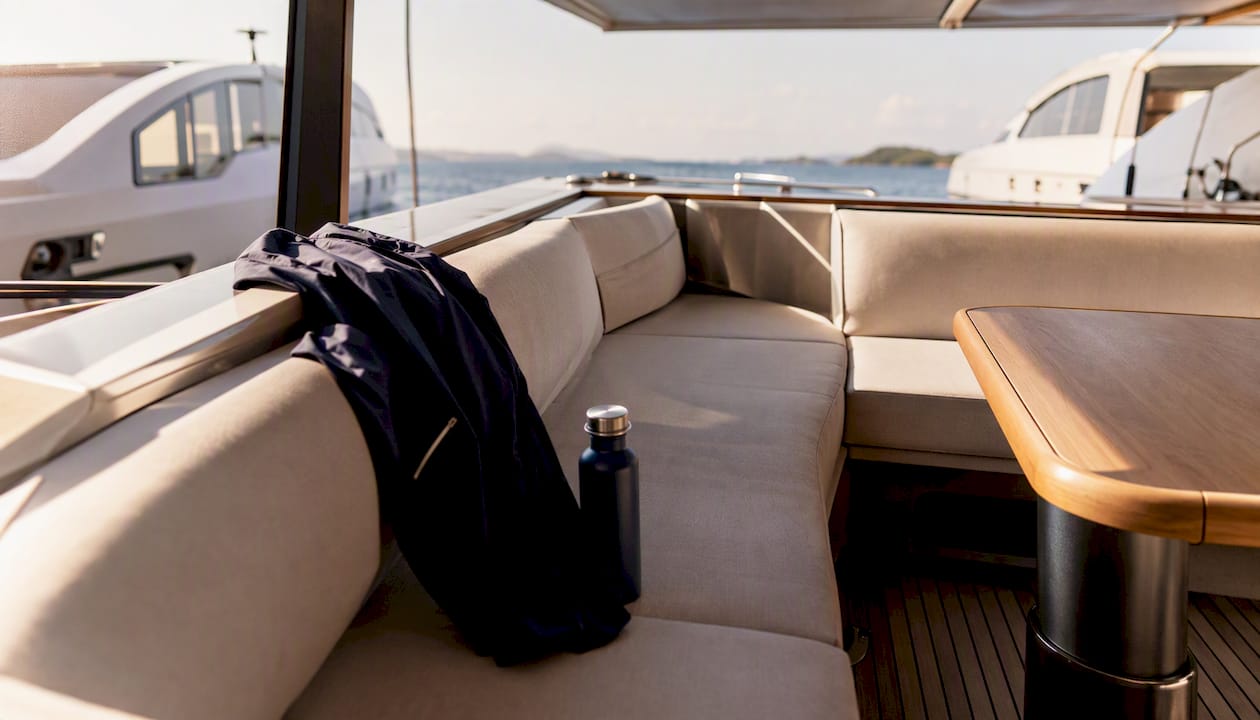
Fix your gaze on the horizon
A fixed, distant reference point gives your visual system the motion data your inner ear is already detecting. The mismatch shrinks, and symptoms often ease within minutes. NOAA confirms that fresh air and horizon focus are among the most effective immediate interventions available.
Offer to take the helm
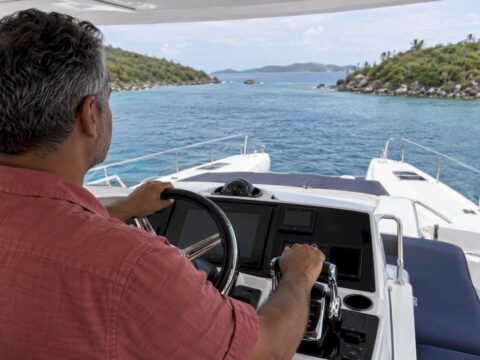
Steering reduces symptoms because directing the vessel lets your brain predict the next movement. When you are at the helm, your visual and vestibular systems finally agree. Ask the captain if you can steer for a while. Most skippers are happy to hand over the wheel.
Sip, don’t gulp
Small sips of water or flat ginger ale, plus a few plain crackers, help settle the stomach without overloading it. Avoid strong smells, sunscreen application below deck, and any screens.
Loosen clothing and cool down
A cool, damp cloth on the back of the neck or forehead helps. Overheating accelerates nausea. Loosen anything tight around your waist or chest.
If you vomit, rinse your mouth with water, sip slowly to rehydrate, and replace electrolytes with a rehydration sachet. After vomiting, most people feel temporarily better. Use that window to take a rescue dose of medication if your schedule allows, and tell the captain what happened.
Pro Tip: Do not wait until you feel terrible to act. The moment you notice the first hint of queasiness, get on deck. Catching symptoms early is far easier than reversing them once they escalate.
Recovery typically follows within 30–90 minutes of applying these steps in calm or moderate conditions. If symptoms persist beyond that window without improvement, consider an additional medication dose within the recommended schedule and ask the captain to head for a sheltered anchorage.
How boat and route choices change your seasickness risk
Boat and route selection are the highest-leverage decisions after medication. Choose a catamaran or a stabilizer-equipped motor yacht, and plan your first 48 hours around sheltered, shorter passages.
Catamarans roll far less than monohulls and are widely recommended for motion-sensitive guests. Their wide beam and twin-hull configuration provide greater initial stability and keep the boat level at anchor, which matters for overnight comfort. The tradeoff is bridge deck slamming in short, steep chop and reduced marina access in some ports, but for most BVI and Caribbean itineraries, neither is a significant issue.
| Vessel type | Typical roll / heel | Suitability for sensitive guests | Common charter size | Key tradeoffs |
|---|---|---|---|---|
| Catamaran | Low; stays level at anchor | Excellent | 50 ft | Bridge deck slam in steep chop; wider berth needed |
| Monohull sailing yacht | Moderate to high; heels under sail | Moderate | 35 ft | More motion; lower cost in some markets |
| Stabilizer-equipped motor yacht | Very low with stabilizers active | Excellent | 45 ft | Higher fuel cost; stabilizers less effective at anchor |
Itinerary planning rules for sensitive guests:
- Keep initial sailing legs under 15 nautical miles for the first 48 hours.
- Schedule passages in the morning when trade wind seas are typically calmer.
- Avoid long open-water crossings in your first two days. In the BVI, the Sir Francis Drake Channel offers sheltered sailing with short legs between islands.
- Build in anchor stops and beach time. Time ashore resets the vestibular system and gives everyone a break from motion.
Before you book, ask:
- Does the vessel have stabilizers, and are they zero-speed capable?
- Which cabins are mid-ship? Request one.
- What is the captain’s typical routing for guests who are prone to motion sickness?
- What are the expected sea conditions for your charter dates?
For guests who want the smoothest possible experience, a captained catamaran charter removes the stress of helming and lets an experienced skipper make real-time routing decisions based on conditions and guest comfort.
How to talk to your captain about seasickness
An experienced skipper can materially reduce your risk. The key is telling them before you leave the dock, not after you are already green.
Skippers have a standard toolkit for managing motion-sensitive guests. They can choose routes that avoid exposed crossings, reef early to reduce heel and motion, time passages for the calmest part of the day, offer the helm to prone guests, and position guests mid-ship in the cockpit. None of these options are available if the captain does not know there is a concern.
Concrete questions to ask your charter company or captain before you confirm:
- “We have a guest who is prone to motion sickness. Can you recommend a vessel with stabilizers or a catamaran?”
- “What are the typical leg lengths on this itinerary, and can we adjust them?”
- “Does the boat carry any seasickness medication or rehydration supplies in the medical kit?”
- “What is your plan if conditions are rougher than expected on day one?”
What to say when you board: A simple “I tend to get seasick in rough conditions, so I wanted to flag it early” is enough. Experienced crews hear this regularly and will not make it awkward. They will point you to the best seat, keep an eye on conditions, and check in with you during passages.
Pro Tip: If you are booking a catamaran cruising charter and have a particularly sensitive guest in the group, mention it at the time of booking, not the day before departure. That gives the charter company time to match you with the right vessel and captain.
Crews can also support you with dry crackers, extra water, a cool cloth, and a steadying hand when moving around the boat. Do not be embarrassed to ask. Keeping guests comfortable is part of the job, and a good crew takes it seriously.
Medical warnings and when to get help
Common seasickness medications help most people, but they carry real contraindications. Consult your doctor before the trip if you are older than 60, pregnant, have cardiovascular disease, glaucoma, or cognitive concerns, or take anticholinergic, sedative, or antihistamine medications.
Scopolamine patch cautions: The FDA has issued a heat-related warning for Transderm Scop. In hot environments, the patch can release medication faster than intended, increasing the risk of confusion, rapid heart rate, and urinary retention. In the Caribbean heat, this is a genuine concern. Remove the patch if you develop confusion, agitation, or a racing heart, and seek medical attention. Never cut a scopolamine patch to reduce the dose.
Dimenhydrinate and meclizine both cause drowsiness and can impair judgment. Do not combine them with alcohol, sedatives, or other antihistamines. Older adults are more sensitive to anticholinergic effects, including confusion and urinary retention.
Tradipitant is newer and generally well tolerated in clinical trials, but it requires a prescription and physician guidance on interactions.
Severe or prolonged vomiting lasting more than 8–24 hours, signs of significant dehydration (dark urine, dizziness when standing, no urination for 8 hours), or any neurological symptoms (confusion, severe headache, slurred speech) require immediate medical attention. Do not wait to see if it passes. Contact local medical services or ask the captain to head to the nearest port with medical facilities.
Safety checklist for the charter:
- Store all prescription medications in their original labeled containers.
- Keep a written list of medications, doses, and any known allergies accessible to the captain.
- Know the location of the nearest medical facility on your itinerary before you depart.
- Carry oral rehydration salts and know how to use them.
If vomiting persists beyond 8 hours despite medication and rehydration, the captain should be informed and a plan made to reach shore. Medevac is available in the BVI and most Caribbean islands for serious cases, but it is rarely needed when symptoms are caught and managed early.
What actually works on real charters
The advice in this article is grounded in medical guidance and maritime experience, but there is one thing that does not show up in clinical summaries: most guests who are nervous about seasickness arrive expecting the worst and leave surprised by how manageable it was.
The combination that resolves the majority of cases is not complicated. Steering, horizon focus, and crew support end most episodes within an hour. The guests who struggle longest are almost always the ones who stayed below, said nothing to the captain, and skipped their medication because they felt fine at the dock. Prevention is not just more effective than treatment medically. It is also the difference between a trip you remember fondly and one you spend dreading the next passage.
Open communication with the captain is the fastest path to comfort. Skippers who know a guest is prone to motion sickness will route differently, time passages better, and check in proactively. That one conversation, before you cast off, is worth more than any single remedy in your kit. And for most guests, by day two or three, the concern has faded entirely.
Virgin Charter Yachts plans charters with stability in mind
Motion-sensitive guests are not an afterthought at Virgin Charter Yachts. The fleet is built around modern power catamarans from Fountaine Pajot, Leopard, Aquila, Lagoon, Aventura and other top builders, chosen specifically because their stability and comfort profile suits guests who want smooth, enjoyable passages rather than a test of their sea legs.
When you book with Virgin Charter Yachts, the team helps you match the right vessel to your group’s needs, including guests who are prone to motion sickness. They can recommend the most sheltered BVI itineraries, suggest the calmest morning departure windows, and connect you with an experienced captain who knows how to manage conditions and guest comfort in equal measure. The fleet has been based in Tortola for 30 years, and that local knowledge translates directly into smarter routing decisions on the water.
To start planning a charter built around your group’s comfort, visit Virgin Charter Yachts and reach out to the team directly.
Sources
The following sources informed the recommendations in this article:
- Remedies for motion sickness — what works (Harvard Health)
- What causes seasickness?
- Surviving seasickness: Remedies, tricks, and lessons learned (Cruising World)
- Sea Tow — Sea sickness: remedies, prevention tips & treatment
This article is general information, not a substitute for advice from a qualified doctor. Consult a qualified healthcare professional about your own circumstances before acting on anything here.
Did You Know?
The BVI are only accessible by boat. Check out our charter yachts that can get you there. View Our Fleet