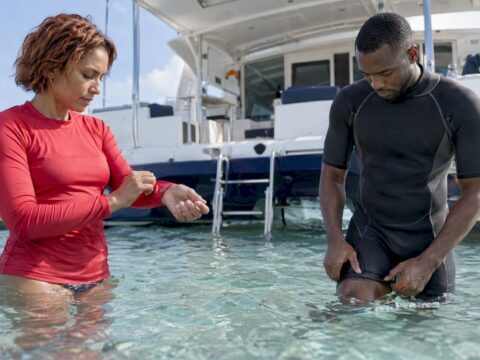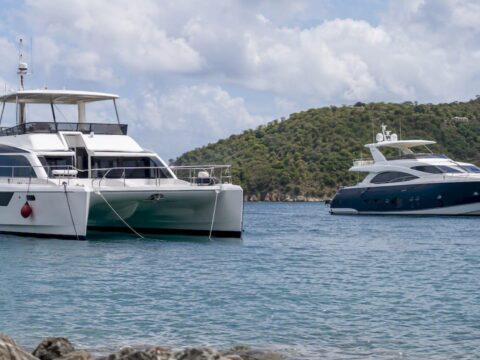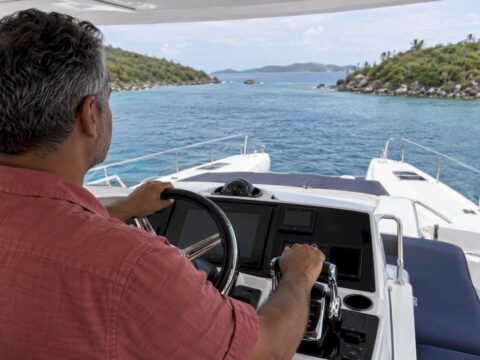

For most people and most outdoor situations, polarized lenses are the better default. They remove reflected glare from water, wet roads, and snow, which reduces eye strain and sharpens contrast in a way that a standard tinted lens simply cannot match. The main exceptions: pilots, heavy-equipment operators, and anyone who depends on LCD instrument displays should stick with non-polarized lenses, since polarization can darken or distort those screens at certain angles. Snow and fast-terrain sports are a gray area — more on that below.
One thing to get straight before anything else: polarization does not equal UV protection. A polarized lens without a UV400 rating can still let harmful ultraviolet light reach your eyes. Always check for UV400 or “100% UVA/UVB” on the label, regardless of which lens type you choose.
Table of Contents
- How does polarization actually work?
- What are the real benefits of polarized lenses?
- When do polarized lenses become a problem?
- Why would you choose non-polarized sunglasses?
- Which lens type should you pick for each activity?
- How can you test whether lenses are genuinely polarized?
- UV protection, mirror coatings, and what actually matters for your eyes
- Can you get polarized prescription lenses?
- What the research says about lenses for yachting and extended deck time
- Key Takeaways
- The lens choice most people get backwards
- Useful sources and further reading
How does polarization actually work?
Light from the sun scatters in all directions, but when it bounces off a flat, reflective surface — a lake, a wet highway, a car hood — it tends to align horizontally. That concentrated horizontal light is what you experience as blinding glare.
A polarized lens contains a chemical filter oriented vertically, like a microscopic venetian blind. It blocks that horizontal light while letting vertically oriented light through. The result: glare disappears, and the scene in front of you looks cleaner and more defined.
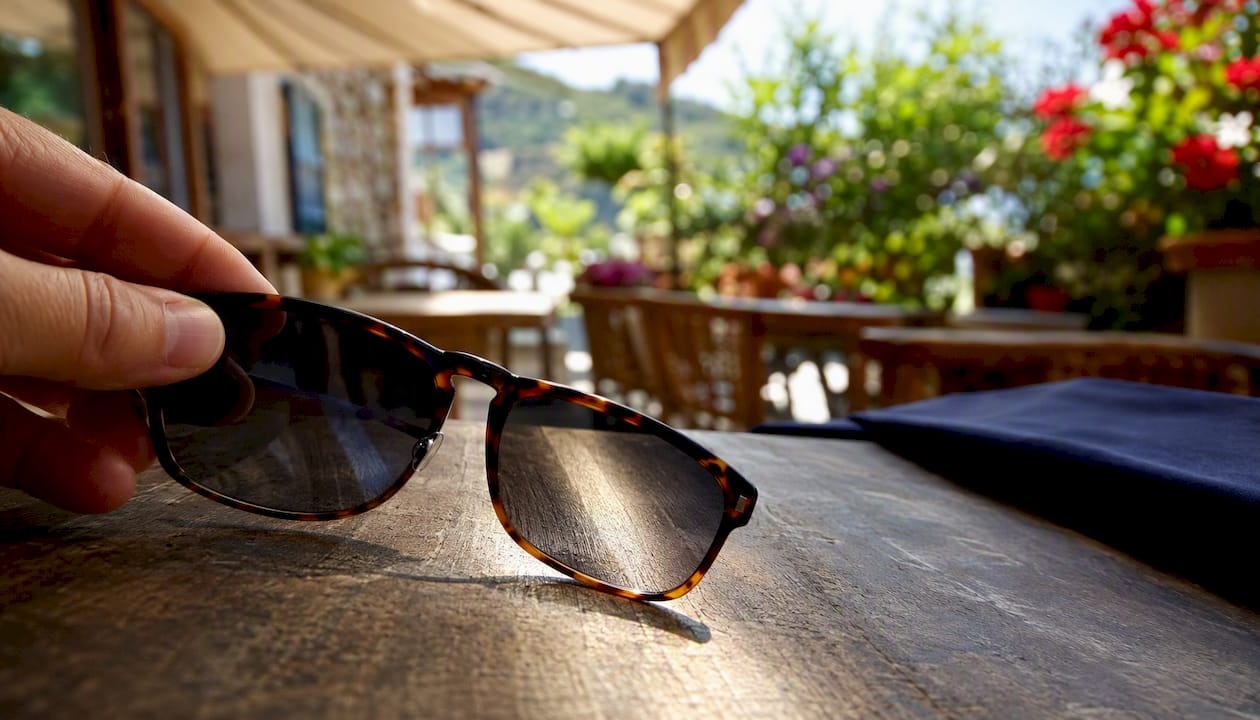
Non-polarized lenses work differently. They use a uniform tint that dims all incoming light by a fixed percentage. Glare is reduced somewhat, but the horizontally polarized component still gets through. You’re squinting less, but you’re not actually removing the problem.
Here’s a quick breakdown of what each approach does:
- Non-polarized: — Reduces overall brightness uniformly, preserves screen readability, keeps glare cues intact for certain sports
Pro Tip: If you’re shopping in-store, hold the lens up to a reflective surface (a glass counter or a window) and tilt it. A genuinely polarized lens will visibly darken as horizontal light is blocked. If nothing changes, the polarization is either weak or absent.
What are the real benefits of polarized lenses?
The primary payoff is glare elimination, but the downstream effects matter just as much. Polarized lenses improve color vibrancy and contrast and reduce eye strain for outdoor activities, making them the preferred choice for most people who drive regularly or spend time on the water.
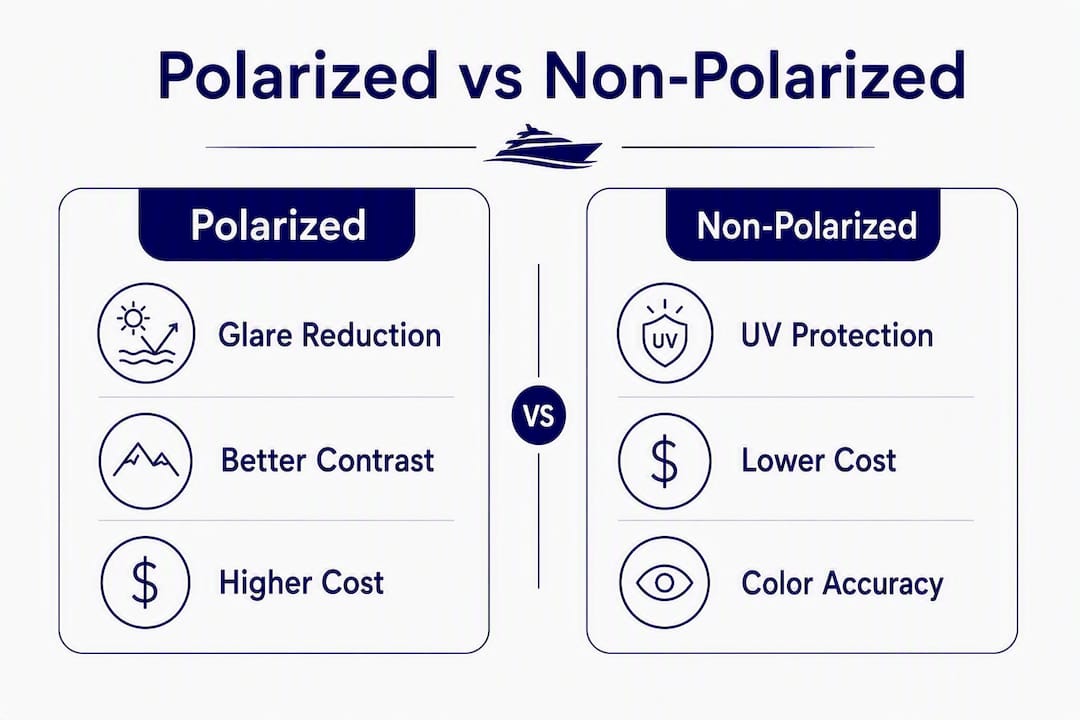
For fishing and boating, the difference is dramatic. Non-polarized lenses show you a mirror-like surface. Polarized lenses cut through that reflection and let you see below the waterline — fish, rocks, depth changes. If you’re looking for the best polarized lenses for fishing, this is the core reason they dominate that category.

On wet roads, polarized lenses remove the blinding reflection off standing water and oncoming headlight scatter. Drivers who switch from standard tints often describe the experience as “the road suddenly coming into focus.” Snow and ice present a more nuanced picture: polarization reduces surface glare, but it can also suppress the visual cues that tell you where a patch of ice begins. More on that in the limitations section.
Other benefits worth noting:
- Less squinting over a full day outdoors, which reduces fatigue headaches
- Improved depth perception on water (critical for docking or anchoring)
- Better color rendering in bright, high-contrast environments
- Reduced need to shade your eyes manually in open settings
On cost: polarized lenses typically run higher than comparable non-polarized options. That premium reflects the additional manufacturing step of embedding or laminating the polarizing filter. Budget pairs exist, but quality varies significantly — a point worth returning to when we cover testing.
When do polarized lenses become a problem?
The most common complaint is screen readability. Polarized lenses can make LCD and LED instrument displays harder to read, sometimes producing dark patches or distortion. This happens because many screens emit polarized light themselves, and when the screen’s polarization axis meets the lens’s filter at the wrong angle, the display goes dark or shows interference patterns.
Specific situations where polarized lenses cause real problems:
- Cockpit instruments and aviation: Pilots are routinely advised against polarized lenses. Attitude indicators, altimeters, and glass-panel avionics all use LCD technology that can become unreadable with polarized eyewear.
- Marine electronics: Chartplotters, depth sounders, and VHF radio displays can show dark patches or rainbow interference at certain viewing angles. Test your sunglasses with the vessel’s electronics before you rely on them for navigation.
- Some snow sports: Polarization suppresses the glare that experienced skiers use to read icy patches and terrain changes. Racers and backcountry skiers often prefer non-polarized lenses for exactly this reason.
- Night driving: Polarized lenses reduce overall light transmission. They are not suitable for low-light or night use — this applies to non-polarized dark tints as well, but it’s worth stating clearly.
Pro Tip: Cheap polarized sunglasses sometimes use a thin film that can peel or delaminate after a season of use. Some budget pairs aren’t genuinely polarized at all — the film is decorative. The testing section below shows you how to verify before you buy.
Why would you choose non-polarized sunglasses?
Non-polarized lenses have a real place in the market, and not just as a budget fallback. They keep LCD and instrument displays fully readable and preserve glare cues that are useful for some snow or fast-terrain sports, which makes them the smarter pick for pilots, heavy-equipment operators, and certain racers.
The practical case for non-polarized:
- Screen-dependent roles: Pilots, air traffic controllers, heavy-equipment operators, and outdoor technicians who read digital displays throughout the day need consistent, undistorted screen visibility.
- Fast-terrain sports: Downhill racers and mountain bikers who rely on glare cues to read the surface ahead often find non-polarized lenses give them more complete visual information.
- Fashion and everyday urban wear: For city use with minimal reflective surfaces, a quality non-polarized lens with UV400 does the job without the cost premium.
- Predictable tint behavior: Non-polarized lenses behave consistently across all viewing angles and screen types, which matters when you’re switching between outdoor and indoor environments frequently.
Here’s the safety angle that often gets missed: a non-polarized lens with a verified UV400 rating is safer for your eyes than a polarized lens without UV protection. Polarization is a comfort feature. UV400 is a health feature. Consumers should always verify UV protection regardless of polarization. If you’re choosing between a cheap polarized pair with no UV spec and a quality non-polarized pair with UV400, take the non-polarized option every time.
Which lens type should you pick for each activity?
The honest answer is that it depends on what you’re doing more than anything else. Here’s a direct breakdown:
| Activity | Best Choice | Why |
|---|---|---|
| Driving (daytime) | Polarized | Removes wet-road and windshield glare; improves contrast |
| Fishing / boating | Polarized | Cuts surface reflection; lets you see below the waterline |
| Skiing / snowboarding (casual) | Polarized | Reduces surface glare on open runs |
| Skiing / snowboarding (racing / backcountry) | Non-polarized | Preserves icy-patch cues and terrain reading |
| Cycling (road) | Polarized | Reduces road glare and oncoming reflection |
| Aviation | Non-polarized | Instrument readability is non-negotiable |
| Urban / everyday wear | Either (UV400 required) | Minimal reflective surfaces; personal preference |
| Extended time on deck (yachting) | Polarized + mirror coating | Manages both surface glare and midday brightness |
| Screen-heavy outdoor work | Non-polarized | Consistent display readability across all angles |
A simple decision rule: if your activity involves reflective surfaces (water, roads, snow) and you’re not reading instruments, choose polarized. If your activity involves screens, instruments, or reading terrain cues from glare, go non-polarized.
Retail guides consistently recommend a dual strategy: keep polarized for water and driving, and non-polarized for fashion, urban, or screen-heavy use. Owning both pairs is not overkill if your days switch between those contexts.
How can you test whether lenses are genuinely polarized?
Three reliable tests, no equipment required:
- The phone/LCD rotation test. Hold the lens up to your phone screen (brightness on full, white background). Slowly rotate the lens 90 degrees. If it’s genuinely polarized, the screen will darken noticeably at around 90 degrees. If nothing changes, the lens is not polarized. Do not perform this test while driving.
- The two-lens cross test. Hold two polarized lenses face-to-face and rotate one 90 degrees relative to the other. Genuine polarized lenses will block nearly all light when perpendicular — the overlap will go almost black. Non-polarized or fake polarized lenses won’t show this effect.
- The water-surface test. Stand near a pool, lake, or any reflective water surface. Look at the surface through the lens. A polarized lens will cut the reflection and let you see below the surface. A non-polarized lens will show you mostly reflection.
For UV verification, the test is simpler: look for “UV400” or “100% UVA/UVB protection” printed on the lens, tag, or case. A UV meter (available at most opticians) can verify the claim, but the label is the practical starting point. Ask the optician directly — any reputable retailer will confirm the UV spec without hesitation.
Pro Tip: When buying polarized prescription lenses, bring your phone and test the lenses with the actual screen you use most before the order is finalized. Some lens materials and coatings interact differently with specific screen types.
UV protection, mirror coatings, and what actually matters for your eyes
Polarization and UV protection are completely separate technologies. A polarized lens without UV400 can still allow harmful UV radiation through. UV400 blocks wavelengths up to 400 nanometers, covering both UVA and UVB. That’s the spec that protects against cataracts, macular degeneration, and photokeratitis. Polarization does none of that.
Mirror coatings are a third, independent technology. They work by reflecting light away from the outer lens surface, which reduces visible light transmission (VLT) before it even reaches your eye. Combined mirrored-polarized lenses are a high-performance option for open-water midday conditions: the mirror coating handles overall brightness, and the polarizing filter removes horizontal glare. The result is significantly more comfortable vision during peak sun hours on the water.
What to check when buying any pair of sunglasses:
- UV400 or 100% UVA/UVB — non-negotiable for eye health
Pro Tip: Gray lenses render colors most accurately. Brown and amber lenses boost contrast and warm the color palette, which many anglers and drivers prefer. Neither is “better” — it depends on whether you want true color or enhanced contrast.
Lens tint color affects how you perceive the world but has no bearing on UV protection or polarization effectiveness. Choose tint based on your primary activity and personal preference.
Can you get polarized prescription lenses?
Yes, and it’s more accessible than it used to be. Most optical labs offer polarized lenses in single-vision, progressive, and bifocal prescriptions. Lead times are typically longer than standard lenses — often a week or more — and the cost premium over non-polarized Rx lenses is real but not prohibitive.
Key considerations for prescription polarized lenses:
- Progressives and bifocals: Polarized film must align precisely with the lens geometry. Off-axis polarization in a progressive lens can create distortion at the reading zone. Work with an optician experienced in polarized progressives.
- High-index lenses: Polarized film bonds differently to high-index materials. Ask specifically about delamination warranties for high-index polarized pairs.
- Photochromic (Transitions) + polarization: Some lens lines combine both technologies. The trade-off is activation speed — photochromic lenses take time to darken and lighten, while polarization is always on. In a car, photochromic lenses often don’t darken fully because windshields block UV activation. A dedicated polarized pair usually outperforms a photochromic-polarized combo for driving.
Practical advice: before committing to an Rx polarized order, test a non-prescription polarized lens with your phone, your car’s GPS, and any instrument displays you use regularly. If those pass, the prescription version will behave the same way optically.
What the research says about lenses for yachting and extended deck time
For anyone spending long hours on the water, the lens choice has a direct impact on both comfort and safety. Combining polarized lenses with a mirror coating is often optimal for Caribbean yacht charter conditions: polarization removes surface glare while the mirror coating manages the intense midday brightness that open-water settings produce.
The trade-off comes with marine electronics. Chartplotters, depth sounders, and navigation displays can show dark patches or rainbow interference when viewed through polarized lenses at certain angles. Captains and crew should test their sunglasses against the vessel’s specific electronics before relying on a single pair for navigation.
Practical recommendations for time on deck:
- Carry two pairs: polarized-mirrored for open-deck hours, non-polarized for instrument-reading at the helm
- Test your polarized lenses against the chartplotter and VHF display before departure
- Rotate your phone to different angles to confirm readability through your lenses
- Prioritize UV400 in both pairs — reflected UV off water is significantly more intense than on land
Pro Tip: On a yacht in the Caribbean, UV exposure is amplified by reflection off the water’s surface. A UV400-rated lens is not optional in that environment — it’s the minimum standard for protecting your eyes over a multi-day charter.
Guests aboard Virgincharteryachts charters in the British Virgin Islands regularly encounter exactly these conditions: intense midday sun, highly reflective water, and navigation electronics that need to stay readable. The mirrored-polarized combination handles the deck hours; a backup non-polarized pair handles the helm.
Key Takeaways
Polarized lenses are the right default for most outdoor activities, but UV400 is the non-negotiable spec for eye health regardless of which lens type you choose.
| Point | Details |
|---|---|
| Polarized is the default for most | Choose polarized for driving, fishing, boating, and casual snow sports where glare is the main problem. |
| Non-polarized for instruments and screens | Pilots, marine navigators, and screen-dependent workers need non-polarized lenses for undistorted display readability. |
| UV400 is the health spec | Polarization does not block UV; always verify UV400 or 100% UVA/UVB on any pair you buy. |
| Test before you trust | Use the phone rotation test or two-lens cross test to confirm genuine polarization before purchasing. |
| Mirrored + polarized for open water | The combination manages both overall brightness and surface glare, making it the best choice for extended time on deck. |
The lens choice most people get backwards
Most buyers treat polarized as a premium upgrade and non-polarized as the budget fallback. That framing gets it backwards in one important way: for pilots, marine navigators, and anyone whose safety depends on reading a screen clearly, non-polarized isn’t the cheaper option. It’s the correct one.
The more interesting oversight is how few people think about UV400 at all. Polarization is visible and immediate — you notice the glare disappear the moment you put the lenses on. UV damage is invisible and cumulative. Spending $200 on a polarized pair without UV400 is a worse decision than spending $40 on a non-polarized pair that has it.
For yachting specifically, the mirrored-polarized combination earns its price. Reflected UV off Caribbean water is intense enough that standard lenses, polarized or not, leave you squinting and fatigued by midday. The mirror coating handles brightness; the polarizing filter handles glare. Together, they make a full day on deck genuinely comfortable rather than just tolerable.
My practical recommendation: own two pairs if your life involves both water and screens. One polarized-mirrored pair for outdoor use, one non-polarized UV400 pair for cockpits, helms, and screen-heavy work. The cost of a second pair is trivial compared to the clarity and safety you gain in each context.
Useful sources and further reading
A curated list of authoritative references for deeper reading on polarized and non-polarized lens technology:
- Polarized vs. Non-Polarized Sunglasses | Cleveland Clinic — Medical perspective on UV protection, glare reduction, and when polarized lenses are not recommended.
- Mirrored Sunglasses vs. Polarized Sunglasses | Liberty Sport — Activity-specific guidance on choosing between mirrored and polarized lenses for sports.
- Virgincharteryachts — Context on yacht charter operations in the British Virgin Islands and why lens choice matters for guests spending extended time on deck.
Did You Know?
The BVI are only accessible by boat. Check out our charter yachts that can get you there. View Our Fleet