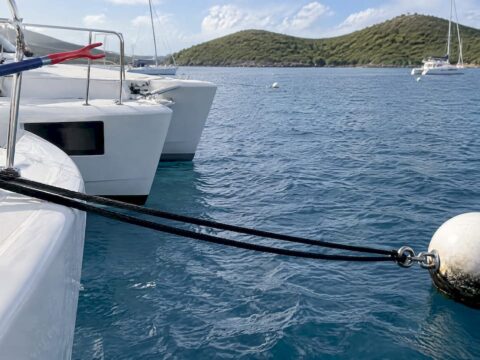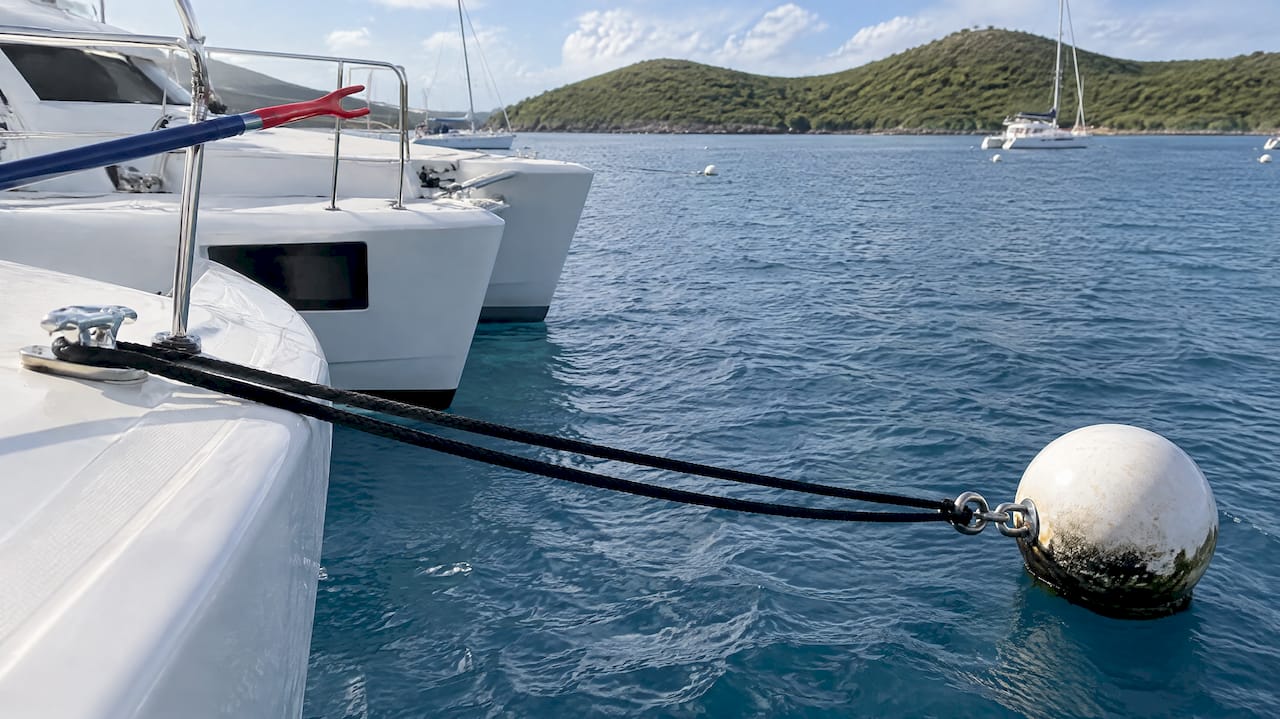

To secure to a mooring ball, approach slowly with the bow into the wind or current, whichever is stronger. Put the engine in neutral as the pendant gets close, and pick it up from the bow with a boat hook. Then run one line through the pendant eye and back to a bow cleat, and a second line through the same eye and back to the other bow cleat. Never cleat to the stern. Check your scope, swing room and chafe points before you relax.
That is the short version. The rest of this guide covers each step in the order you will do it, who does what on the boat, the mistakes that cause most problems, and what is different in the British Virgin Islands, where picking up a ball is part of nearly every charter day.
TL;DR
- Approach at minimum control speed, bow into the stronger of wind or current, with the ball on the helm’s side so the helmsperson can see it.
- Go to neutral before the pendant is within reach of the propeller, and retrieve it from the bow, never the side or stern.
- Use two lines: each runs from a bow cleat, through the pendant eye, and back to the same cleat. This shares the load and reduces chafe.
- Never cleat a mooring line at the stern. Add chafe gear and enough scope for a horizontal pull.
- Inspect the buoy and its pendant yourself. The skipper is responsible for the boat once it is attached.
Table of Contents
- Before you reach the ball: brief the crew
- Step 1: Read the wind and current
- Step 2: Approach slowly, with the ball in sight
- Step 3: Neutral before the pendant is in reach
- Step 4: Hook the pendant and bring it aboard
- Step 5: Secure with two lines
- Step 6: Chafe gear and the “after” checks
- Is this ball safe to use?
- Rules that apply wherever you moor
- Common mistakes
- Mooring balls on a BVI charter
- Ready to practice in the BVI?
- FAQ
- Sources
Before you reach the ball: brief the crew
Most botched pickups come from a crew that has not agreed who does what. Talk it through before you are 100 feet from the ball.
A simple split works on almost any boat:
- Helm: drives the boat and listens to the bow.
- Bow person: points at the ball, calls distance and direction, and hooks the pendant.
- Second crew member (optional): prepares the lines and passes them forward.
The bow person’s calls matter more than you might expect. Boating educators advise that the person at the helm may lose sight of the ball as it passes under the bow, so the bow person should call out the remaining distance. Agree on hand signals too. Wind and engine noise make shouting unreliable.
Rig your lines before you approach. Lead two dock lines to the bow, one at each cleat, with the loose ends ready on deck. Have a boat hook within reach. If the boat has only one bow cleat, you can pass a single line through the pendant and back to that cleat, but watch it closely for chafe (more on that below).
Step 1: Read the wind and current
The boat’s final movements before the pickup should be controlled by the engine, not pushed around by the elements. That means working out which force is dominant and facing it. BoatWise advises identifying the dominant force and approaching generally into it. US Powerboating puts it the same way for operators: use minimum control speed and point the bow into the wind or current, whichever is stronger.
The National Park Service gives the same basic instruction for its buoys at Dry Tortugas: approach slowly from downwind or down-current, so you are heading into it.
In practice:
- Before committing, watch other boats on balls nearby. They point into the dominant force and show you the answer.
- Look at the surface of the water near the ball. A current can show as a wake around the buoy even when the wind says otherwise.
- If wind and current oppose each other, favor whichever is stronger and give yourself extra room to abort.
If you are not lined up, do not force it. Motor away, circle around and try again. A second pass costs you two minutes. A rushed pickup can cost you a fouled propeller.
Step 2: Approach slowly, with the ball in sight
Slow is the whole secret here. At idle or just above it, you can stop the boat in a boat length. At any real speed you cannot.
US Powerboating suggests keeping the buoy on the operator’s side so you can see it, rather than aiming the bow straight at it. This is a practical point. On most boats the bow blocks your view of the water directly ahead, so a ball you aim straight at disappears just when you need it most. Offset slightly, keep the ball in view through the side of the windshield or past the bow, and let the bow person guide the last few feet.
Also keep the speed down for others’ sake. Florida Fish and Wildlife advises idle speed and no wake near mooring buoys, and asks boaters to watch for swimmers, snorkelers and diver bubbles. Mooring fields are exactly where people are in the water.
Step 3: Neutral before the pendant is in reach
The most expensive mistake on a mooring ball is wrapping the pickup line around a spinning propeller. BoatWise advises shifting to neutral before the mooring line, buoy or pickup equipment is close enough to be snagged.
A good habit: the bow person calls “neutral” when the ball is about one boat length ahead, and the helm confirms. The boat carries its momentum the last few feet. If you are drifting back because of the wind, a short touch of forward gear is fine, but only while the pendant is still clear of the props.
The same logic explains why you pick up from the bow. Passagemaker recommends keeping the bow toward the buoy and having a crew member at the bow retrieve the pendant with a boat hook. Approaching from the side or stern risks fouling the propeller, rudder or stabilizer. On a twin-engine catamaran or power cat, the props sit well aft of the bows, but the principle holds: the line should come aboard forward, far from anything that turns.
Step 4: Hook the pendant and bring it aboard
Most mooring balls have a floating pickup line (the pendant) with a loop or eye at the end. Your bow person hooks that loop with the boat hook and lifts it onto the deck.
Keep these points in mind:
- Kneel or brace, especially on a cat with a wide bow. Reaching over a rail at an awkward angle is how people go overboard.
- Hook the eye, not the ball. Grab the pendant and keep the boat’s momentum in mind. Do not try to hold the boat with your arms.
- Take your time. If you miss, say so and let the helm back off. There is no prize for the first attempt.
The National Park Service sums up the securing method simply: run a line from a boat cleat through the loop in the end of the mooring pickup line and back to a boat cleat. That is the core of every method below.
Step 5: Secure with two lines
There are a few accepted ways to attach, and most boating authorities lean toward the same one: two independent lines.
The two-line method
- Take the first dock line from the port bow cleat. Pass it through the pendant eye.
- Bring it back to the same cleat and make it fast.
- Take the second dock line from the starboard bow cleat, pass it through the same eye, and return it to its own cleat.
Passagemaker describes this arrangement, with one line at each bow cleat passed through the pendant eye and back to its original cleat, and notes that it reduces chafe and minimizes swinging. BoatLife Academy adds the reason: with two lines, the load is shared and the eye is not dragged across a single line.
That last point is the failure mode of the single-line shortcut. If one line runs from one side of the boat through the eye to the other side, the eye slides back and forth as the boat yaws, and it saws the line. A single line can chafe through, which on a quiet evening means you wake up somewhere you did not intend to be.
Mercury Marine gives the more basic version: pass a dock line through the loop and secure it to the bow cleat, and with two bow cleats, attach each end to a different cleat. If you only have one line available, that is better than nothing, but a second independent line is better.
Never cleat to the stern
This rule has no exceptions. Mercury Marine and BoatLife Academy both warn against cleating a mooring line to the stern, because changing weather or following seas can wash water over the transom and swamp the boat. A boat should always lie bow to the wind and the waves, which only happens when it is held from the front.
Give the lines enough length
Florida Fish and Wildlife advises using enough line for a horizontal pull, and letting out extra scope if the buoy is being pulled underwater. If the ball is dragged under or the pendant stands almost vertical, you have too little line out. That upward pull can lift the buoy or load the ground tackle in ways it was not designed for. More line also softens the ride in a chop.
Practical rule of thumb: the buoy should sit on the surface, with the pendant trailing off at a shallow angle toward your bow. If it does not, let out more.
Step 6: Chafe gear and the “after” checks
Tying up is not the end of the job. A few minutes now saves a bad night.
Chafe protection. BoatLife Academy and SailboatZone recommend chafe gear on mooring lines at the pendant and wherever they pass through a chock or hawsepipe, particularly for longer stays or if heavy weather is expected. Wrap the line with a sleeve, or use a length of hose. Check it again before bed.
Do a walk-around. SailboatZone lists what to check once you are secure: the attachment, the lead of the lines and chafe, the depth, swing room, the weather and nearby boats. Swing room is the one people forget. On a mooring you swing around the ball, and so does everyone else, but not always in step.
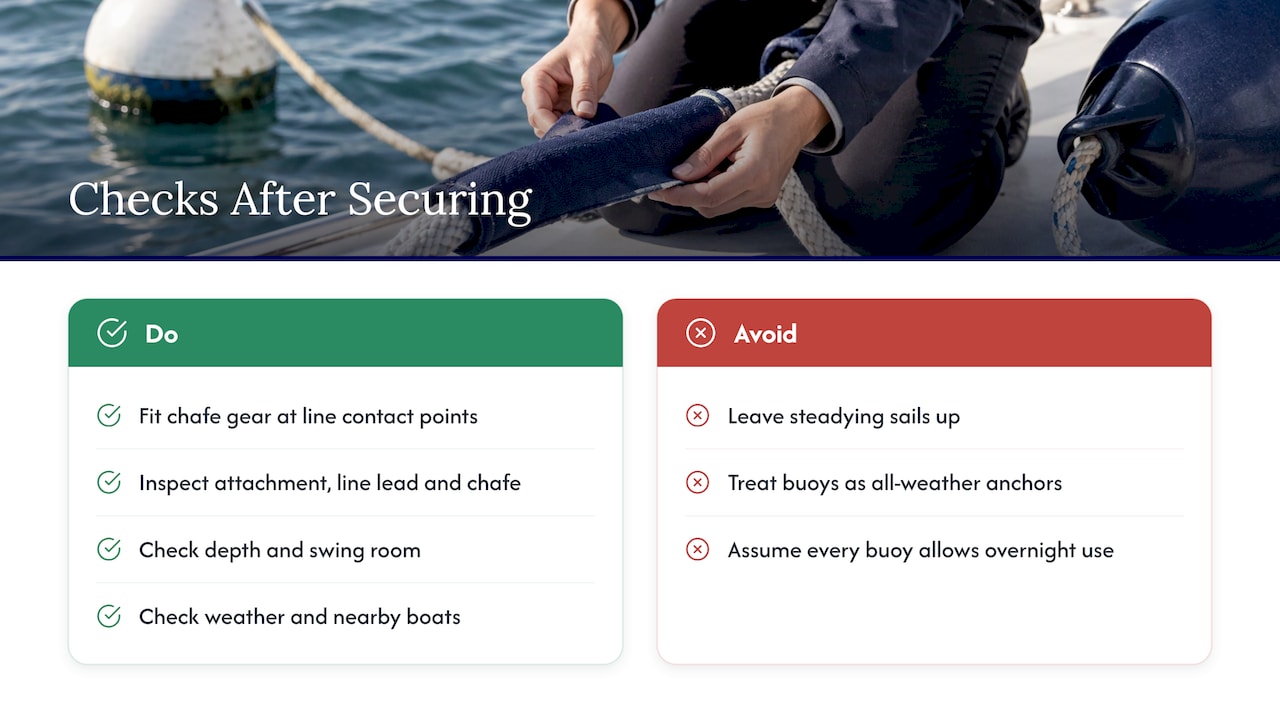
Mind the sails. On a sailboat, do not leave steadying sails up while on a mooring. Both the National Park Service and Florida Fish and Wildlife caution that they put excessive strain on the buoy’s eyebolt and gear.
Keep the engine ready. Mooring buoys are typically designed for short-term use, not as long-term or all-weather anchoring, and some are explicitly not for overnight use. If a front comes through, be prepared to start the engine and relieve the load, or move.
Is this ball safe to use?
You cannot see the chain, the block or the pin. You can see the buoy, the pendant and the shackle. That is the part you can inspect.
The National Park Service states that the vessel operator is responsible for inspecting the buoy and checking that it is holding as intended. Florida’s boating guidance says the same: inspect the buoy your boat is tied to, and you are responsible for your vessel. Look for:
- A pendant that is frayed, hard, or heavily chafed.
- A shackle with no pin seized or moused.
- A buoy that sits low, rides sideways or is dragged under.
- Marine growth that hides the condition of the eye.
Size matters too. Park Service buoys at Dry Tortugas are designed for recreational vessels up to 100 feet, in appropriate conditions. Virgin Islands National Park uses colors and stripes to sort moorings by boat length and purpose, so read the markings before you pick one.
Rules that apply wherever you moor
These are the legal and etiquette points that catch visitors out.
- Use only a mooring buoy. The U.S. Coast Guard’s boating safety guidance says mooring buoys are the only buoys a vessel may tie to. Never tie to a navigation buoy, daybeacon or light structure, and do not damage or hinder an aid to navigation. See the Coast Guard guide to markers on the water.
- Ask permission when needed. The same guide notes that most mooring buoys are privately owned or rental buoys, and permission is usually needed to use them.
- Check local rules. The Coast Guard’s guide to federal requirements tells boaters to check with their area’s boating agency about state boating laws and to keep a proper lookout.
- Pay the fee. Many parks and managed fields charge for overnight use and limit stays. Virgin Islands National Park, for example, uses self-registration for overnight mooring use, with caps on nights per year and consecutive nights per bay. Check the current official page before you go.
Common mistakes
| Mistake | What goes wrong | Fix |
|---|---|---|
| Approaching downwind or down-current | You cannot stop the boat; you overshoot | Turn and approach into the stronger force |
| Staying in gear near the pendant | Line wraps the propeller | Neutral before the pendant is in reach |
| Picking up from the side or stern | Fouled prop, rudder or stabilizer | Always retrieve from the bow |
| One line through the eye to both sides | Eye slides and saws the line | Two lines, each returning to its own cleat |
| Cleating at the stern | Water over the transom in a swell | Bow cleats only |
| Too little scope | Buoy dragged under, vertical pull | Let out more line for a horizontal lead |
| No chafe gear | Line parts overnight | Sleeve at the pendant and chocks |
If you want a broader safety habit for small-craft holding, the same instinct (set up so the load is horizontal and the boat faces the weather) is why guides on anchoring a pontoon boat correctly stress good technique. The tackle is different, but the seamanship is shared.
Mooring balls on a BVI charter
In the British Virgin Islands you will pick up a ball most days. Anchoring is restricted in many of the popular bays to protect coral and seagrass, and the most popular spots fill up early. That makes a smooth pickup, and a plan for getting the ball in the first place, part of the trip.
A few practical notes for first-time charterers:
- Get there early. Our guide to BVI mooring balls and the 7 AM rush explains how the morning competition works and how to avoid it.
- Plan the route. Our bay-by-bay mooring guide helps skippers decide where to be and when.
- Think about reservations. If you would rather not race for a ball, see our page on booking through BoatyBall.
- Compare your options. Our comparison of mooring balls versus marinas covers the trade-offs for overnight stays.
- Know the limits. Before you plan, read where bareboat guests can and cannot go in the BVI cruising restrictions.
If your first pickup makes you nervous, remember that a charter crew practices as a team. Assign roles at the first bay, rehearse the hand signals, and the third pickup will feel routine. If you would rather leave it to a professional, a skippered bareboat option puts an experienced captain on board.
Our perspective
We have run charters out of Tortola since 1996, and in that time we have seen the same thing happen on the first afternoon of nearly every trip: a capable, calm crew meets its first mooring ball and suddenly nobody knows who is holding what.
Our view is that a pickup is a team job, not a test of the skipper. We encourage guests to agree roles before approaching, to go slowly, and to use two lines every time. It is the method the park and boating authorities describe, and it is the one that lets you sleep.
It is also why we keep our fleet of modern power catamarans so carefully maintained. A well-kept boat with tidy bow gear and a reliable engine makes the whole routine easier, and we believe that the details of ownership show up in exactly these moments. Because we are a family-owned operation based in the BVI, we can talk you through the local bays and the pickup in plain language before you ever arrive.
alexia
Ready to practice in the BVI?
If you want to put these steps to use on warm, clear water, we offer bareboat and crewed charters on modern power catamarans from our base in Tortola. Published bareboat rates run from £6,000 to £10,000 per week for a 3-cabin power catamaran, £8,000 to £14,000 for a 4-cabin, and £12,000 to £20,000 for a 5+ cabin luxury power catamaran. See the bareboat pricing page for details.

Prefer to hand the lines to someone else? Our luxury crewed charters come with a crew, and our crewed versus bareboat comparison helps you choose. A captain can also join a bareboat charter, at a published $250 per day for a standard captain. See charter costs for what applies.
FAQ
Can I tie to a mooring ball with just one line?
Yes, but it is the weaker option. A single line passed through the pendant eye and back to one cleat can chafe through, and a line run from one side of the boat to the other lets the eye slide back and forth. Use two lines, each returning to its own bow cleat, whenever you can.
Should I approach a mooring ball into the wind or into the current?
Into whichever is stronger. Agencies and boating educators advise identifying the dominant force and facing it, so the engine controls your last movements. If the two oppose each other, favor the stronger one and leave room to abort and try again.
Can I cleat the mooring line at the stern?
No. Mercury Marine and BoatLife Academy both warn that a stern-held boat can take water over the transom when the weather or seas change. Always secure at the bow, so the boat faces the wind and waves.
Is it safe to stay overnight on a mooring ball?
Often yes, but only if you have checked the gear and the conditions. Recreational buoys are typically designed for short-term use, and some prohibit overnight stays. Inspect the buoy and pendant yourself, make sure you have enough scope and chafe gear, and check swing room and the forecast before bed.
What do I do if the ball is pulled underwater?
That means too little scope. Let out more line so the pull on the buoy is horizontal, not upward. Florida Fish and Wildlife gives this advice, since a vertical pull can lift the buoy or strain the ground tackle.
Sources
- Dry Tortugas Mooring Buoys, National Park Service
- Quick Mooring Information, Virgin Islands National Park
- Boating: Mooring Buoys, Florida Fish and Wildlife
- Approach/Depart a Buoy/Mooring, US Powerboating
- Boat Handling Tips for Mooring Ball Mastery, Passagemaker
- How To Properly Tie to a Mooring Ball, BoatLife Academy
- How to Tie Up to a Mooring Ball, Mercury Marine
- How to Use a Mooring Buoy, SailboatZone
- What You Need to Know About the Markers on the Water, U.S. Coast Guard
- A Boater’s Guide to the Federal Requirements for Recreational Boats, U.S. Coast Guard
Recommended
- BVI Mooring Balls: Beat the 7 AM Booking Rush on Your First Charter
- Never Miss a BVI Mooring for Skippers: Bay by Bay Reservation Tactics
- BVI Mooring Balls vs. Marinas | Bareboat Charter Guide
- Reserve BVI Mooring Balls On-Line!
Did You Know?
The BVI are only accessible by boat. Check out our charter yachts that can get you there. View Our Fleet