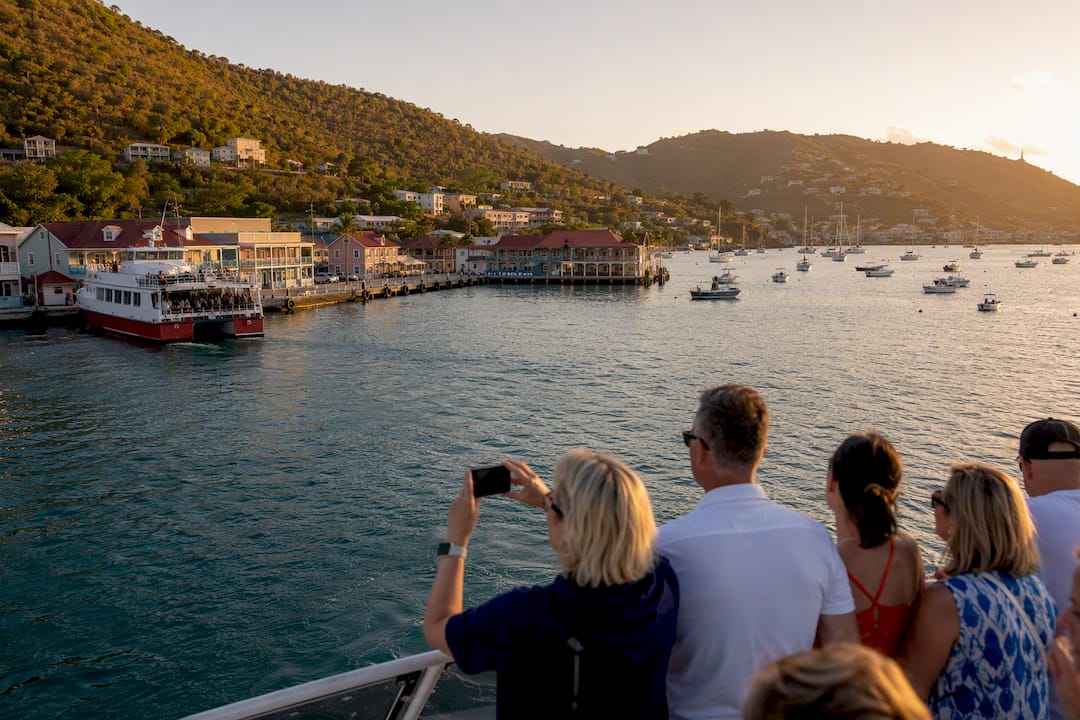

There are four workable ways to reach Tortola:
- Fly direct to Terrance B. Lettsome International Airport (EIS) on Beef Island
- Fly into a regional gateway like San Juan (SJU) and then take a small commuter flight to EIS
- Fly into St. Thomas (STT) and finish the trip to Tortola with a public ferry
- Fly into St. Thomas (STT) and finish the trip to Tortola via a private water taxi
The choice usually comes down to how much handling and transfers you want to do versus how much you want to save.
Ferries from St. Thomas take 45 to 60 minutes, landing at either Road Town or West End. Before you book anything, complete the BVI’s online ED Card at bviedcard.gov.vg. You can file it up to 36 hours before you land, and skipping it means standing in a slower line at customs.
Quick prep list:
- Valid passport (not just an ID card)
- Completed BVI Online ED Card, filed within 36 hours of arrival
- Ferry or flight confirmation with terminal name (Charlotte Amalie, Red Hook, Road Town, or West End)
- A buffer of at least 45 minutes for customs on either end
Table of Contents
- How to Get to Tortola: Choosing Between Flights and Ferries
- Flying Direct to Beef Island: EIS Gateways and Arrival Steps
- Connecting Through San Juan, St. Thomas, Antigua, or St. Maarten
- Ferry From St. Thomas to Tortola: Routes, Fares, and Customs
- Getting Around After You Land: Taxis, Rentals, and Transfers
- Which Route Fits Your Trip? A Quick Decision Guide
- Reaching Tortola From Virgin Gorda or Jost Van Dyke
- When Should You Travel? Seasonal Shifts in Tortola Transport
- Baggage Rules for Flights and Ferries to Tortola
- Sources
How to Get to Tortola: Choosing Between Flights and Ferries
Four things decide which route makes sense for your trip: how fast you need to arrive, what you’re willing to spend, how much luggage you’re hauling, and how much schedule risk you can tolerate. A direct flight to EIS skips the extra leg entirely but usually costs more and depends on seasonal service. A gateway-plus-ferry combination costs less and gives you open-water views of the BVI chain, but it adds a connection and a hard cutoff time.
Before booking, run through this order of operations:
- Check your passport expiration; the BVI enforces standard entry rules for U.S. travelers.
- File your ED Card at bviedcard.gov.vg once your travel dates are locked.
- Confirm the ferry operator’s schedule if you’re routing through St. Thomas.
- Decide whether you need to overnight in a gateway city or can make a same-day connection.
If your connection window is under three hours, or your flight into STT lands after early afternoon, book a hotel night rather than risk missing the last boat.
Flying Direct to Beef Island: EIS Gateways and Arrival Steps
EIS sits on Beef Island, connected to Tortola’s main road network by a short bridge, so once you land you’re already close to Road Town and most marinas. Direct intercontinental service is limited. Travel + Leisure reports seasonal direct flights from Miami to EIS operated by American Airlines, but outside that window, most arrivals come through regional or commuter carriers connecting from hubs like San Juan or Antigua. American Airlines is the only carrier that flies directly from Miami to Tortola. In peak season, December through April, they operate up to 4 flights a day. In the slower season, it is sometimes just 1 flight daily.
Arrival at EIS is straightforward. You’ll clear immigration and collect bags in a small, single-level terminal, generally faster than a major international airport. From there:
- Taxis line up just outside arrivals and are the default transfer for most visitors.
- A few car rental counters operate on-site, though availability is limited compared to larger Caribbean airports.
- The drive to Road Town takes roughly 40 minutes across the bridge and along the coast road.
Pro Tip: If you’re joining a yacht charter, tell your operator your flight number before you leave home. Flight delays happen often enough in the Caribbean that most crewed and bareboat operators build in flexibility, but only if they know your actual arrival window.
Because so many EIS routes run through regional carriers rather than major airlines, check baggage rules carefully. Some commuter aircraft cap checked bags well below what size and weight you’d expect from a mainline U.S. flight.
Connecting Through San Juan, St. Thomas, Antigua, or St. Maarten
Most U.S. travelers headed to the BVI pass through one of four gateways: San Juan (SJU), St. Thomas (STT), Antigua (ANU), or St. Maarten (SXM). Travel guides consistently list these as the standard connectors, since direct long-haul service into EIS remains limited to seasonal routes.
SJU and STT function as the primary U.S.-friendly hubs, both with frequent commuter flights and, in STT’s case, a direct ferry link. Antigua and St. Maarten serve travelers connecting from the eastern Caribbean or Europe rather than the U.S. mainland.
A few things to expect on the commuter leg:
- Smaller aircraft mean stricter weight limits, often 30 to 40 pounds checked versus the 50 pounds standard on major carriers.
- Flight frequency on regional routes can thin out significantly outside peak winter season.
- Check-in windows tend to close earlier relative to departure than they do on major airlines.
Give yourself at least 90 minutes between an international arrival and a regional connection. If your inbound flight lands after 4 p.m. and you’re connecting to a ferry rather than a flight, it is safter to plan to overnight in St. Thomas instead of racing the clock.
Ferry From St. Thomas to Tortola: Routes, Fares, and Customs
Two departure points on St. Thomas serve Tortola: Charlotte Amalie, near the cruise ship docks, and Red Hook, on the island’s east end. Ferries from either port typically run 45 to 60 minutes, though timing shifts with sea conditions and which operator you book.
The large cruise ships typically operate out of Charlotte Amalie and the smaller, private water water taxis operate out of Charlotte Amalie. The last large ferry of the day, typically at 5:30 pm, also tends to depart from Red Hook rather than Charlotte Amalie.
On the Tortola side, boats land at either Road Town or West End. Road Town is usually the better choice. Road Town Fast Ferry notes that arriving there avoids an extra taxi from West End into town, a trip that typically runs about $15 and 15 minutes.
Three operators handle most of the St. Thomas to Tortola ferries: Road Town Fast Ferry, Native Son Ferry, and Smith’s Ferry. Fares generally range around seventy to ninety dollars each way, though prices vary by operator and season, so confirm rates directly before booking.
A few booking notes:
- Reserve online in advance during winter high season; boats do fill up.
- The same ferry times run each day, they just rotate through which operator is responsible for the run that day/time - they publish a schedule in advance so you know who to book with
- Do not book a round trip ticket - if the return ferry operator changes or you need to change your departure time, you will not be given a refund. You are better to book your return ticket a few days before your departure
- Arrive at the terminal at least 30 minutes before departure for check-in.
- Have your ED Card confirmation ready. Customs officers process it faster than a paper form.
Pro Tip: Booking the ferry can save you several hundred dollars compared to a second regional flight into EIS, and you get open water views of the BVI chain most flights never show you.
Build in a 45 minute buffer after your ferry lands before you need to be anywhere else. Customs at small island terminals moves fast most days, but not always.
Private Water Taxi from St. Thomas to Tortola: Pricing, Location and Timing
A private water taxi needs to be reserved in advance, but it allows you to depart from St. Thomas on your own schedule, and they take only your group directly to West End Tortola to clear customs and then they also take you directly to the marina where your yacht is waiting.
After arriving at Cyril E. King Airport (STT) in St. Thomas, you will take a land taxi across the island to Red Hook, on the eastern end of St. Thomas. Most private water taxi companies depart from American Yacht Harbor in Red Hook.
The drive from the airport to Red Hook generally takes about 30–40 minutes, although it can take longer during periods of heavy traffic.
Regular St. Thomas taxi rates from the airport to Red Hook are approximately $23 for one passenger or $17 per person when two or more people are traveling together, plus applicable luggage charges. An exclusive private taxi for the vehicle is considerably more. Some water taxi companies can also arrange the airport transfer for you. For example, Dolphin offers its own airport-to-Red-Hook transfer as part of the process.
Once you reach Red Hook, your captain and boat will be waiting for you. Instead of waiting for the next scheduled ferry departure, you'll board your private boat, load your luggage and head directly across to the British Virgin Islands.
The boat ride from St. Thomas to Tortola is generally about 30–45 minutes, depending on sea conditions. Your first stop in the BVI will normally be West End, Tortola, where you clear BVI Customs and Immigration. With many private water taxi services, passengers can remain aboard while the captain handles much of the clearance process using your passports and paperwork.
Once everyone has cleared into the BVI, your water taxi can continue to your final destination. For guests beginning a yacht charter, this can be particularly convenient because many operators can deliver you directly to your charter marina rather than requiring another taxi ride across Tortola.
How Much Does a Private Water Taxi Cost?
Pricing varies considerably depending on the water taxi company, number of passengers and your final destination. As a general guideline, expect a private transfer between St. Thomas and Tortola to cost approximately $800–$1,500 per boat, one way, although some operators price their service per passenger instead. The maximum number of people that a private water taxi can accommodate is typically a group of 12. If you are a larger group, a private water taxi is a much more cost effective option to consider than if you are just one or two couples traveling together.
There are also BVI customs, immigration and international processing fees associated with private transportation. Dolphin, for example, currently lists $75 per person for entry into the BVI and $45 per person for the return/exit portion.
For comparison, Dolphin currently provides an example of approximately $180 per person for the water taxi portion from St. Thomas to Tortola, plus the land transfer and international fees, although rates depend on group size and destination. Because pricing structures vary, we recommend requesting a quote for your specific group before deciding between the ferry and a private transfer.
Pro Tip: Make sure to compare 'apples to apples' when looking at quotes from Water Taxi companies. Some water taxi operators include all the BVI customs and immigration fees in their water taxi rate pricing and/or they include land taxi costs from the airport to Red Hook. Other operators show you the 'base rate' for the rate of the water taxi, and then you are responsible for paying all the customs fees separately upon arrival.
Recommended St. Thomas–BVI Water Taxi Companies
Two established companies we recommend checking for private transfers are:
Island Time Water Taxi — Offers private and semi-private transfers between St. Thomas, St. John and destinations throughout the BVI. Island Time can also arrange the land taxi from STT Airport to Red Hook, making the transfer relatively seamless from the time you land.
Dolphin Water Taxi — One of the longest-established operators serving St. Thomas and the BVI. Dolphin offers airport meet-and-greet service, transportation to Red Hook, assistance with BVI Customs and Immigration, and direct delivery to a number of Tortola marinas and other BVI destinations.
Why We Like This Option for BVI Charter Guests
The fly-to-St.-Thomas/private-water-taxi combination can be a great "best of both worlds" option for BVI travelers.
You can take advantage of the potentially lower airfares and greater selection of flights into St. Thomas while still enjoying much of the convenience of flying directly into the BVI. Instead of collecting your luggage and then waiting several hours for a scheduled ferry, your private water taxi is arranged around your arrival.
This can be especially worthwhile for families and larger charter groups, since the cost of a private boat becomes more reasonable when divided among several passengers.
It also removes one of the biggest drawbacks of flying into St. Thomas: being dependent upon the public ferry schedule. Public ferries operate at set departure times, so depending upon when your flight lands, you could have a significant wait before continuing to Tortola. Also, if you land after 4 or 5 pm, there might not even be an option for a public ferry to St. Thomas on the same day. A private water taxi gives you considerably more flexibility and can often take you directly from Red Hook, through Customs at West End, and onward to your charter marina.
For guests who find a significantly better airfare into St. Thomas but don't want the inconvenience of coordinating their vacation around ferry schedules, a private water taxi to Tortola can be one of the easiest ways to start a BVI yacht charter.
Getting Around After You Land: Taxis, Rentals, and Transfers
Once you’re on Tortola, last-mile transport is simple but worth planning. A taxi from Beef Island to Road Town typically costs around thirty dollars. Road Town to Cane Garden Bay, on the north shore, usually costs about twenty to twenty-five dollars. Shared “safari” taxis (open-air trucks with bench seating) cost less per person than a private cab but take longer with multiple stops. Taxi fares are regulated by the government so the rates are the same with every driver.
To rent a car, you’ll need a temporary B.V.I. driving permit, issued on the spot at the rental counter for a small fee using your valid U.S. license. Reserve rentals at least a few weeks ahead in high season, since the local fleet is smaller than what you’d find on a bigger island.
- Budget 40 to 45 minutes for the drive from EIS to Road Town.
- Budget 15 minutes plus a short taxi if you land by ferry at West End instead of Road Town.
- If you’re connecting between the airport and a ferry terminal on the same day, allow at least an hour total for the taxi transfer and check-in combined.
What about Uber or Lyft?
Neither Uber or Lyft operate in BVI, so do not plan on taking out your phone to order a ride at the airport. You need to take a traditional taxi, which often are larger sized vans/SUVs to help navigate the hilly roads in Tortola.
Which Route Fits Your Trip? A Quick Decision Guide
If minimal handling matters most, book direct to EIS. One flight, one immigration line, and you’re on Tortola without touching a boat schedule.
If cost matter smore than speed, fly into STT and take the ferry. You’ll likely save on airfare compared to booking a second regional flight, and the crossing itself is part of the experience.
For a balance between the two, if you are a group of 8-10, then a private water taxi from Red Hook is a great option. The price is generally less than flying into Tortola, but the convenience of departing on your schedule is advantageous over taking the public ferry.
Charter guests need to think about timing differently. Coordinate your arrival window with your charter operator well ahead of embarkation, since most request guests arrive with enough buffer to handle a delayed flight or missed ferry without derailing the whole trip.
Before you lock in flights or ferry tickets:
- Confirm your passport is valid and your ED Card is filed.
- Build in a customs buffer on both ends of the trip.
- Never assume a late ferry exists. Most cross-border boats stop running by early evening.
Pro Tip: If your only option lands you in St. Thomas after 3 p.m., book a hotel for the night rather than gamble on making the last boat. It’s a cheap insurance policy against missing your charter’s embark time.
Reaching Tortola From Virgin Gorda or Jost Van Dyke
If your BVI trip includes island hopping, you’ll likely use inter-island ferries rather than the St. Thomas routes. Virgin Gorda connects to Tortola through several daily crossings, generally running under 30 minutes between the two islands, with boats landing at either Road Town or the North Sound area depending on the operator.
Jost Van Dyke runs a shorter hop from West End on Tortola, often 15 to 20 minutes, with additional but less frequent service from Road Town. These inter-island routes run on tighter, more limited schedules than the St. Thomas ferries. Some days see only a handful of departures, especially outside peak season, so a same-day return trip needs advance planning rather than a walk-up approach.
None of these routes require the same immigration processing as an international ferry from St. Thomas, since you’re moving between BVI islands rather than crossing a border. That said, always carry your passport when island hopping. Officials do check identification periodically, and having it on hand avoids any confusion.
If you’re chartering a yacht, these inter-island connections often become moot. Most charter itineraries already include stops at Virgin Gorda’s Gorda Sound and Jost Van Dyke’s Great Harbour, so you’re sailing between them rather than relying on a commercial ferry. That’s one advantage of booking a charter over piecing together inter-island transport yourself: the boat becomes the transfer.
When Should You Travel? Seasonal Shifts in Tortola Transport
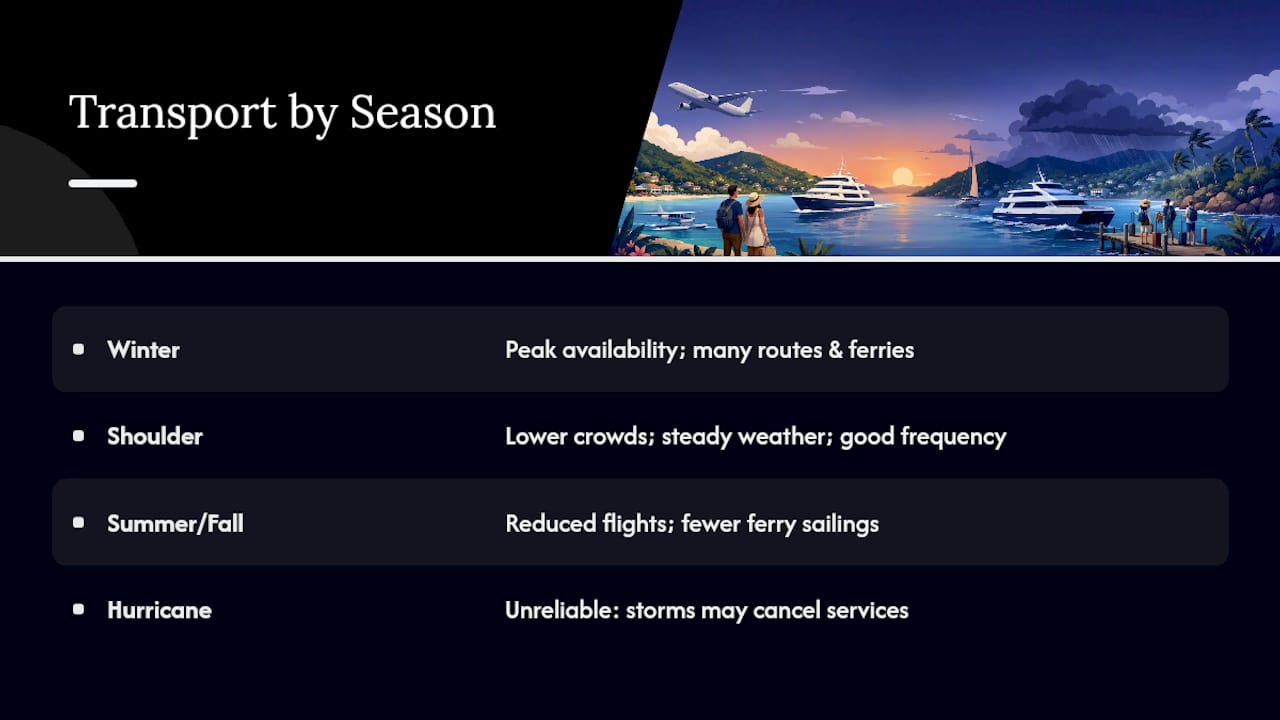
Winter, roughly December through April, is peak season in the BVI, and it shows in both flight and ferry availability. More seasonal flight routes operate during these months, including the direct Miami to EIS service mentioned earlier, and ferry operators typically run their fullest schedules.
Summer and fall bring the opposite. Fewer seasonal flights operate, ferry frequency can thin out, and some smaller routes reduce to a few sailings a week. Hurricane season, June through November, adds another variable. Storms can cancel ferries with little notice and occasionally disrupt flight schedules into EIS or STT for a day or two at a time.
Shoulder season, roughly May and late November, often gives you the best mix: reduced crowds, steadier weather than peak hurricane months, and still-decent transport frequency. If you’re traveling during hurricane season, build a flexible day or two into your itinerary rather than booking a tight connection between your inbound flight and a charter embarkation.
Whatever the season, check operator schedules close to your travel dates rather than relying on a general rule. Ferry companies adjust sailing counts based on demand, weather, and fuel costs, and a route that runs six times a day in February might run three times a day in September.
Baggage Rules for Flights and Ferries to Tortola
Baggage limits shift depending on which leg of your trip you’re on, and this catches travelers off guard more than almost anything else. Major U.S. carriers to gateways like SJU or STT generally follow standard domestic rules: one checked bag around 50 pounds, plus a carry-on. Once you switch to a regional or commuter flight into EIS, that allowance often drops, sometimes to 30 or 40 pounds checked, with stricter enforcement on small aircraft where weight distribution matters.

Ferries are more forgiving but not unlimited. Most operators allow one or two standard suitcases per passenger without extra charge, and oversized items like surfboards, golf bags, or extra coolers may carry a small additional fee. There’s rarely a strict weight limit at the ferry dock the way there is on a small plane, but space is limited, especially during high season sailings when boats run close to capacity.
If you’re packing dive gear, snorkel equipment, or provisions for a charter, it’s worth calling your ferry operator or airline ahead of time to confirm what fits. A duffel that’s no problem on a ferry could trigger an overweight fee on a nine-seat commuter flight. Pack a smaller, more flexible bag if you’re routing through a regional gateway rather than flying direct, and keep anything essential, like medications or your ED Card confirmation, in a carry-on you control the whole way.
Publisher Perspective: Coordinating Arrival Logistics With Your Charter
Virgin Charter Yachts has run luxury bareboat and crewed charters from Tortola since 1996, and after three decades as a family-owned operation based right here, we’ve learned that arrival hiccups almost always trace back to one thing: the operator not knowing your actual plan. Share your flight number, ferry operator and departure time, passenger count, and luggage volume as soon as you book. That’s what lets us schedule a transfer that actually matches your real arrival, not your best guess at one.
The fastest, most reliable way to Tortola is flying direct to EIS when seasonal service allows it, though a St. Thomas ferry connection remains the better value for most U.S. travelers.
| Point | Details |
|---|---|
| File your ED Card early | Complete the BVI Online ED Card at bviedcard.gov.vg up to 36 hours before arrival to skip slower customs lines. |
| Ferry crossing runs 45 to 60 minutes | St. Thomas to Tortola ferries depart Charlotte Amalie or Red Hook and land at Road Town or West End. |
| Road Town beats West End | Landing at Road Town avoids an extra $15 taxi ride into town that West End arrivals need. |
| Last ferries stop by early evening | Most cross-border boats cease running by late afternoon to early evening, so plan an overnight if you arrive late. |
| Charter guests should sync arrival details | Virgin Charter Yachts asks guests to share flight, ferry, and luggage details ahead of time to arrange punctual transfers. |
Official Portals and Operator Sites to Check Before You Book
Verify every detail here directly with the source before locking in your itinerary. The BVI ED Card portal is the only place to file your required entry form, and it takes just a few minutes once you have your travel dates. For ferry timing, cross-check current schedules with VInow’s Virgin Islands ferry guide and Road Town Fast Ferry’s own service page, since both operators adjust sailing counts seasonally. If you’re still mapping out which islands to visit once you land, this guide on selecting yacht destinations is worth a read before you finalize a route.
How Virgin Charter Yachts Handles Your Arrival
Getting yourself to Tortola is only half the job. Getting from the ferry dock or the airport onto your boat, with your bags, on time, is the part guests underestimate. Virgin Charter Yachts coordinates that transfer directly, using three decades of local knowledge on Tortola to match pickups to your actual flight or ferry, not a generic pickup window.
Once you’ve booked a charter with us, share your arrival details early: flight number or ferry operator, passenger count, and luggage. We’ll build your pickup and embarkation timing around it, so you’re not standing at a dock wondering what happens next. If you’re still comparing bareboat and crewed options for your BVI trip, visit Virgin Charter Yachts to check current availability and get a quote for your dates.
Frequently Asked Questions
What’s the fastest way to get to Tortola from the U.S.? Flying direct to EIS on Beef Island, when seasonal service is running, is the fastest option since it skips the ferry leg entirely. Outside that window, connecting through San Juan or St. Thomas is standard.
Do I need a passport to travel to Tortola? Yes. A valid U.S. passport is required, along with a completed BVI Online ED Card filed at bviedcard.gov.vg up to 36 hours before you arrive.
How long does the ferry from St. Thomas to Tortola take? Typically 45 to 60 minutes, though the exact time depends on the operator and sea conditions on the day you travel.
Is it cheaper to fly direct or take the ferry? Flying into St. Thomas and taking the ferry is often less expensive than booking a second regional flight into EIS, though the trade-off is an added connection and a firm schedule cutoff.
What time does the last ferry to Tortola run? Most cross-border ferries stop running by 4:30 to 5:00 PM. If your flight into St. Thomas lands later than that, plan to overnight there instead.
Sources
Did You Know?
The BVI are only accessible by boat. Check out our charter yachts that can get you there. View Our Fleet