
One of the first decisions when planning a bareboat charter in the British Virgin Islands is whether to charter a power catamaran or a sailing catamaran.
Both are excellent ways to explore the BVI, and both give you the space, stability and privacy that make catamarans so popular for yacht charters.
But they offer very different experiences.
The best choice usually has less to do with which type of catamaran is “better” and much more to do with what kind of boater you are and how you want to spend your vacation.
If you grew up sailing and love the art of sailing, you probably want sailing to be part of your BVI vacation.
If you grew up driving powerboats on a lake, have always owned motorboats and have never sailed, a sailing vacation may not be what you're looking for at all.
Here are the differences we recommend considering before choosing your yacht.
Start With the Kind of Boating You Already Enjoy
For many guests, this is the easiest way to make the decision.
If you grew up sailing, have owned sailboats or simply love sailing, chances are you want sailing to be part of your BVI vacation.
You enjoy reading the wind, trimming sails and shutting off the engines once you're underway. The quiet is part of the appeal.
For a sailor, getting from one island to another isn't simply transportation.
The journey is part of the experience.
In that case, charter a sailing catamaran. A powercat isn't going to replace the experience you love.
On the other hand, if you grew up boating on a lake, own a powerboat or have spent your life around motorboats and have never sailed, a vacation may not be the time you want to learn an entirely different style of boating.
You may be much happier aboard a power catamaran.
And if you've never sailed and don't particularly have a desire to learn, there's no reason to choose a sailing catamaran simply because you're chartering in the Caribbean.
The BVI is just as spectacular from a powercat.
Do You Enjoy the Journey or Are You Excited About the Destination?
This is another good way to think about the difference.
For sailors, the passage between islands can be one of the best parts of the day.
Turn off the engines, raise the sails and enjoy the trip to the next island. You're not necessarily trying to shorten the passage because sailing itself is one of the activities you're there to enjoy.
There's also something special about sailing quietly through the BVI with the engines off and hearing little more than the wind and water around the boat.
A powercat cannot duplicate that experience.
Powercat guests often approach the day differently.
You might wake up at Norman Island thinking about snorkeling The Caves before breakfast and then heading to Cooper Island so you have the afternoon to swim, snorkel or go ashore.
The trip between the islands is still enjoyable, but the destination is usually the focus.
Neither approach is better.
They're simply two different ways to experience the BVI.
If you love sailing and enjoy the journey as much as the destination, choose a sailing catamaran. If you're a powerboater and your priority is exploring the islands, a powercat may feel much more like the vacation you had in mind.
Powercats Give You More Predictable Cruising Times
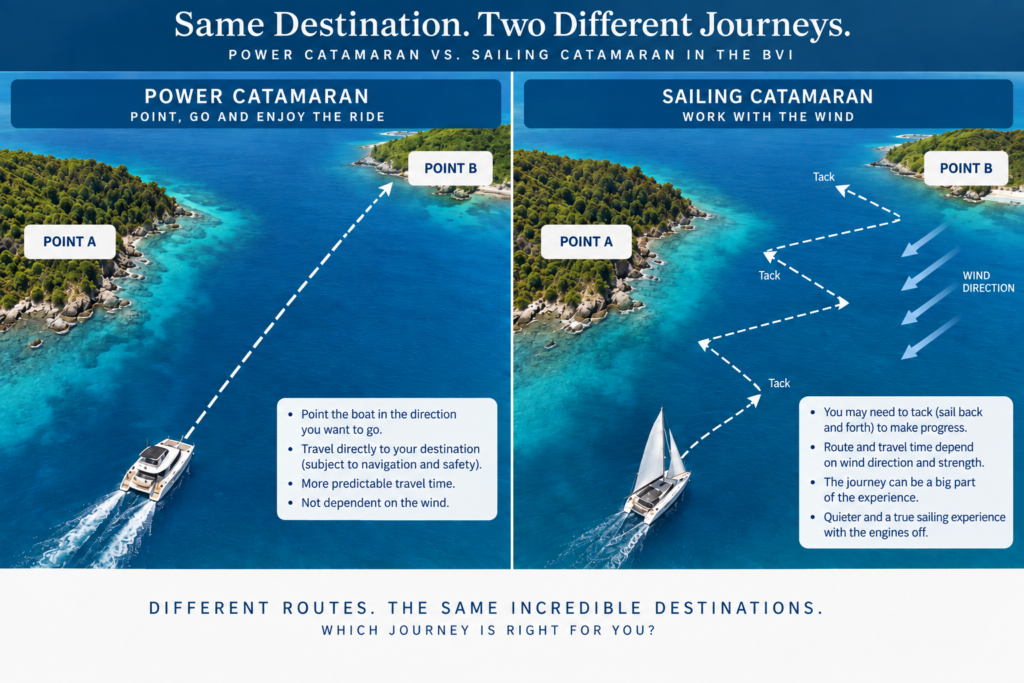
One of the biggest advantages of a power catamaran is that your travel time isn't dependent on having the right wind.
Virgin Charter Yachts' power catamarans generally cruise in the 10–18 knot range, depending on the yacht and conditions. Although some models are technically capable of higher speeds, there is no need to race from island to island and the higher speed, the higher the fuel consumption.
It's that your cruising time is relatively predictable regardless of the wind.
That can make itinerary planning easier.
If you wake up in North Sound and want to head to Anegada, you're not relying on the wind to make the passage work the way you hoped.
For guests trying to experience a lot of the BVI in seven days, that flexibility can be valuable.
Sailing Cats Give You Something a Powercat Can't: Silence Underway
There is an important tradeoff.
A powercat uses its engines whenever it is underway.
Modern powercats are designed to make cruising comfortable, but you're still operating engines.
On a sailing catamaran, once the sails are up and the engines are off, the experience is completely different.
For people who love sailing, that peaceful feeling is often one of the primary reasons they own or charter sailboats in the first place.
If the idea of quietly sailing across the Sir Francis Drake Channel sounds like one of the highlights of your vacation, that's a strong argument for choosing sail.
If you're accustomed to powerboats and engine noise doesn't bother you, it may not be much of a consideration at all.
Power Catamarans Are Designed Around Living Space
Another major difference is how the yacht itself is designed.
A sailing catamaran needs a mast, boom, sails, rigging and the equipment necessary to operate them.
A powercat doesn't.
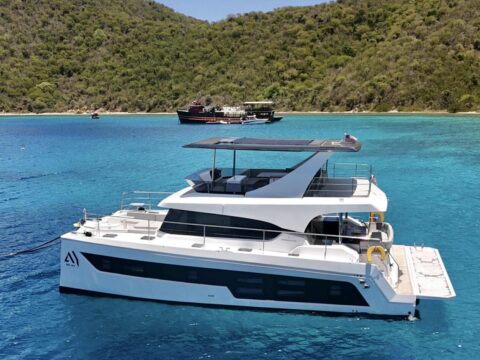
That gives powercat designers more freedom to build the yacht around living, entertaining and outdoor space.
One of the most noticeable differences is often the flybridge.
Large powercats can have expansive upper decks with seating, lounging and entertaining areas in addition to the cockpit and salon below. Many guests end up spending a significant part of their charter on the flybridge.
For families and groups of friends, that gives everyone more places to spread out.
Different models prioritize space differently, which is one reason we encourage guests to look beyond simply comparing yacht lengths.
A 50-foot yacht with the right layout for your group can be a much better fit than a larger yacht with a layout that doesn't work as well for you.
Compare Cabins and Layouts — Not Just Yacht Length
This is particularly important when comparing powercats.
Virgin Charter Yachts' bareboat fleet includes several different manufacturers because they offer very different layouts.
For example, depending on your group, you might prefer:
- A Fountaine Pajot MY44 or MY6 for six guests who want three comfortable cabins.
- A Leopard 51 or Leopard 53 for a larger group that wants additional sleeping accommodations.
- An Aventura 50 or Aventura 56 for groups looking for multiple double cabins and generous living space.
- An Aquila 54 for up to 10 guests with five guest cabins.
- A layout like the Aventura 50 Unwinding, which offers six cabins and six heads and can accommodate up to 12 guests.
The important question isn't simply, “How many feet long is it?”
Ask:
How many people are traveling? Who is sharing cabins? How many heads do you want? Where will everyone spend time together?
Those answers will tell you much more about whether a yacht is right for your group.
Powercats Use More Fuel
This is one area where sailing catamarans have a clear advantage.
Power catamarans generally use considerably more fuel than sailing catamarans.
You're using engines as your primary propulsion rather than taking advantage of the wind whenever conditions permit.
Fuel consumption varies substantially depending on the yacht, cruising speed, conditions and how far you travel during the week.
For someone who loves sailing, paying for additional fuel to motor around the BVI probably doesn't make much sense. You would rather put up the sails.
For someone who prefers powerboats, the additional fuel expense may be an acceptable tradeoff for predictable cruising times and the type of yacht they prefer.
Fuel should simply be part of the budget when comparing the two options.
Be sure to review our comprehensive guide on BVI charter costs.
What About Handling and Bareboat Experience?
Don't choose a powercat because someone tells you it's automatically “easy to drive.”
A large power catamaran is still a substantial vessel.
Twin engines provide excellent maneuverability, particularly once you're familiar with how the yacht responds, but operating a large catamaran requires appropriate boating experience and judgment.
The same is true for sailing cats.
Someone who has extensive sailing experience may be completely comfortable aboard a sailing catamaran but have little experience operating a large powerboat.
Likewise, an experienced powerboater may be very comfortable with twin engines but have no experience managing sails and rigging.
This brings us back to the same question:
What type of boating do you already know?
At Virgin Charter Yachts, we review the boating resume of the person who will be operating the yacht before approving a bareboat charter.
If you're unsure whether your experience is sufficient for a particular yacht, talk to us. We can review your experience and discuss the appropriate options, including captain assistance when needed.
Which Is Better for Families?
Either can be fantastic.
If yours is a family of sailors, chartering a sailing catamaran through the BVI could be one of the most memorable family vacations you take.
Your children can learn about sailing, participate in the experience and grow up with the same appreciation for sailing that you have.
But if your family has always been around powerboats, a powercat may feel much more familiar.
It can also work particularly well for families who are primarily interested in everything they'll do once they arrive somewhere — snorkeling, swimming, paddleboarding, exploring The Baths, visiting beaches or spending an afternoon at a resort.
There's no need to turn a family vacation into a sailing vacation unless sailing is something your family actually wants to do.
For more suggestions, review our guide on the best things to do on a yacht charter with kids.
Which Is Better for Couples and Groups of Friends?
Again, it depends on the group.
A couple who loves sailing may want nothing more than a smaller sailing cat, a good breeze and a week exploring the islands.
Another couple may prefer a powercat with a large flybridge, spacious owner's cabin and plenty of outdoor living space.
For groups, think about whether everyone shares the same enthusiasm for sailing.
If six people are traveling together and only one person really wants to sail, it's worth asking whether sailing should dictate the entire group's vacation.
If everyone loves sailing, the answer is completely different.
Choose the yacht based on how your group actually likes to spend its time.
Does the Time of Year Make a Difference?
It can.
The BVI enjoys excellent boating conditions throughout much of the year, but the tradewinds are generally most consistent during the winter and early spring.
For sailors, good wind is obviously part of the attraction.
During periods when winds are lighter, a powercat isn't relying on sailing conditions to maintain its itinerary. In fact, many of our powercat guests particularly enjoy the flatter conditions that can occur during the late spring and summer.
If you're choosing between sail and power, think about what conditions you actually want rather than assuming there's one universally “best” time to charter.
You can review our guide on the Best Time of Year to Charter a Yacht in the BVI.
Why Does Virgin Charter Yachts Specialize in Power Catamarans?
There are plenty of excellent sailing catamarans available for charter in the BVI.
Virgin Charter Yachts has chosen to specialize in bareboat power catamarans.
Many of our guests come from a powerboating background and want the space and stability of a catamaran without giving up the style of boating they're accustomed to.
We also like being able to offer different manufacturers rather than limiting the fleet to one brand.
Our bareboat powercat fleet includes models from Fountaine Pajot, Leopard, Aventura and Aquila, allowing us to match different group sizes, cabin requirements, layouts and budgets with the yacht that fits them best.
Power Catamaran vs. Sailing Catamaran: Quick Comparison
| Power Catamaran | Sailing Catamaran | |
|---|---|---|
| Best for | Guests focused on destinations, space and flexibility | Guests who genuinely enjoy sailing |
| Underway | Powered by engines | Sail-powered when conditions allow |
| Wind dependent | No | Sailing performance depends on conditions |
| Travel times | More predictable | More affected by wind and sailing conditions |
| Noise underway | Engines running | Quiet when sailing with engines off |
| Fuel consumption | Higher | Generally lower |
| Living space | Designed without sailing rig and equipment | Must accommodate sailing systems |
| Experience | Best suited to experienced powerboaters | Best suited to experienced sailors |
| The journey | Primarily gets you to the next destination | Often an important part of the day's experience |
| Ideal guest | “Let's get to the next island and explore.” | “Let's put the sails up and enjoy getting there.” |
So, Which Should You Charter?
Start with what kind of boater you are.
If you grew up sailing, love the feeling of moving under sail and enjoy the journey as much as the destination, charter a sailing catamaran.
You'll probably miss sailing if you don't.
If you grew up on powerboats, have never sailed and are primarily excited about exploring the BVI, don't assume you need to learn to sail simply because you're chartering in the Caribbean.
A power catamaran may be a much more natural fit.
You'll have predictable cruising times, generous living space and the freedom to build your days around the islands and experiences you want to enjoy.
And if you're somewhere in between, we're happy to talk through the differences.
Virgin Charter Yachts has been helping guests explore the British Virgin Islands since 1996. Tell us about your boating experience, your group and what you want from your vacation, and we'll help you determine which of our power catamarans best fits your charter.
Did You Know?
The BVI are only accessible by boat. Check out our charter yachts that can get you there. View Our Fleet