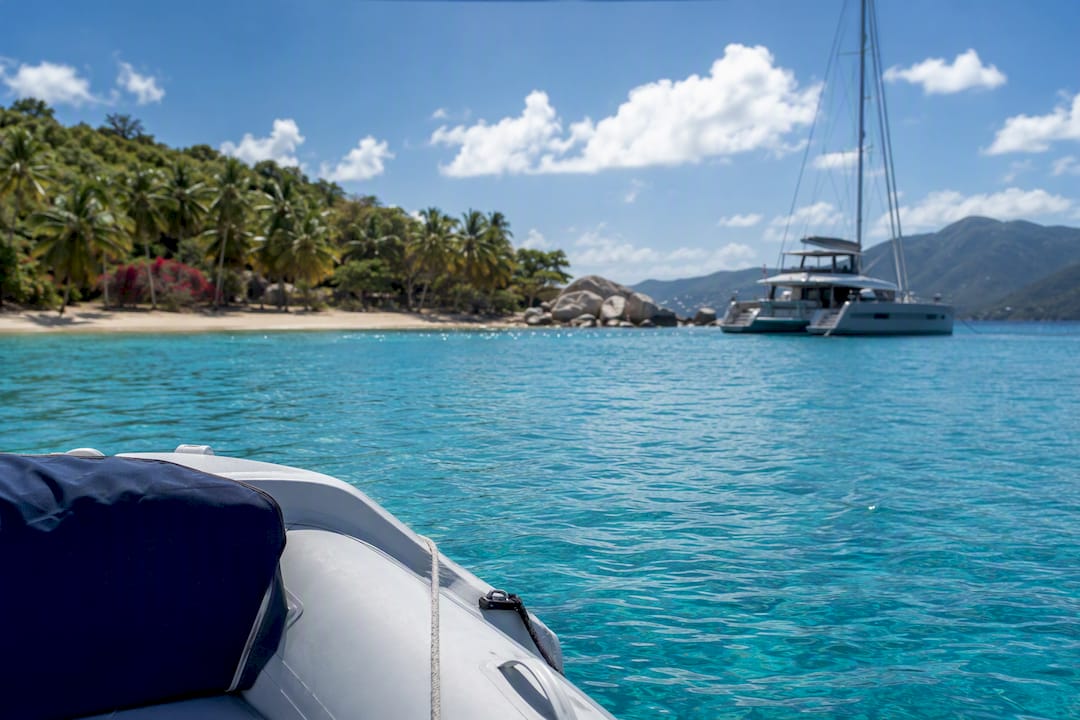

The British Virgin Islands are a chain of islands and cays scattered east of Puerto Rico, and they exist almost entirely for people who want to get on a boat. Sailors come for the short, protected hops between anchorages; everyone else comes for beaches with almost no one on them. If you’re planning a trip, build it around a boat, whether that’s a day charter, a bareboat week, or a fully crewed itinerary, because the best of the BVI doesn’t sit at the end of a road.
TL;DR:
- The best way to experience the British Virgin Islands is by boat, as most attractions are accessible only through sailing or water transport.
- Visiting during peak season from December to April offers optimal sailing conditions, but prices are significantly higher and reservations should be made well in advance.
- The islands require careful planning around weather, with hurricane season from June to November posing the greatest travel risk and potential itinerary disruptions.
- Entry rules are flexible for short stays, but travelers must carry passports and verify current customs, immigration, and health regulations before departure.
- Chartering with experienced local operators ensures better anchorage knowledge, weather planning, and a tailored itinerary for all levels of sailors and visitors.
Table of Contents
- British Virgin Islands Quick Facts for Trip Planning
- Why Visit the British Virgin Islands?
- Which BVI Island Should You Visit First?
- Getting There and Entry Essentials
- When Is the Best Time to Visit the British Virgin Islands?
- How Do You Get Around the British Virgin Islands?
- What Are the Best Things to Do in the BVI?
- Where to Stay in the British Virgin Islands
- How Much Does a Trip to the British Virgin Islands Cost?
- Is the British Virgin Islands Safe to Visit?
- Packing and Practical Travel Tips
- How Chartering Actually Works in the BVI
- Wildlife and Nature in the British Virgin Islands
- Popular Dining and Local Cuisine in the BVI
- Shopping and Local Markets in the BVI
- A Sample First-Timer’s Itinerary
- Book a BVI Charter With Local Expertise Behind It
- Sources
British Virgin Islands Quick Facts for Trip Planning
The British Virgin Islands sit east of Puerto Rico and just north of the U.S. Virgin Islands, close enough that ferries connect the two territories daily. The territory is a British Overseas Territory made up of four main islands — Tortola, Virgin Gorda, Anegada, and Jost Van Dyke — plus more than 50 smaller islands and cays, though only about 16 are inhabited.
Here’s what you need before you book anything:
- Capital and largest island: Road Town, on Tortola, is both the capital and the commercial hub.
- Currency: The U.S. dollar is the official currency, so there’s no exchange rate to think about if you’re coming from the United States.
- Language: English, spoken with a distinct Caribbean lilt.
- Main airport: Terrance B. Lettsome International Airport (EIS) on Beef Island, connected by causeway to Tortola. Virgin Gorda has a smaller strip (VIJ) for regional hops.
- Main ferry ports: Road Town and West End on Tortola, plus Spanish Town on Virgin Gorda.
- Entry note: There’s a departure tax and a Tourist Levy built into most airline tickets and ferry fares; rules shift periodically, so check the Government of the Virgin Islands site before you fly.
Financial services and tourism drive the territory’s economy in significant but varying proportions, according to Britannica, which is part of why the islands feel more polished than many nearby destinations without feeling overbuilt.
Why Visit the British Virgin Islands?
Chartering is the point, not a side activity. The islands sit close enough together, most crossings run 30 minutes to two hours, that a week on the water lets you wake up in a different anchorage almost every day without ever spending a night on a rough passage. That geography is why the BVI tourism board markets the territory as a sailing-first destination rather than a beach-resort one, and why marinas here rival anything in the Caribbean for infrastructure.
A few experiences show up on nearly every itinerary for good reason:
- The Baths on Virgin Gorda: granite boulders the size of houses form sea grottoes and tidal pools you swim between.
- Anegada’s reefs: the third-largest barrier reef system in the world, plus grilled lobster on a beach with no crowds.
- Jost Van Dyke’s beach bars: Foxy’s and the Soggy Dollar Bar turned a tiny island into a legendary one-day stop.
- Sage Mountain and Tortola’s hiking trails: rainforest above, turquoise water below, all within a 20-minute drive of Road Town.
Pro Tip: Book The Baths for early morning. Cruise ship tenders and day-trip catamarans arrive by mid-morning, and the grottoes get crowded fast once they do.
What separates the BVI from louder Caribbean destinations is what locals call “spare luxury”: upscale without the high-rise resorts or all-inclusive sprawl you’d find elsewhere. There’s no strip of chain hotels here. Development stayed deliberately restrained, which means the coastline still looks the way it did decades ago, just with better moorings.
Which BVI Island Should You Visit First?
Each of the four main islands plays a different role in a BVI trip, and picking the wrong base for your priorities is the most common planning mistake first-timers make.
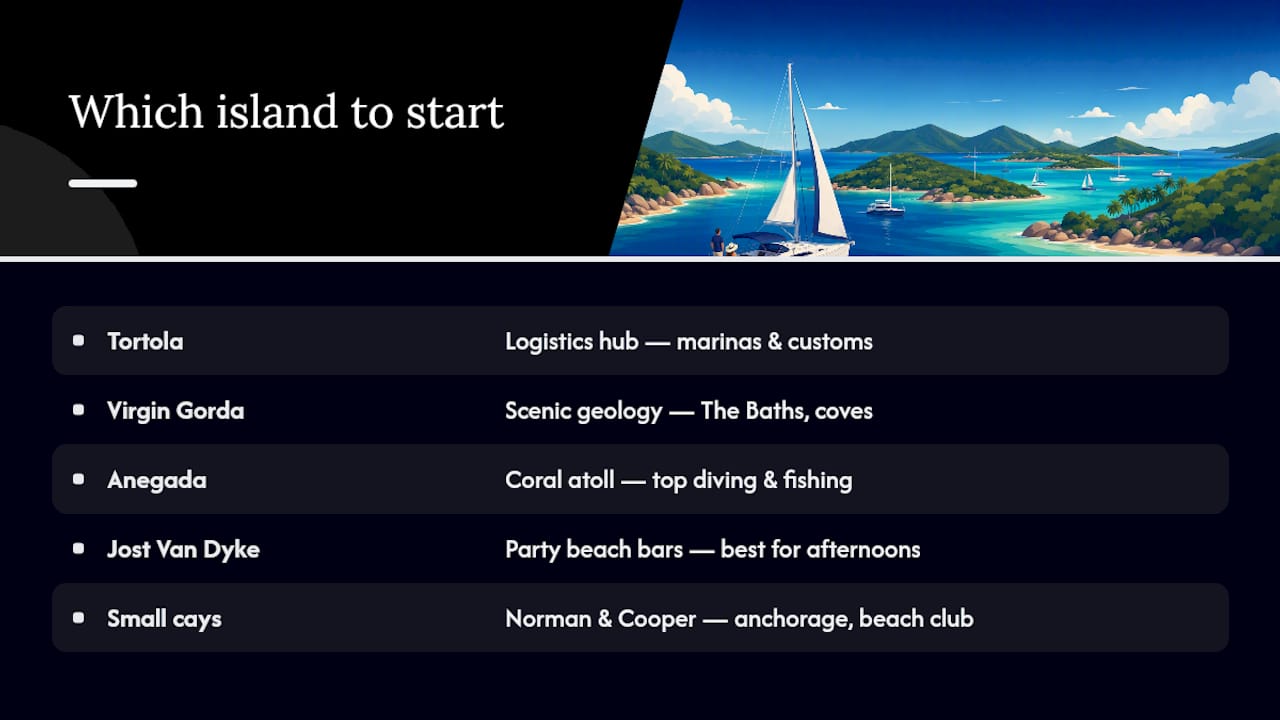
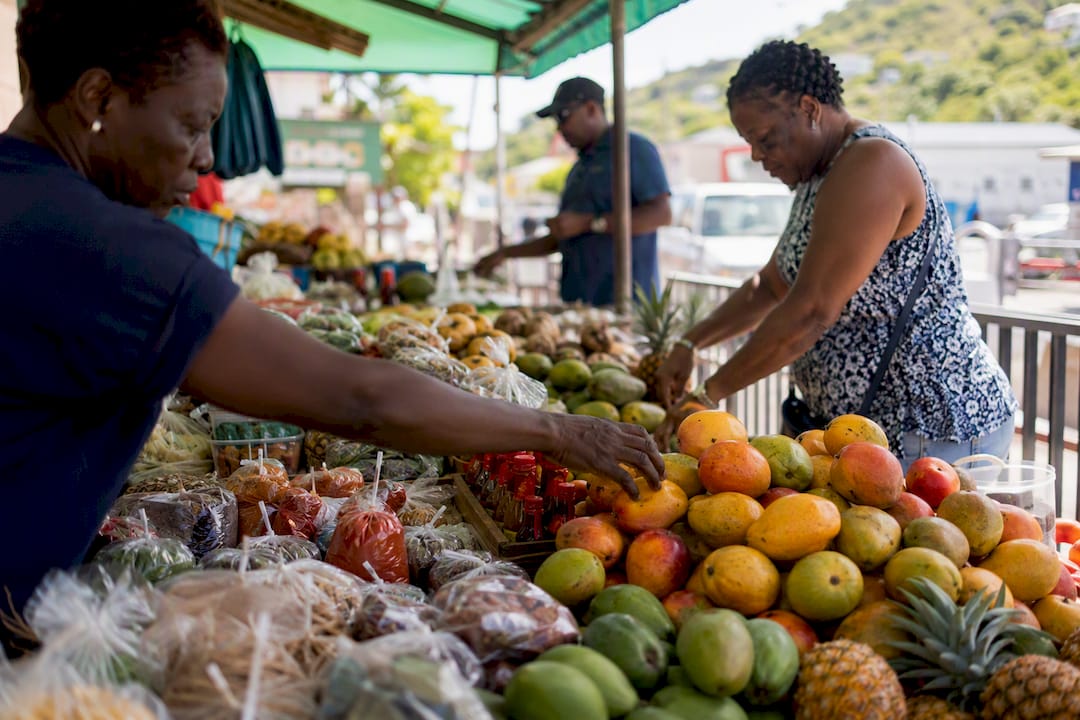
Tortola is the logistical center of the territory. Road Town has the provisioning, the customs office, most of the marinas, and the airport connection. If this is your first BVI trip, or if you’re starting a bareboat charter, you’ll almost certainly begin here. Sage Mountain National Park gives you rainforest hiking a short drive from the harbor, and Road Town’s produce market is worth a stop before you head out on the water.
Virgin Gorda is the geology showpiece. Beyond The Baths, Spring Bay and The Crawl offer quieter versions of the same granite scenery without the crowds. It’s the right pick if relaxation and scenery matter more to you than nightlife.
Anegada breaks from the volcanic pattern of the other islands entirely, it’s a flat coral atoll, and that’s exactly why divers and snorkelers love it. The reef system around it is why the fishing and lobster here are considered the best in the territory. Getting there usually means either a ferry from Tortola or a direct sail, since it sits further out than the other main islands.
Jost Van Dyke is built for a single unforgettable afternoon, not a multi-night stay. White Bay’s beach bars and the annual Foxy’s Old Year’s Night party give it an outsized reputation for such a small island (under four square miles).
Beyond the four main islands, small cays like Norman Island and Cooper Island slot easily into a sailing itinerary as half-day or overnight stops. Norman Island is rumored to have inspired Treasure Island, and its Bight anchorage is one of the most popular overnight moorings in the territory. Cooper Island pairs a laid-back beach club with a small brewery, a nice contrast if your trip has been all snorkeling and no shade.
Getting There and Entry Essentials
Flying directly into the BVI from outside the Caribbean isn’t really an option. Most travelers connect through a regional hub and land at Terrance B. Lettsome International Airport (EIS) on Beef Island.
- Pick your air route. Common connections run through San Juan, Antigua, St. Martin, or St. Thomas, with a short hop into EIS on a regional carrier.
- Or take the ferry from the USVI. Daily ferries connect Red Hook or Charlotte Amalie on St. Thomas to Road Town or West End on Tortola, a popular option if you’re already island-hopping in the U.S. Virgin Islands.
- Carry a valid passport at every step. Even transiting through the USVI or Puerto Rico on the way to the BVI requires a passport, since the BVI is a separate immigration jurisdiction from the United States.
- Clear customs and immigration on arrival. Expect standard passport control at the airport or ferry dock, plus a Tourist Levy and departure tax that’s often, but not always, baked into your ticket price.
- If you’re arriving by private yacht, clear in properly. Vessels must clear customs and immigration at an official Port of Entry (Road Town, West End, or Virgin Gorda’s Gun Creek, among others) before dropping anchor anywhere else in the territory.
- Verify current rules before you go. Entry requirements, fees, and health documentation shift more often than travelers expect. Check the U.S. Department of State’s BVI page and the Government of the Virgin Islands site directly rather than relying on secondhand travel blogs.
Most nationalities, including U.S. citizens, don’t need an advance visa for short tourist stays, but the rules depend on nationality and length of stay, so confirm your specific case rather than assuming.
When Is the Best Time to Visit the British Virgin Islands?
December through April is peak season, and for good reason: steady trade winds make for excellent sailing, humidity drops, and rain is rare. It’s also when hotel rates and charter prices hit their highest point, so book boats and villas months ahead if you’re traveling over the holidays or in February.
May and November function as shoulder months, warmer, quieter, and noticeably cheaper, while still sitting outside the worst of the storm risk.
Hurricane season runs June through November, with the statistical peak in September, and it’s the single biggest factor in whether your charter goes smoothly. Storms in this window can force last-minute itinerary changes or cancellations, which is exactly why travel insurance with hurricane and cancellation coverage is close to mandatory for anyone booking a Caribbean sailing trip in these months.
A rough month-by-month read:
- December to April: Best sailing conditions, highest prices, book early.
- May, June, November: Good value, warmer water, lower hurricane exposure than midsummer.
- July to October: Cheapest rates, but genuine storm risk; watch forecasts closely if you book.
Charter operators typically price bareboat and crewed weeks 20 to 40 percent higher during peak months, and availability on popular catamarans can dry up by early fall for the following winter.
How Do You Get Around the British Virgin Islands?
Inter-island ferries handle most point-to-point travel for people not on a private boat. Operators run scheduled routes between Tortola, Virgin Gorda, Jost Van Dyke, and Anegada, but schedules shift with weather and season, so check the day-of rather than trusting a printed timetable.
- Ferries: The main artery between islands; expect fewer sailings on Anegada and Jost Van Dyke routes outside peak season.
- Taxis: Unmetered and priced on government-set rate sheets; confirm the fare before you get in, especially from the airport.
- Rental cars: Driving is on the left, opposite of the U.S. mainland, and roads on Tortola get steep and narrow fast. Only rent if you’re staying land-based and comfortable with mountain driving.
- Yacht charter: Functions as transport and lodging combined. Bareboat charters require a sailing resume or a skipper’s test in some cases; crewed charters need neither, since a licensed captain and crew run the boat.
For most multi-day itineraries, the boat is the transportation, which is the entire appeal: you skip the ferry schedules and taxi negotiations altogether once you’re aboard.
What Are the Best Things to Do in the BVI?
A well-built sailing itinerary is the backbone of a good BVI trip, and most charter guests follow some version of the same loop, adjusting for wind and mood.
- Day 1 to 2, Tortola to Norman Island: Clear customs in Road Town, provision, then sail south to the Bight for snorkeling and an easy first night.
- Day 2 to 3, Norman Island to Virgin Gorda: A longer sail east to Spanish Town or the North Sound, timed to hit The Baths early before the day boats arrive.
- Day 3 to 4, Virgin Gorda to Anegada: Only for confident sailors or crewed charters, since the passage runs further offshore; reward is the best reef diving in the territory.
- Day 4 to 5, back through Jost Van Dyke: Finish with an afternoon at White Bay before returning to Tortola to check the boat back in.
Beach quality varies by island: Virgin Gorda’s Spring Bay has shade and calm water for families, Anegada’s Loblolly Bay has some of the best snorkeling right off the sand, and Jost Van Dyke’s White Bay trades quiet for beach bars and music.
Divers should prioritize the RMS Rhone wreck near Salt Island, consistently ranked among the Caribbean’s best wreck dives, and Anegada’s Horseshoe Reef for drift snorkeling. Most dive shops in Road Town and Virgin Gorda run PADI certification courses alongside single-tank trips, so you don’t need to arrive certified.
On land, Sage Mountain’s rainforest trails and Trellis Bay’s Thursday night market (fire dancers included) round out a trip that’s spent mostly on the water. If your dates align, the BVI Spring Regatta in late March or early April turns Nanny Cay into a week of racing and shoreside parties, one of the best times to visit if you don’t mind crowds.
Pro Tip: Reserve moorings at popular anchorages like the Bight or Cane Garden Bay by mid-afternoon during peak season. They fill fast, and mooring balls are first-come, first-served.
Where to Stay in the British Virgin Islands
Lodging choices in the BVI split into three real categories, and picking the right one shapes your entire trip more than picking the right island does.
- Resorts: Concentrated on Virgin Gorda, Tortola, and a handful of private islands. Good for travelers who want a fixed base with restaurants and a pool, not ideal if island-hopping is your priority.
- Private villas: Common on Virgin Gorda and Tortola’s north shore, offering space and privacy for families or groups, but you’ll need a rental car or driver to get anywhere.
- Liveaboard charter stays: A yacht functions as your hotel room, moving to a new anchorage most nights. This is the option that actually delivers the archipelago experience, since you wake up somewhere different without packing a bag.
Sailors booking a bareboat trip should factor in marina logistics before choosing a home port: provisioning options, fuel dock hours, and dockage rates vary considerably between Nanny Cay, Village Cay, and the marinas around Virgin Gorda’s North Sound.
Booking six months ahead is realistic for peak season villas and popular charter boats. Shoulder-season travelers have far more flexibility and can often book six to eight weeks out without losing their preferred boat or resort room.
How Much Does a Trip to the British Virgin Islands Cost?
Budgets swing widely depending on how you structure the trip, and the biggest cost lever by far is whether you’re staying land-based or chartering.
- Budget travelers: Roughly $150 to $250 per day, staying at guesthouses, eating at local roti shops, and using ferries instead of taxis.
- Mid-range travelers: Roughly $300 to $500 per day, mixing a nicer hotel or villa with restaurant meals and day-charter excursions.
- Luxury travelers: $600 and up per day, typically tied to a crewed yacht charter or a high-end private villa with staff.
Charter pricing depends primarily on boat size, season, and whether you go bareboat or crewed. A tourism-board-recognized week-long bareboat catamaran charter for a group of six or eight splits down to a fraction of a standard hotel rate per person once you divide the boat cost across everyone aboard, one reason groups gravitate toward chartering over booking individual hotel rooms.
Budget for a few costs that catch first-timers off guard: dockage fees if you tie up in a marina overnight, fuel for the boat, the customs clearance fee when you check in, and standard 15 to 20 percent tips for crew on a crewed charter. Splitting a boat among more people and traveling in May or June instead of February are the two most reliable ways to cut your per-person cost without sacrificing the experience.
Is the British Virgin Islands Safe to Visit?
Healthcare on the islands covers routine needs well. Peebles Hospital in Road Town handles general medical care, but serious injuries or major medical events typically require medevac to Puerto Rico or the U.S. mainland, which is exactly why travel insurance with medical evacuation coverage matters here more than in most destinations.
- Hurricane prep: If you’re traveling June through November, monitor forecasts, keep travel insurance with cancellation coverage current, and know your resort or charter operator’s storm protocol before you arrive.
- Boating documentation: Bareboat charterers need proof of sailing experience or a competency certificate; crewed charters remove this requirement entirely.
- Insurance: Confirm your charter contract’s liability and damage coverage, and separately carry personal travel insurance with medical evacuation.
- Personal safety: Petty theft happens, mainly unlocked cars and unattended bags on beaches, so use common sense rather than expecting a crime-free destination.
- Anchoring safety: Use designated mooring balls where available rather than anchoring in coral, both for reef protection and to avoid dragging overnight.
For anything beyond routine planning questions, the U.S. State Department’s BVI page is the most reliable source for current advisories, and it’s worth checking a week or two before departure rather than months in advance.
Packing and Practical Travel Tips
Pack light, pack smart, and pack for sun exposure that’s more intense than most travelers expect on their first Caribbean trip.
- Essentials: Passport, reef-safe sunscreen (regular sunscreen is discouraged near coral), prescription medication in original containers, a power bank, and light, quick-dry layers.
- On a charter: Provisioning happens once at the start; plan meals loosely and expect to generate trash that gets disposed of properly on land, not tossed overboard.
- Customs: Locals appreciate a friendly, unhurried pace; island time is real, and rushing conversations tends to backfire.
- Tipping: 15 to 20 percent for crewed charter staff and restaurant service is standard.
- Connectivity: Local SIMs are available at the airport; an eSIM set up before you fly saves time if your phone supports it.
- Money: The U.S. dollar means no currency exchange, but small vendors and beach bars often run cash-only.
Pro Tip: Bring a dry bag for your phone and passport on any day you’re moving between boats and tenders. Saltwater and phones are a bad combination, and it happens more often than you’d think.
How Chartering Actually Works in the BVI
Bareboat charters put you in command of the boat with no crew aboard, which suits experienced sailors comfortable with navigation, anchoring, and basic mechanical troubleshooting. Crewed charters put a licensed captain and often a chef aboard, which suits everyone else, families, couples, and groups who want the sailing experience without the responsibility.
Either way, planning follows the same basic steps: map your route around realistic sailing distances, provision before you leave the dock, confirm mooring availability at your priority anchorages, and know where the fuel docks are along your route. Virgin Charter Yachts has run bareboat and crewed charters out of Tortola for three decades, and that kind of long-standing local presence tends to matter most exactly at this planning stage, when knowing which anchorage will be calm on a given wind direction saves a frustrating first night.
Before booking with any charter operator, ask a few direct questions:
- What’s included in the base price versus billed as an add-on (fuel, dockage, provisioning)?
- What’s the cancellation and hurricane-season policy?
- What qualifications does bareboat chartering require, and what happens if conditions exceed your comfort level?
- Is the fleet recent and well-maintained, and can you see photos or specs of the actual boat model?
Pro Tip: Ask any charter company how long they’ve operated locally, not just how long the company has existed. Local tenure usually tracks with better anchorage knowledge than corporate size does.
Wildlife and Nature in the British Virgin Islands
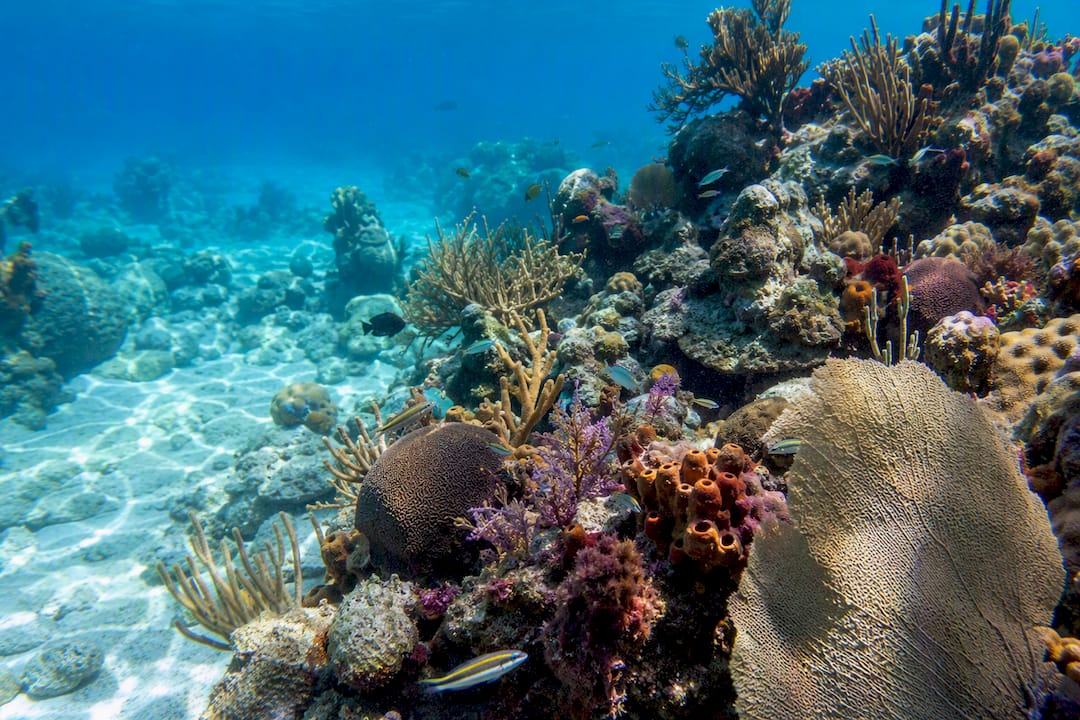
The reef systems ringing Anegada and the waters around Salt Island and the Baths support some of the healthiest coral in the eastern Caribbean, and the territory has leaned into protecting it rather than developing around it. Several marine parks and protected moorings exist specifically to keep anchors off coral, part of why the reefs here still look the way they did decades ago.
Green and hawksbill sea turtles nest on quieter beaches, and it’s common to spot one surfacing near a mooring field while snorkeling. Offshore, the waters host dolphins and, seasonally, humpback whales migrating through the region. On land, the mongoose population (introduced generations ago to control snakes) still roams Tortola’s hillsides, alongside native lizards and a healthy bird population that includes pelicans diving for bait fish right off the docks.
The BVI’s national parks trust maintains protected land at Sage Mountain and several smaller reserves, preserving pockets of rainforest that once covered far more of Tortola before agriculture cleared it in the colonial period. Anegada’s interior salt ponds and mangrove areas support flamingos, reintroduced decades ago after a long absence, now one of the more unexpected wildlife sightings in the territory. Respecting no-anchor zones and mooring-ball-only rules in these areas isn’t just etiquette. It’s the reason the reefs remain worth visiting at all.
Popular Dining and Local Cuisine in the BVI
Food here leans heavily on what comes out of the water. Fresh fish, conch, and, on Anegada specifically, spiny lobster grilled right on the beach define the territory’s signature meal. Beach bars double as some of the best casual dining, Anegada’s beachfront grills and Jost Van Dyke’s Soggy Dollar Bar (birthplace of the Painkiller cocktail) are as much a food stop as a drinking one.
Road Town offers the widest range, from roti shops serving curried goat and chicken wrapped in flatbread to upscale seafood restaurants overlooking the harbor. Johnny cakes, a fried cornmeal bread, show up at breakfast almost everywhere, alongside fungi (a cornmeal and okra side dish) that pairs with the fish dishes at dinner. Rum plays a bigger role here than in most Caribbean destinations, both in cocktails and in local rum cakes sold at roadside stands.
Provisioning for a charter is its own small culinary decision. Most groups stock the boat with grocery-store basics in Road Town, then plan one or two dinners ashore at beach bars along the route rather than cooking every meal aboard. Anegada’s lobster season runs roughly spring through summer, and it’s worth timing a stop there if fresh lobster is part of the appeal, since prices and availability shift outside peak catch months.
Shopping and Local Markets in the BVI
Shopping in the BVI skews toward small, independent vendors rather than duty-free malls, though duty-free shopping does exist around the cruise ship dock in Road Town for jewelry, liquor, and watches. The more interesting finds are elsewhere.
Trellis Bay’s Thursday evening market, held near Aragorn’s Studio, mixes local artisans selling metalwork, pottery, and jewelry with food stalls and, on full moon nights, a fire-dancing show that turns the whole market into an event. Road Town’s produce market sells fruit, spices, and local hot sauces worth bringing home, and it’s a good stop before heading out on a charter to round out provisioning with something more interesting than grocery-store staples.
Look for local rum, handmade jewelry using sea glass or shells, and BVI-specific spice blends as the most distinctive souvenirs. Prices at artisan stalls are often negotiable in a way that supermarket and duty-free prices aren’t, so it’s reasonable to ask, particularly if you’re buying more than one item from the same vendor.
A Sample First-Timer’s Itinerary
Five days is enough to get a real feel for the archipelago without rushing. Fly into Beef Island on day one, clear customs, and spend the afternoon provisioning in Road Town before an easy first sail to Norman Island. Day two means an early swim at the Bight, then a longer sail east toward Virgin Gorda, timed to reach The Baths before the day-tripper boats show up around 10 a.m.
Day three is North Sound, quiet water, good snorkeling, dinner at a dockside restaurant with your feet still wet. Day four heads to Jost Van Dyke for a loud, sun-soaked afternoon at White Bay, then a short overnight hop back toward Tortola. Day five is slow mornings, a last snorkel, and the return sail into Road Town by early afternoon.
Families should shorten the crossings and lean on Virgin Gorda’s calmer bays; couples can stretch the Jost Van Dyke stop into a full day; sailors comfortable with longer passages can swap one night for a run out to Anegada instead.
Book a BVI Charter With Local Expertise Behind It
Chartering the British Virgin Islands works best when the operator knows the territory, not just the boats. Virgin Charter Yachts has run bareboat and crewed charters from Tortola for three decades as a family-owned operation, with a fleet of modern power catamarans from Fountaine Pajot, Leopard, Aquila, Aventura, Lagoon, Horizon, and Two Oceans.

That kind of local tenure changes the planning conversation. Instead of generic route suggestions, you get real answers on which anchorage handles a northeast swell better, when the North Sound moorings fill up in peak season, and how to time a passage to Anegada around the weather. Whether you want to skipper the boat yourself or bring a full crew aboard, Virgin Charter Yachts builds the itinerary around your group’s experience level and priorities rather than a fixed template. Check available dates and request a quote to start planning your own route through the islands.
Sources
Confirm entry rules and safety updates directly through the U.S. State Department’s BVI page and the Government of the Virgin Islands before you travel, since fees and requirements change periodically. The BVI Tourist Board lists current events and official attractions, while Wikipedia and Britannica offer solid background on geography and governance. For broader Caribbean travel inspiration around low-density luxury destinations, the Barbados travel guide offers useful comparative context.
- British Virgin Islands - Wikipedia
- Paradise Redefined | British Virgin Islands Tourism
- British Virgin Islands – U.S. Department of State
- Government of the Virgin Islands
- British Virgin Islands | Britannica
Recommended
Did You Know?
The BVI are only accessible by boat. Check out our charter yachts that can get you there. View Our Fleet