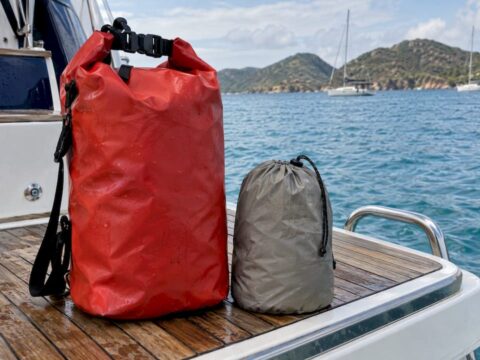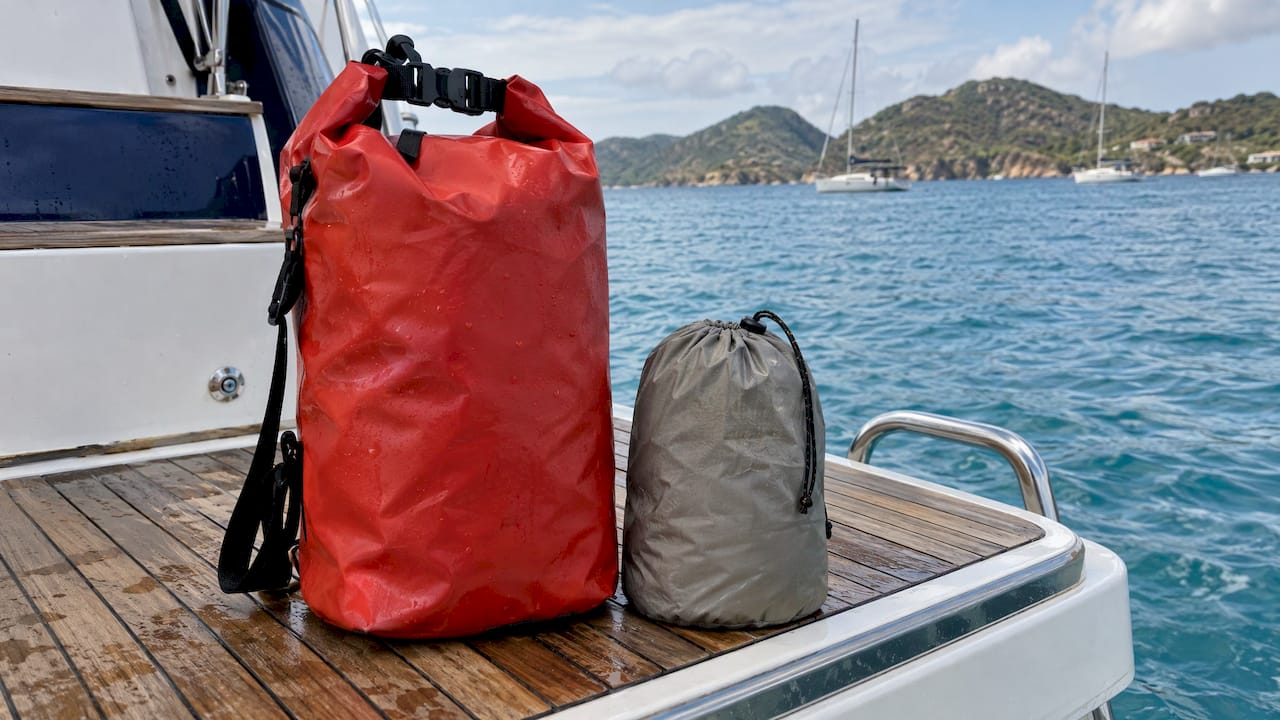

A dry bag is a stand-alone waterproof container built to take abuse. A dry sack is a lighter sack meant to live inside another bag. On a yacht charter you want both, in different jobs: dry bags for anything that rides in the dinghy, onto a beach or out on a snorkel trip, and dry sacks to organize what stays inside your luggage and lockers. Add a waterproof pouch or case for your phone, and your gear is covered.
That split matters on a Caribbean trip. Most of the wet moments on a charter happen in the short hops between a catamaran and the shore, not on the catamaran itself. If you are planning a week in the British Virgin Islands, this guide shows what each item does, where it fails and how to pack the lot without overbuying.
TL;DR
- A dry bag is waterproof on its own, with a roll-top and taped or welded seams. Use it for dinghy rides, beach days and snorkel trips.
- A dry sack is ultralight and meant to go inside another pack or duffel. Use it to organize clothes, chargers and toiletries.
- A waterproof pouch is cheap and universal and floats. A fitted case costs more and gives better photo and drop protection.
- Whatever you buy, fold the roll-top at least three times and test it with paper towels before you travel.
- Packing lists and trip planning for the BVI are on our site, and we can help you plan the whole week.
Table of Contents
- The real difference between a dry bag and a dry sack
- Which one belongs on a boat
- What makes a dry bag actually keep water out
- Waterproof case vs pouch for your phone
- Wet-dry bags: keeping swimsuits away from everything else
- What to pack, and in what
- What the bags cost
- Our perspective
- Plan the week, then pack for it
- FAQ
- Sources
The real difference between a dry bag and a dry sack
The two names get used as if they meant the same thing. They do not, and the confusion costs people a wet phone.
According to a Public Lands buying guide, a dry sack is an ultralight kind of dry bag that is waterproof but designed to go inside another pack, with the outer bag handling abrasion. A dry bag is heavy-duty enough to be waterproof alone, even against the floor of a boat.
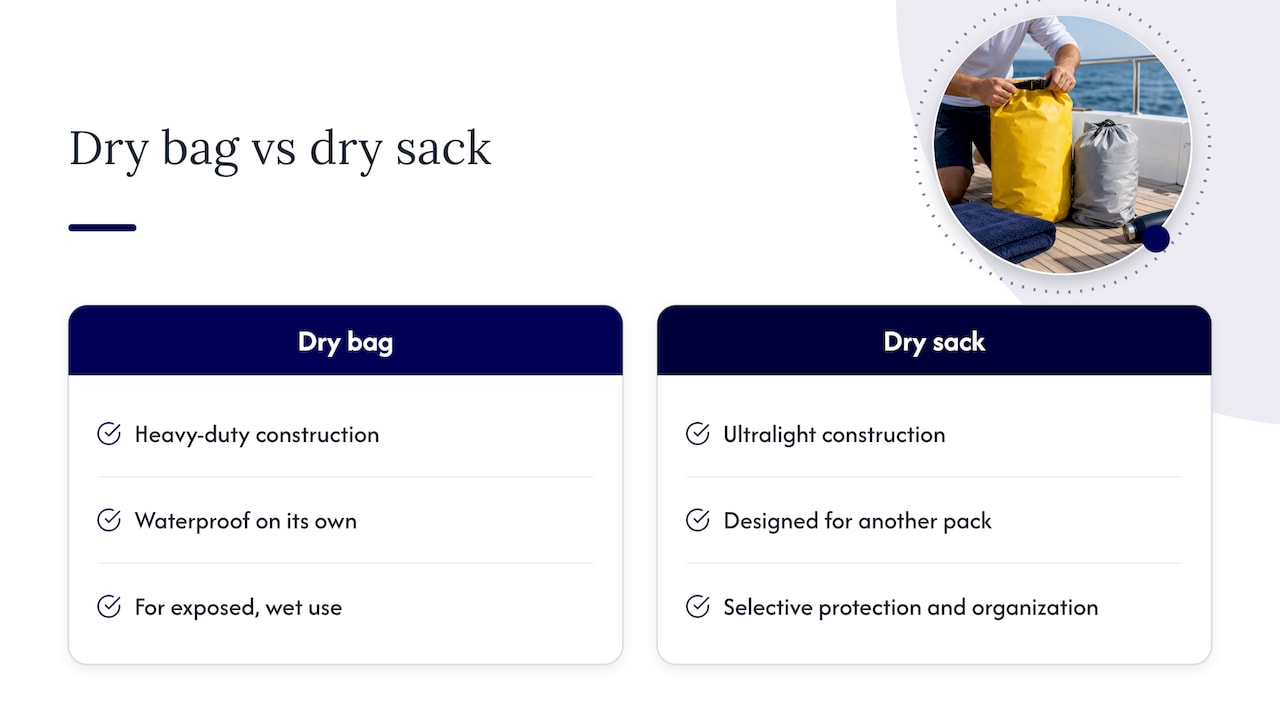
The origins explain the design. Cascade Designs, which makes SealLine gear, says dry bags come from the paddlesport world, built from heavy-duty materials for exposed, wet use. Packing sacks come from camping and backpacking: light, meant to sit inside a larger pack for selective water protection and organization.
Construction is where you can see it. Sea to Summit explains that a true dry bag has seam-taped seams and a roll-top closure. A plain stuff sack has untaped seams and a drawstring, so water gets in. Many ultralight dry sacks sit between the two: lighter fabric, often silnylon, and a roll-top. They handle rain and splashes better than they handle being submerged, as Packing Light Travel puts it, while heavier dry bags use PVC or 200 to 300 denier nylon with a polyurethane coating.
Side by side
| Dry bag | Dry sack | |
|---|---|---|
| Built for | Stand-alone protection on boats, rafts, beaches | Organizing and protecting items inside another bag |
| Fabric | Heavier coated nylon, vinyl or PVC | Ultralight, often siliconized nylon |
| Seams | Welded or taped | Often lighter or sewn and sealed |
| Handles abrasion | Yes, on a dinghy floor or sand | Not on its own |
| Survives a dunk | Designed to, if sealed properly | Rain and splashes, not reliable submerged |
| Weight and price | Heavier, usually costs more | Lighter, usually costs less |
| Best charter job | Dinghy, beach, snorkel day bag | Packing cubes inside your duffel |
Which one belongs on a boat
The rule is simple: if the contents could end up in the water, or the bag will sit in standing water, take a dry bag. RiverBent makes the same point for river trips: a sealed dry bag keeps gear dry through a flip or if it falls out of the rigging, while dry sacks are not waterproof when submerged and are better for separating items inside a dry box or cooler.
A charter is gentler than whitewater, but the logic carries over. Think about the three places gear gets wet on a BVI week:
- The dinghy or tender. Spray, a puddle in the bottom and a wet step onto a dock. A dry bag is the right tool.
- The beach. Sand, wet towels and a sudden shower. A dry bag again, ideally one you can set down without worrying about abrasion.
- Inside your cabin. Here a dry sack shines. Public Lands notes that dry sacks are lighter and cost less, so choose them if you already have an outer bag, such as a duffel, for them to go in.
So the answer to “which one” is not either/or. Carry one or two dry bags for the outings and a few dry sacks to keep your suitcase organized. Sealed sacks also help with something less dramatic: humid island air and damp swimwear. Keeping a wet suit in one sack and dry clothes in another means one wet item doesn’t spoil the rest of the bag.
How big should a dry bag be?
Public Lands says dry bags run from 1 liter for small personal items to 60 liters for a week of gear, and that bags of 50 liters and up often get heavy and awkward when full. For a day ashore, a 10 to 20 liter bag holds towels, sunscreen, a water bottle and a shirt for two people. Anything larger is better handled as luggage on the yacht, not a bag you carry down a dock.
What makes a dry bag actually keep water out
Two details decide whether a bag works: the closure and the seams.
Closure. Roll-top closures are the most popular because they’re simple and reliable, and they double as a carry handle, according to Public Lands. Packing Light Travel says rolling the top down at least three folds creates a watertight seal and squeezes out air. Clip the buckle, and the bag also gets a little compression.
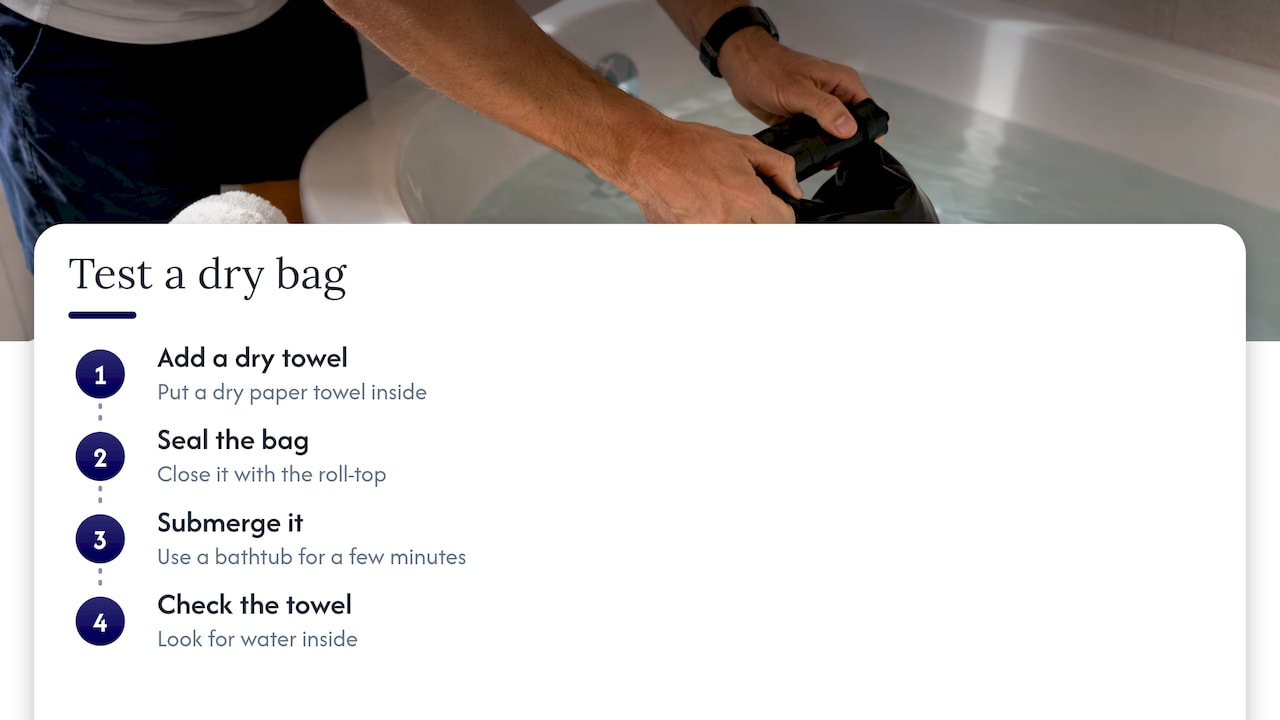
Seams. Public Lands says welded seams, sealed with pressure and heat, work best because there are no stitch holes and the bond is more durable than glue or tape. Travel + Leisure’s testers agree on welded over sewn, and suggest testing your closed bag before taking it onto a boat. A cheap way to do it: put a dry paper towel inside, seal the bag, submerge it in the bathtub for a few minutes and check the towel.
Travel + Leisure also makes a useful distinction: all dry bags are waterproof, but not all waterproof bags are dry bags. A waterproof bag can have ordinary zippers, clips and seams that let water seep through. Dry bags pair waterproof material with watertight closures and welded seams, and they often float because air has a hard time escaping.
Understanding the ratings
Waterproof ratings are easy to misread. SealLine, for example, sorts its products into three levels: splashproof for light rain, waterproof for quick submersions such as a tipped canoe, and submersible for one meter for 30 minutes, to the IP-67 standard. For a charter, “waterproof” is the right level for a day bag. “Submersible” is for gear you intend to dunk.
Waterproof case vs pouch for your phone
This is the other half of the question many readers ask. Your phone is the most expensive item that goes near the water on a charter, and a dry bag is often too bulky for it when you are snorkeling or paddling.
Travel + Leisure’s phone case guide lays out the trade-off clearly:
- Pouches are cheaper, fit many phone models, can carry keys, cash and ID, and are usually floatable.
- Fitted cases are specific to one phone model, typically cost more and suit serious photography better.
Most pouches are rated IPX8, IP67 or IP68. In practice that means roughly 30 minutes to an hour of submersion at three to six feet. Snorkel Pursuits adds that IPX8 means continuous submersion was tested, while IPX7 or IP67 covers temporary immersion only. TechBloat’s testing stresses that a rating is not a promise of unlimited underwater use. Stay inside the stated depth and time.
Price and performance examples
TechBloat’s 2026 comparison lists the Case-Mate Pelican Marine pouch at $25, rated IP68 to 3.3 feet for 30 minutes, and floating. The CASETiFY Bounce Extreme sits at $44 and is rated to 6.6 feet for an hour. Prices move, so check the retailer before buying.
Two practical notes from the same testing. A pouch’s touchscreen may not respond underwater, so set a camera timer before you submerge. And flotation matters around boats and docks: a floating pouch that slips out of your hand is a pouch you get back.
For a boat week, a floating pouch on a lanyard is the pick for most families. If you plan underwater photos or want drop protection, a fitted case is worth the extra cost.
Where a pouch-style dry bag fits
Small dry cases such as the Yeti SideKick Dry sit between a pouch and a dry bag. Travel + Leisure’s tester carried a phone, sunglasses, keys and wallets in the 3-liter version while snorkeling, and the case comes in 1, 3 and 6-liter sizes. It is a good model for the person who wants one small, sealed bag for valuables on the dinghy.
Wet-dry bags: keeping swimsuits away from everything else
A wet-dry bag has a separate compartment, usually at the bottom, for wet swimsuits or water shoes. Platinum Sun describes them as suited to beach days and watersports. The same source notes that zippered dry bags are quicker to open on boats, though they may not handle full submersion the way a roll-top does.
On a charter you can get the same result with two dry sacks: one for wet, one for dry. It is lighter, packs flatter and lets you reuse the wet sack as a laundry bag on the way home.
What to pack, and in what
Here is a practical setup for a week aboard, for two to four people. It is a starting point, not a rule.
| Item | Container |
|---|---|
| Phone, in the water | Floating waterproof pouch on a lanyard |
| Phone, camera, wallet, keys on the dinghy | 5 to 10 liter dry bag, roll-top |
| Beach day: towels, sunscreen, shirts | 10 to 20 liter dry bag per couple |
| Clean clothes in your duffel | Dry sacks, one per person or per category |
| Wet swimsuits and rash guards | A dedicated dry sack |
| Chargers, adapters, medications | Small dry sack inside carry-on |
| Passport copies, cash | Small dry pouch kept in the cabin |
A few habits make the system work:
- Roll, don’t fold. Three full rolls, then clip.
- Trap a little air in a bag you want to float, and keep the bag upright in the dinghy.
- Dry before you store. Salt and moisture trapped in a sealed sack smell by day three.
- Soft luggage helps. Duffels and soft bags store in cabin lockers far more easily than hard suitcases. Our guide on how to pack for your BVI yacht charter covers this, and our BVI packing list breaks down clothing and gear.
If you are chartering without a crew, the bareboat packing list covers what to bring and what to skip. And for the footwear side of things, see our comparison of water shoes vs sandals.
For a deeper look at organizing sacks inside a larger dry container, this piece on lightweight packing for outdoor trips has practical ideas that work just as well in a cabin locker.
What the bags cost
You do not need a closet full. Retail prices in the US cluster in a predictable range:
- Ortlieb’s own US pricing puts its Dry-Bag line at $30 to $65 and its lighter Dry-Bag Light at $28 to $40, in a range of sizes, all roll-top.
- Travel + Leisure’s tested roundup names the Sea to Summit Dry Bag at $55 as best overall and the Ortlieb Dry Bag at $26 as most durable.
- The same roundup lists the Sea to Summit Ultra-Sil set of three at $70 for organizing inside luggage.
Two dry bags, three or four dry sacks and one floating pouch will usually run you under $200 and cover a family week. Prices change with seasons and sales, so use these as ranges, not quotes.
Our perspective
We have been running charters out of Tortola since 1996, and the same thing happens every season: guests arrive with luggage designed for a hotel and then discover that a catamaran is a small, damp, beautifully organized space. Hard suitcases do not fit anywhere. A duffel and a few sacks do.
Our view is that the dry bag question is really a packing question. Treat the dry bag as the thing that leaves the yacht with you, and the dry sack as the thing that keeps your cabin tidy. Everything else follows from that.
It is also why we like to plan trips with guests personally. The right gear depends on the itinerary: a week of snorkel stops and beach bars asks for different bags than a quiet week of anchorages. We are a family-owned operation with local knowledge of the islands, and we are happy to talk through your plans before you pack.
alexia
Plan the week, then pack for it
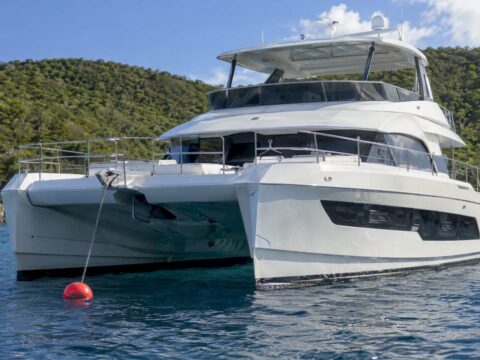
The right bags are easy to pick once you know how you will spend your days. If you are still choosing a yacht, our bareboat power catamarans start at £6,000 to £10,000 per week for a 3-cabin boat, and run up to £12,000 to £20,000 per week for a 5+ cabin luxury power catamaran, as listed on our bareboat pricing page. Crewed charters are listed on our luxury crewed pricing page, from $25,000 to $35,000 per week for a premium catamaran for four to six guests.
Virgin Charter Yachts offers bareboat and crewed power catamarans and motor yachts in the British Virgin Islands and the Caribbean, with trip planning handled by people who live and work on Tortola. If you tell us who is coming and what you want to do, we can help you build an itinerary and a sensible packing plan around it.

When you are ready, start on our site or look at the water sports and toys you can add to your days on the water.
FAQ
Can I use a dry sack instead of a dry bag on a boat?
Only inside something else. A dry sack is lighter and meant to go inside a pack or duffel, which protects it from abrasion. Left loose in a wet dinghy, or submerged, it is not designed to stay dry, so use a proper dry bag for anything that will sit in water.
How many times should I roll the top of a dry bag?
At least three folds, then clip the buckle. Packing Light Travel notes that this creates a watertight seal and pushes out air. Test the bag with a dry paper towel and a short dunk before your trip.
Is a waterproof pouch enough for my phone while snorkeling?
For casual use within its rating, yes. Most pouches are rated for 30 minutes to an hour at three to six feet, and you should stay inside the limits printed on yours. Expect the touchscreen to be unreliable underwater, so set the camera timer first and keep the pouch on a lanyard.
Do I need a wet-dry bag?
Not necessarily. A wet-dry bag has a separate compartment for swimsuits and water shoes. Two dry sacks, one for wet items and one for dry, give you the same separation and pack flatter in a cabin locker.
Sources
- What Makes A Good Dry Bag, Public Lands
- FAQ, SealLine by Cascade Designs
- Stuff Sacks vs Dry Bags, Sea to Summit support
- Best Dry Bags for River Trips, RiverBent
- 13 Useful Reasons to Travel with Dry Bags, Packing Light Travel
- The 8 Best Dry Bags of 2026, Travel + Leisure
- The 8 Best Waterproof Phone Pouches of 2026, Travel + Leisure
- Best Waterproof Bag for Snorkeling, Snorkel Pursuits
- The 5 Best Waterproof Phone Pouches of 2026, TechBloat
- Types of Dry Bags and Their Purposes, Platinum Sun
- Compare Ortlieb Dry Bags
Recommended
- Dry Snorkel vs Semi Dry: Which One Should You Buy?
- BVI Packing List for Yacht Charters: What to Bring
- How to Pack for Your BVI Yacht Charter Vacation
- BVI Bareboat Packing List: What to Bring & Skip
Did You Know?
The BVI are only accessible by boat. Check out our charter yachts that can get you there. View Our Fleet